Asking for an appraisal can feel uncomfortable, but it is an important part of career growth. Many professionals assume their work will automatically be recognised during review cycles. Managers often make appraisal decisions based on documented achievements, role scope, business impact, and organisational priorities.
Learning how to ask for an appraisal professionally helps you communicate your value, discuss future growth opportunities, and ensure your contributions are visible during performance reviews. The goal is not simply to ask for a salary increase but to have a structured conversation about performance, progression, and long-term career development.
In Indian companies, especially larger and more structured employers, that distinction matters a lot. Asking for an appraisal isn’t a plea for recognition. It’s a professional request for a formal review of your contribution, market position, and next-step value to the business. Done well, it signals maturity. Done poorly, it sounds like frustration wrapped in a salary ask.
The strongest employees I’ve seen don’t wait passively for the annual cycle to define their narrative. They prepare evidence, choose timing carefully, and make it easy for the manager to engage. They don’t ask, “Can you give me a better appraisal?” They ask, “Can we review my performance, expanded scope, and next-cycle growth path based on outcomes?”
That shift changes everything.
Why Asking for an Appraisal Matters
Many employees avoid appraisal conversations because they worry about appearing impatient or overly focused on compensation. However, a professional appraisal discussion demonstrates initiative, career ownership, and a commitment to growth.
An appraisal is an opportunity to review your achievements, discuss expanded responsibilities, identify development opportunities, and evaluate whether your compensation and role align with your contributions. Employees who communicate their expectations clearly are often better positioned for future opportunities.
Here’s the practical difference:
| Approach | How it sounds | Likely manager reaction | Better alternative |
| Emotional ask | “I’ve worked very hard and expected more.” | Hard to defend upward | Show outcomes, scope, and market context |
| Vague ask | “I want a better appraisal.” | Unclear next step | Ask for a review tied to role, impact, and growth path |
| Comparative ask | “Others got more than me.” | Triggers defensiveness | Focus on your own contribution and business value |
| Strategic ask | “I’d like to review my performance, expanded responsibilities, and compensation alignment.” | Easier to evaluate | Bring a short document and a clear request |
Practical rule: Your manager doesn’t promote effort. They advocate for evidence they can explain to HR and leadership.
A proactive appraisal request also does something more important than securing a raise. It clarifies your future inside the organisation. If the company sees you as promotion-ready, you’ll learn what proof is still missing. If budget is the issue, you can ask for role expansion, title correction, project ownership, or a dated follow-up discussion.
That’s why learning how to ask for appraisal matters. You’re not just seeking a number. You’re testing whether your organisation recognises your current value and sees a credible path for your next one.
When to Ask for an Appraisal
Timing can significantly influence the outcome of an appraisal discussion. The best time to ask for an appraisal is when your contributions are recent, measurable, and visible to key stakeholders.
Successful appraisal conversations usually happen after major project deliveries, role expansions, significant business achievements, or before formal review decisions are finalised.
Best Time to Ask for an Appraisal
The best moment is usually when your value is visible and recent. Not when you feel most frustrated.
Strong windows include:
- After a major delivery: You completed a difficult client launch, closed a critical hiring plan, stabilised an operations issue, or led a product release. Your contribution is fresh, and your manager can connect it to business outcomes.
- When your role has expanded: If you’re already doing work above your title, don’t wait too long for the organisation to normalise that stretch as your baseline.
- After a capability jump: A certification, new tool ownership, or domain expertise only matters if you can tie it to business use.
- Before the formal review cycle closes: A late ask often fails because managers have already calibrated ratings and budgets.
Data from Indian corporates indicates that appraisal requests that include a forward-looking development plan are 45% more likely to result in a promotion or expanded role within the next 12 months, according to this HR strategy India report. That matters because good timing isn’t only about asking after success. It’s also about showing what you’ll do next.
If you want to understand how companies’ structure formal evaluations, Taggd’s overview of performance appraisal methods is a useful reference point.
When Not to Ask for an Appraisal
There are also moments when even a fair request will struggle.
Avoid these patterns:
- Immediately after a weak quarter for the business: If leadership is visibly cost-sensitive, make your case around role calibration and future contribution, not entitlement.
- In the middle of a crisis your manager is firefighting: They won’t process nuance well.
- Right after peer increment announcements: That usually makes your request sound reactive.
- During festival payout conversations: In many Indian organisations, bonus season and appraisal logic are related but not identical. Don’t blur them.
Ask when your manager has both memory and room. Memory of your impact. Room to act on it.
One more nuance matter in Indian firms. Many decisions are shaped by manager calibration, HR policy windows, and business-unit budgets. So don’t ask only, “Is this the right time for me?” Ask, “Is this a time when my manager can still influence the outcome?”
How to Prepare for an Appraisal Discussion
A manager can support you only if your case is concrete. “I’ve done a lot” is true for many people. It isn’t persuasive on its own.
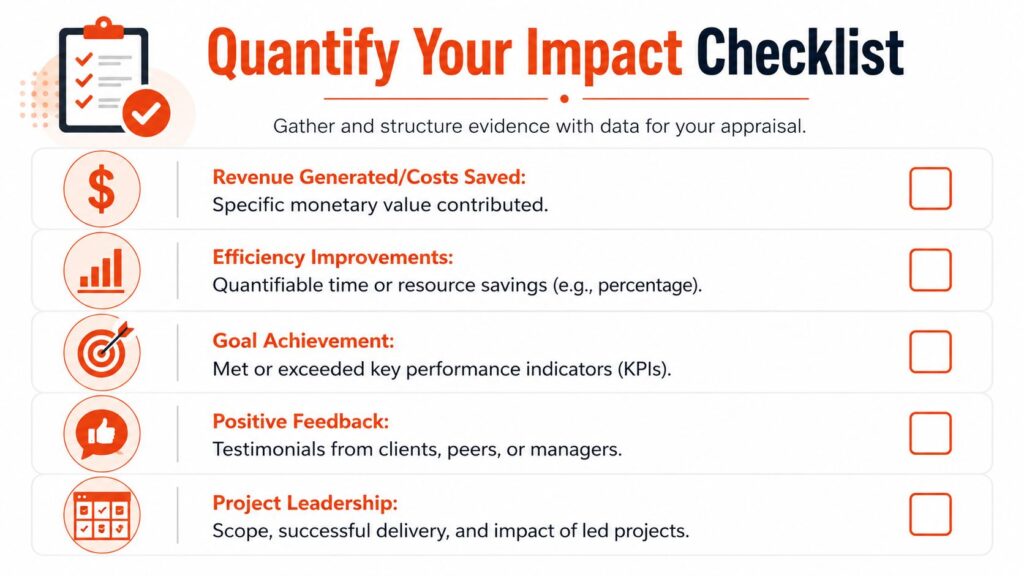
Document Your Achievements
Build your case from the inside out. Start with what changed because of your work.
A useful structure is STAR. Situation, Task, Action, Result. Keep it brief and business-facing.
For example:
- Project delivery: What was at risk, what you owned, what you changed, and what happened after.
- Process improvement: Which bottleneck existed, what you redesigned, and how the team benefited.
- Commercial impact: Revenue influenced, customer retention supported, escalations prevented, or costs reduced.
- Leadership scope: Mentoring, stakeholder management, cross-functional coordination, or decisions taken without supervision.
Use your actual data. If you don’t have precise numbers you can verify, stay qualitative. Mention reduced rework, faster turnaround, improved client confidence, smoother onboarding, or cleaner reporting. The point is credibility, not inflation.
A strong file usually includes:
- Three to five achievements tied to team or business goals.
- Role expansion evidence showing what you do now that wasn’t part of your earlier scope.
- Feedback snippets from managers, clients, peers, or partners.
- A next-cycle plan that shows how you’ll create more value.
Use Market Data Effectively
Many employees either skip market data completely or overplay it. Both are mistakes.
In India, compensation conversations are increasingly benchmark driven. The 2025 Aon India Salary Increase and Turnover Survey projected an average salary increase of 9.3% and found employee turnover at 18.7%, which signals that employers are already evaluating pay with market movement and retention pressure in mind, as noted in Aon’s India salary increase survey.
That doesn’t mean you walk into the meeting saying, “The market owes me this much.” It means you frame your request like this: my role has evolved, my outcomes are documented, and I want to review whether my current compensation and designation are aligned with internal expectations and external reality.
For broader planning, this India salary forecast 2026 resource can help you think through how employers look at compensation trends by sector and role family.
Create an Appraisal Summary
Most managers don’t need a long deck. They need a short document they can understand in under five minutes.
Include these headings:
| Section | What to include | What to avoid |
| Current role | Title, tenure in role, reporting line | Full CV-style history |
| Key achievements | Specific outcomes from this cycle | Long task lists |
| Expanded responsibilities | New stakeholders, decisions, team scope | Complaints about workload |
| Market context | Relevant benchmark observations | Aggressive external comparisons |
| Your ask | Salary review, title change, expanded role, development path | “Any improvement is fine” |
A good appraisal brief does one job well. It helps your manager retell your story accurately when you’re not in the room.
If you’re wondering how to ask for appraisal without sounding self-promotional, this is the answer. Don’t talk yourself up in abstract terms. Document value in a format the business can use.
How to Ask for an Appraisal Professionally
The most effective appraisal discussions feel collaborative rather than confrontational. Instead of focusing only on compensation, focus on your achievements, responsibilities, future goals, and alignment with organisational expectations.
A professional conversation allows managers to evaluate your contribution objectively while providing guidance on the next steps needed for career progression.
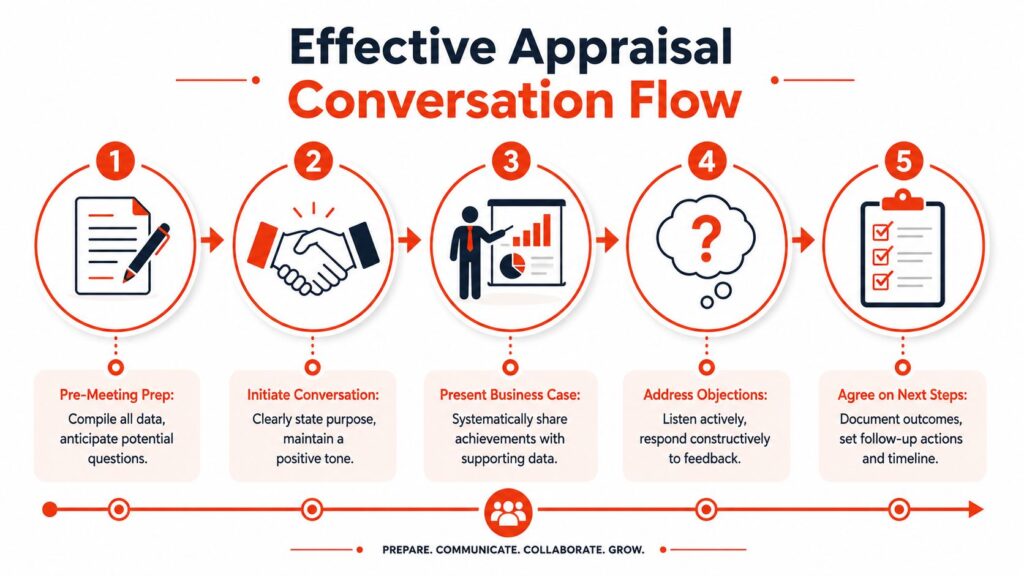
A Simple Appraisal Conversation Framework
The conversation works best when it follows a clear sequence.
First, open cleanly.
State why you asked for time. Keep it calm and direct.
Example: “I wanted to set up this discussion to review my contribution over the current cycle, the responsibilities I’ve taken on, and whether my appraisal outcome should reflect that.”
Next, present your case.
Walk through your brief. Don’t narrate every effort. Highlight outcomes, scope change, and future relevance.
Then, make a specific ask.
Be clear whether you want a compensation review, title correction, expanded scope, or a formal development path linked to the next cycle.
This practical flow becomes much easier when regular manager conversations already exist. If your team lacks that rhythm, Taggd’s explainer on one-on-one meetings shows how structured check-ins support better performance discussions.
A short video can also help you think about delivery and tone before the meeting:
What to Say During an Appraisal Discussion
Here are phrases that work in Indian corporate settings because they are clear without being aggressive.
- To request the meeting by email:
“I’d appreciate time to discuss my performance across the current review period, the additional responsibilities I’ve taken on, and how I can align my growth path with team priorities.” - To start the discussion:
“I’ve put together a summary of my contributions, role expansion, and areas where I believe I can create more impact. I’d like your perspective on how that should reflect in my appraisal.” - To make the ask:
“Based on the outcomes delivered and the scope I’m currently handling, I’d like to discuss a review of my compensation and role alignment.”
A credible request is built on concrete KPI results and open-ended questions, because that keeps the meeting focused on defined outcomes rather than impressions, as highlighted in these performance management best practices.
Questions to Ask During an Appraisal Meeting
You don’t need to dominate the conversation. You need to improve it.
Ask questions like:
- “Which parts of my contribution do you think have had the strongest business impact?”
- “Where do you see the gap, if any, between my current role and the next level?”
- “What would make this case easier to support in the current cycle?”
- “If compensation movement is limited now, what formal steps can we agree for the next review point?”
The strongest appraisal conversations are forward-looking. They don’t stop at “What did I get?” They push toward “What will it take to move next?”
That’s the core skill behind how to ask for appraisal. You’re not chasing approval. You’re building a documented path.
What to Do If Your Appraisal Request Is Rejected
Not every appraisal request results in an immediate salary increase, promotion, or role change. However, a negative response does not necessarily mean your efforts have gone unnoticed.
Treat the discussion as an opportunity to gather feedback, understand organisational constraints, and identify specific milestones that could strengthen your case during future review cycles.
How to Handle a Negative Appraisal Outcome
“No” can mean several different things. Budget is frozen. Your manager agrees but can’t push it through. Leadership sees you as valuable but not yet ready for the next band. Or the case was presented too late.
Those are very different problems. If you react emotionally, you leave without knowing which one you’re solving.
A useful mindset is this: the first answer is not the final story. It’s information about the system you’re operating in.
In a 2025 poll of Indian HR leaders, 72% said an employee’s professional handling of a negative appraisal outcome significantly influences future leadership potential assessment, according to this Indian HR sentiment survey. That’s why composure matters. People remember how you behave when you don’t get what you want.
Retention is part of this equation too. When organisations handle these conversations poorly, they create avoidable flight risk. This is one reason talent teams invest in stronger employee retention strategies.
How to Respond Professionally
Don’t argue the decision in circles. Ask for precision.
Use lines like:
- “I understand the decision. Could you help me separate whether this is a budget constraint, a timing issue, or a readiness question?”
- “What would I need to demonstrate over the next review period to make this a stronger case?”
- “Can we agree on two or three measurable milestones that would support reconsideration?”
- “When should we revisit this formally?”
Then write the points down. If your manager gives broad feedback such as “show more ownership” or “increase visibility,” translate it into behaviour. Ownership of what. Visible to whom. By when.
A vague no is frustrating. A specific no is useful.
If the discussion reveals factual misunderstandings about your contribution, correct them calmly and follow up in writing. If the issue is readiness, ask for stretch assignments. If the issue is timing, lock a future review date. If the issue is manager support, ask what documentation would help.
That’s how you turn a closed door into an operating plan.
Tips for Managers Conducting Appraisal Discussions
Managers often say they want employees to be proactive. Then an employee arrives with a thoughtful appraisal request, and the manager treats it as discomfort instead of capability. That’s a mistake.
Creating Better Appraisal Conversations
Employees don’t need instant yeses. They need clarity, consistency, and a process they can trust.
A survey by a major Indian HR consulting firm found that 68% of managers are more receptive to appraisal discussions when the employee provides a documented summary of achievements beforehand, reducing ambiguity, according to this manager effectiveness India survey. That should tell managers something simple. Preparation improves the quality of the conversation for both sides.
When employees know how performance is assessed, they usually present stronger evidence and ask better questions. When they don’t, managers get defensive requests, delayed escalations, and sudden resignations.
A sound performance management system should make appraisal conversations easier, not more political.
A practical manager checklist
Managers who want better appraisal discussions should do five things well.
- Clarify the rules early: Explain what the review cycle can and cannot change. Separate compensation, rating, promotion readiness, and development planning.
- Reward evidence, not style: Some employees are polished presenters. Others are quieter but equally strong. Evaluate substance, not confidence alone.
- Translate feedback into actions: “Be more strategic” isn’t feedback unless you define the behaviour.
- Document the path forward: If the answer is not now, specify milestones, stakeholders, and review timing.
- Prepare upward advocacy: If you support the employee, say what proof you need to represent the case credibly to HR or leadership.
Managers can also improve outcomes by inviting a pre-read before the meeting, asking for two-way discussion rather than one-way defence, and making space for role-shape conversations beyond pay alone.
Good managers don’t wait for annual forms to surface ambition. They create safe, structured moments where employees can discuss value, readiness, and growth without guessing the rules.
That approach helps retention, improves trust, and gives high-potential employees a reason to stay and build inside the organisation rather than test the market out of frustration.
FAQs
How do I ask for an appraisal professionally?
Prepare evidence of your achievements, request a formal discussion, and focus on performance, responsibilities, business impact, and future growth rather than compensation alone.
When is the best time to ask for an appraisal?
The best time is after significant achievements, role expansion, or before performance review decisions are finalised.
Should I ask for an appraisal by email?
Yes. A professional email allows your manager time to prepare and creates a structured starting point for the discussion.
What should I include in an appraisal discussion?
Discuss achievements, measurable outcomes, additional responsibilities, development goals, and how your role has evolved since your last review.
What if my manager says no?
Ask for specific feedback, understand the reasons behind the decision, and agree on measurable goals that can strengthen your case in future reviews.
Is asking for an appraisal the same as asking for a raise?
No. An appraisal discussion covers performance, growth, responsibilities, career development, and compensation, whereas a raise request focuses primarily on salary.
If your organisation wants more structured, evidence-based performance and hiring conversations, Taggd works with Indian businesses on talent strategy, hiring, and workforce planning across sectors where role clarity, market benchmarks, and growth pathways directly affect retention and performance.