Organizations today face unprecedented workforce challenges. According to multiple industry reports, nearly 75% of employers globally report difficulties finding skilled talent, while AI and automation are expected to transform millions of jobs over the next decade. As workforce planning becomes a board-level priority, HR Directors have emerged as critical business leaders responsible for ensuring organizations have the talent, capabilities, and culture needed to grow.
The role has evolved far beyond traditional HR administration. Modern HR Directors influence business strategy, organizational design, leadership development, compensation, and workforce transformation. This guide explores HR Director responsibilities, skills, qualifications, career progression, salary drivers, hiring trends, interview questions, and industry demand in 2026.
What is an HR Director?
An HR Director is a senior people leader who owns the design and execution of an organization’s human resources strategy, covering talent acquisition, performance management, learning and development, compensation, compliance, and culture across the entire workforce.
| An HR Director is a specialist who bridges the gap between business strategy and people capability, converting organizational goals into workforce plans, talent programs, and HR systems that attract, develop, and retain the professionals an organization needs to compete. |
HR Directors connect workforce capability with organizational growth. They oversee the full employee lifecycle while ensuring people strategies support broader business objectives. In 2026, the role combines strategic leadership, talent management, organizational development, rewards strategy, and compliance governance.
HR Directors typically lead initiatives across:
- People Strategy & Workforce Planning
Aligning workforce capabilities, organizational design, and succession plans with business goals. - Talent Acquisition & Employer Brand
Building talent pipelines, improving hiring quality, and strengthening employer reputation. Many organizations are also adopting practices outlined in the CHRO Guide to Recruitment Marketing to improve talent attraction and employer visibility. - Learning, Development & Succession Planning
Developing future leaders and ensuring leadership continuity. - Compensation & Total Rewards
Designing competitive salary, benefits, and incentive frameworks. - Culture, Compliance & Governance
Driving employee engagement while ensuring adherence to labour laws and HR policies.
As strategic business partners, HR Directors act as a combination of a People Strategy Architect, Talent and Culture Leader, Organizational Design Advisor, Compensation Strategist, and HR Governance Leader, helping organizations attract, develop, and retain the talent needed for long-term success.
Core Operational Tasks of an HR Director
Understanding the scope of the role is only the beginning. To appreciate the impact HR Directors, have on business performance, it’s important to examine their core tasks.
- People Strategy and Workforce Planning
Translating business strategy into multi-year workforce plans covering headcount, capability, organizational design, and succession requirements across all functions and geographies. - Talent Acquisition and Employer Brand
Overseeing recruitment strategy, talent pipeline development, employer brand positioning, and hiring quality across all levels from campus to C-suite. - Performance and Succession Management
Designing performance frameworks, managing succession pipelines, identifying high-potential talent, and ensuring leadership continuity across critical roles. - Total Rewards and Compensation
Owning salary structure design, compensation benchmarking, benefits strategy, and incentive program design to maintain market competitiveness and internal equity. - Learning, Development, and Culture
Leading learning strategy, leadership development programs, culture initiatives, and organizational development interventions aligned with business transformation priorities. - HR Compliance and Governance
Ensuring HR policy, statutory compliance, employment law adherence, and HR audit readiness across all people processes and employee relations matters.
Key Responsibilities of an HR Director
While HR Directors oversee multiple people functions, their responsibilities ultimately revolve around aligning workforce strategy with business growth. They translate leadership priorities into talent outcomes, ensuring the organization has the people, culture, and systems required to scale successfully.
Strategic Leadership
Align hiring, retention, workforce planning, and leadership development initiatives with long-term business goals. Partner with the CEO and leadership team on organizational design, growth planning, and future workforce requirements.
Talent & Performance Management
Oversee recruitment strategy, succession planning, performance management frameworks, leadership development, and employee growth initiatives to build a strong talent pipeline.
Policy & Compliance
Ensure compliance with labour laws, workplace regulations, internal HR policies, POSH requirements, and governance standards while minimizing legal and operational risk.
Compensation & Benefits
Design competitive salary structures, incentive programs, benefits frameworks, and total rewards strategies that improve attraction, retention, and employee satisfaction.
Culture & Employee Relations
Shape organizational culture, strengthen employee engagement, resolve complex workplace issues, and promote diversity, inclusion, and positive employee relations across the workforce.
What Skills Does an HR Director Need?
With a clear understanding of the role’s responsibilities, the next question is: what skills enable HR Directors to perform effectively at this level?
Here is what the best bring to the table:
| Technical Skills | Soft Skills |
|---|---|
| Workforce Planning | Strategic Leadership |
| People Analytics | Executive Presence |
| HR Technology (HRIS) | Communication & Influence |
| Compensation & Rewards | Change Management |
| Talent Acquisition | Coaching & Mentoring |
| Labour Compliance | Commercial Acumen |
| Succession Planning | Stakeholder Management |
HR Director Job Description Template
Job Title: HR Director / Director of Human Resources
Department: Human Resources / People and Culture
Reports To: CEO / Managing Director / CHRO
Location: [Location]
Employment Type: Full-time
Job Summary: We are looking for a commercially astute and strategically driven HR Director to lead our people function. In this role, you will design and execute our people strategy, lead talent acquisition and development, own total rewards, and build the HR systems and culture that attract and retain the professionals we need to grow. You will work as a trusted advisor to the C-suite and business leaders while leading a high-performing HR team.
Key Responsibilities
- Develop and execute enterprise-wide people strategy.
- Lead talent acquisition, employer brand, and hiring quality programs.
- Own performance management and succession planning frameworks.
- Design and manage compensation, benefits, and total rewards strategy.
- Ensure HR compliance with all applicable labour laws and regulations.
- Build and lead high-performing HR teams across all people functions.
Required Qualifications
- MBA in Human Resources or equivalent postgraduate qualification.
- 12 to 18 years of progressive HR experience with 5+ years in senior leadership.
- Strong knowledge of Indian labour codes and statutory compliance requirements.
- Proven track record designing people strategies and leading organizational change.
- Proficient in HRIS platforms and people analytics tools.
Preferred Qualifications
- Experience leading HR across multi-site or multi-geography organizations.
- Knowledge of HR technology including AI-powered talent and analytics platforms.
- SHRM-SCP, CIPD Level 7, or equivalent senior HR certification preferred.
- Exposure to M&A HR integration and organizational restructuring programs.
- Familiar with compensation benchmarking methodologies and market pay analysis.
Key Skills
- People Strategy and Workforce Planning
- Talent Acquisition and Employer Brand Leadership
- Total Rewards and Compensation Design
- Performance Management and Succession Planning
- HR Compliance and Organizational Governance
How to Become an HR Director in 2026?
Building all the above listed capabilities is a gradual process that typically takes years of experience, continuous learning, and leadership exposure.
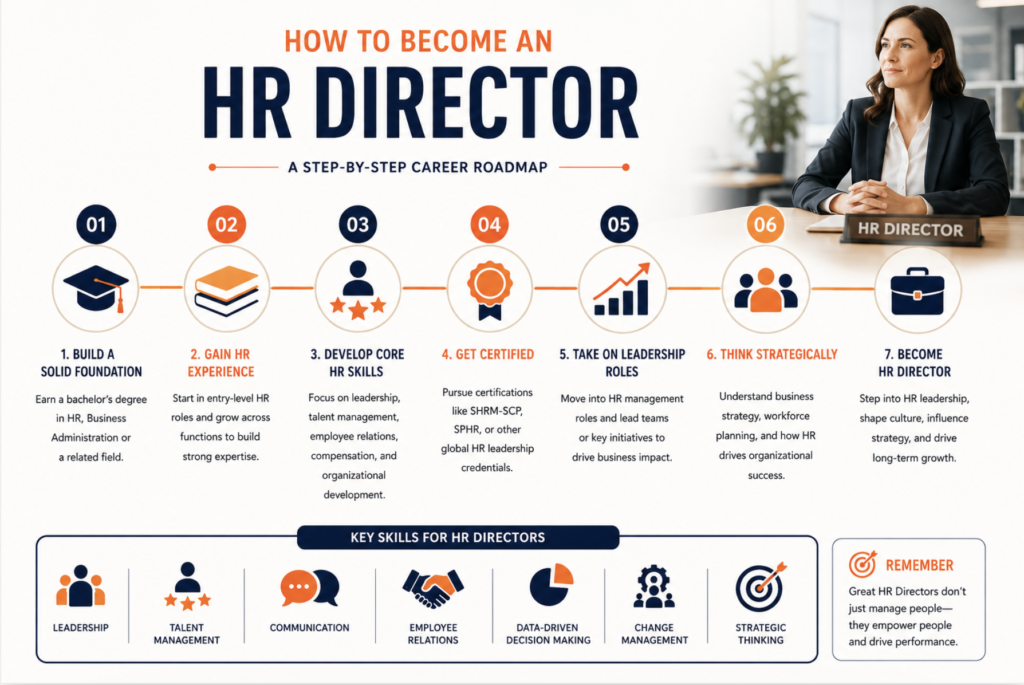
Educational Qualifications and Certifications
Most HR Directors hold an MBA in Human Resources or a related postgraduate qualification. For enterprise or multi-geography leadership roles, companies prioritize candidates with globally recognized senior HR certifications and demonstrated strategic business impact.
Educational Background
- MBA with HR Specialization from recognized institutions including XLRI, TISS, or IIM
- M.A. in Industrial-Organizational Psychology for analytics and culture-focused HR roles
- B.Tech / B.Sc with MBA in HR for manufacturing and industrial sector HR leadership
- LLB / LLM with HR specialization for compliance-heavy HR director roles
- Specialized PG Diploma in Human Resource Management from recognized institutes
Relevant Certifications
In 2026, senior HR certifications validate strategic HR expertise and significantly strengthen candidacy for Director and CHRO-track roles. These credentials demonstrate the depth of people strategy, organizational design, and HR governance knowledge that boards and CEOs expect from senior HR leaders.
| Certification | Best For | Industry Value |
|---|---|---|
| SHRM-SCP | Senior HR strategy, governance, and leadership expertise | Gold standard for senior HR professionals globally |
| CIPD Level 7 | Advanced HR management and organizational development | High value for HR directors in global or UK-linked organizations |
| XLRI HR Analytics Certification | People data, workforce analytics, and HR technology | Growing demand for analytics-driven HR leadership roles |
| Certified Compensation Professional (CCP) | Compensation design and total rewards strategy | Essential for HR directors with significant rewards ownership |
| Executive Coaching Certification (ICF) | Leadership coaching and senior team development | Strong differentiator for HR directors with organizational development scope |
| Workday / SuccessFactors HCM Certification | HRIS platform strategy and HR technology oversight | Critical for HR directors owning technology transformation programs |
Industries Hiring HR Directors
HR Directors are in demand across nearly every sector, but some industries are experiencing particularly strong hiring activity due to workforce growth, digital transformation, and regulatory complexity.
Technology and Global Capability Centers (GCCs)
India’s GCC market is projected to exceed 2,500 centers by 2030, creating demand for HR leaders capable of managing large-scale hiring, workforce planning, and employee experience programs.
Manufacturing and Industrial Organizations
Industry 4.0 initiatives, automation, and workforce modernization are increasing demand for HR Directors who can manage transformation, reskilling, and labour relations.
Banking, Financial Services and Insurance (BFSI)
Large workforces, strict regulatory requirements, and growing competition for digital talent make strategic HR leadership a critical business priority.
Pharmaceutical and Life Sciences
Compliance-heavy environments require HR Directors who can balance talent acquisition, workforce capability development, and regulatory adherence.
FMCG and Consumer Goods
Rapid expansion into new markets, high-volume hiring, and leadership succession planning continue to drive demand for experienced HR leaders.
Retail and E-commerce
Organizations require HR Directors capable of managing distributed workforces, frontline employee engagement, and seasonal workforce scaling.
Healthcare and Hospitals
Healthcare providers face ongoing shortages of skilled professionals, increasing the need for strategic workforce planning and retention initiatives.
Logistics, Supply Chain and Infrastructure
As infrastructure and logistics investments accelerate, organizations require HR leaders who can support workforce growth across multiple locations.
Latest Trends to Watch in 2026 for HR Directors
Now that we’ve explored where HR Directors are being hired, let’s look at the trends reshaping the role in 2026 and beyond.
- AI-powered HR platforms are shifting HR Director focus from process administration to strategic talent intelligence.
- People analytics has become a board-level reporting requirement, with HR Directors owning workforce data dashboards.
- The four new Indian Labour Codes are reshaping compliance obligations across wages, industrial relations, and social security.
- Skills-based workforce planning is replacing role-based headcount planning as the primary talent strategy framework.
- HR Directors with M&A integration experience are among the most competed-for profiles in India’s consolidating sectors.
- Chief People Officer roles are being created in organizations that previously combined HR with admin or finance functions.
- Total rewards personalization including flexible benefits and lifestyle allowances is entering mainstream compensation design.
- HR Directors with DEI strategy ownership experience command salary premiums of up to 25% above generalist HR leaders.
- Succession planning for AI-adjacent roles is becoming a top HR Director priority across technology and GCC organizations.
- HR technology transformation programs are now routinely led by HR Directors rather than IT, requiring stronger digital fluency.
Career Path of an HR Director
The journey to becoming an HR Director typically takes 12–18 years and involves progressively broader responsibility across recruitment, employee relations, compensation, organizational development, and strategic workforce planning. Professionals who reach this level often combine deep HR expertise with strong business and leadership capabilities.
Typical Career Progression
HR Executive → HR Generalist → HR Manager → HR Business Partner / Senior HR Manager → HR Director → VP Human Resources → CHRO / Chief People Officer
Alternative Routes to HR Director
Not all HR Directors follow the same path. Many professionals specialize in a particular HR function before moving into enterprise leadership roles:
- Talent Acquisition Leader → HR Director
- Compensation & Benefits Manager → HR Director
- Learning & Development Head → HR Director
- HR Business Partner → HR Director
- Employee Relations Specialist → HR Director
An HR career grows from supporting basic HR operations to owning enterprise people strategy as a CHRO. Each level builds deeper strategic capability, commercial acumen, and organizational influence across one of the most consequential leadership functions in modern business.
Hiring Challenges in HR Director Recruitment
Organizations face a persistent shortage of HR Directors who combine genuine strategic business partnering capability with technical HR depth and board-level credibility.
- Strategic versus Operational Balance: Finding directors who can operate at board and C-suite level while maintaining deep HR execution credibility is consistently difficult.
- Commercial Acumen Gap: Many experienced HR professionals are strong on people processes but lack the commercial fluency to connect people decisions directly to business outcomes.
- Analytics Leadership Scarcity: HR Directors with genuine people analytics capability and data-driven decision making experience are scarce relative to the growing board expectation.
- Labour Code Transition Complexity: India’s new labour code transition requires HR Directors with current and deep statutory compliance expertise that many candidates lack.
- Retention Risk: Strong HR Directors are frequently attracted to CHRO roles at smaller organizations or consulting positions offering greater scope and compensation.
Salary Trends of HR Director in 2026
In 2026, HR Director salaries in India typically range from INR 10 L – INR 70 L+ per year, with early‑career at INR 15 L – INR 25 L, mid‑career at INR 22 L – INR 35 L, senior at INR 30 L – INR 45 L, and executive (CHRO/VP‑HR) at INR 35 L – INR 70 L+. Pay is highest in Bangalore, Mumbai, and Delhi‑NCR, especially in tech, SaaS, and BFSI, driven by strategic people leadership, talent density, and organizational transformation responsibilities.
1. By industry
HR Directors in tech, SaaS, and product companies typically earn INR 25 L – INR 60 L+. IT services and consulting pay around INR 20 L – INR 50 L, BFSI and financial services INR 22 L – INR 55 L, manufacturing, FMCG, and auto INR 18 L – INR 45 L, and startups or high‑growth ventures INR 15 L – INR 35 L.
| Industry sector | Typical salary band (per year) |
|---|---|
| Tech / SaaS / product companies | INR 25 L – INR 60 L+ |
| IT services / consulting | INR 20 L – INR 50 L |
| BFSI / financial services | INR 22 L – INR 55 L |
| Manufacturing / FMCG / auto | INR 18 L – INR 45 L |
| Startups / high‑growth ventures | INR 15 L – INR 35 L |
2. By location
In major business hubs like Bangalore, Mumbai, and Delhi‑NCR, bands are usually INR 22 L – INR 60 L+. Hyderabad, Pune, and Chennai commonly range INR 18 L – INR 45 L, other tier‑1 cities INR 15 L – INR 35 L, and tier‑2 locations INR 10 L – INR 25 L for similar HR Director roles and experience levels.
| Location / city type | Typical salary band (per year) |
|---|---|
| Bangalore / Mumbai / Delhi‑NCR | INR 22 L – INR 60 L+ |
| Hyderabad / Pune / Chennai | INR 18 L – INR 45 L |
| Other tier‑1 cities | INR 15 L – INR 35 L |
| Tier‑2 cities | INR 10 L – INR 25 L |
3. By experience level
Early‑career HR heads (8–10 years) generally earn INR 15 L – INR 25 L. Mid‑career HR directors (11–14 years) often land INR 22 L – INR 35 L. Senior HR directors (15–18 years) commonly reach INR 30 L – INR 45 L, and CHROs or VP‑HR (19+ years) can command INR 35 L – INR 70 L+ in large tech, BFSI, and product firms.
| Experience level | Typical salary band (per year) |
|---|---|
| Early‑career / 8–10 years (HR head) | INR 15 L – INR 25 L |
| Mid‑career / 11–14 years (HR director) | INR 22 L – INR 35 L |
| Senior / 15–18 years (senior HR director) | INR 30 L – INR 45 L |
| Executive / 19+ years (CHRO / VP‑HR) | INR 35 L – INR 70 L+ |
How to Hire an HR Director?
Hiring exceptional HR Directors requires strategic leadership assessment, business partnering capability evaluation, and senior HR specialist recruitment support.
- Use Strategic Case Assessments: Ask candidates to present a people strategy for a real business challenge rather than discussing generic HR frameworks.
- Assess Commercial Acumen Directly: Evaluate how candidates connect people decisions to revenue, cost, and competitive positioning rather than HR metrics alone.
- Verify Board-Level Credibility: Include CEO or board member involvement in final interviews to assess executive presence and communication quality.
- Partner with Senior HR Specialist Recruiters: Work with agencies experienced in CHRO-track and HR Director hiring to access passive candidates.
Top Interview Questions for an HR Director
HR Director interviews increasingly focus on strategic leadership, workforce planning, people analytics, and business impact. Candidates are expected to demonstrate how their HR initiatives influenced growth, productivity, retention, and organizational performance rather than simply describing HR processes.
1. How do you build a people strategy aligned with a rapidly changing business model?
I start with a deep understanding of the business strategy, translate it into capability requirements, identify gaps between current and future state, and build a phased people plan covering hiring, development, and organizational design.
2. How have you connected HR initiatives to measurable business outcomes?
I tied a leadership development program to succession readiness scores and promotion rates, demonstrating a 30% improvement in internal fill rates for senior roles within 18 months of program launch.
3. How do you handle a senior leader who consistently ignores people issues in their team?
I present the business cost of disengagement and attrition in their team using data, offer coaching support proactively, and escalate to the CEO if the pattern continues creating organizational risk.
4. How do you design a compensation framework that is fair, competitive, and sustainable?
I benchmark against market data by function and level, ensure internal equity through structured job grading, build variable components tied to performance, and review annually against business affordability and retention data.
5. How do you lead HR through a major organizational restructuring?
I partner with leadership on design decisions from the start, ensure legal compliance at every step, communicate transparently and quickly, support impacted employees with dignity, and stabilize remaining teams through clear role clarity and engagement.
Explore top interview questions with this guide which covers preparation tips across fresher, intermediate, and expert levels & recruiter insights.
Why RPO is the Answer to HR Director Recruitment
Finding an HR Director requires more than sourcing HR professionals—it requires identifying leaders who can align people strategy with business growth. Since many qualified HR leaders are passive candidates, traditional hiring methods often fall short.
RPO partners provide access to specialized leadership talent pools, executive assessment frameworks, and targeted sourcing strategies, helping organizations hire the right HR Director faster and with greater confidence.
Key Benefits: Faster hiring | Access to passive talent | Stronger leadership assessment | Reduced hiring risk | Scalable executive search support
Industries Hiring HR Directors Through RPO: Technology | Manufacturing | BFSI | Pharmaceuticals | FMCG | Retail | Healthcare | Logistics & Supply Chain
FAQs
What is an HR Director and what do they do?
An HR Director designs and executes an organization’s people strategy covering talent acquisition, performance, compensation, compliance, and culture to attract, develop, and retain the workforce needed to achieve business goals.
How is an HR Director different from a CHRO?
HR Directors typically own people strategy execution across the organization. CHROs sit at C-suite level, own the enterprise-wide people vision, and present workforce strategy and performance directly to the board and investors.
What qualifications does an HR Director need in India?
An MBA in HR from a recognized institution combined with 12 to 18 years of progressive experience, strong statutory compliance knowledge, and certifications like SHRM-SCP or CIPD Level 7 are the standard profile.
What is the career outlook for HR Directors in India?
Strong and improving. AI workforce transformation, new labour code compliance, and growing board-level people accountability are driving sustained demand for senior HR leaders with strategic and commercial depth.
What are the top 5 skills for HR Directors in 2026?
People Strategy and Workforce Planning, Total Rewards Design, People Analytics, Organizational Design, and Labour Compliance. These determine hiring success and career progression across all HR Director roles.
Forward-leading organizations are already partnering with Taggd to hire for senior HR and people leadership roles using Agentic AI workflows embedded directly into their recruitment process, enabling faster pipeline development and smarter leadership screening at scale.