A product can be manufactured perfectly, packaged flawlessly, and sold successfully. But if it does not reach the customer on time, none of those matters.
That is where a Logistics Coordinator comes in.
As supply chains become more global, customer expectations continue to rise, and organizations pursue faster and more efficient delivery networks. Logistics coordination has become one of the most operationally critical functions in modern business.
In 2026, every successful supply chain depends on professionals who can move products, information, and resources seamlessly from origin to destination.
This guide explains everything candidates and recruiters need to know about Logistics Coordinators, including responsibilities, required skills, hiring challenges, job descriptions, and recruitment strategies.
What is a Logistics Coordinator?
A Logistics Coordinator is a professional responsible for planning, organizing, and monitoring the movement of goods, materials, and shipments across the supply chain.
Unlike warehouse personnel who focus on storage operations or transportation managers who oversee fleet operations, logistics coordinators ensure all logistics activities work together efficiently to meet delivery timelines and business objectives.
| A Logistics Coordinator is a specialist who coordinates transportation, inventory movement, shipment tracking, vendor communication, and delivery scheduling to ensure smooth supply chain operations. |
Logistics coordinators work at the intersection of:
• Transportation Planning and Coordination
• Inventory Movement and Distribution
• Vendor and Carrier Management
• Supply Chain Visibility and Tracking
• Customer Service and Delivery Management
Logistics Coordinators are responsible for:
• Scheduling inbound and outbound shipments across multiple transportation channels
• Coordinating with suppliers, warehouses, carriers, and customers to ensure timely deliveries
• Monitoring shipment status and resolving transportation disruptions proactively
• Managing logistics documentation, freight records, and compliance requirements
• Supporting inventory planning and distribution activities across supply chain networks
Think of a Logistics Coordinator as a combination of:
• Transportation Planner
• Supply Chain Facilitator
• Vendor Relationship Coordinator
• Customer Service Representative
• Operations Problem Solver
Why Do Organizations Need a Logistics Coordinator?
In 2026, supply chains move faster than ever. Customers expect real-time visibility, next-day delivery, and seamless order fulfillment. Without dedicated logistics coordination, organizations face shipment delays, increased transportation costs, inventory disruptions, and poor customer satisfaction.
| Factor | Why It Matters |
|---|---|
| Delivery Reliability | Ensures products reach customers and facilities on time. |
| Supply Chain Visibility | Provides real-time tracking and communication across logistics networks. |
| Cost Optimization | Efficient routing and shipment planning reduce transportation costs. |
| Inventory Flow | Prevents stockouts and overstock situations through coordinated movement. |
| Customer Satisfaction | Timely deliveries improve customer experience and retention. |
| Vendor Coordination | Aligns suppliers, warehouses, and carriers across the supply chain. |
| Risk Management | Helps mitigate transportation delays and operational disruptions. |
| Business Growth | Scalable logistics operations support expansion into new markets. |
Core Operational Tasks of a Logistics Coordinator
Logistics coordinators keep supply chains moving efficiently and on schedule. Here is what their day-to-day looks like:
1. Shipment Planning and Scheduling
Coordinating inbound and outbound shipments, scheduling pickups and deliveries, and ensuring transportation resources are available to meet operational requirements.
2. Shipment Tracking and Monitoring
Monitoring shipment progress using transportation management systems and proactively addressing delays, route deviations, or carrier issues.
3. Carrier and Vendor Coordination
Communicating with carriers, suppliers, warehouses, and distribution partners to maintain smooth logistics operations and resolve operational bottlenecks.
4. Documentation Management
Preparing and maintaining shipping documentation, invoices, bills of lading, customs paperwork, and transportation records accurately.
5. Inventory Movement Support
Coordinating inventory transfers between facilities and warehouses to support purchase managers and supply continuity.
6. Customer and Internal Communication
Providing shipment updates, delivery status information, and issue resolution support to customers and internal stakeholders.
Key Responsibilities of a Logistics Coordinator
Logistics coordinators ensure efficient transportation, inventory movement, and delivery performance by coordinating logistics activities, managing vendor relationships, and maintaining supply chain visibility.
1. Transportation Planning and Shipment Coordination
• Schedule inbound and outbound shipments across multiple transportation modes.
• Coordinate transportation resources to meet delivery commitments and operational requirements.
• Optimize routing and shipment consolidation opportunities where appropriate.
• Monitor transportation schedules and address delivery disruptions.
2. Carrier and Vendor Management
• Maintain strong working relationships with transportation providers and logistics partners.
• Monitor carrier performance against delivery timelines and service expectations.
• Coordinate shipment bookings and transportation capacity planning activities.
• Support service-level monitoring alongside contract managers and logistics vendors.
3. Logistics Documentation and Compliance
• Prepare shipping documents, freight records, invoices, and customs documentation accurately.
• Maintain logistics databases and transportation records for audit and reporting purposes.
• Ensure compliance with transportation regulations and company logistics policies.
• Support freight claims and shipment discrepancy investigations when necessary.
4. Supply Chain Visibility and Tracking
• Monitor shipment status using transportation management and tracking systems.
• Provide regular updates to customers and internal stakeholders regarding delivery performance.
• Escalate critical shipment delays and coordinate corrective actions promptly.
• Analyze logistics performance metrics and identify improvement opportunities.
5. Customer Service and Issue Resolution
• Resolve delivery issues, shipment discrepancies, and customer logistics concerns.
• Coordinate urgent deliveries and recovery plans for delayed shipments.
• Maintain high service standards throughout the delivery lifecycle.
• Support continuous improvement initiatives aimed at enhancing logistics efficiency.
Additional Scope (Senior Logistics Coordinator Roles)
• Lead logistics coordination across multiple regions or distribution networks.
• Mentor junior logistics coordinators and transportation planners.
• Support logistics process improvement and digital transformation initiatives.
• Present logistics performance reports and improvement recommendations to management.
What Skills Does a Logistics Coordinator Need?
Great logistics coordinators are not just schedulers. They are highly organized, operationally aware, and capable of solving complex supply chain problems under pressure.
Here is what the best brings to the table:
Technical Skills
• Transportation Management Systems (TMS)
• Shipment tracking and logistics visibility tools
• Freight and carrier management
• Inventory movement coordination
• Supply chain planning fundamentals
• Logistics reporting and analytics
• Freight documentation and compliance requirements
• ERP systems such as SAP, Oracle, and Microsoft Dynamics
Soft Skills
• Organization and multitasking capability
• Communication and stakeholder management
• Problem-solving and decision-making under pressure
• Attention to detail and accuracy
• Time management and prioritization
• Adaptability in fast-paced operational environments
Logistics Coordinator Job Description Template
Job Title: Logistics Coordinator / Senior Logistics Coordinator
Department: Supply Chain / Logistics / Operations
Reports To: Logistics Manager / Supply Chain Manager / Operations Manager
Location: [Location]
Employment Type: Full-time
Job Summary:
We are looking for a highly organized and detail-oriented Logistics Coordinator to join our [Department] team. In this role, you will coordinate transportation, shipment tracking, inventory movement, and vendor communication activities to ensure efficient and cost-effective logistics operations. You will work closely with suppliers, carriers, warehouses, and internal stakeholders to deliver exceptional supply chain performance.
Key Responsibilities
• Coordinate inbound and outbound logistics activities.
• Monitor shipment status and resolve delivery issues.
• Maintain logistics records and transportation documentation.
• Coordinate with carriers, suppliers, and warehouses.
• Support inventory movement and distribution planning.
• Ensure logistics compliance and operational efficiency.
Required Qualifications
• Bachelor’s degree in supply chain management, Logistics, Business Administration, or related discipline.
• 2 to 5 years of experience in logistics, transportation, or supply chain operations.
• Experience using logistics software and shipment tracking systems.
• Strong organizational and communication skills.
• Ability to manage multiple logistics activities simultaneously.
Preferred Qualifications
• Experience with ERP and Transportation Management Systems.
• Exposure to freight forwarding, distribution, or warehouse operations.
• Knowledge of import/export documentation and customs processes.
• Familiarity with logistics, analytics and reporting tools.
• Experience with third-party logistics providers (3PLs)
Key Skills
• Logistics Coordination and Shipment Planning
• Carrier and Vendor Management
• Transportation Tracking and Visibility
• Inventory Movement Coordination
• Customer Service and Issue Resolution
How to Become a Logistics Coordinator?
Start with a degree in supply chain management, logistics, business administration, or operations management. This builds foundational knowledge in transportation, inventory management, as a procurement specialist and supply chain operations.
Then follow these essential steps:
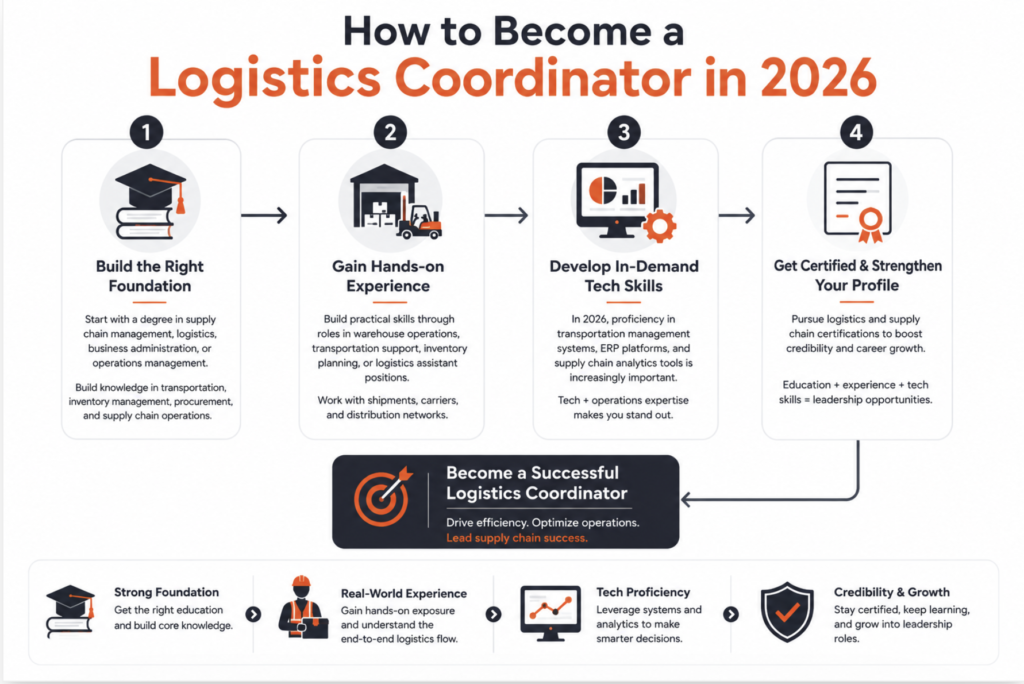
Educational Qualifications and Certifications
Most Logistics Coordinators hold a bachelor’s degree in logistics, supply chain management, business administration, or operations.
For senior logistics and supply chain leadership positions, organizations increasingly prioritize candidates with professional logistics certifications and technology expertise.
Educational Background
• Bachelor’s Degree in Supply Chain Management
• Bachelor’s Degree in Logistics and Transportation Management
• BBA in Operations or Business Administration
• Bachelor’s Degree in Commerce or Industrial Management
• MBA in Supply Chain Management or Operations
• Specialized Diploma in Logistics and Distribution Management
Relevant Certifications
In 2026, certifications like CSCP, CLTD, and APICS validate logistics and supply chain expertise and directly accelerate hiring. Certified professionals consistently outperform in shortlisting, command higher salaries, and are fast-tracked into logistics leadership positions.
| Certification | Best For | Industry Value |
|---|---|---|
| APICS Certified Supply Chain Professional (CSCP) | End-to-end supply chain management expertise | Highly valued across manufacturing, retail, and logistics sectors |
| APICS Certified in Logistics, Transportation and Distribution (CLTD) | Transportation and distribution operations | Essential for logistics-focused career progression |
| CILT Certification | Logistics and transport management | Globally recognized logistics qualification |
| Lean Six Sigma Green Belt | Process improvement and operational efficiency | High value for logistics optimization roles |
| SAP Supply Chain Certification | ERP-based logistics and inventory management | Preferred in organizations using SAP ecosystems |
| Certified Professional Logistician (CPL) | Advanced logistics planning and coordination | Strong differentiator for senior logistics positions |
| FIATA Diploma in Freight Forwarding | International freight and shipping operations | Valuable for global logistics and trade organizations |
Industries Hiring Logistics Coordinators
Logistics coordinators are in demand across every industry where products, materials, and inventory must move efficiently through complex supply chains.
Manufacturing and Industrial Operations
Manufacturing organizations depend on logistics coordinators to ensure uninterrupted material flow between suppliers, production facilities, warehouses, and customers.
• Raw material inbound logistics coordination
• Production inventory movement planning
• Distribution and outbound shipment management
• Vendor and transportation partner coordination
E-commerce and Retail
Fast-growing retail and e-commerce companies require logistics coordinators to manage inventory distribution, fulfillment operations, and last-mile delivery performance.
• Order fulfillment coordination
• Distribution center logistics planning
• Reverse logistics and returns management
• Customer delivery tracking and support
Pharmaceuticals and Healthcare
Healthcare and pharmaceutical supply chains require precise logistics of coordination to maintain product integrity, compliance, and delivery of reliability.
• Medical inventory distribution management
• Temperature-controlled logistics coordination
• Regulatory-compliant transportation planning
• Healthcare facility delivery scheduling
Transportation and Third-Party Logistics (3PL)
Logistics service providers hire coordinators to manage transportation networks, freight operations, and customer logistics requirements.
• Freight movement coordination
• Carrier scheduling and management
• Shipment visibility and customer communication
• Multi-client logistics operations support
Latest Trends to Watch in 2026 for Logistics Coordinators
Logistics coordinators in 2026 are technology-enabled supply chain professionals commanding stable salaries and strong career growth. Digital logistics platforms, visibility tools, and supply chain analytics are reshaping the role.
Job Role Trends
• Real-time shipment visibility platforms are becoming standard across logistics networks.
• AI-powered route optimization improves transportation efficiency and delivery reliability.
• Digital freight marketplaces are transforming carrier sourcing and capacity planning.
• Sustainability metrics are increasingly influencing transportation and distribution decisions.
• Logistics coordinators are expected to leverage analytics for operational decision-making.
Hiring Trends
• ERP and Transportation Management System proficiency are now baseline hiring requirements.
• E-commerce growth continues to drive strong demand for logistics coordination professionals.
• Candidates with multi-modal transportation experience are attracting stronger hiring interest.
• Data-driven logistics decision-making skills are becoming highly valued.
• Organizations increasingly seek logistics professionals with technology platform expertise.
Career and Pay Trends
• Logistics coordinators with analytics and automation expertise command higher compensation.
• Experienced coordinators are fast-tracking into supply chain planning and logistics leadership roles.
• Performance incentives tied to delivery accuracy and logistics cost optimization are becoming standard.
• Cross-functional supply chain experience creates stronger career advancement opportunities.
• Logistics remains one of the most resilient and consistently growing operational career paths.
Career Path of a Logistics Coordinator
A logistics career grows from coordinating daily shipments to leading global supply chain networks. Each level builds deeper operational expertise, leadership capability, and strategic supply chain ownership.
| Career level | Typical Years of Experience | Core Focus | Key Responsibilities |
|---|---|---|---|
| Level 1: Logistics Assistant / Coordinator Trainee | 0–2 Years | Learning and Support | Supporting shipment scheduling, documentation, and logistics tracking activities |
| Level 2: Logistics Coordinator | 2–5 Years | Operational Execution | Managing transportation planning, shipment monitoring, and vendor coordination |
| Level 3: Senior Logistics Coordinator | 5–8 Years | Process Ownership | Leading logistics operations, resolving disruptions, and mentoring junior coordinators |
| Level 4: Logistics Manager | 8–12 Years | Team Leadership | Managing logistics teams, carrier networks, and distribution operations |
| Level 5: Supply Chain Manager | 12–16 Years | Strategic Management | Leading logistics strategy, inventory planning, and operational optimization |
| Level 6: Director of Supply Chain / Chief Supply Chain Officer | 16+ Years | Enterprise Leadership | Driving end-to-end supply chain strategy and organizational logistics excellence |
Logistics Coordinator Salary Trends in 2026
In 2026, Logistics Coordinator salaries in India typically range from INR 3 L – INR 15 L+ per year depending on industry, experience, and technology expertise.
Salary by Experience
Entry-level logistics coordinators typically earn between INR 3–8 LPA depending on industry, location, and operational complexity. Professionals who develop expertise in transportation management systems, inventory planning, and shipment coordination often experience faster salary growth and promotion opportunities.
| Experience Level | Typical Salary Band (Per Year) |
|---|---|
| 0–2 Years | INR 3 L – INR 5 L |
| 2–5 Years | INR 5 L – INR 8 L |
| 5–8 Years | INR 8 L – INR 12 L |
| 8+ Years | INR 12 L – INR 15 L+ |
Salary by Industry
Senior logistics coordinators and logistics managers can earn between INR 8–15+ LPA, particularly in e-commerce, pharmaceuticals, and large manufacturing organizations. Experience in multi-location logistics operations, supply chain optimization, and team leadership significantly increases earning potential and career progression.
| Industry | Typical Salary Band (Per Year) |
|---|---|
| Manufacturing | INR 4 L – INR 10 L |
| E-commerce and Retail | INR 5 L – INR 12 L |
| Pharmaceuticals | INR 5 L – INR 11 L |
| Third-Party Logistics (3PL) | INR 4 L – INR 9 L |
| Technology and High-Value Supply Chains | INR 6 L – INR 15 L+ |
Salary by Location
Logistics Coordinators in Mumbai, Delhi‑NCR, and Bangalore typically earn INR 3 L – INR 6 L. Chennai, Hyderabad, and Pune commonly range INR 2.5 L – INR 5 L, port cities like Kolkata and Ahmedabad INR 2.5 L – INR 4.5 L, other tier‑1 cities INR 2 L – INR 4 L, and tier‑2 hubs INR 1.8 L – INR 3.5 L. Salaries are driven by logistics volume, e‑commerce demand, and supply‑chain complexity in each region.
| Location / city type | Typical salary band (per year) |
|---|---|
| Mumbai / Delhi‑NCR / Bangalore | INR 3 L – INR 6 L |
| Chennai / Hyderabad / Pune | INR 2.5 L – INR 5 L |
| Kolkata / Ahmedabad / Chennai ports | INR 2.5 L – INR 4.5 L |
| Other tier‑1 cities | INR 2 L – INR 4 L |
| Tier‑2 cities / logistics hubs | INR 1.8 L – INR 3.5 L |
Hiring Challenges in Logistics Coordinator Recruitment
Organizations in 2026 face increasing difficulty hiring logistics coordinators who combine operational expertise, technology proficiency, and strong communication skills.
Technology Skills Gap
Many candidates possess logistics experience but lack proficiency in modern TMS, ERP, and logistics visibility platforms.
Multi-Stakeholder Coordination Challenges
Professionals capable of coordinating effectively across suppliers, carriers, warehouses, and customers remain scarce.
High Attrition Rates
Experienced logistics coordinators are frequently attracted to higher-paying supply chain and operations management opportunities.
Demand-Supply Imbalance
Rapid growth in e-commerce, manufacturing, and distribution operations continues to outpace available logistics talent.
Analytics Capability Shortage
Organizations increasingly seek professionals who can interpret logistics data and drive operational improvements, yet qualified candidates remain limited.
How to Hire a Logistics Coordinator?
Hiring skilled logistics coordinators requires practical logistics assessments, technology evaluation, and supply chain recruitment expertise.
• Prioritize candidates with hands-on transportation and shipment coordination experience.
• Assess ERP, TMS, and logistics platform proficiency during interviews.
• Evaluate problem-solving capability through logistics disruption scenarios.
• Partner with supply chain institutes and logistics training programs.
• Offer clear career progression into supply chain leadership pathways.
• Invest in technology training to expand the available talent pool.
• Leverage specialist supply chain recruitment partners to reduce time-to-hire.
Top 10 Interview Questions for a Logistics Coordinator
1. How do you manage multiple shipments with competing delivery deadlines?
I prioritize shipments based on urgency, customer commitments, and operational impact while maintaining continuous communication with carriers and stakeholders.
2. How do you respond to a shipment delay?
I identify the root cause, communicate proactively with stakeholders, explore alternative transportation options, and implement recovery plans immediately.
3. What logistics software platforms have you used?
I have experience with ERP systems, transportation management platforms, shipment tracking tools, and logistics reporting solutions.
4. How do you ensure logistics documentation accuracy?
I follow standardized processes, verify shipment information carefully, and maintain detailed records throughout the transportation lifecycle.
5. How do you manage carrier relationships?
I maintain regular communication, monitor performance metrics, and address service issues proactively to ensure reliability.
6. How do you handle inventory transfer coordination?
I align warehouse, transportation, and inventory teams to ensure accurate and timely movement of stock between locations.
7. What KPIs do you track in logistics operations?
I monitor on-time delivery, transportation costs, shipment accuracy, inventory movement efficiency, and carrier performance.
8. How do you reduce logistics costs?
I optimize shipment consolidation, improve carrier utilization, evaluate routing options, and identify operational inefficiencies.
9. How do you manage customer delivery expectations?
I provide proactive updates, maintain transparency regarding delays, and ensure timely resolution of logistics issues.
10. How do you stay current with logistics industry trends?
I follow industry publications, attend supply chain webinars, and continuously learn about logistics technology and best practices.
Why RPO is the Answer to Logistics Coordinator Recruitment
As supply chains become more complex, customer delivery expectations rise, and organizations expand their distribution networks. Traditional recruitment models often struggle to keep pace with the volume and speed of logistics hiring required.
This is where Recruitment Process Outsourcing (RPO) solutions have become a game changer for logistics-driven organizations. RPO providers embed themselves within your company to hire qualified logistics professionals at scale while maintaining hiring quality and operational efficiency.
They bring dedicated supply chain sourcing teams, pre-built talent pools of logistics professionals, and competency-based assessment frameworks. This allows organizations to hire skilled logistics coordinators without overwhelming internal HR teams during periods of rapid growth.
For logistics coordinator hiring specifically, the best RPO partners bring deep supply chain and logistics expertise. They screen candidates for real transportation coordination capability, logistics technology proficiency, stakeholder management skills, and operational problem-solving ability rather than simply matching keywords on a resume.
Key Benefits of RPO for Logistics Coordinator Talent Acquisition
Faster Time-to-Hire: RPO significantly reduces hiring timelines for logistics, transportation, and supply chain operations roles.
Access to Passive Logistics Talent: Recruiters engage experienced logistics professionals who are not actively applying but remain open to attractive opportunities.
Scalable Hiring Model: Ramp from hiring a few logistics coordinators to building an entire logistics operations team without rebuilding internal recruitment capability.
Reduced Cost-per-Hire: Achieve significant savings compared to traditional staffing approaches for high-volume logistics recruitment.
Technical Screening Support: Expert assessment of transportation planning, shipment coordination, ERP proficiency, logistics analytics, and stakeholder management capability before candidates reach final interviews.
Employer Branding: Position your organization as an attractive logistics employer by highlighting technology adoption, operational scale, career progression, and supply chain impact.
Industries Leveraging RPO Most Actively for Logistics Coordinator Hiring
Manufacturing and Industrial Operations | E-commerce and Retail | Pharmaceuticals and Healthcare | Third-Party Logistics (3PL) | FMCG | Automotive | Technology Supply Chains | Distribution and Warehousing
Wrapping Up
The role of a Logistics Coordinator in 2026 has never been more operationally critical or strategically valuable. As organizations manage increasingly complex supply chains, expand omnichannel distribution networks, and face growing customer expectations around delivery performance, logistics professionals have become essential drivers of business success.
Whether you are a logistics professional building a supply chain career or an organization looking to hire the right logistics talent, understanding the skills, certifications, and market trends shaping this profession is essential for remaining competitive in 2026 and beyond.
Ultimately, efficient supply chains are built by skilled people. By embracing continuous learning, logistics technology, operational excellence, and modern recruitment solutions like RPO, both logistics professionals and forward-thinking organizations can build supply chains that are agile, resilient, and prepared for future growth.
FAQs
What is a Logistics Coordinator and what do they do?
A Logistics Coordinator manages the movement of goods, materials, and shipments across the supply chain by coordinating transportation, tracking deliveries, managing logistics documentation, and ensuring timely order fulfillment.
How is a Logistics Coordinator different from a Supply Chain Manager?
Logistics Coordinators focus on daily transportation, shipment tracking, and logistics execution. Supply Chain Managers oversee broader strategic activities including procurement, inventory planning, supplier management, and end-to-end supply chain optimization.
How do I become a Logistics Coordinator in 2026?
Earn a degree in logistics, supply chain management, business administration, or operations. Gain hands-on experience in transportation, warehousing, inventory management, or distribution operations while developing proficiency in logistics technology platforms.
What are the top skills required for Logistics Coordinators?
Transportation Planning, Shipment Tracking, Vendor Coordination, ERP and TMS Proficiency, Problem Solving, Customer Communication, Inventory Movement Coordination, and Logistics Analytics.
How long does it take to become a Logistics Coordinator?
Most professionals enter logistics coordinator roles within 2–4 years through logistics assistant, warehouse operations, inventory control, or transportation support positions combined with relevant education and technology skills.
What is the career outlook for Logistics Coordinators?
Exceptionally strong. E-commerce growth, manufacturing expansion, supply chain digitization, and rising customer delivery expectations are driving sustained demand for logistics professionals across industries.
Which industries hire the most Logistics Coordinators?
Manufacturing, Retail, E-commerce, FMCG, Pharmaceuticals, Healthcare, Automotive, Third-Party Logistics (3PL), Distribution, and Technology Supply Chains are among the largest employers of logistics coordinators.
What certifications are most valuable for Logistics Coordinators?
APICS CSCP, APICS CLTD, CILT Certification, Lean Six Sigma, SAP Supply Chain Certification, and Certified Professional Logistician (CPL) are among the most recognized credentials.
Can Logistics Coordinators move into leadership roles?
Yes. Many professionals progress into Senior Logistics Coordinator, Logistics Manager, Supply Chain Manager, Head of Logistics, and ultimately Chief Supply Chain Officer positions.
Is logistics a good career in 2026?
Yes. Logistics remains one of the most stable and future-focused career paths due to continued supply chain expansion, technology adoption, global trade growth, and increasing demand for operational efficiency.
Building resilient supply chains starts with hiring the right logistics professionals.
Taggd helps organizations hire skilled Logistics Coordinators across manufacturing, retail, e-commerce, healthcare, automotive, FMCG, and logistics sectors through specialized hiring solutions, talent intelligence, and scalable RPO support.