More than 100 million registered job seekers and over 97,000 monthly active recruiters are active on Naukri.com in India, according to GMAC’s resume guidance citing the Indian hiring context. That single fact changes how you should think about resume mistakes. In a market this crowded, your resume isn’t being judged in isolation. It’s being compared against a large pile of similar profiles, often under time pressure, often through ATS filters first, and then through a recruiter’s very impatient scan.
Most resume advice online is too generic to be useful in India. It tells candidates to avoid typos, keep things neat, and add keywords. Fair enough. But it usually skips the core issue: which mistakes hurt most in India’s hiring environment, where GCCs want role precision, manufacturing employers want operational clarity, tech teams want tool-level proof, and recruiters are balancing both automation and human judgement.
This guide is written from that reality. It’s for candidates who want interviews, and for junior recruiters who want a sharper eye for what weak resumes are really signalling.
Why Resumes Get Rejected by Recruiters
Recruiters in India reject more resumes for weak presentation than candidates realise. The profile may be relevant. The document still loses in the first scan.
That happens before anyone debates skill depth, domain fit, or interview potential. In high-volume hiring, the first filter is simple. Can a recruiter understand who you are, what role you fit, and what value you bring within a few seconds?
One of the most common resume mistakes is creating friction for recruiters. A resume that is difficult to scan, poorly structured, or overloaded with irrelevant information can reduce your chances of being shortlisted.
Dense blocks of text, vague job titles, copied summaries, irrelevant certifications, and poor structure force the reviewer to hunt for meaning. Most recruiters do not have the time to do that, especially in bulk hiring for IT services, GCCs, plant operations, shared services, and frontline corporate roles.
I see this often with strong candidates from Indian companies who have done solid work but describe it badly. An engineer in manufacturing writes only process steps and misses production scale, yield improvement, downtime reduction, or audit exposure. A GCC analyst lists tools but not business outcomes. A software candidate mentions responsibilities but hides ownership, delivery scope, and measurable impact. The problem is not always capability. The problem is translation.
Sector context matters.
A resume that works for a product startup in Bengaluru will often miss the mark for a Pune manufacturing plant or a finance GCC in Hyderabad. GCC hiring teams usually expect precision, systems familiarity, process maturity, and evidence of stakeholder management. Manufacturing recruiters look for safety, shift exposure, throughput, maintenance, quality, lean practices, and plant-level accountability. Tech recruiters want clarity on stack, architecture, delivery, and problem-solving. A generic resume ignores these differences and gets treated as low intent.
AI has made this worse in a specific way. Candidates can now produce polished-looking resumes quickly, but many of those resumes sound identical. Junior recruiters see the pattern immediately. Broad claims, inflated language, and keyword-heavy summaries create suspicion because they read like generated content with no real working context behind it.
The first section of the resume carries disproportionate weight. If the headline, summary, current role, and top bullets do not establish relevance fast, the rest of the document may never get read. Candidates who need to fix that first impression should start with a clean curriculum vitae format that recruiters can scan quickly.
Common Reasons Recruiters Reject Resumes
- Low scan value: Key information is buried under long summaries, cluttered formatting, or filler content.
- Weak role alignment: The resume does not show why the candidate fits this role, in this sector, at this level.
- No business proof: Work is described as activity, not outcome.
- Artificial optimisation: Keywords are stuffed in, but the document does not read like a real person did real work.
- Context missing: Tools, plants, teams, systems, or scale are not mentioned, so recruiters cannot judge complexity.
A strong resume gets one thing right above all else. It reduces decision effort for the recruiter while increasing confidence in the candidate.
Resume Mistakes That Hurt Your First Impression
A large share of resumes in India gets rejected for reasons that have nothing to do with capability. They fail on basic execution. In high-volume hiring, especially across GCCs, IT services, shared services, and plant roles, that is enough to push an application out before anyone assesses actual fit.
Resume Mistake #1: Typos and Grammar Errors
Candidates often treat spelling mistakes as minor. Recruiters do not. In India, where one recruiter may screen hundreds of applications for the same role, basic language errors become a shortcut signal for poor attention to detail.
The trade-off is simple. A recruiter can spend time decoding a sloppy resume, or move to the next one. They usually move.
This hits harder in roles where written accuracy is part of the job. Client support. PMO. Procurement. Quality. HR operations. Compliance. Plant documentation. Any role involving reports, SOPs, audit records, vendor communication, or customer emails.
Before
- “Manged vendor comunication for monthly dispatches”
After
- “Managed vendor communication for monthly dispatch planning”
A practical proofreading process works better than another spellcheck pass:
- Print the resume once: Layout and missing words show up faster on paper.
- Read one line at a time from bottom to top: This forces attention on the sentence, not the story you think you wrote.
- Check proper nouns separately: Company names, ERPs, tools, certifications, and client names are common failure points.
- Ask one other person to review it: A mentor, recruiter, or colleague will spot obvious errors you now skip over.
AI has made this problem sharper, not smaller. Candidates copy generated summaries, then miss awkward phrasing, American spellings that do not match the rest of the document, or inflated claims that do not sound like their real work. Recruiters notice that mismatch quickly.
Resume Mistake #2: Poor Resume Formatting
Poor formatting tells the reader that the candidate did not test the document before sending it. That matters in India because many resumes are first reviewed on a recruiter laptop, then reopened on mobile, then passed to a hiring manager as a PDF. If the document breaks across those steps, your content loses clarity.
Common issues are predictable:
- mixed fonts
- inconsistent bullet indentation
- crowded margins
- dates shown in different formats
- headings that look like body text
- long paragraphs with no visual hierarchy
A resume should be easy to scan in seconds. Use one font family. Keep heading styles consistent. Show dates in the same format throughout. Make sure bullet alignment stays clean. If one experience entry includes location, the others should follow the same pattern unless there is a good reason not to.
I see this often with experienced candidates who keep editing an old file for six or eight years. The content may be strong, but the document carries formatting baggage from every role change. Starting fresh withresume templates designed for cleaner, recruiter-friendly structure is usually faster than repairing a bloated legacy document.
Resume Mistake #3: Incorrect Contact Information
This is one of the easiest mistakes to avoid, and one of the most common.
Wrong phone number. Old email ID. Missing city. Broken LinkedIn URL. No mention of relocation openness for a plant or site-based role. These errors do not look dramatic, but they stop follow-up. In fast-moving hiring cycles, especially for GCCs, shift roles, and manufacturing plants outside metro locations, recruiters rarely chase a candidate twice.
Use a final contact check before every application:
| Checkpoint | What to verify | Why it matters |
| Phone number | Active and reachable | Recruiters often call before sending an email |
| Email ID | Professional and current | An outdated or casual ID affects credibility |
| Location | Current city or relocation readiness if relevant | Plant, site, and hybrid roles often filter by this |
| Updated and clickable | Recruiters use it to cross-check career progression |
One more point for the Indian market. If location flexibility matters, say it clearly. “Open to relocate to Pune, Chennai, Hosur, Ahmedabad” helps far more than leaving the recruiter to guess. For manufacturing, field service, and many GCC expansion roles, that one line can decide whether your resume gets shortlisted or parked.
Resume Mistakes That Show a Lack of Focus
Carelessness gets you rejected. Lack of focus gets you ignored.
Resume Mistake #4: Using the Same Resume for Every Job
The most damaging strategic mistake is sending the same resume everywhere. Candidates do this because it feels efficient. It isn’t. A resume is a key. A job description is a lock. If the cuts don’t match, the door doesn’t open.
India’s hiring context makes this more complicated than standard global advice suggests. The Ministry of Labour and Employment’s e-Shram platform had registered over 30 crore unorganised workers by late 2024, showing that a large share of the workforce still moves into formal hiring through uneven documentation and varied norms, which is why one-size-fits-all resume advice is less useful.
That’s exactly why tailoring matters. A fresher applying to a GCC analyst role, a maintenance engineer applying to an automotive plant, and a product manager applying to a SaaS company should not be using the same top section, the same skills order, or the same project emphasis.
Resume Mistake #5: Weak Professional Summary
Your professional summary is often the first section recruiters read. A weak summary filled with generic phrases such as “seeking a challenging opportunity” does little to differentiate you from other candidates.
An effective summary should explain who you are, what experience you bring, and the value you can offer. Recruiters should immediately understand your professional focus and key strengths without reading the entire resume.
That line says nothing. Every recruiter has seen it a thousand times. Replace it with a short professional summary that answers three questions fast:
- What role do you do?
- In what context have you done it?
- What value do you usually create?
For example:
- Tech: Backend engineer with experience building API-driven services, improving reliability, and supporting high-volume transactional systems.
- Manufacturing: Production engineer with experience in line operations, downtime reduction, process discipline, and shift coordination.
- GCC finance: FP&A professional supporting budgeting, variance analysis, reporting cadence, and stakeholder reviews across shared services environments.
The third mistake is clutter. Irrelevant internships, school-level achievements from years ago, hobby paragraphs, and every tool you’ve ever touched make the resume look unfocused.
Recruiters don’t reward completeness. They reward relevance.
A practical way to fix this is to map each bullet to the role you want. If the bullet doesn’t help the recruiter assess fit, remove it or compress it. Candidates often improve this by rewriting experience as actual roles and responsibilities in a resume instead of dumping full job histories.
How to Tailor Your Resume to a Job Description?
Use the job description as a filter, not just a reading exercise.
- Mark repeated words: If “stakeholder management”, “SAP”, “shift operations”, or “Python” appears multiple times, it belongs in your resume if it’s true.
- Identify business intent: Is the employer hiring for growth, process control, migration, reporting discipline, plant reliability, or customer delivery?
- Bring matching evidence higher: Your strongest matching evidence should appear near the top, not buried in role three.
That’s how you avoid resume mistakes to avoid in a generic sense and start avoiding the ones that cost interviews in India specifically.
Resume Mistakes That Hide Your Achievements
In high-volume hiring, resumes that only list duties get skimmed and dropped fast. In India, that problem gets worse because recruiters often review dozens of similar profiles for the same role, especially across GCCs, IT services, manufacturing plants, and shared services teams.
Resume Mistake #6: Listing Duties Instead of Results
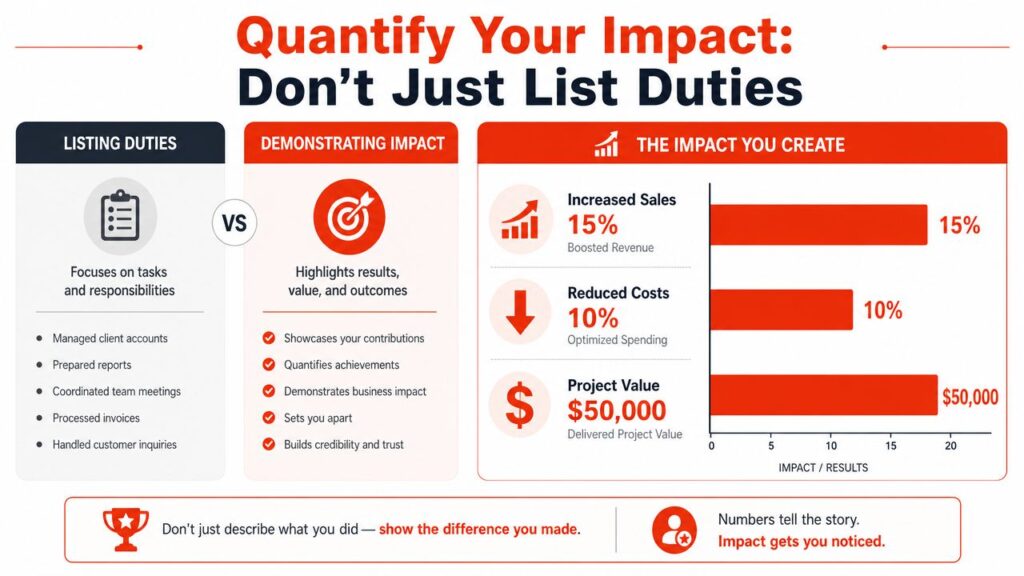
One of the biggest resumes writing mistakes is describing responsibilities without demonstrating results. Recruiters already know the typical duties associated with most job titles. What they want to understand is how effectively you performed those responsibilities and what impact you created.
Candidates describe motion, not outcome. Junior recruiters also miss this during screening and pass weak resumes because the job title looks relevant.
A weak resume says:
- Responsible for monthly reporting
- Handled vendor coordination
- Worked on dashboard development
A better resume says:
- Prepared monthly reporting packs for leadership reviews, improving reporting accuracy and reducing last-minute rework
- Coordinated with vendors across dispatch and planning teams, cutting follow-up delays and improving closure time
- Built dashboards for sales and operations reviews, reducing manual tracking and helping faster decision-making
The second version still sounds credible even without dramatic percentages. That matters in the Indian market, where many candidates do genuine operational work but do not have formal ownership of revenue, budgets, or team KPIs.
How to Quantify Resume Achievements
Quantifying achievements is one of the most effective ways to strengthen a resume. Numbers help recruiters understand the scale of your work and make your accomplishments easier to evaluate.
Metrics can include revenue growth, cost savings, productivity improvements, project timelines, customer volume, team size, audit performance, production output, or operational efficiency. The goal is to provide evidence rather than simply list activities.
Even if exact numbers are confidential, you can still show business weight. Mention scope such as:
- team size
- plant capacity or number of lines
- region or market coverage
- ticket volume
- reporting frequency
- vendor base
- SKU count
- audit volume
- customer segment
- dataset size
How to Write Strong Resume Bullet Points
KDnuggets recommends a simple structure for technical resumes: action, work done, and result, as explained in its piece on resume mistakes in data science. The format works well beyond data roles because it forces candidates to answer three hiring questions quickly. What did you do. Where was the complexity. What improved.
Use that logic, then adapt it by function.
Better bullet examples by sector
- GCC operations
“Prepared monthly variance reports” becomes “Prepared monthly variance reports for business reviews across shared services stakeholders, improving review readiness and helping faster closure of open action items.”
- Manufacturing
“Handled machine maintenance” becomes “Planned preventive maintenance for critical machines on the production floor, reducing unplanned stoppages and improving schedule adherence.”
- Tech
“Worked on API integration” becomes “Built and integrated APIs for internal applications, improving data reliability and reducing manual reconciliation for operations teams.”
- BFSI
“Managed customer onboarding” becomes “Managed onboarding workflows for new accounts, improving documentation quality and reducing processing delays during compliance checks.”
Numbers help only if you can defend them in an interview.
I tell candidates this often. If you write “improved efficiency by 40%” and cannot explain the baseline, the team will doubt the whole resume. A smaller, believable number beats an inflated one every time.
What candidates in India often miss
Freshers have more material than they think. Final-year projects, internships, apprentice work, capstones, hackathons, and live assignments can all be quantified through scale, timeline, accuracy, output, or adoption.
Support roles also create measurable outcomes. Recruiters can mention closure ratios, time-to-schedule, offer drop-off reduction, or hiring volume handled. HR operations teams can show query resolution time and audit accuracy. Executive assistants can show calendar load, stakeholder coordination volume, and review cadence. Quality teams can show NCR closure, audit readiness, and defect reduction. These are business outcomes, not “just support work.”
A resume with clear impact also makes your profile more believable outside the document. It improves interview consistency and helps recruiters verify whether your public profile matches your claims. That is why candidates should build a professional online presence hiring managers can verify quickly.
If your resume only says what you were assigned, it leaves the recruiter with a basic question. Why this candidate over the next fifty with the same title?
ATS Resume Mistakes to Avoid
The newest resume mistake is thinking ATS optimisation is the whole game.
LinkedIn’s 2025 Work Change report says job applications via AI assistants tripled, and 82% of leaders globally plan to invest in AI-driven hiring, according to TechTarget’s summary of common resume mistakes. The implication is straightforward. Candidates are using AI to write resumes at the same time employers are using AI and automation to screen them.
Resume Mistake #7: Keyword Stuffing for ATS
A resume has two audiences. First, software checks whether the document is parseable and relevant. Then a human decides whether the candidate feels credible.
That’s where many applicants fail. They copy skills from the JD, repeat keywords unnaturally, and end up with a document that reads like a search index. ATS may recognise the terms, but the recruiter sees a hollow profile.
Use keywords where they belong:
- In the summary: Mention role type, domain, and core tools.
- In skills: List genuine platforms, methods, and systems.
- In experience bullets: Show where and how you used them.
Avoid this:
- “SAP, SAP MM, SAP procurement, procurement operations, procurement analysis”
Prefer this:
- “Supported procurement operations using SAP MM, vendor coordination, and purchase documentation controls”
If you want to understand how systems read resumes structurally, this explanation of resume parsing is useful for both candidates and junior recruiters.
Resume Mistake #8: Overusing AI Tools
Use AI for first drafts, proofreading, phrasing alternatives, and JD comparison. Don’t let it invent achievements, over-polish your language, or erase the specifics that make your profile believable in India.
A recruiter in a GCC or industrial company can usually spot machine-written copy quickly. It sounds polished but oddly empty. The claims are broad. The verbs are repetitive. The content lacks local and operational reality. There’s no sense of team context, plant environment, reporting setup, stakeholder geography, shift model, domain exposure, or business problem.
This short video covers some of those ATS and AI balancing issues well:
A useful test: Delete your name from the resume and ask yourself whether the document still sounds recognisably like your work. If it could belong to anyone, AI has done too much.
One practical option for candidates who want a cleaner, ATS-compatible structure is using tools or templates designed for parsing. Taggd, for example, offers ATS-compatible curriculum vitae templates that can help candidates avoid layout issues while keeping content readable.
The balance is simple. Let AI help with mechanics. Keep judgement, proof, and specificity human.
Common Indian resume dilemmas:
For candidates, the goal is simple: make it easy to say yes to the next step. For recruiters, the lesson is just as important: some resumes are weak because the candidate lacks fit, but many are weak because the candidate has never been taught how hiring works.
| Dilemma | Recommendation | Reasoning |
| Resume length | One page for early career, two if the second page adds strong relevance | Recruiters prefer concise evidence, not compressed clutter |
| Photograph | Skip unless specifically requested | Most roles evaluate skills and fit, not appearance |
| Personal details | Include only essentials like name, phone, email, city, LinkedIn | Extra personal data weakens professional focus |
| Career gaps | Mention briefly and honestly | A clear explanation builds more trust than omission |
FAQs
What are the most common resume mistakes?
Common resume mistakes include spelling errors, poor formatting, generic content, missing achievements, keyword stuffing, and failing to tailor the resume to the job description.
How can I make my resume ATS-friendly?
Use a clean format, standard section headings, relevant keywords from the job description, and avoid graphics or complex layouts that ATS software may struggle to read.
Should I customize my resume for every job?
Yes. Tailoring your resume helps demonstrate relevance and improves your chances of matching the employer’s requirements and ATS filters.
How do I show achievements on a resume?
Focus on measurable outcomes such as revenue growth, cost savings, efficiency improvements, project delivery, quality improvements, or operational impact rather than listing responsibilities alone.
Can AI help me write a resume?
AI can help with drafting, proofreading, and formatting. However, candidates should ensure the content reflects their actual experience, achievements, and working style.
What is the biggest resume mistake candidates make?
One of the biggest resume mistakes is using a generic resume that fails to clearly show how the candidate fits the specific role they are applying for.
Every hiring decision starts with a resume. At Taggd, we help organisations identify the right talent through data-driven recruitment, talent fulfilment, and hiring solutions across industries. We also provide practical career resources and hiring insights to help candidates create stronger resumes, improve their visibility, and approach the job search process with greater confidence.