You’ve probably opened five tabs, copied three resume summary examples, and still ended up with a line like “hardworking professional seeking a challenging role”. That’s exactly where most candidates lose recruiter attention.
In enterprise hiring and GCC recruitment, the top of the resume does heavy lifting. Recruiters don’t read your summary as a formality. They use it to decide whether your profile deserves another scan. A sharp summary can quickly establish role fit, domain relevance, and evidence of delivery. A weak one sounds interchangeable with a hundred others.
For candidates in India, that matters even more. Large hiring teams often review high volumes of applications across tech, manufacturing, BFSI, shared services, and operations roles. If your summary doesn’t signal relevance fast, the rest of the resume may not get a fair look.
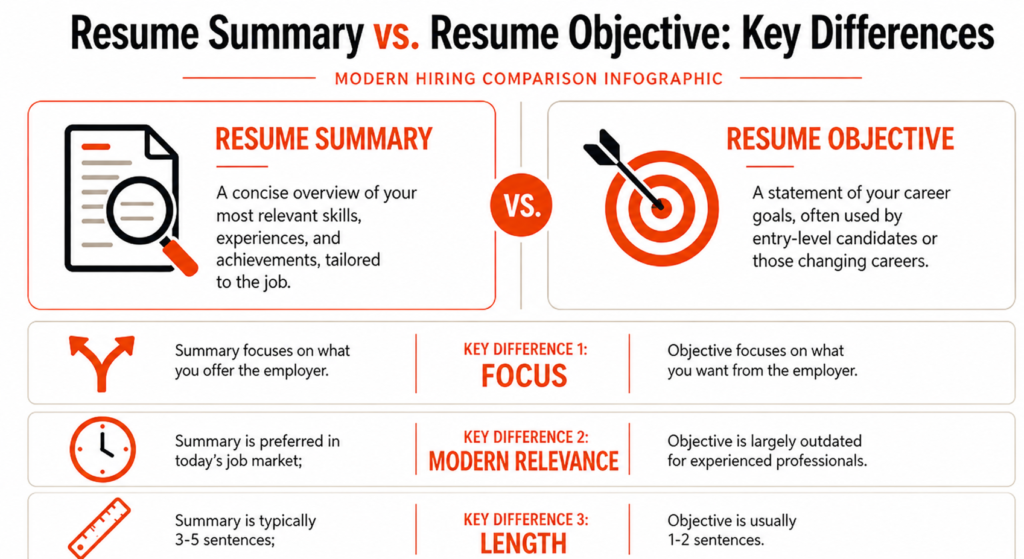
What Is a Resume Summary vs a Resume Objective
A resume summary is a short introduction at the top of your resume that tells an employer what you already bring. It should quickly communicate your professional identity, relevant experience, core strengths, and proof of impact. Hiring teams use it as a rapid filter.
For example- “Data-driven marketer with 4 years of experience specializing in SEO and content strategy. Proven track record of increasing organic website traffic by 35% and improving conversion rates across B2B campaigns.”
A resume summary is most effective when it stays 2 to 3 sentences and is built around your role title, years of experience, core skills, and one quantified achievement. That matches what recruiters look for in practice. A summary isn’t your life story. It’s your opening case.
What a resume summary does well
A good summary helps a recruiter answer three questions quickly:
| Recruiter question | What your summary should answer |
|---|---|
| Who are you professionally? | Your role or functional identity |
| Why are you relevant? | Your sector, skills, or problem area |
| What proves it? | One achievement, business outcome, or scale marker |
That’s why a summary is stronger than a generic introduction on a curriculum vitae. It creates direction before the recruiter moves into employment history, projects, and qualifications.
Practical rule: If your summary could fit ten different jobs without any edits, it’s too vague.
Where a resume objective is different
A resume objective focuses on what you want. It usually talks about career goals, learning intent, or the type of opportunity you’re seeking. That can still work in some cases, especially for early-career candidates, fresh graduates, or career changers who need to frame a transition.
The issue is relevance. For experienced professionals, objectives often sound self-focused:
- “Seeking a challenging role”
- “Looking for growth opportunities”
- “Want to build a long-term career”
None of those statements tell the recruiter what business problem you can solve.
Which one should you use
For most experienced candidates, use a resume summary. It aligns with how modern recruitment works, especially in high-volume enterprise environments. Recruiters want evidence, not aspiration.
Use an objective only when your profile needs context:
- You’re a fresher with internships, projects, or campus leadership but no formal work experience
- You’re changing careers and need to connect transferable skills to a new role
- You’re returning to work after a gap and need to frame your positioning carefully
Even then, many candidates are better served by writing a summary with a forward-looking angle rather than a pure objective.
A simple test helps. If you have anything concrete to show, use a summary. If you mainly need to explain direction, an objective can help, but keep it tightly tied to employer value.
The Formula for Writing a Job-Winning Resume Summary
Most candidates overcomplicate the opening line. They try to sound polished before they sound relevant. A better approach is to build your summary in three parts: identity, expertise, and impact.
A strong resume summary is typically 2 to 3 sentences long, specific to the role, and should highlight experience, impact, and skills near the top of the resume. If you have less than 10 years of experience, your resume should usually stay to one page. That should influence how tightly you write the summary. Every word needs to earn its place.
Start with the visual model below.

Part one: Professional identity
Open with who you are in market terms, not with adjectives like “dynamic” or “motivated”.
Good openings sound like this:
- Software engineer with experience in enterprise applications
- Financial analyst supporting budgeting and business planning
- Talent acquisition specialist hiring for manufacturing and shared services
Poor openings usually sound like this:
- Hardworking professional
- Results-oriented individual
- Dedicated team player
The recruiter needs a clear category first.
Part two: Core expertise
The second part tells the reader where you operate and what you’re trusted to do. Here, role fit becomes obvious.
Use a line that includes:
- Function such as hiring, planning, analysis, production, quality, sales, operations
- Domain such as automotive, BFSI, GCC, IT services, semiconductors, pharma
- Tools or skills if they matter to the job
A simple writing prompt helps:
- “Experienced in…”
- “Specialising in…”
- “Skilled in…”
If you’re struggling to frame this section, reviewing role expectations can sharpen the language. Taggd’s guide to roles and responsibilities in a resume is useful for translating tasks into employer-relevant wording.
Part three: Quantified impact
Weak summaries usually fail when they stop at duties. Strong summaries add evidence.
Your closing line should point to business value:
- delivery against SLAs
- scale of hiring
- cost control
- efficiency improvement
- customer outcome
- process improvement
- revenue or retention contribution
Don’t write “responsible for recruitment”. Write the result of that responsibility.
A reusable formula
Use this structure:
[Role title] with [years or level of experience] in [function/domain]. Skilled in [core skills or tools] across [industry/business context]. Delivered [specific result, scale marker, or quantified outcome].
Example:
“Recruitment specialist with experience hiring for engineering and operations roles across manufacturing and industrial businesses. Skilled in stakeholder management, sourcing strategy, and interview coordination. Delivered hiring support across high-volume and niche requirements while maintaining strong candidate communication.“
That summary is clear, but it becomes stronger when the last sentence includes a concrete business outcome from your own work.
Resume Summary Examples for Internship Roles
Internship resume summaries should focus on skills, academic projects, certifications, tools, and career interests instead of full-time work experience. Recruiters hiring interns usually look for learning ability, communication skills, technical knowledge, and project exposure.
A strong internship resume summary helps students and freshers show potential even if they have limited professional experience. The best internship resume summaries are specific, role-focused, and aligned with the industry or job profile.
Software Engineering Intern
“Computer science student with hands-on experience in Python, Java, and web development projects. Familiar with APIs, debugging, and database management through academic and internship projects. Looking to contribute to real-world software development environments.”
Digital Marketing Intern
“Marketing student with knowledge of SEO, content writing, and social media campaigns. Experienced in using Canva, Google Analytics, and keyword research tools through academic and freelance projects.”
HR Intern
“HR enthusiast with strong communication and coordination skills. Familiar with recruitment processes, employee engagement activities, and HR operations through internship exposure and management coursework.”
Data Analyst Intern
“Data analytics student skilled in Excel, SQL, and Power BI dashboards. Completed academic projects focused on business reporting, data visualisation, and performance analysis.”
Finance Intern
“Commerce graduate with knowledge of financial reporting, budgeting, and Excel-based analysis. Skilled in data interpretation and financial documentation through academic projects and internships.”
Role-based Resume Summary Examples
Industry-specific resume summaries perform better because they match the language recruiters search for in different job roles and sectors. The strongest resume summaries highlight measurable achievements, relevant skills, business impact, and industry-specific expertise instead of only listing responsibilities.
Software Engineer Resume Summary Example
“Software engineer with experience in Python, Java, AWS, and API development for enterprise applications. Improved system performance by 40% through code optimisation, debugging, and scalable backend development.”
Digital Marketing Specialist Resume Summary Example
“Digital marketing specialist with experience in SEO, content marketing, and paid advertising campaigns. Increased organic website traffic by 35% and improved lead conversions through data-driven campaign strategies.”
Project Manager Resume Summary Example
“Project manager with 6+ years of experience leading cross-functional technology and operations projects. Delivered multiple projects on time through stakeholder management, execution planning, and risk coordination.”
Sales Representative Resume Summary Example
“Sales representative with experience in B2B sales, client relationship management, and business development. Consistently achieved sales targets and expanded customer accounts through consultative selling strategies.”
Data Analyst Resume Summary Example
“Data analyst skilled in SQL, Excel, Power BI, and dashboard reporting. Improved business reporting accuracy and supported faster decision-making through data visualisation and performance analysis.”
HR Recruiter Resume Summary Example
“HR recruiter with experience in talent sourcing, stakeholder management, and end-to-end recruitment across multiple industries. Improved hiring efficiency and reduced recruitment turnaround time.”
Financial Analyst Resume Summary Example
“Financial analyst with experience in budgeting, forecasting, financial reporting, and variance analysis. Supported leadership teams with data-backed financial insights and reporting improvements.”
Production Manager Resume Summary Example
“Production manager with experience managing manufacturing operations, shopfloor coordination, and process monitoring. Improved production consistency through quality-focused execution and operational planning.”
Customer Support Executive Resume Summary Example
“Customer support executive with experience handling customer queries, issue resolution, and service operations across voice and email support channels. Maintained strong customer satisfaction through responsive support.”
Business Analyst Resume Summary Example
“Business analyst skilled in requirement gathering, stakeholder communication, process improvement, and business reporting. Supported operational efficiency through workflow analysis and data-driven recommendations.”
Content Writer Resume Summary Example
“SEO content writer with experience creating blogs, website content, and marketing copy for B2B and digital platforms. Improved organic engagement through keyword-focused and audience-centric content strategies.”
Graphic Designer Resume Summary Example
“Graphic designer with experience in branding, social media creatives, and digital design projects. Skilled in Adobe Creative Suite, visual storytelling, and brand-aligned creative execution.”
Operations Executive Resume Summary Example
“Operations executive with experience in workflow coordination, reporting, and process management. Improved operational efficiency through better tracking, communication, and execution support.”
Mechanical Engineer Resume Summary Example
“Mechanical engineer with experience in equipment maintenance, production systems, and process optimisation. Improved operational efficiency through preventive maintenance and quality-focused engineering support.”
Civil Engineer Resume Summary Example
“Civil engineer with experience in site supervision, construction planning, and vendor coordination. Delivered projects while maintaining safety standards and quality compliance.”
Accountant Resume Summary Example
“Accountant with experience in GST compliance, bookkeeping, reconciliation, and financial reporting. Skilled in maintaining accurate records and supporting audit and compliance processes.”
UI/UX Designer Resume Summary Example
“UI/UX designer with experience creating user-friendly web and mobile interfaces. Skilled in wireframing, prototyping, and improving user experience through intuitive design solutions.”
Healthcare Professional Resume Summary Example
“Healthcare professional with experience in patient care, healthcare coordination, and clinical documentation. Focused on delivering quality healthcare services while maintaining operational standards.”
Supply Chain Executive Resume Summary Example
“Supply chain executive with experience in inventory management, logistics coordination, and vendor communication. Improved operational planning and tracking efficiency across supply chain activities.”
DevOps Engineer Resume Summary Example
“DevOps engineer skilled in CI/CD pipelines, deployment automation, and cloud infrastructure management. Improved deployment reliability and reduced downtime through infrastructure optimisation and monitoring.”
Resume Summary Examples for Every Career Stage
Resume summaries should reflect where you are in your career, not force every candidate into the same template. A fresher’s summary will look very different from that of an experienced professional, a career switcher, or someone returning after a break.
That is why generic advice often falls short. Many resume summary examples assume a linear career path with steady progression in one field. In reality, today’s workforce includes fresh graduates, professionals changing industries, candidates with project-based experience, and individuals restarting their careers after a gap.
The best resume summary examples are the ones tailored to different career stages and career journeys. In the Indian job market especially, non-linear careers are increasingly common, making personalized resume summaries more important than ever.
Resume Summary Examples for Freshers
Freshers often think they have nothing to say. That’s not true. You may not have full-time experience, but you still have evidence: internships, capstone projects, certifications, academic work, student leadership, freelance assignments, apprenticeships.
Use this structure:
- your education or target role
- your strongest relevant skills
- one proof point from internship, project, or achievement
Examples:
- “BCom graduate with internship exposure to accounts support, reconciliation tasks, and documentation. Skilled in Excel, basic reporting, and structured data handling. Built a strong foundation in finance operations through coursework and practical assignments.“
- “Mechanical engineering graduate with project experience in production planning and process documentation. Skilled in AutoCAD, technical problem-solving, and team-based project execution. Keen to contribute to manufacturing or operations roles with a disciplined, hands-on approach.“
- “Computer science graduate with internship exposure to web development and testing support. Skilled in Python, SQL, and front-end fundamentals, with academic projects focused on building usable applications. Strong fit for entry-level software or analyst roles requiring structured problem-solving.“
If you’re applying for your first role, your summary should connect your education to employer value, not apologise for limited experience. Taggd’s guide to a cover letter for fresher can help you align that message across both documents.
Resume Summary for Career Change
Career changes fail at the summary stage when candidates focus only on the target role and ignore what they already bring.
A better summary does two things:
- names the new direction clearly
- translates existing experience into transferable relevance
Examples:
- “Operations professional transitioning into supply chain planning, with experience in coordination, vendor follow-up, and process tracking. Skilled in Excel, reporting discipline, and cross-team communication. Brings a strong execution mindset and experience managing moving parts in deadline-driven environments.“
- “Customer support specialist transitioning into HR operations, with experience in stakeholder communication, issue resolution, and process documentation. Skilled in handling high-volume interactions and maintaining service consistency. Positioned to support people operations roles that require empathy, structure, and follow-through.“
- “Sales coordinator moving into business analysis, with experience working with reports, pipeline tracking, and cross-functional updates. Skilled in Excel, data interpretation, and commercial communication. Brings practical business context to analysis-oriented roles.“
One-Line Resume Summary Examples
One-line summaries are useful for networking profiles, compact resumes, referrals, and top-line introductions. They work only when they’re precise.
Examples:
- “Recruitment specialist hiring across tech and shared services roles with strong stakeholder and sourcing capability.“
- “Production engineer with experience in shopfloor coordination, quality focus, and process discipline.“
- “Financial analyst supporting reporting, planning, and performance reviews in structured business environments.“
- “Fresher in computer science with internship exposure to testing, SQL, and application support.“
- “Project coordinator experienced in tracking timelines, dependencies, and cross-functional updates.”
The best one-line summaries are specific enough to place you in a hiring bucket instantly.
Professional Summary Examples for Key Industries
Generic resume summary examples rarely help because they don’t show the difference between acceptable and persuasive. The real shift happens when you move from duties to marketable proof.
Using specific numbers in summaries such as
- “increased sales by 30% in 1 year”
- “40% increase in online engagement over 2 years”, and
- “95% customer satisfaction” create credibility.
Technology
India’s technology hiring market is crowded with similar-looking profiles. Stack names alone won’t separate you.
For example- “Software developer with experience building and maintaining enterprise applications using Java and API-based integrations. Skilled in debugging, code optimisation, and cross-functional collaboration across product and QA teams. Improved application performance and contributed to smoother release cycles in high-dependency environments.”
Why the second works:
- It identifies the environment
- It names useful technical strengths
- It hints at business impact instead of stopping at tools
Taggd’s technology and IT recruitment solutions helps recruiters hire for digital and engineering roles.
Data and analytics
For example- “Data analyst with experience translating business data into actionable dashboards and reporting insights for operational teams. Skilled in SQL, Excel, data visualisation, and stakeholder-facing analysis. Identified reporting gaps and helped teams make faster decisions through cleaner, more usable performance data.”
Why it works:
- It shows business use, not just tools
- It signals communication ability
- It positions the candidate as decision support, not only report generation
Manufacturing
Manufacturing recruiters look for delivery, process control, safety awareness, and consistency. Vague summaries don’t land well here.
For example- “Production manager with experience leading shopfloor operations, output planning, and team coordination in manufacturing environments. Skilled in process discipline, cross-shift supervision, and quality-focused execution. Improved operational consistency through tighter production monitoring and stronger coordination with maintenance and quality teams.”
Why it works:
- It reflects actual manufacturing language
- It connects operations to outcomes
- It sounds practical, not inflated
BFSI
For example- “Financial analyst with experience supporting budgeting, financial reporting, and business performance reviews in structured finance environments. Skilled in variance analysis, forecasting support, and data-backed decision inputs for leadership teams. Known for improving reporting clarity and helping stakeholders track performance against plan.”
Why it works:
- It uses BFSI-friendly terminology
- It shows stakeholder value
- It sounds credible to finance hiring managers
GCC and project roles
Global Capability Centres often want candidates who can work across time zones, functions, and systems without needing heavy hand-holding.
For example- “Project manager with experience driving cross-functional execution across shared services and global stakeholder environments. Skilled in planning, dependency tracking, stakeholder communication, and risk coordination. Delivered structured execution across multiple workstreams while keeping teams aligned on timelines and handoffs.”
In GCC hiring, summaries work best when they signal coordination, process maturity, and comfort with matrixed teams.
Critical Resume Summary Mistakes You Must Avoid
Most bad summaries aren’t bad because the candidate lacks substance. They’re bad because the writing hides the substance.
The fastest fix is to remove what recruiters ignore and keep what they can use.

Mistake one: using clichés
Don’t: Results-oriented team player with excellent communication skills.
Do: Recruitment coordinator with experience managing interview scheduling, candidate communication, and hiring team follow-ups across high-volume roles.
Why it matters: clichés sound polished but say nothing.
Mistake two: writing a summary that could belong to anyone
Don’t: Experienced professional with diverse background and strong ability to work under pressure.
Do: Operations executive with experience in dispatch coordination, vendor follow-up, and daily reporting in fast-moving supply environments.
Specificity is what makes a recruiter stop.
Mistake three: turning it into a task list
Don’t: Responsible for sourcing, screening, coordinating interviews, and maintaining records.
Do: Talent acquisition specialist with experience supporting end-to-end hiring across business and operations roles, with strong control on candidate flow and hiring-team coordination.
Mistake four: making it too long
If the summary becomes a dense paragraph, recruiters skip it.
A summary should feel like a sharp introduction, not a compressed autobiography.
Mistake five: ignoring the target role
Don’t send the same summary to a GCC finance role and a domestic manufacturing role. Even when your experience is broad, your opening should reflect the job you want next.
Mistake six: weak proofreading
Spelling issues, tense shifts, and cluttered wording create doubt. In hiring, small errors can suggest low attention to detail.
A quick self-check:
- Role named clearly
- Domain made visible
- No clichés
- No copied objective language
- No unnecessary filler
- Clean grammar and punctuation
Advanced Tips for an ATS-Friendly Resume Summary
ATS optimisation is often misunderstood. The goal isn’t to trick software. It’s to make your relevance machine-readable and human-readable at the same time.

Use job-description language naturally
Read the role and identify repeated terms:
- job title
- tools
- domain words
- must-have skills
- process terms
Then use those exact or closely aligned words in your summary if they truthfully reflect your experience.
Bad example: “Experienced professional with broad exposure.”
Better example: “Business analyst with experience in reporting, stakeholder communication, and process documentation.”
Match standard terminology
ATS tools don’t interpret creativity well. If the market says “HR operations”, don’t write “people excellence wizard”. If the role asks for “supply chain planning”, don’t rename it as “end-to-end logistics orchestration” unless that wording is also standard in the target company.
For teams trying to understand how systems process resume data, Taggd’s glossary entry on resume parsing is a useful reference.
Don’t stuff keywords
Repeating the same term over and over makes the summary sound robotic and weakens recruiter trust.
Use keyword optimisation like this:
- mention the role
- add the function
- include one or two tools or business terms
- close with evidence of impact
That’s enough.
Keep formatting simple
The summary should be plain text. Avoid icons, tables inside the summary block, text boxes, or design-heavy layouts that can affect parsing. You can use strong section headings in the resume overall, but the summary itself should stay clean.
Treat ATS and recruiter review as one process
Candidates sometimes optimise for software and forget the person reading the file next. The best summary satisfies both:
- clear title
- relevant keywords
- readable sentence flow
- actual substance
If you’re revising resumes at scale, tools such as internal ATS platforms, parsing workflows, or recruitment partners like Taggd can help standardise screening, but the candidate-side rule stays the same. Use accurate keywords and write for comprehension.
FAQs
What is the best resume summary example?
The best resume summary should be 2 to 4 sentence short highlighting your experience, core skills, and measurable achievements. For example- “Data-driven marketer with 4 years of experience specializing in SEO and content strategy. Proven track record of increasing organic website traffic by 35% and improving conversion rates across B2B campaigns.”
What is a good resume summary example for experienced professionals?
The best resume summary for experienced professionals emphasize years of experience, key achievements, leadership skills, industry expertise, and measurable results. For example- “Project manager with 7+ years of experience leading cross-functional technology projects across enterprise environments. Skilled in stakeholder management, delivery planning, and risk coordination. Successfully delivered multiple projects within budget and timeline expectations.”
What is a strong resume summary example for freshers?
The best resume summary for freshers focus on academic achievements, internships, certifications, technical skills, and career goals. For example- “Computer science graduate with internship experience in Python, SQL, and web application testing. Completed academic projects focused on database management and front-end development. Looking to contribute strong analytical and problem-solving skills in an entry-level software role.”
What is a good resume summary example for career change candidates?
A good resume summary for career change candidates highlights transferable skills, relevant certifications, project work, and career goals aligned with the new industry. For example- “Customer support professional transitioning into HR operations, with experience in stakeholder communication, issue resolution, and process coordination. Skilled in handling high-volume interactions and maintaining service quality across fast-paced environments.”
What is an ATS-friendly resume summary example?
“Business analyst with experience in reporting, stakeholder communication, process documentation, and workflow optimisation. Skilled in Excel, SQL, and data analysis across operations and business support functions.”
What is a good one-line resume summary example?
“HR recruiter with experience hiring across technology and operations roles through stakeholder coordination and sourcing strategy support.”
What is a resume summary example for internship roles?
“Marketing student with knowledge of SEO, content writing, and social media campaign management. Experienced in Canva, Google Analytics, and keyword research through internship and academic projects.”
What is a resume summary example for freshers with no experience?
To write a strong resume summary with no experience or career gaps, focus on skills, certifications, freelance work, internships, academic projects, volunteer experience, and career goals. For example- “BCom graduate with strong knowledge of Excel, financial reporting, and business communication. Completed academic projects in accounting and data analysis, with a strong interest in finance operations roles.”
If your hiring team is trying to improve resume quality, candidate fit, and screening consistency across large-scale or specialised roles, Taggd supports enterprises and GCCs in India with talent fulfilment, hiring strategy, and recruitment operations designed around real business needs.