A lot of HR leaders in India are dealing with the same uncomfortable pattern. A business scales quickly, adopts more digital tools, adds third-party vendors, expands payment flows, and enters tighter regulatory scrutiny. Then a cyber incident, customer complaint spike, vendor failure, or audit observation exposes the same truth. Risk wasn’t being managed as an operating discipline. It was sitting in scattered policies, spreadsheets, and fragmented ownership.
That’s where a good risk management consultant earns their place. This role isn’t just about documenting threats. It’s about helping the business identify where failure is most likely, what the impact looks like, who owns each control, and how leadership can act before small breakdowns become reportable events, customer harm, or financial loss.
For CHROs, recruiters, and hiring managers, the challenge is that “risk management consultant” can mean very different things across industries. Some candidates are policy-heavy and operationally weak. Others are strong in cyber or regulatory issues but can’t influence business leaders. The hiring decision gets expensive when the role is defined too broadly. The better approach is to treat this as a strategic advisory hire with clear outcomes, not a generic compliance position.
Who Is a Risk Management Consultant
A risk management consultant helps an organisation identify threats, assess exposure, design controls, and build practical response plans. In India, that now spans far more than insurance or checklist-style compliance. It increasingly covers cyber risk, vendor risk, operational breakdowns, conduct issues, data governance, internal controls, and regulatory readiness.
A useful way to think about the role is this. A risk management consultant sits between business ambition and business fragility. Leadership wants faster growth, digitisation, automation, outsourcing, and tighter margins. The consultant’s job is to make that growth safer and more controllable without paralysing execution.
What the role looks like in practice
In a modern Indian enterprise, this person might review how customer data is handled, test whether a key vendor creates concentration risk, map complaint trends to control failures, or redesign escalation rules for incidents. They don’t just ask, “What could go wrong?” They ask, “Where will this fail first, how will we know, and who acts when it does?”
That’s why the business case has hardened. IBM’s 2024 Cost of a Data Breach report put the average breach cost in India at USD 2.35 million, while CERT-In’s 2024 annual report recorded 1.59 million cybersecurity incidents in 2024, making risk a core digital and operational issue rather than a side concern as noted in this industry discussion on risk management consultants.
If you’re hiring for people risk, conduct risk, or workforce governance, it also helps to align the role with a broader understanding of risk management in HR.
Practical rule: If a candidate defines risk management mainly as policy writing, you’re probably looking at an incomplete profile.
Why the role matters more now
The role has become more strategic because Indian organisations are operating with denser interdependencies. A failed API, weak access review, poor complaints handling process, or under-governed vendor can create legal, financial, customer, and reputational consequences at the same time.
That changes how CHROs should evaluate talent. The strongest consultant is rarely the one with the most polished framework slides. It’s the one who can move from risk identification to control ownership, governance cadence, and measurable remediation.
Core Roles and Responsibilities
A risk management consultant’s work should be judged by whether they convert abstract risks into operating controls. The role gets vague when companies ask for “someone to handle risk”. It gets effective when the business defines the risk domains, decision rights, and expected outputs.
The clearest benchmark is control quality. RBI’s Integrated Ombudsman Scheme reported 2.96 million complaints in 2023-24, showing how quickly weak process controls surface as service, conduct, and compliance failures at scale. In practical terms, a consultant creates a risk-and-control matrix tied to operational KPIs, incident categories, review frequency, and accountable owners so management can evidence remediation before losses compound.
The five responsibility areas that matter most
- Risk identification
They map the organisation’s exposure across operations, technology, vendors, people, finance, compliance, and strategic initiatives. This includes risk registers, process walk-throughs, incident reviews, and stakeholder interviews. - Risk assessment
They evaluate likelihood, business impact, control gaps, and interdependencies. A mature consultant doesn’t stop at heat maps. They prioritise based on what can actually interrupt revenue, trigger regulatory action, or impair customer trust. - Control design and improvement In this domain, average consultants and strong ones separate. Strong consultants define preventive and detective controls, assign owners, set test frequency, and document what evidence proves the control is working.
- Monitoring and reporting
They design dashboards, escalation thresholds, issue logs, and governance packs for management committees. Good reporting is concise, decision-oriented, and linked to action dates. - Incident response and remediation support
When a control fails, they coordinate containment, root-cause review, and corrective action tracking. The point isn’t to produce a post-mortem deck. It’s to ensure the same issue doesn’t recur under a different label.
Common day-to-day tasks
Some days are highly analytical. Others are stakeholder-heavy. Typical responsibilities include:
- Building risk registers for new business lines, products, systems, or locations
- Running control testing to verify whether key controls operate as designed
- Reviewing third-party dependencies and challenge points in vendor onboarding
- Supporting audits and regulatory reviews with evidence packs and remediation logs
- Training managers so control ownership doesn’t sit only in the risk team
- Drafting policies and playbooks where missing guidance creates repeatable failure
The role should reduce uncertainty for leadership, not create more paperwork for the business.
What doesn’t work
Three things usually fail.
- Policy-only consulting that produces documents with no owner, evidence standard, or review cycle
- Theoretical risk scoring that doesn’t connect to business processes, customer harm, or operating metrics
- Detached advisory models where consultants diagnose issues but never help embed controls in line teams
If you’re writing a job description, build it around execution. Ask for someone who can identify, assess, design, implement, monitor, and report. Not someone who can “support governance”.
Risk Management Consultant Job Description Template
Job Title: Risk Management Consultant / Enterprise Risk Advisor
Department: Risk Advisory / Consulting / Governance
Reports To: Risk Advisory Director / Managing Partner / Head of Risk Consulting
Location: [Location]
Employment Type: Full-time
Job Summary: We are looking for a commercially astute and analytically rigorous Risk Management Consultant to join our [Department] team. In this role, you will advise organizations on enterprise risk management, regulatory compliance, operational resilience, and governance improvement, helping clients build robust risk frameworks that protect performance and support strategic decision-making. You will work across diverse client environments delivering high-quality risk advisory services that create measurable and lasting organizational resilience.
Key Responsibilities
- Conduct enterprise risk assessments across financial, operational, and strategic categories.
- Design and implement ERM frameworks aligned with ISO 31000 and COSO standards.
- Advise on regulatory compliance risk programs and governance framework design.
- Develop business continuity plans and operational resilience programs for clients.
- Build risk reporting infrastructure and board-level risk dashboards.
- Present risk findings and strategic recommendations to senior leadership and boards.
Required Qualifications
- Degree in Finance, Economics, Business Administration, Engineering, or related discipline.
- 5 to 10 years of experience in risk management, risk consulting, or financial risk advisory roles.
- Proficient in ERM framework design and enterprise risk assessment methodologies.
- Strong analytical and financial modelling skills with ability to quantify risk exposures effectively.
- Familiar with applicable regulatory risk frameworks and governance standards across key industry sectors.
Preferred Qualifications
- Experience with GRC platform implementation including MetricStream, Archer, or ServiceNow GRC.
- Knowledge of financial sector regulatory frameworks including Basel III/IV, Solvency II, and DORA.
- FRM, CFA, CRISC, or equivalent risk management professional certification preferred.
- Exposure to emerging risk categories including cyber risk, climate risk, and AI governance frameworks.
- Familiar with business continuity standards including ISO 22301 and operational resilience regulatory requirements.
Key Skills
- Senior Stakeholder Communication and Presentation
- Enterprise Risk Framework Design and Implementation
- Regulatory Compliance and Governance Advisory
- Risk Quantification and Financial Modelling
- Business Continuity and Resilience Planning
Top Industries and Career Path
Risk management consulting has moved into the mainstream because companies now treat resilience, governance, and continuity as board-level concerns. One market study valued the global risk-management consulting services market at USD 21.42 million in 2024 and projected it to reach USD 43 million by 2033, reinforcing that this is an expanding advisory category rather than a niche support function according to this market overview.
Industries hiring in India
Different sectors hire for different kinds of failure risk. That matters because the best candidates are usually shaped by industry context.
| Industry | What they typically need from a risk management consultant |
|---|---|
| BFSI | Conduct risk, complaints handling, regulatory controls, fraud risk, digital process oversight |
| IT and ITeS | Cyber risk, access controls, client assurance, third-party risk, business continuity |
| Manufacturing | Plant operations risk, supply chain dependency, safety governance, vendor controls |
| Healthcare and pharma | Data handling, patient-related process risk, compliance controls, incident readiness |
| Retail and ecommerce | Payment risk, customer grievance processes, fraud, logistics and vendor exposure |
| Shared services and GCCs | Process controls, outsourcing governance, data workflows, internal control design |
Typical career progression
Most candidates don’t start with the title “risk management consultant”. They arrive through adjacent functions such as audit, controls, compliance, cyber governance, process excellence, or finance transformation.
A common path looks like this:
- Analyst or junior consultant
Supports risk assessments, maintains documentation, performs control testing, and prepares reports. - Consultant or senior consultant
Runs workstreams, facilitates workshops, drafts control frameworks, and engages stakeholders directly. - Manager
Owns client or internal programmes, supervises teams, prioritises remediation, and leads governance meetings. - Director or principal
Shapes enterprise-wide risk strategy, advises senior leadership, and manages large portfolios or major accounts. - Partner or Chief Risk Officer track
Focuses on business leadership, regulatory interface, board reporting, and enterprise decision-making.
The strongest mid-career candidates usually combine one deep domain with enough breadth to advise across operations, technology, and governance.
What separates a strong career path from a stalled one
Candidates progress faster when they build three things early. First, process literacy. They need to understand how work flows. Second, control judgment. They need to know which control is cosmetic and which one changes outcomes. Third, stakeholder credibility. They must challenge leaders without sounding academic or adversarial.
People stall when they stay trapped in documentation work. Risk careers accelerate when consultants learn to influence decisions, not just maintain records.
Risk Management Consultant Salary in India 2026
In 2026, Risk Management Consultant salaries in India typically range from INR 5 L – INR 35 L+ per year, with entry‑level consultants earning INR 5 L – INR 10 L, mid‑level at INR 10 L – INR 25 L, and senior or director‑level roles reaching INR 15 L – INR 35 L+. Pay is rising due to stricter regulations, cyber‑risk concerns, ESG compliance, and increasing demand for Enterprise Risk Management (ERM) expertise in banks, consulting firms, and large corporates.
1. By industry
Risk Management Consultants in Big 4 and top management consulting firms typically earn INR 10 L – INR 25 L. Banks and financial institutions pay around INR 9 L – INR 22 L, insurance and reinsurance INR 8 L – INR 20 L, large corporates and MNCs INR 8 L – INR 18 L, and mid‑size or boutique risk firms INR 6 L – INR 15 L.
| Industry sector | Typical salary band (per year) |
|---|---|
| Big 4 / top management consulting firms | INR 10 L – INR 25 L |
| Banks / financial institutions | INR 9 L – INR 22 L |
| Insurance / reinsurance companies | INR 8 L – INR 20 L |
| Large corporates / MNCs | INR 8 L – INR 18 L |
| Mid‑size consulting / boutique risk firms | INR 6 L – INR 15 L |
2. By location
In financial and tech hubs like Mumbai, Bangalore, and Delhi‑NCR, bands are usually INR 9 L – INR 25 L. Hyderabad, Pune, and Chennai commonly range INR 7 L – INR 18 L, other tier‑1 cities INR 6 L – INR 14 L, and tier‑2 locations INR 4 L – INR 10 L for similar risk management consulting roles and experience levels.
| Location / city type | Typical salary band (per year) |
|---|---|
| Mumbai / Bangalore / Delhi‑NCR | INR 9 L – INR 25 L |
| Hyderabad / Pune / Chennai | INR 7 L – INR 18 L |
| Other tier‑1 cities | INR 6 L – INR 14 L |
| Tier‑2 cities | INR 4 L – INR 10 L |
3. By experience level
Fresher risk management consultants (0–2 years) generally earn INR 6 L – INR 10 L. Mid‑level consultants (3–5 years) often land INR 9 L – INR 16 L. Senior consultants (6–9 years) commonly reach INR 14 L – INR 24 L, and lead or manager roles (10+ years) can command INR 20 L – INR 35 L+ in consulting firms and large financial institutions.
| Experience level | Typical salary band (per year) |
|---|---|
| Fresher / 0–2 years (junior consultant) | INR 6 L – INR 10 L |
| Mid‑level / 3–5 years (consultant) | INR 9 L – INR 16 L |
| Senior / 6–9 years (senior consultant) | INR 14 L – INR 24 L |
| Lead / 10+ years (manager / director) | INR 20 L – INR 35 L+ |
For broader compensation planning, it helps to compare this role against adjacent advisory and specialist functions in the India salary forecast for 2026.
A better compensation lens for CHROs
Don’t anchor salary only to title. Anchor it to the damage the person is expected to prevent and the complexity they’re expected to govern. A consultant who can independently assess cyber, vendor, and regulatory exposure across multiple teams should not be benchmarked the same way as a documentation-heavy controls analyst.
How to become a Risk Management Consultant
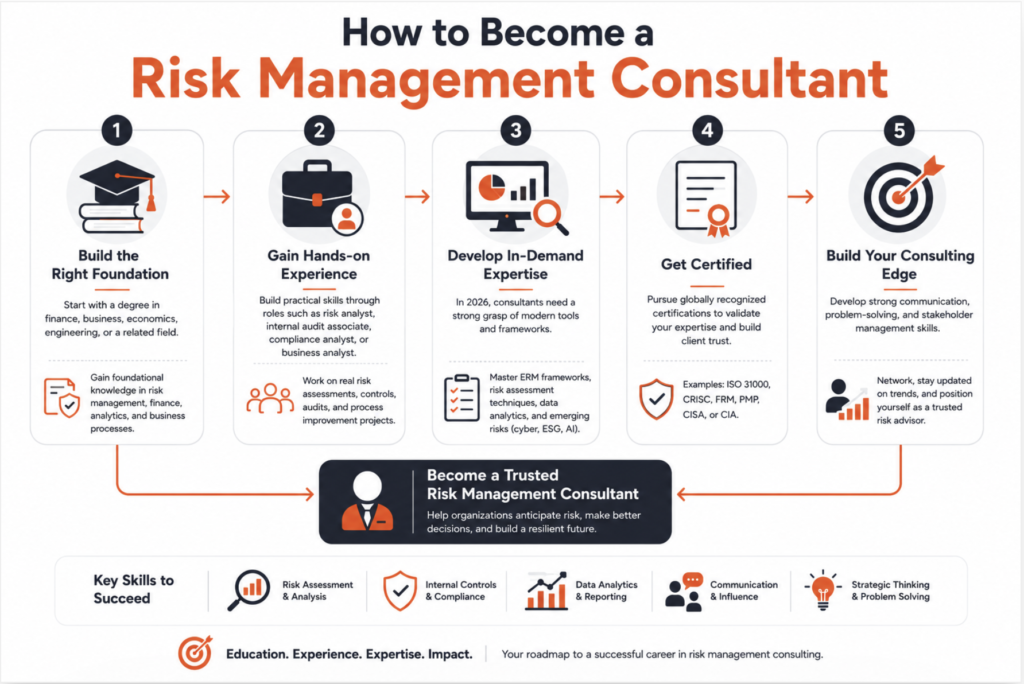
Earn a degree in finance, business, economics, engineering, or a related field. Gain experience in risk analysis, compliance, or auditing roles. Develop expertise in risk assessment frameworks, analytics, and regulations. Pursue certifications and strengthen consulting, communication, and problem-solving skills to advance.
How to Hire a Top Risk Management Consultant
Most companies hire this role too late and define it too vaguely. They start looking after an audit issue, a regulator query, a serious complaint trend, or a cyber scare. Then they publish a broad job advert asking for experience across every risk domain imaginable. That approach attracts either generic applicants or very expensive specialists who don’t fit the actual need.
The smarter route is to hire against a business problem. Start by deciding what kind of failure you need this person to reduce.
Define the mandate before you open the role
In India, the strongest hiring signal is breadth across regulatory, cyber, and third-party risk. The RBI has noted that expanding digital payments volumes raise fraud exposure, while CERT-In requires timely cyber incident reporting. In practice, that means a top consultant should be able to design controls such as privileged-access reviews, vendor due-diligence scoring, control testing cadence, and incident-response playbooks mapped to Indian regulatory timelines as reflected in this consulting risk overview.
Before sourcing begins, answer these questions:
- What risk domain is primary
Enterprise risk, operational risk, cyber risk, vendor risk, conduct risk, or a blended remit - What operating model applies
Advisory consultant, embedded business partner, central governance role, or transformation project hire - What outcomes matter in year one
Better controls, cleaner audits, improved complaint handling, stronger incident response, or more disciplined vendor governance
Assess for execution, not presentation
Interview panels often overvalue polished communication and under-test operating depth. That’s a mistake. Good consultants speak clearly, but they also know how controls fail in real environments.
Use assessments that reveal judgment:
- Ask candidates to build a mini risk register for one of your core processes
- Give them a weak policy and ask what operating controls are missing
- Present a vendor failure scenario and test escalation logic
- Ask how they’d prove a control is working, not just how they’d document it
A consultant earns trust when they can connect a business process, a failure point, a control, an owner, and an escalation route in one conversation.
Expand where you source from
Don’t search only in traditional risk teams. Good hires often come from:
- internal audit with strong business understanding
- cyber governance and information security risk
- operations excellence or process control functions
- consulting firms with advisory exposure
- regulated industry roles with vendor or compliance ownership
For large enterprises that need structured support across sourcing, benchmarking, and process discipline, an AI-led RPO and talent intelligence partner such as Taggd’s compliance hiring solutions can be one route alongside internal TA teams, search firms, and specialist networks.
Watch for the red flags
Be cautious if a candidate:
- speaks in frameworks but struggles with examples
- treats risk as a reporting exercise rather than an operating discipline
- can’t explain control evidence, ownership, or review cadence
- has deep technical knowledge but weak stakeholder influence
- has only supported audits, never improved processes
The best hires don’t just identify risk. They make the business more governable.
Top 10 Interview Questions to Ask
A strong interview process should test three things. Can the candidate think structurally, can they work with imperfect information, and can they persuade business stakeholders to act? If you only test technical vocabulary, you’ll miss whether they can operate inside a real organisation.
Technical questions
- How would you build a risk register for a new business process from scratch?
Look for a clear method. Strong candidates mention process mapping, stakeholder interviews, risk categories, impact assessment, control mapping, and ownership. - What makes a control effective in practice, not just on paper?
A good answer should include design adequacy, operating evidence, frequency, ownership, exception handling, and escalation. - How do you prioritise risks when every function claims its issue is critical?
You want candidates who can discuss impact, likelihood, regulatory consequences, customer harm, dependency chains, and business interruption. - What would you include in a risk-and-control matrix for a customer-facing operation?
Strong candidates should talk about process steps, risks, controls, owners, evidence, trigger thresholds, and review cadence.
Situational questions
- Our company is onboarding several critical vendors quickly. What risks would you examine first?
Look for vendor concentration, data access, service resilience, contractual obligations, audit rights, incident escalation, and due diligence quality. - A major incident has occurred, but business leaders want to keep operations running with minimal disruption. How would you respond?
The best answers balance containment, fact preservation, escalation, communication discipline, and practical continuity. - You discover a recurring issue that management has normalised. What do you do?
Strong candidates won’t jump straight to confrontation. They’ll discuss evidence, trend analysis, business impact, stakeholder alignment, and formal escalation where needed.
Behavioural questions
- Tell us about a time you identified a risk others underestimated. What changed after your intervention? Listen for credibility, evidence-based challenge, and whether the person drove action beyond raising a concern.
- Describe a situation where a business team resisted a control you recommended. How did you handle it?
Good consultants don’t hide behind policy. They negotiate, simplify, explain trade-offs, and reshape controls so they’re workable. - What’s the most difficult remediation programme you’ve managed?
Look for ownership discipline, issue tracking, cross-functional coordination, and the ability to sustain momentum after initial urgency fades.
The best answers are specific, process-aware, and realistic. Be wary of polished replies with no examples of ownership, evidence, or trade-offs.
What interviewers should listen for
A high-quality candidate usually reveals themselves through language. They talk about owners, evidence, thresholds, escalation, control design, root cause, and decision-making. A weak candidate talks mostly about awareness, coordination, and documentation.
That distinction matters. You’re not hiring someone to admire risk from a distance. You’re hiring someone to reduce it.
Read here for the most asked interview questions.
Wrapping Up
The role of a Risk Management Consultant in 2026 has never been more commercially consequential or more strategically valued. As organizations navigate simultaneous exposures across financial, operational, regulatory, climate, cyber, and geopolitical risk categories, the professionals who can build frameworks, quantify exposures, and advise senior leaders with clarity and credibility are becoming indispensable business assets.
Whether you are a risk professional building a consulting career or an organization looking to hire the right risk advisory expertise, understanding the skills, certifications, and market dynamics shaping this space is essential for staying competitive and organizationally resilient in 2026 and beyond.
Ultimately, the organizations that manage risk well do not avoid uncertainty. They understand it better than their competitors. By embracing continuous learning, emerging risk specialization, and modern recruitment solutions like RPO, both risk management consultants and forward-thinking organizations can build the resilience and strategic clarity needed to thrive in an increasingly complex business world.
FAQs
What is a Risk Management Consultant and what do they do?
A Risk Management Consultant identifies, assesses, and develops strategies to manage the financial, operational, strategic, and regulatory risks organizations face, advising leadership on building robust risk frameworks that protect performance and enable confident decision-making under uncertainty.
How is a Risk Management Consultant different from an Internal Risk Manager?
Internal risk managers own the ongoing risk management function within an organization, managing day-to-day risk processes and reporting. Risk management consultants provide independent external expertise, structured methodology, and specialist knowledge for specific transformation programs, regulatory projects, or capability building engagements.
How do I become a Risk Management Consultant in 2026?
Earn a degree in finance, economics, or business administration, gain hands-on risk assessment and financial analysis experience, develop ERM framework and regulatory knowledge, and pursue certifications like FRM, CRISC, or ISO 31000 to build professional credibility and accelerate career progression.
How long does it take to become a Risk Management Consultant?
Typically 5 to 8 years including relevant education and 3 to 5 years of hands-on risk management or financial risk experience. Motivated professionals from financial services, internal audit, or actuarial backgrounds can transition into risk consulting within 12 to 18 months with focused upskilling and certification.
What are the top 5 skills for Risk Management Consultants in 2026?
Enterprise Risk Framework Design, Regulatory Compliance Advisory, Risk Quantification and Financial Modelling, Business Continuity Planning, and Senior Stakeholder Communication. These skills determine hiring success and career progression across all risk management consulting roles in 2026.
What is the career outlook for Risk Management Consultants?
Exceptionally strong. Escalating regulatory complexity, emerging risk categories, and growing board demand for independent risk assurance are driving sustained demand for qualified risk advisors. Skilled professionals are commanding premium salaries and fast-tracking into Risk Advisory Director, Partner, and CRO roles across every major industry.
Which certifications matter most for Risk Management Consultants?
FRM for financial risk roles, CRISC for technology and operational risk, ISO 31000 for ERM framework work, and CFA for investment risk advisory are the most valued certifications across risk management consulting in 2026. The right certification depends on the industry vertical and risk specialization the consultant focuses on.
If you’re hiring for risk, compliance, governance, or adjacent advisory roles in India, Taggd can support structured talent discovery through RPO, talent intelligence, and search support. For CHROs, that’s often useful when the brief is hard to define, the market is fragmented, or the business needs faster access to specialised candidates.