The best companies do not just hire people. They build systems that consistently find, attract, and convert the right talent at scale. The professional who builds and runs that system is an RPO Recruitment Manager.
As organizations move away from transactional agency hiring toward embedded, technology-driven talent acquisition models, RPO Recruitment Managers have become among the most strategically valuable professionals in modern HR. In 2026, this is not a glorified recruiter role. It is a client delivery leadership position that sits at the intersection of talent strategy, operational excellence, and commercial accountability.
This guide explains everything candidates and recruiters need to know about RPO Recruitment Managers, including responsibilities, required skills, hiring challenges, job descriptions, and recruitment strategies.
What is an RPO Recruitment Manager?
An RPO Recruitment Manager is a senior talent acquisition professional who leads the delivery of Recruitment Process Outsourcing engagements for client organizations, managing embedded recruitment teams, overseeing end-to-end hiring operations, and ensuring clients consistently achieve their talent acquisition goals.
| An RPO Recruitment Manager is a specialist who owns the recruitment delivery relationship between an RPO provider and its client, combining operational team leadership, process excellence, and strategic talent advisory to drive hiring outcomes that directly impact client business performance. |
RPO Recruitment Managers work at the intersection of:
- Talent Acquisition Strategy and Delivery
- Client Relationship and Account Management
- Recruitment Team Leadership and Development
- Process Design and Technology Optimization
- Data Analytics and Hiring Performance Reporting
In 2026, RPO Recruitment Managers are responsible for:
- Leading embedded recruitment teams across single or multi-client RPO engagements
- Managing client relationships and ensuring hiring targets, SLAs, and quality standards are consistently met
- Designing and optimizing end-to-end recruitment processes aligned with client business requirements
- Driving adoption of AI-powered sourcing, ATS platforms, and recruitment analytics tools
- Presenting hiring performance data, market intelligence, and talent strategy recommendations to client stakeholders
Think of an RPO Recruitment Manager as a combination of:
- Talent Acquisition Leader
- Client Account Manager
- Recruitment Operations Specialist
- Hiring Analytics Expert
- Employer Brand Champion
Why Do Organizations Need an RPO Recruitment Manager?
In 2026, talent acquisition has become too complex, too competitive, and too strategically important to be managed reactively. Organizations partnering with RPO providers need experienced managers who can embed seamlessly, lead high-performing recruitment teams, and deliver consistent hiring outcomes while navigating fast-changing talent markets and business priorities.
| Factor | Why It Matters |
|---|---|
| Hiring at Scale | High-volume and multi-location hiring needs dedicated delivery leadership to execute. |
| Quality of Hire | Structured recruitment processes and team oversight directly improve candidate quality. |
| Client Accountability | RPO engagements require a single point of accountability for delivery performance. |
| Technology Adoption | AI sourcing and ATS platforms need experienced leadership to implement effectively. |
| Talent Market Complexity | Passive candidate markets require proactive and strategic sourcing leadership. |
| SLA and Compliance Management | Contractual hiring commitments need structured management to deliver consistently. |
| Employer Brand Protection | Every candidate in interaction shapes client brand perception in the talent market. |
| Cost Efficiency | RPO model ROI depends on strong operational management, reducing cost per hire. |
Core Operational Tasks of an RPO Recruitment Manager
RPO Recruitment Managers keep client hiring programs running efficiently, compliantly, and at consistently high quality. Here is what their day-to-day looks like
1. Client Relationship Management:
Managing the day-to-day client relationship, conducting regular business reviews, presenting hiring performance updates, and proactively identifying and resolving issues before they affect delivery quality or client satisfaction.
2. Recruitment Team Leadership:
Leading, coaching, and developing embedded recruitment teams including recruiters, sourcers, and coordinators, setting clear performance expectations, and building individual and team capability across all hiring functions.
3. End-to-End Recruitment Process Oversight:
Overseeing every stage of the recruitment process from job briefing and sourcing through screening, interviewing, offer management, and onboarding to ensure consistent quality, compliance, and candidate experience across all open roles.
4. Hiring Performance Reporting and Analytics:
Tracking and analyzing key recruitment metrics including time to fill, cost per hire offer acceptance rates, source of hire, and quality of hire, and presenting data-driven insights and improvement recommendations to client stakeholders regularly.
5. Technology and Process Optimization:
Driving ATS configuration, sourcing tool adoption, and process standardization across the recruitment team to improve hiring efficiency, data quality, and candidate experience throughout the engagement.
6. Talent Market Intelligence and Advisory:
Providing clients with regular talent market intelligence including candidate availability, compensation benchmarks, competitor hiring activity, and talent pool insights to support informed hiring decision-making.
Key Responsibilities of an RPO Recruitment Manager
RPO Recruitment Managers drive client hiring success by leading delivery teams, managing client relationships, optimizing recruitment processes, and ensuring every aspect of the RPO engagement delivers measurable and commercially valuable talent acquisition outcomes.
1. Client Relationship and Account Management
- Own the primary client relationship and serve as the strategic point of contact for RPO delivery.
- Conduct regular business reviews presenting hiring performance, market insights, and improvement plans.
- Proactively identify client hiring challenges and propose solutions before they escalate.
- Manage contract compliance, SLA adherence, and commercial performance across the engagement.
2. Recruitment Team Leadership and Development
- Lead and develop embedded recruitment teams across sourcing, screening, and coordination functions.
- Set individual and team performance targets aligned with client hiring commitments and SLAs.
- Coach team members on recruitment best practices, candidate engagement, and process compliance.
- Manage team capacity planning, resource allocation, and contingency coverage across hiring peaks.
3. End-to-End Recruitment Process Management
- Design and implement end-to-end recruitment processes aligned with client culture and requirements.
- Ensure consistent hiring manager briefing, candidate assessment, and offer management standards.
- Monitor compliance with client recruitment policies, legal requirements, and DE&I commitments.
- Drive continuous process improvement through regular workflow reviews and team feedback sessions.
4. Hiring Analytics and Performance Reporting
- Own recruitment metrics dashboard covering time to fill, cost per hire, quality of hire, and SLA performance.
- Analyze hiring funnel data to identify bottlenecks, drop-off points, and improvement opportunities.
- Prepare and present regular client performance reports with actionable insights and recommendations.
- Use data to build evidence-based business cases for process changes, technology investments, and team adjustments.
5. Technology and Sourcing Strategy
- Drive ATS optimization, sourcing platform adoption, and recruitment automation across the team.
- Implement AI-powered sourcing tools and candidate engagement platforms to improve pipeline quality and speed.
- Define channel mix strategies across job boards, LinkedIn, employee referrals, and direct sourcing.
- Evaluate and recommend new recruitment technologies that improve delivery efficiency and candidate quality.
Additional Scope (Senior RPO Recruitment Manager Roles)
- Own multi-client or enterprise RPO account portfolios across multiple geographies.
- Lead bid and solution design for new RPO client pursuits and contract renewals.
- Present RPO delivery strategy and talent market insights to C-suite leaders involved in leadership hiring and workforce planning.
- Build and develop RPO delivery teams and recruitment leadership capability across the practice.
What Skills Does an RPO Recruitment Manager Need?
Great RPO Recruitment Managers are not just experienced recruiters. They are client-facing leaders who combine operational excellence with commercial acumen, data fluency, and the ability to build high-performing recruitment teams under pressure. Here is what the best bring to the table:
Technical Skills
- ATS platforms (Workday / SuccessFactors / Greenhouse / iCIMS)
- AI-powered sourcing tools (HireEZ / Seekout / LinkedIn Recruiter)
- Recruitment analytics and hiring metrics reporting
- Boolean and advanced sourcing techniques
- Recruitment process design and workflow optimization
- Employer brand and candidate experience management
- Compensation benchmarking and talent market mapping
- DE&I sourcing strategies and inclusive hiring frameworks
Soft Skills
- Credible and persuasive client stakeholder communication
- Decisive team leadership under delivery pressure
- Commercial accountability and SLA management discipline
- Analytical and data-driven performance management
- Change management and technology adoption leadership
- Empathy-driven candidate and hiring manager experience focus
RPO Recruitment Manager Job Description Template
Job Title: RPO Recruitment Manager / Talent Acquisition Delivery Manager
Department: Talent Acquisition / Human Resources / RPO Delivery
Reports To: RPO Account Director / Head of Talent Acquisition / CHRO
Location: [Location]
Employment Type: Full-time
Job Summary: We are looking for an experienced and client-focused RPO Recruitment Manager to lead our talent acquisition delivery for [Client/Department]. In this role, you will manage embedded recruitment teams, own the client hiring relationship, oversee end-to-end recruitment processes, and drive consistent delivery of high-quality hiring outcomes across all open roles. You will work closely with hiring managers, HR business partners, and senior leadership to ensure our RPO engagement delivers measurable business value every month.
Key Responsibilities
- Own client relationship and serve as primary RPO delivery point of contact.
- Lead and develop embedded recruitment teams across all hiring functions.
- Oversee end-to-end recruitment process quality, compliance, and candidate experience.
- Manage hiring performance metrics and present data-driven insights to clients.
- Drive ATS optimization and AI sourcing tool adoption across the team.
- Present talent market intelligence and strategic hiring recommendations to stakeholders.
Required Qualifications
- Degree in Human Resources, Business Administration, or related discipline.
- 7 to 12 years of experience in talent acquisition, RPO delivery, or recruitment leadership roles.
- Proven track record leading recruitment teams and managing client hiring relationships.
- Proficient in ATS platforms and AI-powered sourcing and recruitment analytics tools.
- Strong understanding of end-to-end recruitment processes, compliance, and DE&I best practices.
Preferred Qualifications
- Experience managing RPO engagements across multiple industry verticals or geographies.
- Knowledge of recruitment technology stack optimization and ATS configuration.
- SHRM, CIPD, or equivalent HR and talent acquisition professional certification preferred.
- Exposure to recruitment marketing, employer branding, and candidate experience design.
- Familiar with workforce planning, headcount forecasting, and talent pipeline development.
Key Skills
- Client Relationship and Account Management
- Recruitment Team Leadership and Development
- End-to-End Recruitment Process Management
- Hiring Analytics and Performance Reporting
- Sourcing Strategy and Technology Adoption
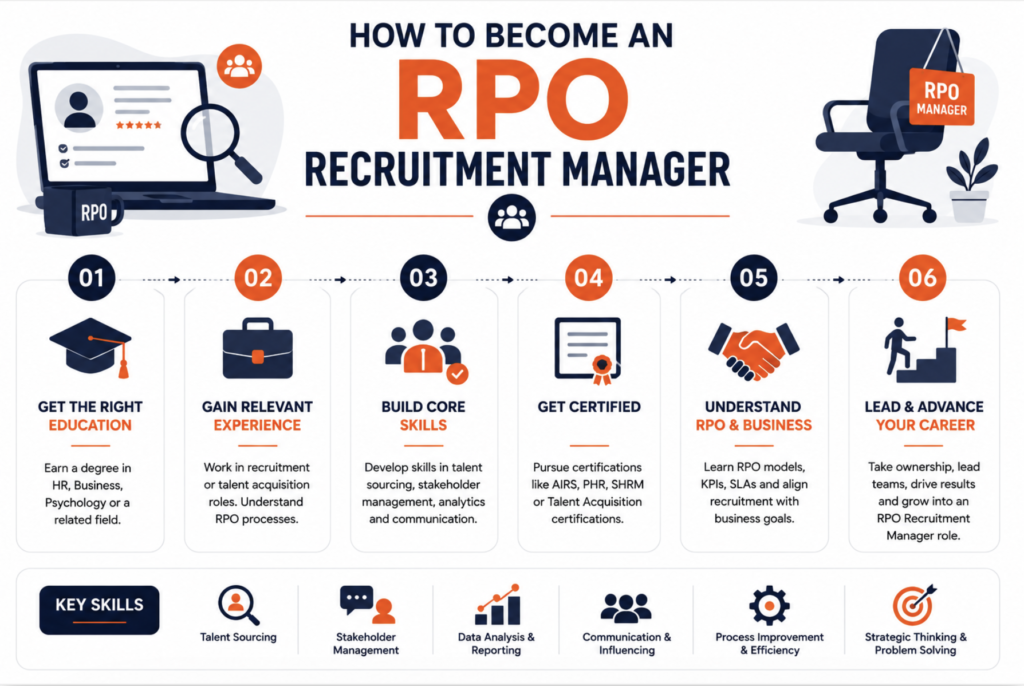
How to Become an RPO Recruitment Manager in 2026?
Educational Qualifications and Certifications
Most RPO Recruitment Managers hold a bachelor’s degree in human resources, business administration, or related discipline. For senior RPO leadership or account director roles, companies prioritize candidates with postgraduate qualifications or globally recognized talent acquisition and HR management certifications.
Educational Background
- BBA / B.Com in Human Resources, Business Administration, or Psychology
- B.Sc / M.Sc in Organizational Psychology or People Analytics (for data-driven TA roles)
- Diploma in Human Resource Management from XLRI, TISS, or equivalent HR institutions
- B.Tech / B.E. in any discipline with HR specialization (for technical recruitment leadership roles)
- MBA with HR Specialization for Senior RPO Manager, Account Director, or Head of TA roles
- Specialized PG Diploma in Talent Acquisition, HR Technology, or Recruitment Operations
Relevant Certifications
In 2026, earning recognized certifications is a powerful way to validate RPO delivery expertise and talent acquisition leadership capability. These credentials help you stand out to clients and employers by demonstrating hands-on experience with industry-standard recruitment frameworks, technology platforms, and people’s leadership methodologies.
| Certification | Best For | Industry Value |
|---|---|---|
| SHRM-SCP (Senior Certified Professional) | Senior HR and talent acquisition leadership and strategy | Gold standard credential for RPO managers and talent acquisition leaders globally |
| CIPD Level 7 Advanced Diploma | Advanced HR management and talent acquisition strategy | High demand for RPO managers working with UK-linked or global enterprise clients |
| LinkedIn Recruiter Certification | Advanced passive candidate sourcing and talent pipeline management | Essential baseline credential for all RPO recruitment delivery professionals |
| AIRS Certified Internet Recruiter (CIR) | Advanced Boolean search and internet sourcing techniques | High value for RPO managers overseeing direct sourcing and talent research teams |
| Workday / SuccessFactors / Greenhouse Certification | ATS platform configuration, optimization, and reporting | Critical for RPO managers owning technology stack and hiring process compliance |
| People Analytics Certification (AIHR) | Data-driven recruitment and hiring metrics analysis | Preferred for RPO managers responsible for client performance reporting and insights |
| HireEZ / Seekout Platform Certification | AI-powered sourcing platform proficiency and pipeline management | Growing demand as RPO organizations accelerate AI sourcing tool adoption in 2026 |
Industries Hiring RPO Recruitment Managers
RPO Recruitment Managers are in demand across every industry where high-volume hiring, talent scarcity, and recruitment process complexity require dedicated embedded delivery leadership. Key industries actively hiring are:
Technology and GCCs
Technology companies and Global Capability Centers face intense competition for engineering, product, and data talent, making experienced RPO managers essential for building and leading high-performing embedded recruitment teams at scale.
- Engineering and software developer hiring team leadership and delivery
- Product, design, and data science talent pipeline management
- GCC ramp hiring program management across Bangalore, Hyderabad, and Pune
- Technical recruitment process design and hiring manager enablement
Banking and Financial Services
BFSI organizations managing large-scale hiring across retail banking, fintech, and financial services operations need RPO managers who understand regulatory hiring compliance and can deliver consistent quality at volume.
- Compliance-aware recruitment process design and delivery management
- Retail banking and branch network high-volume hiring program leadership
- Fintech and digital banking specialist talent acquisition delivery
- Regulatory and risk function hiring team leadership and performance management
Manufacturing and Engineering
Large manufacturers and engineering organizations managing complex multi-location hiring programs across technical, operations, and leadership roles need experienced RPO managers to deliver consistent quality across diverse role categories.
- Technical and engineering talent acquisition team leadership
- Multi-site manufacturing hiring program management and coordination
- Blue-collar and white-collar hybrid recruitment delivery oversight
- Campus and early careers hiring program design and management
Pharmaceuticals and Healthcare
Pharma and healthcare organizations face specialized hiring compliance requirements and niche talent pools requiring experienced RPO managers who understand regulatory hiring standards and scientific talent markets.
- Regulatory affairs and clinical research talent acquisition delivery
- GxP-compliant recruitment process design and audit readiness management
- Medical and scientific talent pipeline development and management
- Healthcare operations and support function high-volume hiring leadership
Latest Trends to Watch in 2026 for RPO Recruitment Managers
RPO Recruitment Managers in 2026 are strategically critical talent acquisition leaders commanding strong salaries and exceptional career growth. AI sourcing expertise, client management credibility, and analytics-driven delivery capability are the key differentiators driving hiring and compensation across the RPO market.
Job Role Trends
- RPO Recruitment Managers are now expected to lead AI-powered sourcing tool adoption and manage algorithmic candidate shortlisting quality.
- Skills-based hiring frameworks have replaced traditional job description-led recruitment, requiring managers to redesign assessment and screening approaches.
- RPO Managers are increasingly accountable for DE&I hiring outcomes as clients embed diversity metrics into SLA and performance frameworks.
- Candidate experience ownership has elevated from a team responsibility to a direct RPO manager KPI tied to client NPS and offer acceptance rates.
- Workforce intelligence and predictive hiring analytics have become core RPO manager deliverables alongside traditional recruitment metrics reporting.
Hiring Trends
- ATS platform ownership experience is now a primary hiring filter for senior RPO recruitment manager roles across enterprise clients.
- Technology, GCCs, and organizations hiring emerging green jobs are driving strong RPO hiring demand.
- RPO managers with multi-industry delivery experience command significantly stronger market interest than single-sector specialists.
- Managers with demonstrable DE&I hiring program design experience are fast becoming a distinct and highly sought-after profile.
- AI sourcing tool proficiency alongside client management credibility is the most competitive skills combination in RPO hiring markets.
Career and Pay Trends
- RPO Recruitment Managers with analytics-driven delivery and AI tool adoption experience command significant salary premiums above peers.
- Senior managers with multi-client portfolio and enterprise account ownership are fast-tracking into RPO Account Director and Head of TA roles.
- Performance bonuses tied to client SLA achievement, quality of hire scores, and account retention outcomes are now standard across leading RPO firms.
- RPO managers specializing in technology, GCC, and pharmaceutical hiring command the highest talent acquisition management premiums in India.
- RPO delivery management is evolving into one of the most important future leadership roles within talent acquisition and workforce strategy.
Career Path of an RPO Recruitment Manager
An RPO recruitment management career grows from coordinating interviews as a junior recruiter to driving enterprise talent acquisition strategy as a VP or Managing Director. Each level builds deeper recruitment expertise, client leadership capability, and commercial acumen across one of the most strategically valued functions in modern HR.
| Career Level | Typical Years of Experience | Core Focus | Key Responsibilities |
|---|---|---|---|
| Level 1: Recruitment Coordinator / Junior Recruiter | 0–2 Years | Learning and Execution | Scheduling interviews, maintaining ATS records, and supporting senior recruiters. |
| Level 2: Recruiter / Talent Acquisition Specialist | 2–5 Years | End-to-End Recruitment | Managing full hiring cycles, sourcing candidates, and managing hiring manager relationships. |
| Level 3: Senior Recruiter / Lead Recruiter | 5–8 Years | Technical Leadership | Owning complex role hiring, mentoring juniors, and supporting client delivery oversight. |
| Level 4: RPO Recruitment Manager | 8–12 Years | Client Delivery Ownership | Leading recruitment teams, owning client relationships, and managing SLA performance. |
| Level 5: RPO Account Director / Head of TA | 12–16 Years | Portfolio Leadership | Owning multi-client accounts, driving commercial growth, and leading practice development. |
| Level 6: VP of Talent Acquisition / Managing Director | 16+ Years | Strategic Leadership | Driving enterprise TA strategy and RPO practice vision at board and C-suite level. |
Salary trends of a RPO Recruitment Manager
In 2026, RPO Recruitment Manager salaries in India typically range from INR 5 L – INR 30 L+ per year, with early‑career at INR 6 L – INR 10 L, mid‑level at INR 9 L – INR 16 L, senior at INR 14 L – INR 22 L, and lead/director levels at INR 18 L – INR 30 L+. Pay is highest in Bangalore, Mumbai, and Delhi‑NCR, especially in IT, BFSI, and large RPO providers, driven by volume hiring, talent scarcity, and complex global delivery mandates.
1. By industry / client sector
RPO Recruitment Managers serving IT and tech services/product companies typically earn INR 10 L – INR 22 L. BPO, KPO, and RPO providers pay around INR 9 L – INR 20 L, BFSI (banks, insurance, fintech) INR 10 L – INR 24 L, manufacturing, auto, and industrial sectors INR 8 L – INR 18 L, and healthcare or pharma INR 9 L – INR 19 L
| Industry / client sector | Typical salary band (per year) |
|---|---|
| IT / tech services & product companies | INR 10 L – INR 22 L |
| BPO / KPO / RPO providers | INR 9 L – INR 20 L |
| BFSI (banks, insurance, fintech) | INR 10 L – INR 24 L |
| Manufacturing / auto / industrial | INR 8 L – INR 18 L |
| Healthcare / pharma | INR 9 L – INR 19 L |
2. By location
In major talent hubs like Bangalore, Mumbai, and Delhi‑NCR, bands are usually INR 10 L – INR 24 L. Hyderabad, Pune, and Chennai commonly range INR 8 L – INR 18 L, other tier‑1 cities INR 7 L – INR 15 L, and tier‑2 locations or RPO delivery centres INR 5 L – INR 12 L for similar RPO recruitment management roles.
| Location / city type | Typical salary band (per year) |
|---|---|
| Bangalore / Mumbai / Delhi‑NCR | INR 10 L – INR 24 L |
| Hyderabad / Pune / Chennai | INR 8 L – INR 18 L |
| Other tier‑1 cities | INR 7 L – INR 15 L |
| Tier‑2 cities / delivery centres | INR 5 L – INR 12 L |
3. By experience level
Early‑career RPO managers (3–5 years) generally earn INR 6 L – INR 10 L. Mid‑level managers (6–9 years) often land INR 9 L – INR 16 L. Senior managers (10–13 years) commonly reach INR 14 L – INR 22 L, and lead roles or delivery heads (14+ years) can command INR 18 L – INR 30 L+in large RPO firms and global accounts.
| Experience level | Typical salary band (per year) |
|---|---|
| Early‑career / 3–5 years (assistant mgr) | INR 6 L – INR 10 L |
| Mid‑level / 6–9 years (manager) | INR 9 L – INR 16 L |
| Senior / 10–13 years (senior manager) | INR 14 L – INR 22 L |
| Lead / 14+ years (delivery head / director) | INR 18 L – INR 30 L+ |
Hiring Challenges in RPO Recruitment Manager Recruitment
Organizations and RPO providers in 2026 face a persistent talent shortage in recruitment delivery leadership as client expectations, technology complexity, and hiring volume demands accelerate faster than the market can produce qualified managers. Finding professionals who combine recruitment expertise with client management credibility, data fluency, and team leadership capability remains the defining challenge.
- Client Credibility Threshold:
RPO managers must advise and influence senior HR and business leaders at client organizations, requiring a level of executive presence and commercial credibility that many experienced recruiters have not yet developed.
- Technology Leadership Gap:
Many experienced recruiters lack hands-on ATS configuration, AI sourcing tool adoption, and recruitment analytics platform leadership experience now required in technology-forward RPO engagements.
- Multi-Industry Delivery Scarcity:
RPO managers with genuine delivery experience across multiple industry verticals and role categories are scarce and command significant market premiums above single-sector specialists.
- Data-Driven Management Capability:
Clients increasingly expect RPO managers to lead with data and analytics rather than intuition and finding professionals who are both recruitment-credible and analytically rigorous is consistently difficult.
- Retention Challenges:
High-performing RPO managers are frequently attracted by in-house Head of TA, Talent Director, and HR leadership roles offering greater stability and organizational influence.
How to Hire an RPO Recruitment Manager?
Hiring skilled RPO Recruitment Managers requires client-facing leadership assessment, practical delivery scenario evaluation, and specialist talent acquisition recruitment support.
Organizations that invest in ATS and analytics capability development, structured leadership pipelines, and compelling RPO career tracks will consistently attract and retain the best delivery management talent in 2026.
- Use Client Scenario Assessments:
Design hiring tasks requiring candidates to manage a client’s escalation, present a hiring performance report, or design a recruitment process for a complex technical role to evaluate real delivery management competence.
- Assess Both Recruitment and Leadership Maturity:
Evaluate candidates on their ability to lead teams, manage client relationships, and use data to drive decisions rather than assess recruitment knowledge alone.
- Partner with HR and TA Academic Programs:
Engage with MBA HR, SHRM, and talent acquisition-focused programs to access emerging RPO leadership talent entering the profession.
- Offer Technology and Analytics Development:
Attract ambitious recruitment professionals by providing access to leading ATS platforms, AI sourcing tools, and people’s analytics programs tied to structured career progression.
- Define Client and Engagement Context Precisely:
Specify industry sector, client size, team size, SLA complexity, and technology stack to attract correctly matched senior candidates.
- Leverage Specialist HR and TA Recruiters:
Partner with agencies focused on HR and talent acquisition leadership hiring to access pre-vetted RPO manager talent and reduce time to hire for urgent client delivery vacancies.
- Build Internal Leadership Pipelines:
Identify high-performing senior recruiters and lead recruiters within existing teams and invest in structured management development programs to build internal RPO delivery leadership.
Top 10 Interview Questions for an RPO Recruitment Manager
1. How do you manage a client relationship when hiring targets are being consistently missed?
I immediately conduct a root cause analysis covering requisition quality, sourcing pipeline health, hiring manager engagement, process bottlenecks, and market availability, present findings to the client with transparency and without defensiveness, develop a structured recovery plan with clear milestones and accountability, increase the frequency of client communication during the recovery period, and track progress against the plan daily until performance stabilizes.
2. Walk me through how you design a recruitment process for a new client engagement.
I start with a detailed discovery session covering the client’s hiring volumes, role complexity, time to fill expectations, hiring manager preferences, ATS environment, compliance requirements, and employer brand position, map the current state process, identify gaps and inefficiencies, design an optimized end-to-end process with clear stage ownership and SLA targets at each step, document the process in a standard operating procedure, and train the team before go-live.
3. How do you build and maintain a high-performing recruitment team under delivery pressure?
I establish clear role expectations and individual performance metrics from day one, hold regular one-on-ones focused on development as much as delivery, create psychological safety so team members escalate problems early rather than hiding them, recognize strong performance visibly and promptly, address underperformance quickly and constructively, and protect the team from unreasonable client pressure while holding them accountable to realistic delivery standards.
4. How do you use data to improve recruitment delivery performance?
I maintain a live dashboard tracking time to fill, offer acceptance rate, source of hire, hiring funnel conversion rates, and quality of hire by role category and recruiter, analyze trends weekly to identify emerging bottlenecks or performance drops, present insights to the client with specific improvement recommendations, and use data to make evidence-based decisions about team resource allocation, sourcing channel investment, and process redesign priorities.
5. How do you manage a situation where a client’s hiring manager is creating bottlenecks in the process?
I gather data quantifying the impact of the hiring manager’s behavior on time to fill and candidate experience, raise the issue constructively with the client HR business partner rather than the hiring manager directly, present the data with specific examples, propose practical solutions including structured interview training, standardized feedback timelines, and calendar management support, and track improvement against agreed response time SLAs going forward.
6. How do you implement a new ATS for a client in mid-engagement without disrupting delivery?
I conduct a parallel running period where both the old and new systems are maintained simultaneously during the transition, develop a phased migration plan that prioritizes active roles, provide hands-on training and job aids for the recruitment team, maintain daily check-ins during the first two weeks post-launch to catch and resolve issues quickly, and report implementation progress and any delivery impact transparently to the client throughout.
7. How do you ensure DE&I commitments are embedded in recruitment delivery?
I audit sourcing channels and job descriptions for bias, implement structured interviews with standardized competency-based questions, set diversity pipeline targets at each funnel stage, track and report diversity metrics alongside standard performance data, brief the recruitment team on inclusive hiring practices, and work with the client to address any systemic barriers identified in the hiring process.
8. How do you manage a sudden spike in hiring demand from a client?
I assess the volume, timeline, and role complexity of the demand spike, review current team capacity against the new requirement, identify the gap and develop a rapid resourcing plan covering internal reallocation, contractor recruiter augmentation, and prioritized sourcing investment, communicate a realistic delivery plan to the client with transparent assumptions and risks, and implement daily progress tracking until the spike is absorbed.
9. How do you handle a situation where a key recruiter on the team resigns unexpectedly?
I immediately assess the impact on active requisitions, redistribute the most critical roles across the team with adjusted capacity expectations, communicate transparently with the client on any potential delivery impact and mitigation actions, activate the replacement hiring process immediately, and use the situation as an opportunity to review team succession planning and identify internal development opportunities to reduce single-point-of-failure risks.
10. How do you demonstrate the commercial value of the RPO engagement to a client who is questioning the investment?
I prepare a comprehensive value analysis covering cost per hire versus pre-RPO baseline, time to fill improvement, quality of hire indicators, hiring manager satisfaction scores, and compliance risk reduction, translate these metrics into direct financial value using the client’s own cost assumptions, present the analysis in a formal business review with supporting data, acknowledge areas where performance can be stronger, and present a forward-looking improvement plan that reinforces the strategic value of the partnership.
Explore top interview questions with this guide which covers preparation tips across fresher, intermediate, and expert levels & recruiter insights.
Why RPO is the Answer to RPO Recruitment Manager Recruitment
The most effective way to hire exceptional RPO talent is to work with an RPO provider that understands the profession from the inside. As RPO delivery functions scale, driven by client hiring volume growth, multi-geography expansion, and increasing technology complexity, traditional recruitment models cannot keep pace with the leadership specialization and client delivery expertise required.
This is where Recruitment Process Outsourcing (RPO) solutions provide a uniquely credible solution for hiring RPO talent. RPO providers bring domain-specific sourcing expertise, pre-built talent pools of certified recruitment professionals, and practical competency-based assessment frameworks that general recruiters simply cannot replicate.
For RPO Recruitment Manager hiring specifically, the best RPO partners bring deep talent acquisition and client delivery domain expertise. They screen candidates for real team leadership competence, client management credibility, and technology platform experience rather than just matching keywords on a CV.
Key benefits of RPO for RPO Recruitment Manager talent acquisition:
- Faster time-to-hire: RPO cuts hiring timelines for scarce senior delivery management and account leadership roles significantly.
- Access to passive TA talent: Recruiters reach experienced RPO managers not active on job boards but open to the right client and delivery opportunity.
- Scalable model: Ramp from hiring one manager to building an entire RPO delivery leadership team without rebuilding your internal HR function.
- Reduced cost-per-hire: Significant savings compared to traditional contingency agencies for specialized talent acquisition leadership recruitment.
- Technical screening support: Expert vetting of ATS platform experience, client management capability, team leadership skills, and recruitment analytics proficiency before candidates reach your interview stage.
- Employer branding: Strategies to position your RPO practice as a top talent acquisition employer highlighting client diversity, technology investment, career growth, and exceptional delivery culture.
Industries leveraging RPO most actively for RPO Recruitment Manager hiring: Technology and GCCs | Banking and Financial Services | Manufacturing and Engineering | Pharmaceuticals and Healthcare | FMCG and Consumer Goods | Infrastructure and EPC.
Wrapping Up
The role of an RPO Recruitment Manager in 2026 has never been more commercially critical or more professionally demanding. As organizations expect their RPO partners to deliver not just filled roles but strategic hiring advantage, the professionals who can lead teams, manage clients, leverage technology, and consistently deliver quality at scale are becoming the most valuable assets in the talent acquisition industry.
Whether you are a recruitment professional building an RPO leadership career or an organization looking to hire the right delivery management expertise, understanding the skills, certifications, and market dynamics shaping this space is essential for staying competitive in one of India’s fastest-growing and most strategically valued HR functions.
Ultimately, great RPO delivery starts with great RPO leadership. By embracing continuous learning, technology platform adoption, and the right recruitment partnerships, both RPO Recruitment Managers and forward-thinking organizations can build talent acquisition programs that consistently deliver competitive hiring advantage in 2026 and beyond.
FAQs
What is an RPO Recruitment Manager and what do they do?
An RPO Recruitment Manager leads the delivery of recruitment process outsourcing engagements, managing embedded hiring teams, owning client relationships, overseeing end-to-end recruitment processes, and ensuring organizations consistently achieve their talent acquisition goals at scale.
How is an RPO Recruitment Manager different from an in-house Talent Acquisition Manager?
In-house TA managers own recruitment for a single organization as permanent employees. RPO Recruitment Managers lead embedded delivery teams on behalf of an RPO provider, managing client relationships commercially, often across multiple clients or geographies, with direct accountability for contractual SLA and performance outcomes.
How do I become an RPO Recruitment Manager in 2026?
Build a strong foundation in end-to-end recruitment, develop team leadership and client management skills, gain experience with ATS and AI sourcing platforms, and pursue certifications like SHRM-SCP or CIPD to build professional credibility and accelerate progression into RPO delivery leadership roles.
How long does it take to become an RPO Recruitment Manager?
Typically, 8 to 12 years including progressive recruitment experience from coordinator through senior recruiter and lead recruiter levels. High-performing recruiters with strong client-facing and leadership skills can accelerate into RPO management roles within 6 to 7 years with focused development.
What are the top 5 skills for RPO Recruitment Managers in 2026?
Client Relationship Management, Recruitment Team Leadership, ATS and AI Sourcing Tool Proficiency, Hiring Analytics and Performance Reporting, and Recruitment Process Design. These skills determine delivery of success and career progression across all RPO recruitment management roles.
What is the career outlook for RPO Recruitment Managers?
Exceptionally strong. Growing RPO adoption across India’s technology, manufacturing, and financial services sectors is driving sustained demand for experienced delivery managers. Skilled professionals command higher salaries and fast-track into RPO Account Director, Head of TA, and VP of Talent Acquisition roles.
What industries offer the best career opportunities for RPO Recruitment Managers?
Technology and GCCs, banking and financial services, manufacturing, pharmaceuticals, and large FMCG organizations offer the strongest RPO Recruitment Manager career opportunities in India in 2026, driven by high hiring volumes, talent scarcity, and growing RPO adoption across these sectors.
Building exceptional talent acquisition programs starts with hiring the right RPO delivery leaders.
Taggd Helps organizations hire skilled RPO Recruitment Managers across technology, banking, manufacturing, pharmaceuticals, FMCG, and infrastructure sectors through specialized hiring solutions, talent intelligence, and scalable RPO support.