India’s new trade agreements change the legal and cost friction around moving talent between global headquarters and Indian GCCs.
They do not change the harder problem: whether headquarters trusts an India centre with higher-order work.
The GCCs that benefit most will be the ones that treat mobility as a talent strategy, not a visa workflow.
Between December 2025 and July 2026, India concluded or activated four trade agreements, and two more frameworks are being upgraded.
Most coverage reads them as trade stories. For a CHRO, they are talent stories: who can move, how often, at what cost, and with what skills.
This piece is based on Taggd’s GCC Talent Lab Report 2026. It is general guidance, not legal or immigration advice.
Get the full data: Download the GCC Talent Lab Report 2026 for the complete corridor analysis and talent-readiness findings.
What do India’s new trade agreements change for GCC talent mobility?
They make cross-border movement of GCC talent more predictable, cheaper in some cases, and easier to structure, but the effect differs by corridor and by agreement status.
| Corridor | Status (as reported) | What it means for mobility |
| India-UK CETA | Signed July 2025, in force July 2026 | 137 services sub-sectors; 24-month National Insurance exemption for short-term assignments; no Economic Needs Test |
| India-EU FTA | Negotiations concluded 27 January 2026; signature and procedures still pending | 144 services sub-sectors; a parallel mobility framework for intra-corporate transferees, business visitors, contractual service suppliers and independent professionals |
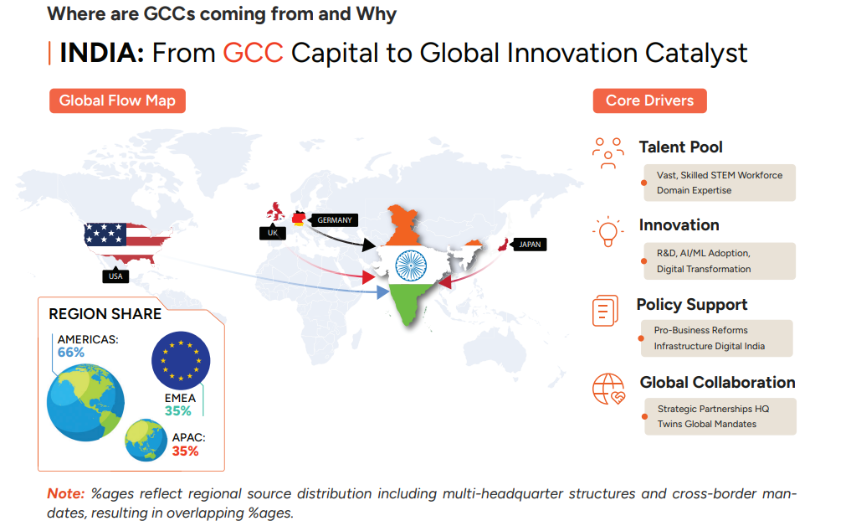
| Japan | Existing CEPA, modernization under discussion | Over 100 GCCs in India, about 6% of the landscape; engineering-led mandates |
| US | Interim trade arrangement under discussion | 66% of India’s established GCC footprint; mandates shifting toward global ownership |
Which trade agreements has India concluded or activated since December 2025?
According to the GCC Report, four: the Oman CEPA (December 2025), the EU FTA (negotiations concluded January 2026), the New Zealand FTA (April 2026), and the India-Israel Bilateral Investment Agreement (in force 4 July 2026), which provides legal guardrails for deep-tech capital.
The India-UK CETA, signed in 2025, came into force in July 2026. Separately, India and the US are working through an interim trade arrangement, and India and Japan are discussing modernizing their CEPA.
The pace is the point. These agreements are converting years of signals into signed frameworks, and India is increasingly negotiating as a country the world needs for its talent, scale and institutional depth, not on cost alone.
What does the India-EU FTA change for GCC talent?
It signals deeper services access and a clearer mobility framework, but it is not yet binding. Negotiations concluded on 27 January 2026, which Commission President Ursula von der Leyen called the “mother of all deals”, covering roughly 2 billion people and about 25% of global GDP across 20 negotiating chapters.
The agreement still requires signature and completion of the relevant procedures before it takes effect.
Three things matter for GCC leaders:
- Services access: The EU opened 144 services sub-sectors to Indian providers, with binding commitments in 37 sub-sectors for contractual service suppliers and 17 for independent professionals, spanning IT, R&D, professional services and higher education.
- A mobility framework: A parallel India-EU mobility agreement, as described in the report, covers intra-corporate transferees, business visitors, contractual service suppliers and independent professionals, with entry and working rights extended to dependents. Social security agreements across EU member states are described as agreed on a five-year horizon. The operative terms will depend on final signature and implementation.
- A trust signal: Chapters on digital trade, IP protection and sustainability address areas where European enterprises have historically hesitated to offshore complex work without clear governance guardrails.
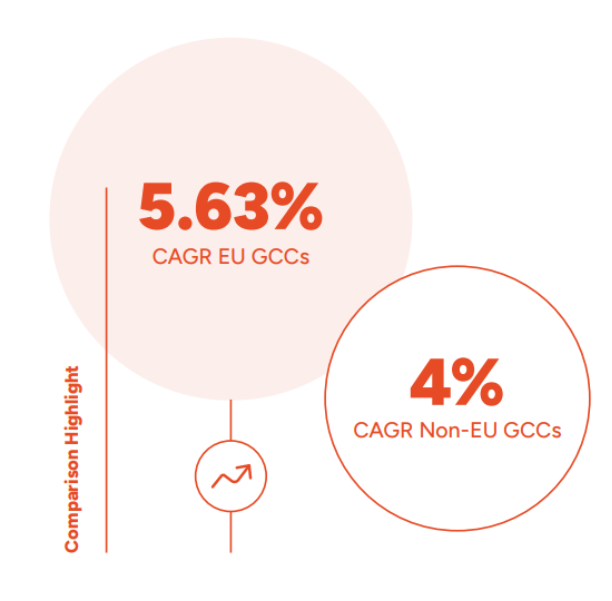
The context is strong. About 25% of India’s 2,100+ GCCs already have European parentage, and EU-headquartered GCCs in India grew at a 5.63% CAGR between 2018 and 2025, against 4% for non-EU GCCs (HFS Research, February 2026).
HFS calls the FTA a “timing lever”: it doesn’t change direction; it accelerates the cycle, especially for expansion decisions waiting on clearer cross-border frameworks.
Because the agreement is not yet binding, the transition window is the opportunity. It is when GCCs can front-run their talent and infrastructure plans.
What does the India-UK CETA change for GCC talent?
It is the most immediate actionable of the new agreements, because it is already in force. Signed in July 2025 and in force since July 2026, it opens 137 services sub-sectors to Indian providers, covering IT and IT-enabled services, financial services, professional services including engineering and management consultancy, and digital trade.
Three provisions shape mobility:
- Double Contribution Convention: Indian professionals on short-term UK assignments are exempt from National Insurance contributions for up to 24 months, which the report estimates reduces the cost of cross-border talent deployment by about ₹40,000 crore.
- Easier rotation: Professionals can rotate into the UK for training, client engagement and project delivery with fewer immigration complications.
- No Economic Needs Test: This removes a barrier that historically discourages businesses from deploying overseas talent at scale.
For GCCs serving UK-headquartered enterprises, this moves India from a back-office delivery location toward a formally recognized strategic partner, with cleaner legal, tax and mobility structures underneath.
Eligibility for any individual assignment still depends on the role, duration, and the individual’s circumstances.
Why does Japan matter for GCC talent mobility?
Because Japan is the largest APAC contributor to India’s GCC ecosystem and its need for Indian talent is structural.
Over 100 Japanese centres operate in India, about 6% of the overall GCC landscape (Deloitte), and Japan’s aging workforce and shrinking domestic talent supply make India’s young, STEM-strong pool a strategic imperative rather than a sourcing preference.
Japanese centres concentrate in engineering-led sectors: technology (20%), industrials (15%), and automotive and healthcare (11% each). They are moving into product R&D, AI, embedded systems, cloud and digital manufacturing.
For talent leaders, the Japan corridor asks for something different from EU and UK mandates: precision, process discipline and long-cycle product thinking, not just regulatory literacy.
How is the US corridor changing what mobility means?
The US still holds the largest share of India’s established GCC footprint at 66%, but the nature of the work is shifting from volume-driven engineering to matrixed global mandates.
Many US-headquartered firms now treat their Indian centres as “HQ Twins”: a Bengaluru or Hyderabad centre given end-to-end global ownership of core product lines, compliance frameworks or transformation strategies.
That maturity built the institutional trust India is now using to secure deeper services agreements with the EU, UK and Japan. It also changes the mobility question.
When an India centre owns a global mandate, the people who move between headquarters and India are no longer just transferring knowledge. They are carrying decision rights.
What is “coordination drag” and how does talent rotation reduce it?
Coordination drag is the gap between what India teams can do and what headquarters trusts them to do. The report identifies it as historically the biggest scaling bottleneck for GCCs.
Predictable global frameworks make structured rotation programs between headquarters and India GCCs more viable, with business teams moving in both directions more often.
A regular, predictable rotation model compresses that gap, because trust is built through proximity, shared context and repeated delivery, not through documentation alone. The report frames this as a delivery accelerant, a “two-way rotation dividend.”
The practical implication: mobility policy should be designed around the trust it needs to build, not just the visas it needs to clear.
What compliance obligations come with global mobility and mandates?
The agreements don’t simplify the operating environment so much as redirect its complexity. EU enterprises operate in one of the world’s most regulated environments, and when mandates move to India, regulatory requirements can follow the work.
Which frameworks apply depend on the mandate, entity, activity and jurisdiction. The relevant GCC regulatory compliance skills include GDPR, DORA, CSRD, CBAM and sector-specific rules.
India’s own regulatory layer is maturing at the same time.
The DPDP Act, 2023, with its Rules notified in November 2025, adds a domestic data governance layer for GCCs that process personal data of Indian data principals, on an 18-month phased commencement schedule.
Section 17(1)(d) provides a limited exemption for processing personal data of data principals outside India under a contract with a person outside India, but whether it applies to a specific workflow needs legal review, and it does not automatically cover Indian employee or customer data.
For talent leaders, this means compliance is a hiring category, not a legal checkbox.
For the DPDP specifics: DPDP Act and AI Hiring: A Compliance Guide for GCC HR Teams.
What does global readiness look like for Indian GCC talent?
It depends on the corridor, but it always goes beyond technical skill.
- EU and UK mandates: Working fluency in the frameworks relevant to the work (GDPR, DORA, CSRD and sector rules), not as legal specialists but as operating professionals who understand the guardrails they build within.
- Japan: The ability to work within engineering cultures that prize precision, process discipline and long-cycle product thinking over speed-to-market.
- Cultural fluency: The gap most GCCs underestimate. Enterprises from Germany, France and the Nordics tend to place a higher premium on contextual communication, stakeholder alignment across time zones and familiarity with European business norms than US counterparts typically do. Structured cross-cultural onboarding becomes part of the delivery model.
- Across all corridors: Product thinking and risk discipline from day one. The volume-first, train-later model that worked in earlier US-corridor expansion will not hold for these mandates.
The shift on the ground is from absorbing delivery work to being trusted with mandates that require judgment, not just execution.
How should CHROs build a global mobility strategy for their GCC?
In five steps, sequenced so that talent readiness runs ahead of the mandate.
| Step | What it involves |
| 1. Map your corridors | Identify which HQ and client relationships touch the EU, UK, Japan or US, and which are likely to as agreements mature |
| 2. Design rotation, not just relocation | Define structured two-way rotation programs with clear purpose: trust-building, capability transfer or client engagement |
| 3. Check eligibility and cost with experts | Confirm visa, tax and social-security treatment per corridor and per role with immigration and tax advisers, since agreement terms and individual eligibility vary |
| 4. Build corridor-specific readiness | Regulatory fluency for EU and UK work, process and precision culture for Japan, cross-cultural onboarding for all |
| 5. Track agreement milestones | Monitor EU FTA signature and implementation, UK CETA rollout, and US and Japan updates, and revisit the plan as terms firm up |
For the planning discipline behind steps 1 and 4: check out this blog on Skill Mapping for GCCs.
What is the real competitive advantage in global talent mobility?
Readiness that is in place before the mandate is live. Early movers across the EU, UK, US and Japan corridors stand to gain in three ways, according to the report:
- A talent pipeline advantage. Demand for regulatory-fluent professionals is expected to spike as global mandates scale, and GCCs that build these skill pools early are described as having a 12–18-month head start.
- A two-way rotation dividend. Predictable rotation compresses coordination drag and speeds delivery.
- Regulatory positioning as a moat. GCCs that build global compliance capability now, domestic and international together, are building something competitors may need 12-24 months to replicate, according to the report.
The agreements are the policy foundation. Talent readiness is what turns them into trust. The GCCs that build it before the mandates go live are the ones global headquarters will turn to first and keep turning to.
FAQs
Is the India-EU FTA in force?
No. Negotiations concluded on 27 January 2026, but the agreement still requires signature and completion of the relevant procedures before it becomes binding. The India-UK CETA, by contrast, has been in force since July 2026.
How does the India-UK CETA help GCC talent mobility?
It opens 137 services sub-sectors, removes the Economic Needs Test, and includes a Double Contribution Convention exempting Indian professionals on short-term UK assignments from National Insurance contributions for up to 24 months. Eligibility for any assignment depends on the role and the individual.
What does the India-EU mobility framework cover?
As described in the GCC Report, it covers intra-corporate transferees, business visitors, contractual service suppliers and independent professionals, with entry and working rights extended to dependents. Its operative terms depend on signature and implementation.
Why is Japan important for Indian GCCs?
Japan is the largest APAC contributor to India’s GCC ecosystem, with over 100 centres and about 6% of the landscape, driven by Japan’s demographic pressure and its need for engineering talent in product R&D, AI, embedded systems, cloud and digital manufacturing.
What skills do Indian professionals need for EU and UK mandates?
Working fluency in relevant regulatory frameworks, cultural fluency with European business norms, and product thinking and risk discipline from day one, not as legal specialists but as operating professionals.
What is a two-way rotation program for a GCC?
A structured program that moves business teams between headquarters and the India centre in both directions, to build trust, transfer context and reduce coordination drag.
For the complete findings on India’s new trade corridors and the talent readiness they require: Download the GCC Talent Lab Report 2026