
AI-powered recruitment is worth considering when hiring demand exceeds recruiter capacity, manual processes delay candidate progression, or limited visibility makes recruitment difficult to manage at scale. The decision should start with a specific hiring constraint and a measurable outcome the organization needs to improve.
Enterprise research highlights why this distinction matters. The ServiceNow and Oxford Economics Enterprise AI Maturity Index 2025 found that 55% of surveyed organizations had deployed more than 100 AI use cases, while only 19% said those efforts were driving meaningful business outcomes.
These findings cover enterprise AI broadly, rather than recruitment specifically, but they underscore the importance of connecting technology adoption to business results.
For Talent Acquisition leaders, the value of AI depends on the hiring problem it is expected to address. AI can support activities such as sourcing, screening, candidate engagement, and recruitment analytics. Human judgment remains essential for handling exceptions, aligning stakeholders, and making hiring decisions.
This article examines how to identify the constraints affecting a hiring mandate, determine whether AI is a suitable intervention, evaluate a recruitment solution, and measure its impact.
Why Hiring Mandates Become Difficult to Deliver
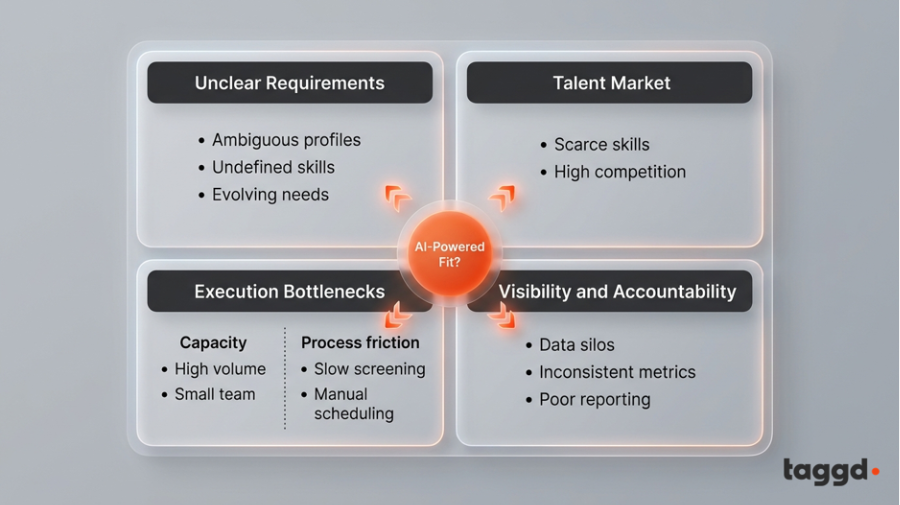
Hiring mandates can fall behind for four related reasons: unclear requirements, limited talent availability, recruitment execution bottlenecks, and gaps in visibility or accountability. Each affects delivery differently, so the symptoms alone rarely reveal the right intervention.
1. Unclear Requirements and Misaligned Expectations
Job descriptions may lack specific qualification criteria, hiring priorities may remain undefined, or recruiters and hiring managers may disagree on the experience and competencies a candidate needs. These gaps can lead to inconsistent sourcing, unsuitable shortlists, repeated changes to requirements, and avoidable rework.
2. Talent Availability and Market Constraints
Specialized skills, location restrictions, compensation gaps, and competition from other employers can limit the pool of qualified candidates. Even an efficient recruitment process may struggle when too few suitable candidates are available or the employment proposition is uncompetitive. The constraint may therefore lie in the talent market rather than the recruitment team’s capacity.
3. Recruitment Execution and Coordination
High application volumes, multiple open requisitions, and manual tasks can exceed recruiter capacity. Reviewing profiles, contacting candidates, coordinating interviews, and managing follow-ups all require time.
When these activities create backlogs, suitable candidates may remain in the pipeline without progressing at the required pace. The key question is whether recruiters lack access to suitable talent or the capacity to process and progress it.
4. Limited Visibility and Unclear Accountability
Fragmented recruitment data can make it difficult to identify bottlenecks, compare funnel progression across roles, or determine why hiring targets are slipping. Unclear ownership creates a separate challenge: pending feedback, approvals, and follow-ups may stall without a defined escalation path.
Visibility helps leaders locate a problem. Accountability establishes who must act on it.
These constraints can coexist within the same hiring mandate. Identifying which constraints are driving the delay provides the starting point for assessing whether AI-powered recruitment can help.
When Is AI-Powered Recruitment the Right Fit for a Hiring Mandate?
AI-powered recruitment is most relevant when recruitment execution exceeds available capacity, repetitive processes delay candidate progression, or limited visibility makes timely intervention difficult. Leaders should identify where the process is breaking down and determine whether AI can address the activities or information gaps contributing to the problem.
When Candidate Volume Exceeds Recruiter Capacity
High application volumes can leave recruiters with limited time to identify suitable candidates, review profiles, and maintain engagement. The pressure increases when teams handle multiple requisitions alongside repetitive screening and outreach tasks.
AI-supported sourcing and screening can help teams process candidate information at scale, while candidate engagement workflows can support timely communication. Clear qualification criteria and appropriate human review remain essential. Processing more profiles does not guarantee a stronger shortlist.
When Manual Processes Slow Hiring Progress
Manual screening, outreach, scheduling, and follow-ups can introduce delays between recruitment stages. These delays become harder to manage when recruiters coordinate several open roles or rely on disconnected workflows to track candidate progress.
AI-enabled workflows can support repetitive activities and reduce coordination friction. Their impact depends on whether the activities causing delays fall within the solution’s capabilities and whether stakeholders respond on time.
When Hiring Spans Multiple Roles, Locations, or Business Units
Concurrent hiring across teams or locations increases the effort required to coordinate requisitions, apply consistent evaluation criteria, and maintain progress against different timelines. Without clear ownership and shared workflows, priorities can become difficult to manage.
Connected recruitment workflows can help teams coordinate activity and apply more consistent processes across requisitions. Conflicting expectations between business units still require stakeholder alignment.
When Recruitment Teams Lack Funnel Visibility
Recruitment teams need to know where candidates are progressing, which requisitions have stalled, how recruiter workload is distributed, and where intervention is required. When funnel data is incomplete or difficult to interpret, leaders may struggle to distinguish isolated delays from recurring delivery problems.
Recruitment analytics can help teams identify stalled candidate progression, requisitions that need attention, and emerging delivery risks. These insights are useful when the underlying data is reliable and leaders can act on the findings.
Which Hiring Constraints Can AI Help Address?
| Your constraint | Can AI help? | What else is needed? |
| High candidate volume | Yes, where sourcing, screening, or engagement activities exceed available capacity. | Clear qualification criteria and appropriate human review. |
| Slow manual processes | Yes, where repetitive tasks and coordination create avoidable delays. | Defined workflows and timely stakeholder responses. |
| Hiring across multiple roles or locations | Yes, where connected execution and consistent processes can support coordination. | Aligned requirements, clear ownership, and agreed priorities. |
| Limited funnel visibility | Yes, where recruitment analytics can surface progress and bottlenecks. | Reliable data, defined metrics, and ownership of follow-up actions. |
| Unclear requirements | Not directly. AI may help structure information, but it cannot independently resolve conflicting expectations. | Hiring-manager alignment and defined evaluation criteria. |
| Talent scarcity or uncompetitive offers | Not on its own. AI may support sourcing, but it cannot create talent supply or make an uncompetitive offer attractive. | Appropriate sourcing strategies, realistic talent-market assumptions, or changes to the offer. |
| Slow hiring decisions | Not on its own. AI may help surface pending actions and send reminders, but it cannot replace timely decisions by the responsible stakeholders. | Clear decision rights and stakeholder turnaround expectations. |
The distinction matters when evaluating recruitment solutions. AI is worth considering when it can address a defined execution or visibility gap. Constraints involving role clarity, talent-market conditions, or decision-making may require separate interventions.
Before evaluating solutions, organizations should confirm the foundations that determine whether AI can deliver: clear requirements, reliable data, defined ownership, and appropriate governance.
When AI-Powered Recruitment Needs More Than Technology
AI-powered recruitment is more likely to deliver value when hiring requirements, candidate evaluation criteria, and responsibilities are clearly defined.
Clear Role Requirements
AI-enabled recruitment workflows depend on well-defined roles, required skills, and hiring priorities. Agree on these requirements before configuring recruitment workflows to ensure they reflect the needs of the business.
A Defined Standard for Qualified Candidates
Recruiters and hiring managers need a shared understanding of what makes a candidate suitable for a role, including the relevant competencies, qualification criteria, and evaluation standards. Without this agreement, AI-supported screening may prioritize profiles against criteria that do not reflect the hiring team’s expectations. Appropriate human review remains essential.
Clear Decision Rights
Teams should understand which activities the technology handles, who reviews its outputs, and who resolves exceptions. Recruiters manage recruitment workflows, coordinate stakeholders, and escalate issues when needed. Hiring managers retain responsibility for hiring decisions, while designated owners oversee system performance and governance.
Data Readiness
Incomplete candidate records, inconsistent requisition details, and unclear recruitment stages can limit the reliability of AI-supported sourcing, screening, and analytics. Check that candidate records, requisition details, and recruitment-stage data are accurate and consistent. Address critical gaps before implementation, while improving reporting and workflow standardization as the solution is rolled out.
Governance and Change Management
Organizations should establish how candidate data is accessed, processed, retained, and protected, alongside appropriate oversight of AI-generated assessments and recommendations. Access controls, documented review procedures, and clear escalation routes help maintain accountability.
Train recruiters and hiring managers on the new workflows, clarify their responsibilities, and establish a process for reporting issues. A pilot involving a defined hiring use case can help identify problems and refine workflows before adoption expands.
These foundations support implementation, but talent scarcity, uncompetitive compensation, and delayed stakeholder decisions can still constrain hiring outcomes, even when recruitment execution improves. Talent scarcity, uncompetitive compensation, and delayed hiring decisions can still constrain outcomes, even when AI improves recruitment execution.
What Should Organizations Look for in an AI-Powered Recruitment Solution?
Organizations should evaluate AI-powered recruitment solutions across six criteria: recruitment coverage, alignment with hiring requirements, system integration, human oversight, operational visibility, and measurable outcomes. Each criterion helps determine whether a solution can address the organization’s hiring needs and operate effectively within its recruitment environment.
Coverage Across Relevant Recruitment Activities
Evaluate which recruitment activities the solution supports, including sourcing, screening, candidate engagement, interviews, and recruitment analytics, depending on the hiring mandate.
Prioritize capabilities that address the greatest operational constraints. Ask providers to demonstrate how the solution handles these activities, what outputs it produces, and where human intervention remains necessary. A broad feature set has limited value if it does not address the organization’s actual requirements.
Alignment With Hiring Requirements
Assess how the solution uses job descriptions, hiring briefs, qualification criteria, and role-specific competencies to support recruitment workflows. Its outputs should reflect the requirements agreed upon by recruiters and hiring managers.
Ask how the system handles incomplete briefs, changing priorities, and conflicting inputs. Evaluate whether outputs can be checked against the original criteria and adjusted when requirements change. This helps establish whether the solution can support consistent execution as hiring needs evolve.
Integration With Existing Recruitment Systems
Determine how the solution will work with the organization’s applicant tracking system (ATS), HR systems, and existing recruitment workflows. Compatibility and integration requirements should be confirmed during technical evaluation rather than assumed from general product descriptions.
Ask which systems and data flows are supported, what implementation work is required, and how candidate records and status updates will be maintained. Clarify data access, security requirements, implementation ownership, and dependencies that could affect rollout or ongoing operations.
Human Oversight and Clear Accountability
Establish which activities the system performs, which outputs require human review, and who is responsible for exceptions and decisions. Providers should explain how recruiters can review or challenge AI-generated outputs and how system performance can be monitored.
Also clarify who manages recruitment workflows, coordinates with stakeholders, resolves delays, and owns delivery against agreed commitments. Hiring managers should retain responsibility for hiring decisions, with these responsibilities established before implementation.
Visibility Into Recruitment Progress
Assess whether the solution provides a reliable view of recruitment activity and pipeline progression. Relevant capabilities may include tracking candidate movement between stages, monitoring engagement, identifying bottlenecks, and comparing performance across requisitions.
Ask how frequently information is updated, how recruitment stages are defined, and whether reported bottlenecks can be traced to specific process steps. The objective is to help recruiters and leaders identify where intervention is needed and determine the appropriate next action.
Measurable Outcomes
Before implementation, establish how the solution’s impact will be evaluated. Select measures that correspond to the hiring constraint the organization intends to address, such as screening turnaround, time to shortlist, recruiter workload, candidate progression, or time to fill.
Ask providers to substantiate reported improvements and disclose the baseline, comparison period, sample, and conditions behind their results. Distinguish measured outcomes from projections, and assess whether the evidence applies to comparable roles and hiring conditions. Evaluation should also account for candidate assessment quality and process safeguards so that faster execution does not compromise appropriate evaluation.
A structured evaluation helps organizations compare solutions against their hiring needs, operating requirements, and expected results. The next step is to examine how a recruitment model brings these capabilities together through AI-enabled execution, human oversight, and delivery accountability.
How Does Taggd’s AI-Native Recruitment Model Support Hiring?
Taggd combines TARA, its AI-native recruitment engine, with Forward-Deployed Recruiters (FDRs) to connect talent intelligence, recruitment execution, and delivery accountability. TARA’s specialized AI agents support recruitment workflows, TARA Insights provides talent market intelligence, and TARA Pulse offers visibility into recruitment performance. FDRs orchestrate these capabilities, coordinate with hiring teams, and remain accountable for recruitment delivery.
The model connects three complementary functions: understanding the talent market, executing recruitment workflows, and monitoring delivery as hiring progresses.
Recruitment Coverage Across the Hiring Lifecycle
TARA’s seven specialized AI agents support activities across hiring intake, recruitment marketing, candidate sourcing, screening, candidate outreach, interviews, and decision support. Together, they support recruitment execution across multiple stages of the hiring lifecycle.
The relevant capabilities depend on the hiring mandate. Organizations should assess which activities need support and how the agents align with their requirements. FDRs direct execution within the engagement and manage exceptions that require human judgment.
Explore TARA’s specialized AI agents to learn more about their roles.
Alignment With Hiring Requirements
TARA’s agents support different stages of recruitment, from structuring hiring requirements to screening and interviewing candidates. Their outputs support recruitment activities against the criteria established for each role.
FDRs oversee execution in the context of the hiring mandate, coordinate with stakeholders, and address changes or exceptions that affect delivery. Recruiters and hiring managers retain responsibility for reviewing candidate information and making hiring decisions.
Human Oversight and Delivery Accountability
The FDR is the human owner of recruitment delivery within Taggd’s AI-native model. FDRs orchestrate TARA’s capabilities, interpret hiring insights, coordinate with stakeholders, and remain accountable for recruitment delivery and agreed commitments.
The division of responsibility is clear: TARA’s agents support recruitment execution, the FDR manages the workflow and owns delivery accountability, and hiring managers retain responsibility for hiring decisions. This combines AI-supported execution with human judgment and ownership throughout the engagement.
Talent Intelligence and Operational Visibility
TARA supports recruitment planning and execution through two complementary capabilities.
TARA Insights provides talent market intelligence to inform hiring strategy. Its capabilities include talent availability analysis, talent mapping, compensation benchmarking, workforce intelligence, and hiring feasibility. These insights help hiring teams assess market conditions and develop recruitment strategies aligned with business requirements.
TARA Pulse provides visibility into recruitment execution, including delivery performance, candidate engagement, hiring velocity, pipeline health, and operational bottlenecks. FDRs can use these insights to identify emerging risks, investigate delays, and determine where intervention is needed.
Together, Insights and Pulse address different needs: understanding talent market conditions and monitoring recruitment delivery as the hiring process progresses.
Measuring Outcomes Against Hiring Requirements
The model should be evaluated against the outcomes agreed upon for the hiring mandate. Depending on the requirements, these may include time to shortlist, time to offer, candidate progression, recruiter productivity, or time to fill.
TARA Pulse provides operational visibility, while FDRs use these insights to manage execution and address delivery risks. Evaluating results requires an established baseline and consideration of relevant factors, including role complexity, talent availability, and stakeholder response times.
The model’s effectiveness should be assessed using evidence from the engagement, with results interpreted in the context of the hiring mandate and the conditions under which it was delivered.
How Should Organizations Measure the ROI of AI-Powered Recruitment?
Organizations should measure AI-powered recruitment against a defined baseline and the specific hiring outcomes they want to improve. Relevant measures include screening turnaround, recruiter productivity, candidate progression, hiring velocity, and time to fill. The right metrics depend on the original hiring constraint and the recruitment activities the solution is intended to improve.
Measure Performance Against the Original Constraint
Start by identifying the problem the implementation is expected to address. A solution intended to reduce screening backlogs should be evaluated differently from one designed to improve candidate engagement or provide better visibility into recruitment performance.
| Hiring constraint | Metrics to track | What they indicate |
| Screening backlogs | Screening turnaround time; time to shortlist | Whether candidates are being assessed and shortlisted more efficiently |
| Repetitive recruitment tasks | Recruiter time spent on manual activities; requisitions managed per recruiter | Whether manual effort is decreasing and recruiter capacity is being used more effectively |
| Candidate drop-offs or weak pipeline progression | Stage-to-stage conversion rates; candidate response rates | Where candidates disengage or progression slows |
| Limited recruitment visibility | Time to identify bottlenecks; time to resolve flagged issues | Whether teams can identify delays and respond more effectively |
These are suggested evaluation measures, not a claim that every metric is available in every recruitment system. Organizations should confirm which measures can be tracked reliably using their existing data and reporting capabilities.
Balance Speed with Candidate Quality
Faster recruitment activity does not automatically translate into better hiring outcomes. Organizations should pair efficiency measures with indicators of candidate suitability and evaluation consistency.
For example, a reduction in time to shortlist should be assessed alongside hiring manager acceptance of shortlisted candidates. Faster screening should be evaluated against the relevance of candidates progressing to subsequent stages. These comparisons help determine whether efficiency gains support the intended hiring objectives.
Establish a Reliable Baseline
Before implementation, document current performance using clearly defined metrics and measurement periods. Agree on when each recruitment stage begins and ends, and apply consistent definitions when evaluating results.
Where possible, compare similar roles, hiring volumes, locations, and seniority levels. Median turnaround times can reduce the influence of unusually long or short hiring cycles. A pilot with a suitable comparison group can provide stronger evidence of impact than a simple before-and-after comparison.
Account for Other Factors Affecting Results
Recruitment outcomes depend on factors beyond technology, including talent availability, compensation, role requirements, hiring manager responsiveness, and changes in hiring demand. Improvements observed after implementation cannot automatically be attributed to AI.
Document relevant changes during the evaluation period and interpret results in that context. This provides a more credible basis for deciding whether to expand the implementation, refine the workflow, or reconsider the approach.
Evaluate Recruitment Delivery and Accountability
When AI is part of a recruitment service, organizations should assess how technology and human oversight contribute to recruitment performance. This includes examining execution efficiency, candidate progression, operational bottlenecks, and delivery against agreed hiring commitments.
Operational visibility helps teams identify delays and determine where intervention is needed. Clear delivery ownership ensures that identified issues are addressed and that progress is evaluated against agreed outcomes.
Ultimately, the assessment should establish whether the recruitment model is improving the hiring outcomes that matter to the organization. This provides a basis for identifying areas for improvement and deciding whether to expand, refine, or reconsider the implementation.
Conclusion: Choosing the Right Recruitment Model for Your Hiring Mandate
AI-powered recruitment is worth considering when a clearly defined hiring constraint can be addressed through automation, structured assessment, or better recruitment intelligence. The decision depends on the nature of the constraint, the organization’s ability to implement the solution, and the outcomes it needs to improve.
Before committing to a solution, Talent Acquisition leaders should establish measurable objectives, assess implementation requirements, and define how performance will be evaluated. They should also determine which responsibilities can be supported by AI and where human judgment and delivery accountability remain essential.
Taggd’s AI-Native Recruitment Services combine TARA, its AI-native recruitment engine, with Forward-Deployed Recruiters (FDRs), who oversee recruitment execution and remain accountable for delivery. This model brings AI-supported recruitment workflows and talent intelligence into a delivery structure with clear human ownership.
For organizations evaluating AI-powered recruitment, the starting point is straightforward: identify the hiring constraint, define the outcome that needs to change, and assess whether the proposed recruitment model can deliver measurable improvement.
FAQs
What Is AI-Powered Recruitment?
AI-powered recruitment uses artificial intelligence to support activities such as candidate sourcing, screening, engagement, interviews, and recruitment analytics. The capabilities available depend on the solution and how it is implemented within the hiring process.
When Should a Company Consider AI-Powered Recruitment?
A company should consider AI-powered recruitment when sourcing, screening, candidate engagement, or recruitment coordination exceeds available team capacity or creates avoidable delays. The first step is to identify the hiring bottleneck and determine whether AI can address it.
Which Hiring Problems Can AI-Powered Recruitment Help Address?
AI-powered recruitment can help manage high candidate volumes, repetitive recruitment tasks, candidate engagement, and coordination across multiple requisitions. It can also support recruitment intelligence and help teams identify workflow bottlenecks. Challenges such as unclear hiring requirements, talent scarcity, uncompetitive compensation, and delayed hiring decisions may require broader process or business changes.
Can AI-Powered Recruitment Reduce Time to Hire?
AI-powered recruitment may reduce delays caused by manual screening, repetitive tasks, and inefficient candidate progression. The impact depends on the original bottleneck, talent availability, hiring requirements, and stakeholder responsiveness. Organizations should measure results against a baseline rather than assume that adopting AI will automatically accelerate hiring.
Does AI-Powered Recruitment Replace Recruiters?
AI-powered recruitment can automate selected tasks and support structured assessments, allowing recruiters to focus on workflow management, candidate evaluation, stakeholder coordination, and delivery. Recruiters remain important for managing exceptions and exercising judgment, while hiring managers retain responsibility for hiring decisions.
What Should Organizations Assess Before Adopting AI-Powered Recruitment?
Organizations should assess hiring requirements, qualification criteria, data readiness, system compatibility, human oversight, decision ownership, and the ability to measure outcomes. These factors help determine whether the proposed solution can support the intended hiring objectives and what needs to be addressed before implementation.
How Should Organizations Measure the Impact of AI-Powered Recruitment?
Organizations should establish a baseline and select metrics linked to the original hiring constraint. Measures may include screening turnaround, time to shortlist, recruiter workload, candidate progression, and time to fill. They should also assess candidate quality and account for other factors affecting results before attributing improvements to AI.
What Is an AI-Native Recruitment Model?
An AI-native recruitment model incorporates AI capabilities into recruitment workflows and delivery. Depending on its design, it may combine specialized AI agents, talent intelligence, operational visibility, and human oversight to support recruitment execution.
How Do Taggd’s AI-Native Recruitment Services Work?
Taggd’s AI-Native Recruitment Services combine TARA, its AI-native recruitment engine, with Forward-Deployed Recruiters (FDRs). TARA’s specialized agents support activities across the recruitment lifecycle. FDRs direct recruitment execution, coordinate stakeholders, manage exceptions, and remain accountable for delivery. Hiring managers retain responsibility for hiring decisions.
Explore Taggd’s AI-Native Recruitment Services to understand how TARA’s AI capabilities and Forward-Deployed Recruiters can address your hiring challenges and improve recruitment delivery.