
Finding qualified candidates is not always a matter of attracting more applications. For specialized, senior, and hard-to-fill roles, relevant professionals may already be employed and not actively seeking a new opportunity. Passive candidate sourcing helps recruiters identify these professionals, assess how their experience aligns with a role, and initiate relevant conversations.
AI can improve this process by expanding candidate discovery beyond conventional job titles, identifying transferable skills, and prioritizing profiles against hiring requirements. However, a profile match does not establish a candidate’s interest, availability, or suitability. These require direct conversations and recruiter judgment.
An effective strategy combines a clear understanding of the role, targeted talent research, relevant outreach, and consistent candidate relationship management. This guide explores how to build that strategy, where AI can improve candidate discovery, and why human expertise remains essential.
What Is Passive Candidate Sourcing?
Passive candidate sourcing is the process of identifying and approaching professionals who are not actively looking for a new job but may consider a relevant opportunity. Recruiters use targeted research, professional networks, specialist communities, referrals, and existing candidate databases to reach talent beyond inbound applications.
The distinction is based on job-search behavior, not professional quality or suitability. A professional who is not applying for jobs may still be open to a conversation if an opportunity aligns with their experience, career goals, or expectations.
Active, Semi-Active, and Passive Candidates
Candidates can be grouped into three broad categories based on how they engage with the job market. These are not fixed identities. A person’s level of interest can change depending on their circumstances.
| Candidate type | Typical behavior | How recruiters can reach them |
| Active candidates | Actively looking for a new role, applying to vacancies, and responding to job postings. | Job boards, career pages, recruitment campaigns, and direct outreach. |
| Semi-active candidates | Not conducting a full job search but following opportunities, speaking with their network, or remaining open to relevant approaches. | Personalized outreach, referrals, professional networks, and employer content. |
| Passive candidates | Not actively pursuing a job change or regularly applying to advertised roles. They may consider moving when a relevant opportunity prompts them to explore one. | Targeted research, relevant direct outreach, professional connections, and relationship building. |
Each category requires a different engagement approach. Active candidates may already have a reason to respond, while semi-active candidates may need a relevant opportunity to consider a conversation. Passive candidates generally need more context about why they were approached and how the role could align with their experience and priorities.
Passive candidate sourcing is a form of proactive recruitment sourcing. Rather than waiting for applications, recruiters identify relevant professionals and initiate conversations with them. The distinction lies in the talent pool being targeted, not whether recruiters are actively searching.
Why Traditional Sourcing Misses Relevant Talent
Traditional sourcing methods can limit candidate discovery when searches rely heavily on exact job titles, keywords, and a narrow set of channels. This is particularly relevant for specialized and senior roles, where professionals may have the required experience but describe their work differently from the language used in a job description.
Keyword-based and Boolean searches remain useful for narrowing talent pools. However, relying too heavily on predefined titles and exact terminology can exclude relevant candidates. Three common limitations contribute to this:
1. Job title mismatch
The same responsibilities can carry different titles across organizations and industries. A Technical Program Manager at one company might hold the title of Delivery Lead or Engineering Manager elsewhere. A search restricted to one title may overlook professionals with comparable responsibilities and experience.
2. Incomplete or outdated profiles
Public professional profiles do not always provide a complete picture of someone’s capabilities. Experienced professionals may have limited profile information, outdated descriptions, or project details that do not reflect their current responsibilities. Searches based only on visible profile information can therefore miss relevant experience.
3. Overreliance on familiar sourcing channels
Recruitment teams that repeatedly use the same job boards and professional networks may reach an overlapping segment of the talent market. This can limit access to professionals in adjacent industries, specialist communities, and organizations outside their usual sourcing landscape.
These limitations do not make traditional sourcing ineffective. They highlight the need to look beyond exact job titles, understand the experience behind a role, and explore a wider range of talent pools.
How to Build a Passive Candidate Sourcing Strategy
An effective passive candidate sourcing strategy starts with a clear understanding of the talent a role requires and where that talent is likely to be found. Recruiters should translate the hiring brief into a structured search plan before beginning individual profile searches.
1. Translate Role Requirements into Skills and Experience
Break the job description into the capabilities needed to perform the role. Separate essential requirements from preferred qualifications, and identify the skills, responsibilities, industry exposure, and experience that demonstrate those capabilities.
For example, a role requiring payment systems experience may call for knowledge of transaction processing, payment gateways, reconciliation, and regulatory requirements. These capabilities provide a more useful starting point than relying only on the job title.
Distinguish between mandatory requirements and skills that can be developed on the job. This helps prevent unnecessarily restrictive searches and allows recruiters to consider candidates from different backgrounds.
2. Identify Transferable Backgrounds and Alternative Job Titles
Consider where else the required skills may be developed. Professionals performing similar work may have different job titles, belong to adjacent functions, or work in industries with comparable operating environments.
For example, a company hiring for a customer analytics role could consider professionals from business intelligence, growth analytics, product analytics, or customer success operations. Their experience may include working with customer data, interpreting trends, and supporting commercial decisions.
The objective is to identify potential sources of relevant experience, not assume that adjacent job titles are interchangeable.
3. Define Target Companies and Talent Ecosystems
Identify the organizations and industries where relevant talent may be concentrated. Consider companies with comparable products, technologies, customer segments, operating models, or functional teams.
For example, a search for a payments technology leader may extend beyond direct competitors to financial technology companies, banking technology teams, payment infrastructure providers, and organizations with large-scale transaction platforms.
This research establishes the talent landscape and provides a foundation for talent mapping, which organizes potential talent sources around specific hiring requirements.
4. Prioritize Talent Pools
Not every potential talent source deserves equal attention. Prioritize pools based on their relevance to the role, likely talent availability, accessibility, and the effort required to engage candidates.
Consider four factors:
- Role relevance: How closely the skills and experience in the pool align with hiring requirements.
- Talent availability: Whether the target market or location is likely to have enough professionals with the required capabilities.
- Accessibility: Whether recruiters can reach professionals through appropriate channels.
- Engagement effort: How much research and relationship-building may be needed to generate meaningful conversations.
Revisit these priorities as market research and candidate responses provide more information.
A structured strategy helps recruiters move from a broad hiring brief to defined capabilities, relevant talent backgrounds, target organizations, and prioritized talent pools before beginning the search.
Where to Find Passive Candidates
Passive candidates can be found across professional networks, specialist communities, target organizations, existing recruitment databases, and industry connections. The right channels depend on the role, required skills, and where relevant professionals are most likely to participate.
1. Professional Networks and Specialist Communities
Professional networks help recruiters identify people with relevant experience and understand their areas of expertise. Beyond platforms such as LinkedIn, specialist communities provide access to professionals working in specific functions, technologies, or industries.
For example, recruiters sourcing cybersecurity professionals can explore security-focused communities, technical forums, and industry groups. These channels may offer more relevant talent pools than general job platforms.
2. Target Organizations and Adjacent Industries
Companies with similar products, technologies, operating models, or customer segments can be useful sources of talent. Recruiters should also consider adjacent industries where comparable capabilities may be developed.
For example, a search for professionals with large-scale payments experience could include banks, fintech companies, payment infrastructure providers, and organizations managing high-volume transaction platforms.
3. Existing Databases and Previously Engaged Candidates
Recruitment teams may already have access to relevant professionals through applicant tracking systems, candidate relationship management platforms, previous searches, and earlier hiring campaigns.
Candidates considered for other roles or those who declined previous opportunities may be relevant for new openings. However, recruiters should verify the accuracy and relevance of their information, account for changes in candidate circumstances, and respect their communication preferences.
4. Referrals and Professional Connections
Employees, former colleagues, industry contacts, and other professional connections can introduce recruiters to professionals who may not be visible through conventional searches.
A referral is an introduction, not proof of suitability. Recruiters must still assess the person’s skills, experience, and interest in the opportunity.
5. Industry Events and Professional Associations
Conferences, trade shows, technical events, and professional association meetings bring together people working in specific sectors and areas of expertise. They help recruiters understand industry developments, identify relevant networks, and build relationships with potential candidates.
These channels can be particularly useful for specialized roles where relevant talent is concentrated in a smaller professional ecosystem. Participation in an event or association, however, does not indicate that someone is considering a job change.
The strongest passive sourcing strategies combine multiple channels rather than depending on one platform. Recruiters can use different recruitment sourcing methods and assess the relevance and accessibility of each talent pool as the search progresses.
How AI Improves Passive Candidate Discovery and Prioritization
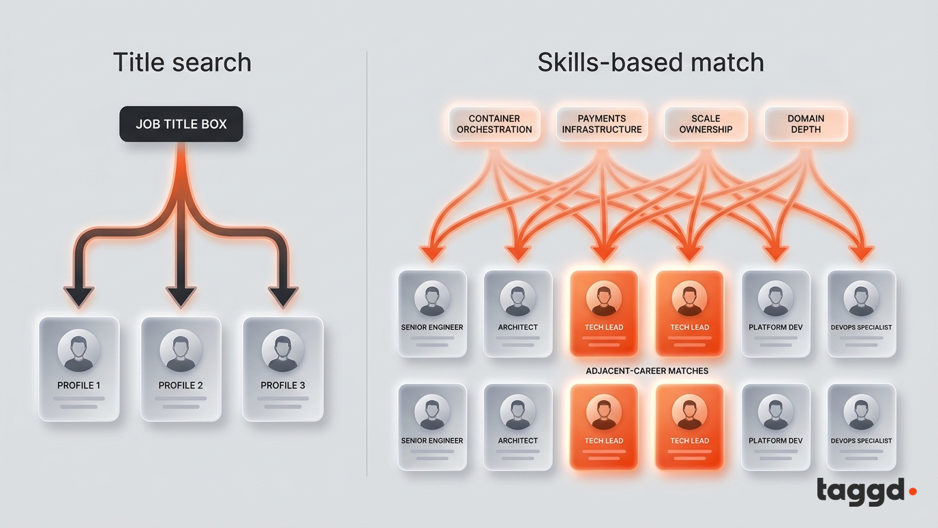
AI can improve passive candidate sourcing by helping recruiters identify professionals beyond exact job-title matches, explore adjacent talent pools, and prioritize profiles against hiring requirements. It can analyze skills, experience, and role-related information across multiple candidate sources, making discovery more focused and structured.
1. Skills-Based Matching
Traditional searches often depend on job titles and specific keywords. AI can broaden this approach by identifying relationships between skills, responsibilities, and experience, even when candidates use different terminology.
For example, a search for a product marketing professional may identify candidates with titles such as Growth Marketing Manager, Go-to-Market Manager, or Product Strategy Manager. Their experience in positioning, product launches, market research, and sales enablement may align with the role despite differences in job titles.
This helps recruiters discover potentially relevant professionals without treating different titles as interchangeable. Their actual experience must still be assessed against the hiring requirements.
2. Talent Mapping
AI can support talent mapping by organizing information about skills, industries, organizations, and talent markets. This helps recruiters explore where specific capabilities are concentrated and identify adjacent talent pools.
For example, a search for payment infrastructure professionals could extend across banks, fintech companies, payment technology providers, and businesses managing large transaction volumes.
Market-level intelligence can also provide context on talent availability, compensation benchmarks, and hiring feasibility. These insights inform sourcing decisions but do not replace individual candidate research.
3. Multi-Pool Search
AI-powered sourcing can help recruiters explore multiple candidate pools instead of relying on a single platform or applicant category. Depending on available data and integrations, these may include active candidates, passive professionals, and individuals previously engaged by the recruitment team.
This can surface relevant profiles that might otherwise remain undiscovered and help recruiters revisit candidates whose experience aligns with new requirements.
The usefulness of multi-pool search depends on the quality and recency of candidate information. Recruiters must also ensure that candidate data is accessed and used in accordance with applicable privacy requirements and communication preferences.
4. Recruiter Validation
AI-generated matches and recommendations are inputs for recruiter review, not final assessments of candidate suitability. A profile may show relevant skills and experience but lack important context about the person’s responsibilities, career priorities, availability, or interest in a new opportunity.
Recruiters must validate relevant information and assess whether the candidate’s experience aligns with the role before proceeding.
As organizations increasingly use AI to support candidate sourcing, the focus is shifting from automating individual tasks to building more integrated recruitment capabilities. Taggd’s AI-native recruitment model brings this approach to life through TARA, its agentic AI recruitment engine. One of its specialized agents, the Candidate Sourcing Agent, uses approved candidate personas and hiring requirements to discover and prioritize profiles across active, passive, and previously engaged talent pools. It also surfaces fit signals and match rationale to support recruiter review.
AI makes candidate discovery more structured and scalable. Its role is to help recruiters find and prioritize potentially relevant talent, allowing them to focus on informed evaluation and meaningful engagement.
How to Engage Passive Candidates Effectively
Engaging passive candidates requires more than sending a job description. Since they may not be actively looking for a new role, recruiters need to explain why the opportunity aligns with their experience and career priorities. Personalized communication and thoughtful follow-ups can turn an initial approach into a meaningful conversation.
1. Personalize the Outreach
An outreach message is more relevant when it demonstrates an understanding of the candidate’s professional background. Reference skills, projects, achievements, or responsibilities relevant to the role.
Personalization should rely on relevant professional information, not assumptions about a person’s motivations or willingness to change jobs. The aim is to establish a credible reason for connecting and give candidates enough context to decide whether to continue.
2. Structure the Message Around Relevance
An effective first message should be concise and give candidates a clear reason to respond. Focus on four elements:
- A relevant introduction: Explain who you are and why you are reaching out.
- A specific reason for contact: Connect the candidate’s experience to the role.
- An overview of the opportunity: Briefly describe the role or its professional challenge.
- A clear next step: Invite the candidate to have a short conversation or learn more.
The first message should open a conversation, not seek an immediate commitment. Details about compensation, responsibilities, and location can follow as the discussion progresses.
3. Follow Up with Context and Timing
A candidate may not respond to the first message, particularly if they are not actively exploring opportunities. A considered follow-up can bring the opportunity back to their attention, but repeated generic reminders can damage the candidate experience.
Set a follow-up cadence based on the communication channel, role urgency, and any response received. Each follow-up should add context rather than repeat the original message. If a candidate is interested but not ready to move forward, ask whether they would be open to staying in touch. Respect and record any request for no further contact.
4. Use AI to Support Candidate Outreach
As candidate volumes increase, maintaining personalized communication across a large talent pool can become difficult to manage manually. AI can support more consistent interactions, conduct initial conversations, and help recruiters understand candidate interest and preferences.
Recruitment teams can use AI-enabled candidate outreach solutions to manage these interactions at scale. One example is Taggd’s TARA Candidate Outreach Agent, which is part of Taggd’s broader AI-native recruitment model. Through personalized WhatsApp and voice conversations, the agent helps validate initial interest and capture preferences such as availability, notice period, compensation expectations, and location.
AI-supported outreach does not replace the recruiter relationship. Recruiters remain responsible for interpreting responses, addressing role-specific questions, managing expectations, and deciding how to progress the conversation.
Effective passive candidate engagement depends on the relevance of the opportunity and the quality of the interaction. A thoughtful approach and respectful follow-ups can build relationships that remain valuable beyond a single hiring requirement.
How to Maintain and Measure a Passive Candidate Pipeline
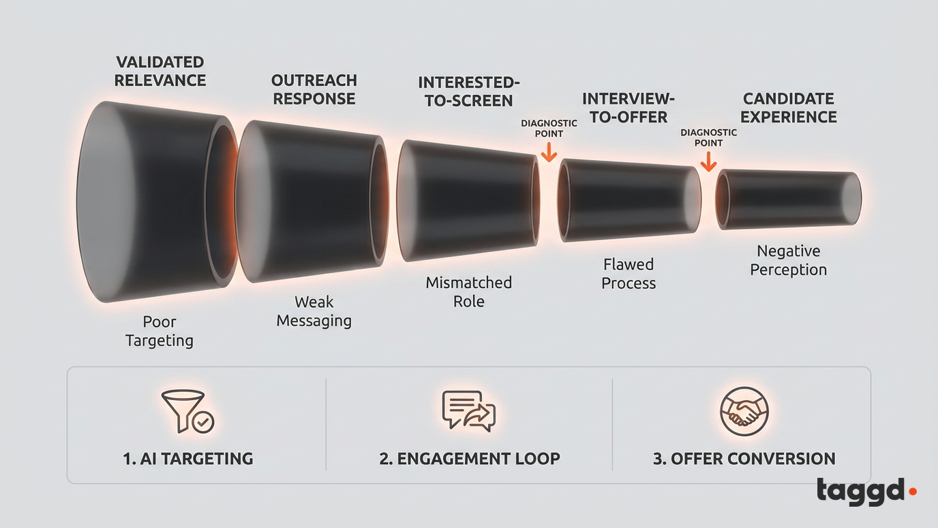
A passive candidate pipeline needs consistent maintenance to remain useful beyond an individual hiring requirement. Identifying relevant professionals is only the beginning. Recruiters must maintain accurate candidate information, record previous interactions, understand changing preferences, and track how candidates progress through the sourcing and engagement process. This helps recruitment teams build continuity across searches and make better-informed sourcing decisions.
1. Maintain Candidate Relationships
Passive candidates may not be ready to consider a new opportunity when recruiters first contact them. Maintaining a professional relationship can make it easier to reconnect when a relevant role becomes available.
Recruiters should maintain records of:
- Candidate skills, experience, and professional background.
- Previous conversations and opportunities discussed.
- Stated career interests and role preferences.
- Location, compensation, and other relevant requirements shared by the candidate.
- Communication preferences, including any request to limit or stop further contact.
These records should be updated when new information becomes available. Recruiters should not treat historical information as confirmation of a candidate’s current interests, availability, or willingness to consider a role.
Relevant employer content, industry updates, and occasional professional check-ins can help maintain relationships. Communication should offer value to the candidate rather than become a series of repetitive recruitment messages.
2. Maintain Pipeline Continuity
A passive candidate pipeline should remain useful even when a vacancy is closed or put on hold. Candidates who were not selected, declined an opportunity, or were not ready to move at the time may still be relevant for future requirements.
Recruiters can support pipeline continuity by:
- Recording the outcome of each candidate interaction.
- Categorizing candidates by skills, experience, and relevant talent pools.
- Maintaining clear records of candidate status and previous recruitment stages.
- Recording whether candidates are open to future opportunities.
- Revisiting relevant candidates when new requirements arise.
This creates a more structured approach to candidate relationship management and reduces the need to restart research for every hiring requirement.
Pipeline continuity also depends on database quality. Outdated information, duplicate profiles, and missing interaction records can make a candidate database less reliable. Recruitment teams should establish processes for reviewing records, removing duplicates, and following applicable data protection requirements.
3. Measure Sourcing Effectiveness
Measuring passive candidate sourcing requires more than counting profiles identified. Recruitment teams should assess whether sourcing activity generates relevant candidates, meaningful conversations, and progress against hiring requirements.
Useful metrics include:
- Relevant profiles identified: Profiles that meet the initial role-related sourcing criteria.
- Profile-to-contact rate: The proportion of identified profiles recruiters decide to approach.
- Outreach response rate: The proportion of contacted candidates who respond.
- Positive response rate: The proportion of contacted candidates who express interest in learning more about the opportunity.
- Candidate progression rate: The proportion of candidates who express interest and progress to the next defined recruitment stage.
- Source effectiveness: The number of relevant candidates generated by each sourcing channel, assessed alongside the proportion of contacted candidates who express interest.
These metrics should be interpreted together. A high response rate does not necessarily indicate strong sourcing effectiveness if the candidates responding are not relevant to the role. Similarly, a large number of identified profiles has limited value if few meet the hiring requirements.
Recruitment teams should define consistent measurement periods, stages, and denominators when comparing performance. This helps identify which talent pools and sourcing channels are producing relevant candidates and where improvements may be needed.
The value of recruitment measurement lies in how teams use the information to improve delivery. As part of Taggd’s AI-Native Recruitment Model, TARA Pulse supports Forward-Deployed Recruiters with insights into recruitment performance, candidate engagement, and pipeline health. These insights help them identify bottlenecks and respond to emerging hiring risks.
Over time, consistent pipeline management and performance measurement help recruitment teams identify which talent pools remain relevant, where candidate engagement needs attention, and how sourcing strategies should adapt to changing hiring requirements.
Where Human Expertise Matters in AI-Powered Passive Sourcing
AI can help recruiters identify professionals whose experience aligns with hiring requirements. However, turning that discovery into meaningful recruitment progress requires an understanding of people, their professional circumstances, and the context behind their experience. Human expertise helps recruiters make these connections and align potential candidates with actual hiring needs.
1. Understanding Candidate Context and Motivation
A candidate’s professional profile provides only part of the picture. It may describe their skills, experience, and career history, but rarely captures their current priorities, reasons for staying in a role, or circumstances that might influence a career move.
Recruiters establish this context through direct conversations. They can understand what a candidate values in a potential opportunity, whether the role aligns with their career direction, and what considerations might affect their decision.
This distinction is particularly important when engaging passive candidates. A professional may have the experience required for a role but have no interest in changing jobs. Recruiters must recognize that difference rather than treating profile relevance as an indication of intent.
2. Evaluating Experience Beyond Profile Matches
A candidate’s job title and listed skills do not always reveal the full scope of their professional experience. Two professionals may have similar profiles but very different levels of responsibility, project exposure, and practical expertise.
Recruiters can explore these differences by discussing specific projects, decisions, achievements, and the candidate’s contribution to previous roles. This helps establish whether their experience matches the actual demands of the position.
This evaluation also helps identify transferable experience that may not be immediately apparent from a profile. Human judgment allows recruiters to recognize relevant capabilities across different roles, functions, and industries without assuming that similar titles represent equivalent experience.
3. Aligning Candidate Expectations with Hiring Requirements
Recruiters connect candidate expectations with the hiring manager’s requirements. A candidate may meet the technical criteria but have expectations around compensation, location, seniority, responsibilities, or working arrangements that do not align with the opportunity.
Understanding these considerations early helps recruiters communicate the role accurately and identify potential gaps before the process progresses. It also allows them to bring relevant market and candidate feedback to hiring managers when requirements need to be clarified or reconsidered.
As the search progresses, recruiters may need to revisit the hiring brief based on what they learn about the available talent market and candidate responses. This helps keep sourcing activity aligned with realistic hiring requirements.
4. Owning the Recruitment Outcome
Passive candidate sourcing is part of a wider recruitment process. Identifying a relevant professional and initiating contact are important steps, but they do not guarantee that the person will progress or join the organization.
Moving from candidate discovery to a successful hiring outcome requires someone to connect the different parts of the process. This means understanding the hiring mandate, aligning candidate expectations with business requirements, coordinating stakeholder decisions, and addressing challenges as they arise. It also means taking responsibility for delivery rather than treating sourcing activity as an isolated task.
At Taggd, this accountability is built into the AI-Native Recruitment Model through the Forward-Deployed Recruiter (FDR). The FDR brings recruitment expertise and human judgment to the hiring mandate, using the capabilities of TARA’s specialized AI agents to support recruitment execution while managing the client relationship, coordinating stakeholders, and owning delivery outcomes.
Technology can expand the reach and scale of passive candidate sourcing, but its value depends on how effectively it is applied to the hiring mandate. Recruiter expertise connects candidate discovery with informed decisions, stakeholder alignment, and accountable recruitment delivery.
How Taggd Combines AI and Recruitment Expertise for Passive Candidate Sourcing
Taggd’s AI-Native Recruitment Model combines agentic AI, talent intelligence, recruitment performance insights, and Forward-Deployed Recruiter (FDR) expertise to support hiring across the recruitment lifecycle. AI supports recruitment execution and provides actionable intelligence, while the FDR retains ownership of the hiring mandate, client relationship, and delivery outcomes.
At the center of this model is TARA, Taggd’s agentic AI recruitment engine. Its specialized agents support different recruitment functions, from defining hiring requirements and discovering talent to candidate engagement, screening, interviews, and decision support.
The TARA Hiring Intake Agent helps translate hiring requirements into structured candidate criteria. The TARA Candidate Sourcing Agent uses these requirements to discover and prioritize relevant profiles across active, passive, and previously engaged talent pools. The TARA Screening Agent supports the evaluation of candidate profiles against established requirements.
Once relevant candidates are identified, the TARA Candidate Outreach Agent supports personalized WhatsApp and voice conversations to validate initial interest and capture candidate preferences. Further along the recruitment process, the TARA Decision Support Agent consolidates evaluation insights to inform hiring decisions.
These agents operate alongside TARA Insights and TARA Pulse. TARA Insights provides talent market intelligence to inform hiring strategies, while TARA Pulse gives FDRs visibility into recruitment performance, candidate engagement, and emerging delivery risks. Together, they connect talent discovery and recruitment execution with the wider hiring mandate.
For passive candidate sourcing, this means identifying relevant professionals is not treated as an isolated activity. Candidate discovery and engagement feed into a broader recruitment process in which candidate suitability, hiring priorities, and progression decisions remain connected. FDRs apply business context and human judgment throughout, retaining accountability for the recruitment outcome.
Explore Taggd’s AI-Native Recruitment Model to understand how TARA’s capabilities and Forward-Deployed Recruiters support hiring across the recruitment lifecycle.
FAQs
What is passive candidate sourcing?
Passive candidate sourcing is the process of identifying and approaching professionals who are not actively looking for a new job but may consider a relevant opportunity. It involves researching talent pools, evaluating professional experience, and initiating conversations to understand whether an individual is open to exploring a new role.
How does AI help recruiters find passive candidates?
AI helps recruiters identify potential passive candidates by analyzing available professional information, including skills, experience, qualifications, and transferable capabilities. It can surface relevant profiles beyond exact job-title matches, prioritize potential candidates against role requirements, and help recruiters determine which profiles warrant further review.
How can recruiters identify passive candidates with transferable skills?
Recruiters can identify candidates with transferable skills by evaluating the capabilities developed through previous roles, responsibilities, and projects rather than relying exclusively on job titles. AI can help surface professionals from adjacent functions or industries, while recruiters validate whether their experience aligns with the requirements of the position.
Can AI determine whether a passive candidate is interested in a job?
AI can support initial candidate engagement by asking relevant questions and collecting information about interest and preferences. However, a candidate’s willingness to respond does not necessarily indicate an intention to change jobs. Recruiters must interpret responses and establish whether the individual is genuinely open to exploring the opportunity.
How can recruiters use AI for passive candidate sourcing responsibly?
Recruiters should use clearly defined hiring criteria, review AI-generated recommendations, and validate candidate information before making sourcing decisions. They should also monitor potential bias, follow applicable data protection requirements, respect candidate communication preferences, and honor opt-out requests. Human judgment should remain central to candidate evaluation and engagement.