Every recruitment metric that’s supposed to signal a healthier hiring engine is moving in the right direction.
Offer-to-join conversion is up. AI adoption has gone from cautious experimentation to near-universal use. Recruiters are processing more candidates, faster, with less manual effort than at any point in the last few years.
And yet, ask a CHRO whether hiring feels more predictable this year than last, and the honest answer is often no.
That gap, between a system that’s measurably more efficient and an outcome that still feels uncertain, is worth sitting with.
It’s the most interesting finding in Taggd’s GCC Report 2026, and it points to a mistake a lot of GCCs are making without realizing it: optimizing the parts of hiring that are easy to measure, while leaving the part that actually determines whether a hire works out, quality, to chance.
Get the full data: Download the GCC Talent Lab Report 2026 for the complete hiring outcomes dataset.
Why Quality of Hire Metrics Matter More Than Hiring Speed
Start with what’s genuinely improved, because it has.
Offer-to-join conversion now averages around 80% across GCCs, up from a 70–75% benchmark a year ago. More than half of organizations report conversion above 85%. That’s meaningful.
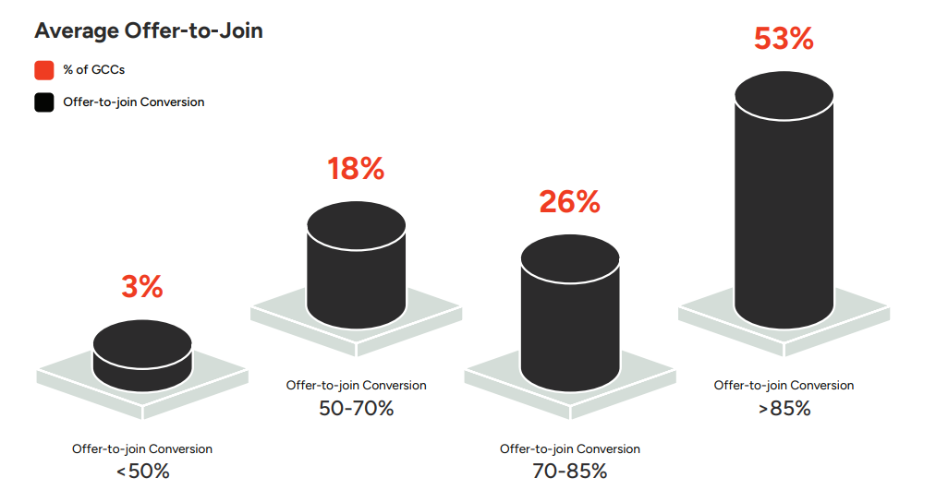
Offer-to-join is the most expensive point in the funnel to lose a candidate, by the time someone withdraws at this stage, a GCC has already spent recruiter time, hiring manager bandwidth, interview panels, and often onboarding or relocation planning. A five-to-ten-point improvement here isn’t cosmetic. Its real cost is avoided.
AI adoption tells a similar story. A year ago, 45% of GCCs were still in the planning stage, and 5% weren’t considering it at all. That hesitation has nearly disappeared. Resume screening (69%) and JD creation (64%) are now AI-assisted at most GCCs. Assessment, sourcing, and scheduling all show adoption above a third of organizations. The technology conversation moved fast.
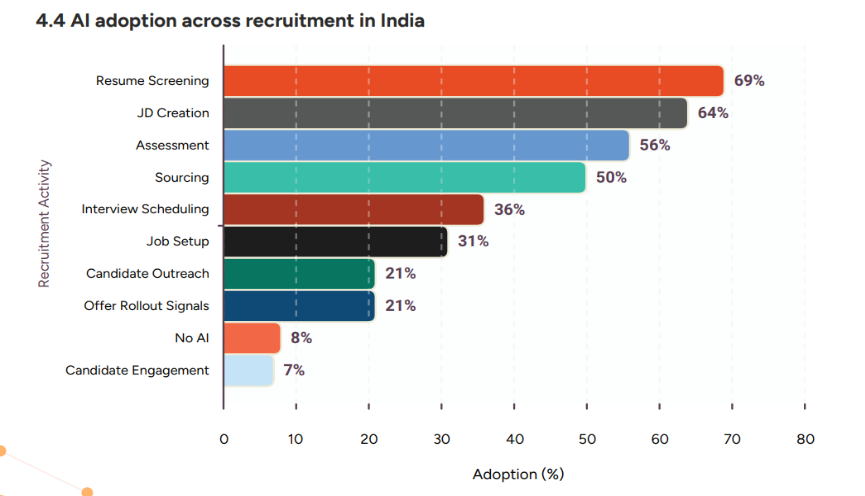
So why doesn’t any of this show up as a better answer to the question that matters most: are you hiring the right people?
Why Time to Fill Is Still a Problem for Critical GCC Roles
Two cracks show up as soon as you look past the averages.
First, the roles that matter most are still slow. Nearly half of all critical vacancies, 47%, take 30 to 60 days to fill. That’s the middle of the distribution.
The edges tell the real story: 30% of critical roles take 60 to 90 days, and 18%, nearly one in five, take more than three months.
These delays concentrate almost entirely in specialist categories: advanced AI architecture, cybersecurity, cloud engineering.
Meanwhile, only 5% of critical vacancies close in under 30 days at all, and the roles in that thin sliver skew toward standardized, early-career positions.
The funnel got faster overall. The roles a GCC’s mandate actually depends on didn’t.
Second, AI adoption hasn’t translated into AI impact. Only 20% of GCCs report a tangible, measurable return from their AI investment in hiring.
Another 26% say it’s too early to tell, a cohort nearly the same size as those seeing moderate impact.
Most GCCs are 12 to 18 months into deployment, which explains some of this. But it doesn’t fully explain why “moderate” is the most common answer, even among GCCs that adopted early.
Why AI in Recruitment Isn’t Yet Improving Hiring Outcomes
Most GCCs didn’t deploy AI recruitment solutions as one system.
They deployed it stage by stage: a screening tool here, a sourcing tool there, scheduling automation somewhere else, each one solving its own slice of the funnel in isolation.
That’s a reasonable way to start, but it’s also why the impact stalls.
A screening conversation picks up a signal about a candidate’s compensation expectations. A sourcing tool notices where demand is spiking for a particular skill.
In a connected system, that information would shape the next decision automatically. In most GCCs today, it doesn’t. It sits in a tracker, an inbox, or a recruiter’s memory, and someone has to manually reconstruct it before it’s useful again.
Every individual task gets faster. The system underneath doesn’t get any smarter. That’s the gap between activity and outcome, and it’s exactly what shows up in the data as “moderate impact.”
The fix isn’t more AI at more stages. It’s AI that connects the stages that already exist, where what a screening tool learns actually shapes how the next offer gets structured, and where every search makes the next one easier instead of starting from zero.
That’s the shift toward agentic hiring systems: agents handle execution and coordination, and recruiters move into a governance role, still owning the decisions that matter, but no longer reconstructing context by hand between every stage.
It’s an early model in India.
The GCCs experimenting with it now are the ones most likely to close the gap between adoption and proof before their competitors do.
What Quality of Hire Really Means for GCCs
Ask ten GCC leaders to define a quality hire, and you’ll get ten different answers, 90-day productivity, ownership readiness, succession potential, and long-term retention.
The definitions vary. But underneath them is a pattern worth naming: most leaders describe quality through what happens after someone joins. Far fewer describe it through the decisions made before an offer goes out.
That’s backwards, or at least incomplete. Quality of hire has two halves, and most GCCs are only building the second one.
Pre-hire quality is a market intelligence problem. Before a single candidate is shortlisted, a GCC can already assess where the relevant talent sits, what it costs at that location, what experience level the role can realistically command, what’s motivating people in that pool to move right now, which sourcing channels tend to produce better fits, and flight risk, how likely a given candidate is to leave their current role, based on tenure, pay band, and how competitive their current employer is.
Used before a requisition opens, this improves the odds of making the right call. Used only after hiring is underway, it becomes a diagnostic for bottlenecks you’ve already hit, useful, but reactive.
Post-hire quality is measurement, not prediction. Once someone joins, quality stops being a forecast and becomes evidence, and that evidence needs to be collected on a defined rhythm, not discovered at the annual review.
Most organizations check in at 30, 60, and 90 days, then again at 180 and 365. That evidence builds in layers:
- Immediately: retention. Is the person still there at each checkpoint?
- Short to medium term: performance against what was promised at hire.
- Long term: contribution, whether the person is actually moving the business forward, not just doing the job.
Most GCCs run the second half of this well. Far fewer run the first half with any rigor. That imbalance is a big part of why “quality” still feels like a guess even in organizations with strong funnel metrics.
You can’t measure your way to a good hire after the fact if nothing was assessed before the offer went out.
How to Improve Quality of Hire Metrics Across the Hiring Funnel
GCCs have gotten better at moving candidates through the funnel and better at using AI to handle repetitive tasks.
Neither of those improvements, on their own, produces a better hire. They just produce a faster process around the same hiring decision quality as before.
What actually closes the gap is connecting three things that most GCCs still treat separately: pre-hire market intelligence, the AI tools running the funnel itself, and structured post-hire measurement.
Right now, most organizations have pieces of all three and a system that connects none of them. The GCCs pulling ahead aren’t the ones with the most AI tools. They’re the ones where a signal picked up at screening still matters by the time someone’s 90 days in.
FAQs
Why hasn’t AI adoption improved hiring outcomes for most GCCs?
Most GCCs deployed AI stage by stage, with each tool solving its own part of the funnel in isolation. Signals picked up at one stage rarely carry forward automatically to the next, so individual tasks speed up without the overall system getting smarter. Only 20% of GCCs report tangible impact from AI in hiring so far.
What’s the difference between pre-hire and post-hire quality of hire?
Pre-hire quality is a prediction, built from market intelligence like talent location, cost, experience level, and flight risk, gathered before a requisition opens. Post-hire quality is measurement, tracked through checkpoints at 30, 60, 90, 180, and 365 days across retention, performance, and long-term contribution.
What is agentic hiring, and how is it different from current AI recruitment tools?
Agentic hiring systems let AI agents handle execution and coordination across the full hiring funnel, carrying signals from one stage to the next, while recruiters shift into a governance role overseeing the decisions that matter. It’s designed to fix the “moderate impact” problem caused by isolated, stage-by-stage AI tools.
Is offer-to-join conversion still a useful metric if critical roles are still slow to fill?
Yes, but it’s not sufficient on its own. Offer-to-join measures funnel efficiency once a candidate is in the process. It says nothing about how long it took to find the right candidate in the first place, which is where most of the delay in critical, specialized roles actually sits.
This is the systemic view. For the full breakdown of offer-to-join trends, time-to-fill benchmarks, and AI adoption by funnel stage:
Download the GCC Talent Lab Report 2026