
An appointment letter is the employer-issued document that formally confirms a person’s employment and sets out the terms of service: designation, joining date, pay, probation, work location, notice period and the policies that govern the role.
A standard appointment letter format runs in a fixed order: company letterhead, date, employee name and address, subject line, confirmation of appointment, numbered terms, authorized signature, and an acceptance block the employee signs and returns.
The part most teams get wrong is not the layout. It is what sits inside clause 8.
A letter that confirms a designation but leaves notice period, probation terms and compensation structure vague creates the exact gaps that turn into disputes a year later.
So, this piece gives you the format first, then the reasoning behind each clause, then samples for the four employment types of HR teams issue most.
What Is an Appointment Letter?
An appointment letter is a written confirmation of employment issued by the employer after a candidate accepts an offer.
It records who employs whom, in what role, from when, on what pay, and under which conditions. Unlike an offer letter, which signals intent to hire, the appointment letter is signed by both parties and becomes the reference document for the employment relationship.
That signature block is the whole point. Once the employee signs and returns a copy, both sides have agreed in writing the same set of terms.
If a dispute comes later over notice period, probation extension or salary structure, the appointment letter is the first document anyone reads.
It also does quiet administrative work. Employees produce it for EPF and ESI enrolment, visa paperwork, home and vehicle loan applications, and background verification during their next job search.
Keep a signed copy in the employee file for the full life of the employment and for several years after exit; a letter you cannot produce is a letter that does not exist.
Recent coverage of India’s labour codes has pushed this further into the mainstream. Reporting by The Economic Times in June 2026 noted that appointment letters must mention job role, workplace and other key conditions, which moves written appointment documentation from good practice toward an expectation.
Check the rules that apply to your establishment and state rather than assuming one national rule covers everyone.
What Is the Format of an Appointment Letter?
The format of an appointment letter follows a formal business letter structure with a numbered terms section in the middle. Here is the full order, and then the template itself.
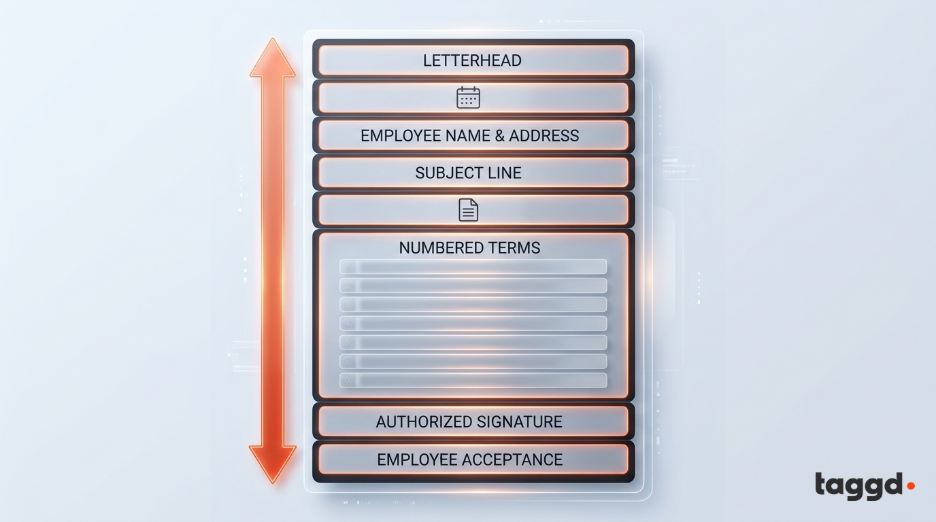
Company letterhead with legal entity name, registered address, phone, email and website
- Date of issue
- Employee name and residential address
- Subject line naming the position
- Salutation and the appointment statement
- Numbered terms and conditions
- Closing line and authorized signatory
- Employee acceptance block with signature and date
Use this template as your base. Everything in square brackets is a field you replace.
APPOINTMENT LETTER
Date: [DD/MM/YYYY]
To,
[Employee Name]
[Employee Address]
Subject: Appointment Letter for the Position of [Designation]
Dear [Employee Name],
We are pleased to appoint you as [Designation] at [Company Name], effective from [Date of Joining]. You will be part of the [Department Name] department and will report to [Reporting Manager / Designation].
Your employment will be governed by the following terms and conditions:
1. Designation and Responsibilities
You will be appointed as [Designation]. Your roles and responsibilities will be communicated by your reporting manager and may be revised based on business requirements.
2. Date of Joining
Your employment will commence on [Date of Joining].
3. Compensation
Your annual Cost to Company (CTC) will be INR [Amount], subject to applicable taxes and statutory deductions. The detailed salary structure will be shared separately or attached as an annexure.
4. Probation Period
You will be on probation for [Duration], during which your performance and suitability for the role will be assessed. The terms of confirmation will be communicated by the company.
5. Work Location and Working Hours
Your initial work location will be [Location]. Your working hours will follow the company’s applicable policies.
6. Leave and Benefits
You will be eligible for leave and other employee benefits in accordance with the company’s policies and applicable laws.
7. Confidentiality
You are required to maintain the confidentiality of the company’s business information, client information and other sensitive data during and after your employment, as applicable.
8. Notice Period and Termination
The notice period and conditions governing termination of employment will be as specified in your employment agreement and applicable company policies, subject to applicable laws.
9. Company Policies
You are expected to comply with the company’s policies, code of conduct and applicable workplace guidelines.
Please sign and return a copy of this letter as confirmation of your acceptance of the above terms and conditions.
We welcome you to [Company Name] and look forward to your contributions.
Sincerely,
[Authorised Signatory Name]
[Designation]
[Company Name]
Employee Acceptance
I, [Employee Name], have read and understood the terms and conditions mentioned in this appointment letter and accept the appointment.
Signature: __________________
Date: __________________
This is a general template, not a complete employment contract. Adapt the clauses to the role, the employment type, the labour laws that apply and your own policies. Do not present every clause as universally mandatory.
Appointment letter format in Word
Most HR teams keep this as an editable .docx so the fields can be merged from the HRIS. A few practical notes from building these:
- Put the letterhead in the Word header, not the body, so it repeats on page two when the clause list runs long.
- Use real numbered-list styles rather than typed numbers. Clauses get inserted and deleted; manual numbering breaks silently.
- Keep bracketed fields in a single distinct color so a missed field is visible before the letter goes out.
- Export to PDF before sending. A Word file is editable by the recipient; a PDF is not.
What Must an Appointment Letter Include, and Why Does Each Clause Matter?
Every clause in the letter is doing a job. This table maps the clause to what it protects and the red flag when it is missing. Scan the right-hand column first: those are the gaps that create disputes.
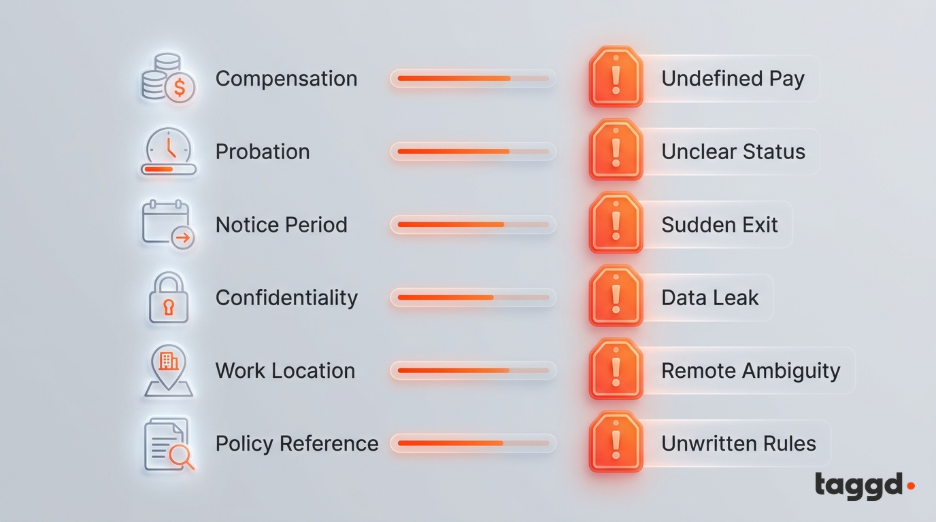
| Clause | What it must state | Why it matters | Red flag if missing |
| Designation and department | Exact title, function, reporting line | Defines scope and the comparison set for pay reviews | Role creep with no agreed baseline |
| Date of joining | Calendar date employment starts | Anchors seniority, gratuity, leave accrual | Service length becomes arguable |
| Work location | Named site, plus mobility wording if any | Sets which state’s rules apply | Transfer disputes |
| Compensation | CTC or gross, with breakup in letter or annexure | Prevents the single most common pay dispute | Employee reads gross as take-home |
| Probation period | Duration and what happens on confirmation | Gives the employer an assessment window | Confirmation becomes automatic by default |
| Working hours | Shift pattern and applicable policy | Overtime and attendance basis | Weak footing on attendance action |
| Leave and benefits | Reference to the policy document | Links the letter to the live policy | Employees assume unlimited or carry-forward |
| Confidentiality | Scope of protected information, during and after | Protects client data and IP | Hard to act on a leak |
| Notice period | Duration, both directions, buyout terms | Protects handover and recovery claims | Recovery claim becomes difficult |
| Termination | Grounds and process | Sets a defensible exit route | Exits escalate |
| Company policies | Code of conduct, acceptance of policy manual | Pulls the whole rulebook into the contract | Each rule argued separately |
| Signature and acceptance | Authorized signatory plus employee sign-back | Makes it a two-way agreement | Only an employer statement, not a mutual one |
Two clauses deserve more than a row in a table.
Compensation. Name the figure and name the type. “CTC of INR 12,00,000” and “gross monthly salary of INR 1,00,000” describe very different take-home amounts, and candidates who confuse the two feel misled in month one. Attach the breakup as an annexure and reference the annexure in the letter so the two travel together.
Notice period. State it in both directions. A letter that says the employee must give 60 days but says nothing about the employer is lopsided and reads badly in any dispute. Also say what a buyout costs and how it is calculated.
One honest caution: this letter summarizes rather than reproduces your policies. Leave, benefits, and conduct rules live in full policy documents, and summaries routinely omit the detail that later causes arguments. Hand new joiners the full policy manual on day one and get a signed acknowledgement of that too.
Appointment Letter Samples for Different Employment Types
The skeleton stays the same across employment types. What changes is which clauses are mandatory, which are optional, and which have to be reworded. This table tells you what to adjust before you reuse the master template.
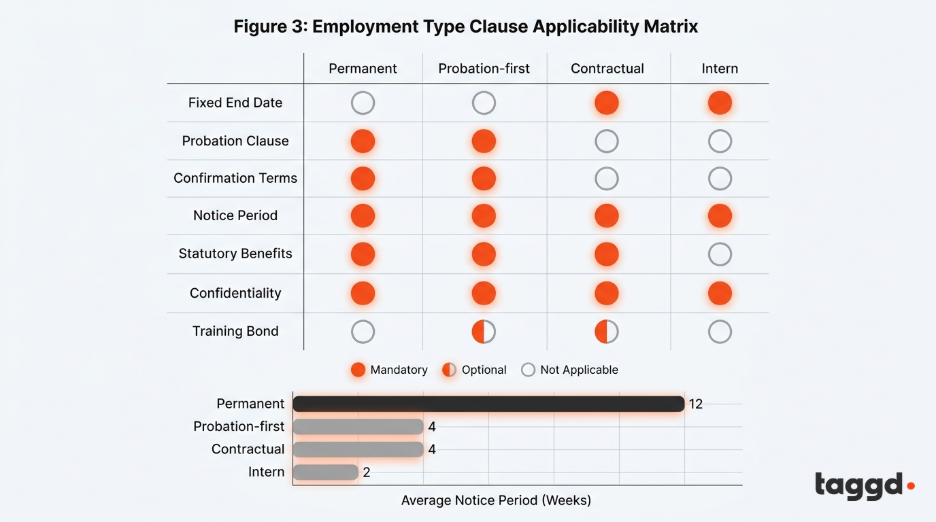
| Clause | Permanent | Probation-first | Contractual | Intern / fresher |
| Fixed end date | Not applicable | Not applicable | Mandatory | Mandatory |
| Probation clause | Usual | Core clause, state review date | Usually dropped | Usually dropped |
| Confirmation terms | Reference only | Must be explicit | Not applicable | Not applicable |
| Notice period | Mandatory, both ways | Shorter during probation | Early-exit clause instead | Short or none |
| Statutory benefits | Full, per law | Full, per law | Depends on engagement type | Stipend terms stated clearly |
| Confidentiality | Mandatory | Mandatory | Mandatory, often tighter | Mandatory |
| Training bond, if any | Rare | Rare | Rare | State cost and recovery, or say none |
Short wording you can lift for each case:
Permanent appointment: “Your appointment is on a permanent basis, effective [Date of Joining], and will continue until terminated by either party in accordance with Clause 8.”
Probation-first appointment: “You will be on probation for six months from your date of joining. Your performance will be reviewed on or before [Review Date]. Confirmation in writing by the company is required; continued employment beyond the probation period without written confirmation does not imply confirmation.” That last line is the one teams forget, and it is the one that matters.
Contractual appointment: “We are pleased to appoint you as [Job Title] at [Company Name] for a contractual period of [Duration], effective from [Start Date] and ending on [End Date], unless extended in writing or terminated earlier under Clause 8.”
Fresher or trainee appointment: “You are appointed as a Graduate Trainee for a training period of [Duration]. Your monthly stipend will be INR [Amount]. On successful completion, you may be considered for appointment as [Designation], subject to performance and business need.” Say “may be considered”, not “will be confirmed”, unless you intend to be held to it.
How to Write an Appointment Letter?
Writing one takes about fifteen minutes once the master template exists. Follow this order and nothing gets dropped.
- Pull the agreed terms from the offer stage. Designation, CTC, joining date, location, reporting manager, probation length. Pull them from the system of record, not from memory or an email thread.
- Check them against the offer letter, line by line. This is the step that prevents the most expensive mistake in the whole process. More on that below.
- Pick the right variant. Permanent, probation-first, contractual or trainee. Starting from the wrong master is how a fixed-term clause ends up in a permanent letter.
- Fill every bracketed field. Then search the document for “” before you move on.
- Attach the salary annexure and reference it by name inside Clause 3.
- Get the authorized signatory to sign. Usually the HR head or a designated representative with authority to confirm employment terms.
- Send as PDF with a clear acceptance deadline, plus the policy manual and any forms the joiner needs.
- File the signed copy in the employee record and log the acceptance date.
When the offer letter and appointment letter disagree
This happens more often than HR teams admit, usually because a negotiated change late in the offer stage never made it into the appointment template.
The employee signs, notices the gap in week three, and now you are arguing about which document wins.
The practical rule: the later, signed, mutually accepted document generally carries more weight, but that does not make the problem go away. A candidate who accepted on the strength of the offer letter has a fair complaint. Fix it the same way every time:
- Treat the offer letter as the source of truth for anything commercial you already promised.
- If the appointment letter must differ, say so in writing before sending it, with the reason, and get acknowledgement.
- If the discrepancy is found after signing, issue a written addendum correcting it rather than quietly reissuing the letter. The addendum references the original letter, states the corrected clause, and is signed by both parties.
An addendum is also the right tool for later changes: promotion, transfer, revised CTC, or a change of reporting line. Do not rewrite history by reissuing a backdated letter.
Can an appointment letter be signed electronically?
Yes, in most cases. E-signature on a PDF is widely used for appointment letters, and for high-volume hiring it is the only workable route.
Two cautions: keep the audit trail from the signing platform, since the trail is the evidence rather than the image of the signature, and check whether your sector or state has a stricter requirement for certain employee categories before you standardize on it.
How Does an Appointment Letter Differ From an Offer, Joining and Appointment Letter Documents?
Four documents circulate around a single hire, and they get used interchangeably until something goes wrong. This table separates them.
![Timeline diagram showing offer letter, appointment letter, joining letter and employment contract in sequence
| Document | Issued by | When | What it does | Legal weight |
| Offer letter | Employer | After selection, before acceptance | States the proposed role and terms, invites acceptance | Conditional; often subject to BGV and notice clearance |
| Appointment letter | Employer | On or just before joining | Confirms employment and the full terms of service | Binding once both parties sign |
| Joining letter | Employee | On the joining date | Confirms the employee has reported for duty on that date | Record of actual joining |
| Employment contract | Employer, signed by both | At or after joining | Detailed agreement, often with bonds, IP and non-compete | Fullest contractual document |
How to use the table: if you only issue one document, make it the appointment letter, because it is the only one that both confirms employment and fixes the terms. If you issue an offer letter first, keep the two consistent.
If your roles involve IP creation, client data or training bonds, add a separate employment contract rather than inflating the appointment letter into a twenty-clause legal document that nobody reads.
For a private company appointment letter format, the structure above is already correct. The difference between a small private company’s letter and a large enterprise’s letter is not the format. It is the annexures: salary breakup, policy manual acknowledgement, and in regulated sectors, a compliance declaration.
Where Appointment Letters Fit in a Faster Hiring Process
The letter is the last step of hiring and the first of onboarding, so delay here is expensive in a way that does not show up in time-to-fill.
A candidate who has accepted verbally but has nothing in writing is still in the market, and most of the market is still reachable: LinkedIn’s survey of 18,000 fully employed professionals found that 85% of the global workforce should be considered fair game, with 45% open to a recruiter approach and 25% actively looking. Every day between verbal acceptance and signed letter is a day a competitor can reach them.
The fix is a clean handoff from selection to documentation.
At Taggd, the recruitment engine is built so hiring signals from screening, interviews and evaluations land in one decision-ready view rather than scattered across inboxes, which is what lets a team move from decision to letter the same day.
The TARA Decision Support Agent consolidates candidate profiles, screening reports, interview outcomes and recruiter feedback into a single view, with Forward-Deployed Recruiters and hiring managers keeping full control over the decision itself.
The same discipline applies to the data inside the letter. Validated details such as notice period, compensation expectation and location preference are captured during candidate outreach in Taggd’s agentic AI recruitment model, which means the figures that go into Clause 3 and Clause 8 are the ones the candidate already confirmed, not numbers retyped from a recruiter’s notes.
Pre-Send Checklist: Audit the Letter Before It Goes Out
Run this before every letter leaves HR. It takes two minutes and catches the errors that cost weeks.
| Check | Pass condition |
| Letterhead | Correct legal entity name and registered address |
| Date | Issue date present and not back-dated |
| Employee details | Name spelled as on ID proof, full address |
| Designation | Matches the offer letter and the approved requisition |
| Joining date | Matches what the candidate confirmed in writing |
| Compensation | Figure stated, type named (CTC or gross), annexure attached |
| Probation | Duration stated, confirmation requires written notice |
| Work location | Named, with mobility wording if transfers are possible |
| Notice period | Stated in both directions, buyout terms clear |
| Confidentiality | Scope defined, covers post-employment where lawful |
| Policy reference | Policy manual named and attached or linked |
| Bracketed fields | Zero instances of “[” remaining |
| Signatory | Authorized person, correct designation |
| Acceptance block | Present, with space for signature and date |
| Delivery | Sent as PDF, acceptance deadline stated |
| Filing | Signed copy stored in employee record, date logged |
If a row fails, fix it before sending rather than after. Reissuing a letter is harmless on day one and awkward on day thirty.
FAQs
Is an appointment letter mandatory for every employee?
It depends on the laws, state rules and the nature of your establishment. Several labour rules require written employment details for specified categories of workers, and recent reporting on India’s labour codes points toward wider written documentation duties. Check what applies to your entity and workforce rather than assuming one rule covers all employees.
Is an appointment letter proof of employment?
Yes, it is documentary evidence of an employment relationship because it names the employer, employee, designation and terms. It does not on its own prove the person joined or is currently employed. Verification requests usually also ask for salary slips, an experience letter or a formal employment verification letter.
Can an appointment letter be issued before the joining date?
Yes, and issuing it before joining is good practice. It gives the candidate time to read and accept the terms before starting work, and it reduces the chance of a late surprise. State the expected joining date clearly, along with designation, compensation and conditions, plus the process if the date has to shift.
Who is authorized to issue an appointment letter?
The employer issues it through HR, recruitment or administration. It is signed by an HR manager, company representative or other designated signatory with authority to confirm employment terms, and printed on official letterhead. Keep a documented list of who holds signing authority for which grade of role.
Can an appointment letter be revised after it is issued?
Yes. Designation, compensation, reporting line, work location or joining date can all change. Put the change in writing as an addendum that references the original letter, get the employee’s acknowledgement or agreement, and keep both documents together in the file. Revisions must stay within the employment contract and applicable law.
What should an employee do if no appointment letter was issued?
Ask HR in writing for one and keep the request on record. In the meantime, collect whatever else evidences the employment: the offer letter, salary slips, bank credits, EPF statements, email from the reporting manager and ID card. Those together usually establish the relationship, but a written appointment letter remains the cleanest single proof.
Building a structured hiring and documentation process end to end?
Explore how Taggd’s AI-native talent fulfillment model connects selection, decision support and onboarding so offers convert and joiners actually show up.