Most advice on agility starts in the wrong place. It tells HR teams to train employees to be more adaptable, ask managers to encourage cross-functional work, and invest in continuous learning. That advice isn’t wrong. It’s incomplete.
A business doesn’t become agile because employees attend more workshops. It becomes agile when leaders can see skills clearly, move talent quickly, and hire with future capability in mind. That is why the critical question isn’t about whether agility matters. It’s about whether your organisation still operates with a recruiting mindset or has built a true talent acquisition function.
For CHROs in India, that distinction has become strategic. Recruiting fills vacancies. Talent acquisition shapes workforce capacity. In a market defined by role redesign, AI-led work changes, and uneven skill availability, the choice between the two directly affects how well your organisation builds agility skills in the workplace.
The table below makes that difference visible early.
| Dimension | Recruiting (Tactical) | Talent Acquisition (Strategic) |
| Primary aim | Fill open roles | Build long-term talent capability |
| Time horizon | Immediate hiring need | Current and future workforce needs |
| View of talent | Candidate for a job | Skills portfolio for business priorities |
| Success measure | Vacancy closure | Quality, mobility, capability alignment |
| Relationship with business | Service response | Workforce planning partner |
| Role in agility | Supports staffing | Enables redeployment, adjacency hiring, and resilience |
The Strategic Imperative for Workforce Agility in India
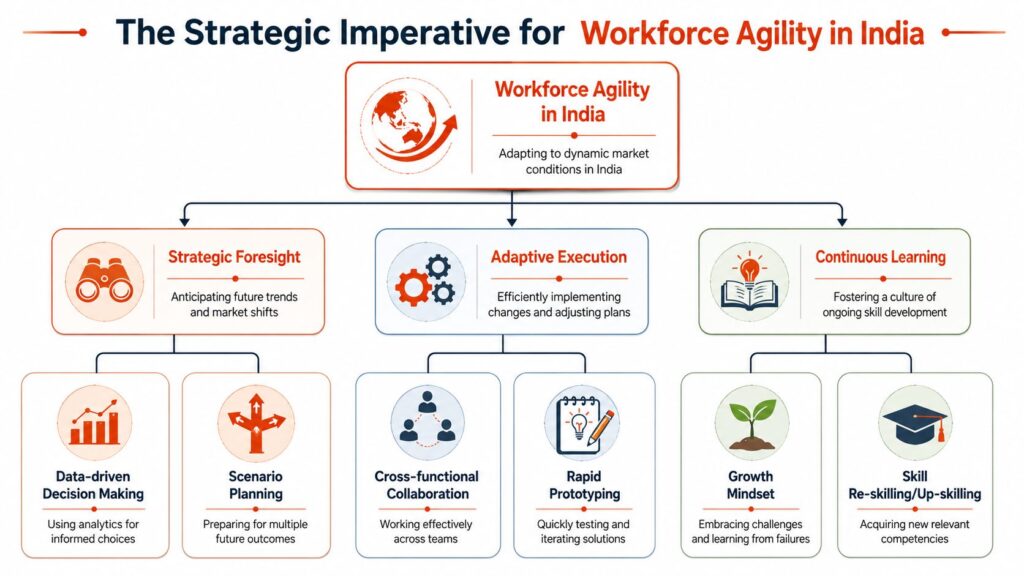
The phrase agility skills in the workplace often gets reduced to behavioural language such as flexibility, learning mindset, or comfort with change. That framing is too narrow for enterprise decision-making. If agility stays defined as a soft trait, it remains hard to measure, harder to manage, and almost impossible to embed through workforce design.
Indian HR research offers a more useful model. It treats workforce agility as three measurable dimensions: task agility, time agility, and resilience, and finds that all three have a significant positive relationship with employee performance, with an agile work environment partially mediating that effect, as detailed in this Indian workforce agility study. That matters because it shifts agility from aspiration to operating metric.
Agility is a management system, not a slogan
Task agility asks whether people can switch effectively across work units. Time agility asks whether they can respond under changing deadlines and volatile demand. Resilience asks whether they recover and continue performing after disruption. None of these are hiring buzzwords. They are workforce outcomes.
That changes the role of HR. If agility is measurable, then the talent function can’t stay confined to requisition fulfilment. It has to shape how skills are identified, assessed, and deployed across the organisation.
Practical rule: If your hiring model only answers who can fill today’s role, it won’t tell you who can absorb tomorrow’s work.
The recruiting versus talent acquisition distinction starts to matter. A recruiting-led organisation tends to hire for fit against a defined vacancy. A TA-led organisation asks a harder question: what blend of adjacent skills, learning capacity, and mobility will help the business keep performing when work changes?
Why this matters more in India
Indian enterprises operate across multiple speed zones at once. A manufacturer may be digitising plant operations while managing legacy workforce structures. A GCC may be scaling specialist teams while global priorities keep shifting. A BFSI employer may need tighter role clarity in one function and far more fluid capability deployment in another.
In that environment, agility doesn’t come from broad statements about continuous learning. It comes from disciplined capability planning. Public workforce discussions in India increasingly reflect this shift, and the broader talent conversation captured in the India Skills Report 2025 reinforces why business leaders need a more granular view of employability, mobility, and future-readiness.
A useful way to think about agility in the Indian context is through three business tests:
- Can you identify adjacent talent fast enough? When priorities shift, can leaders locate people whose capabilities transfer beyond formal job titles?
- Can you move talent without creating disruption? Redeployment only works when managers trust the underlying skill data and employees can step into work with support.
- Can you hire for trajectory, not just pedigree? In fast-changing sectors, past title fit is often less valuable than demonstrated adaptability.
Agility becomes real when the business can convert skill visibility into staffing decisions at speed.
That is why the talent function sits at the centre of workforce agility. Not because TA owns all workforce decisions, but because it shapes the data, processes, and market interfaces that determine whether agility is possible at scale.
Recruiting vs Talent Acquisition: A Fundamental Mindset Shift
Many organisations still use recruiting and talent acquisition as if they mean the same thing. They don’t. One is a process. The other is a capability.
Recruiting solves an immediate vacancy
Recruiting is transactional by design. A business raises a requirement, HR or a recruiter searches the market, candidates are screened, and a role is filled. The operating question is straightforward: who can be hired quickly and acceptably for this open position?
That approach has value. Every organisation needs reliable execution on active requisitions. But recruiting works best when jobs are stable, demand is predictable, and success depends mainly on closure speed and basic fit.
In that model, the recruiter behaves like a service responder. The brief is fixed. The time horizon is near-term. Workforce design sits elsewhere, if it exists at all.
Talent acquisition builds future capability
Talent acquisition works from a broader premise. It treats hiring as one part of a larger system that includes workforce planning, employer branding, pipeline creation, market mapping, skills intelligence, internal mobility, and hiring governance. The central question changes from “How do we fill this role?” to “How do we ensure this business has access to the capabilities it will need next?”
That shift sounds subtle. It isn’t.
A TA function studies role adjacencies before demand becomes urgent. It builds repeatable pipelines for hard-to-find capabilities. It works with business leaders on location strategy, hiring sequencing, and capability gaps. It also influences how the organisation assesses potential, not only experience. Taggd’s own perspective on this evolution is useful in its guide to talent acquisition, which distinguishes strategic workforce thinking from vacancy-led hiring.
A simple way to separate the two is to look at the trigger.
- Recruiting starts with a requisition
- Talent acquisition starts with a business plan
When a business calls every form of hiring “recruitment”, it often hides the absence of a workforce strategy.
For CHROs, the practical implication is clear. If the business expects faster redeployment, better internal mobility, and more resilient hiring in volatile conditions, then tactical recruiting alone won’t deliver it. Those outcomes require a TA mindset that links external hiring with internal capability creation.
Skills-based hiring is becoming a critical enabler of workforce agility. Traditional hiring models prioritise job titles, industry backgrounds, and years of experience. In contrast, skills-based hiring focuses on transferable capabilities, learning agility, and future potential. This allows organisations to access talent pools that may be overlooked by conventional recruitment methods while creating stronger pathways for internal mobility and workforce redeployment.
For Indian organisations facing rapid technological change, skills-based hiring also improves workforce planning outcomes. By evaluating talent against capabilities rather than rigid role requirements, businesses can respond faster to evolving skill demands and reduce dependency on scarce external talent markets.
A Detailed Comparison Function Scope and Impact
The easiest way to see the gap between recruiting and talent acquisition is to compare what each function is designed to optimise. Recruiting optimises closure. TA optimises organisational readiness.
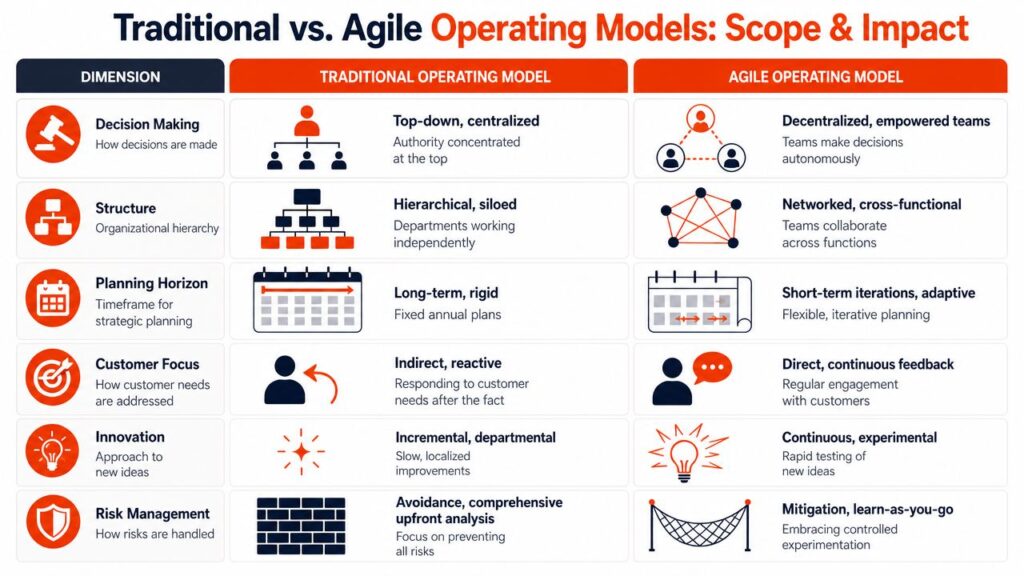
Recruiting and TA drive different operating logic
A recent systematic review shows that workforce agility is now treated as a measurable management capability, while only about 10 published studies had explored it at the organisational level, which shows how new the field still is in formal research. The same evidence base notes that Workday reports 82% of leadersbelieve a skills-based approach provides greater access to job opportunities. That combination is important. It tells us companies are trying to operationalise agility before the organisational playbook is fully mature.
That uncertainty creates risk for Indian companies. Many teams respond by adding more hiring activity, more vendors, or more requisition reviews. But if the underlying model is still transactional, scale only produces more motion, not more agility.
The comparison below makes the structural difference clearer.
Recruiting vs Talent Acquisition At a Glance
| Dimension | Recruiting (Tactical) | Talent Acquisition (Strategic) |
| Time horizon | Immediate to short-term | Multi-quarter and long-term |
| Scope | Fill approved roles | Shape workforce capability and supply |
| Demand trigger | Vacancy raised | Business priorities, skill shifts, expansion plans |
| Talent lens | Experience match for role | Skill adjacency, potential, mobility, and market availability |
| Core metrics | Process throughput and closure | Capability readiness, pipeline health, opportunity creation |
| Technology orientation | ATS-led workflow | Talent intelligence, mapping, CRM, and planning integration |
| Relationship with managers | Intake and delivery | Advisory partnership |
| Role in agility | Supports staffing execution | Enables skill-based movement and resilience |
A good test is to examine how the function behaves when priorities change suddenly. Recruiting asks which open roles must be reprioritised. TA asks which skills can be sourced, borrowed internally, or developed fastest with the least performance risk.
The difference also appears in governance. Recruiting usually reports activity against current vacancies. TA should influence workforce choices before vacancies are approved, including whether a need should be filled externally, solved through redeployment, or met through a different job design.
This discussion benefits from a broader operating model lens.
Why the distinction changes business impact
An Indian enterprise that keeps recruiting and TA indistinguishable usually suffers from three hidden costs:
- Over-specification of roles: Managers ask for exact experience matches because the system doesn’t support skill adjacency decisions.
- Weak internal opportunity flow: Employees don’t see credible movement paths, so the organisation buys capability repeatedly from the market.
- Low confidence in redeployment: Leaders hesitate to move talent because skills data is fragmented or anecdotal.
The more volatile the market, the more expensive a vacancy-led hiring model becomes.
This is why the recruiting versus TA choice is not semantic. It determines whether the talent function acts as a fulfilment channel or as an organisational capability builder.
Choosing an Operating Model for the Indian Context
No single TA model fits every Indian business. The right design depends on demand volatility, role complexity, geographic spread, and how tightly hiring must connect with transformation priorities.
Three practical models for Indian organisations
A centralised TA model works well when the business needs consistency, governance, and shared intelligence across locations or business units. This is often useful in manufacturing, automotive, BFSI, and other sectors where capability planning must align with longer-cycle workforce decisions. In this setup, TA can own market mapping, common assessment standards, and strategic workforce inputs.
A project-based scale model fits high-growth environments such as GCC launches, digital build-outs, or large transformation programmes. Here, the priority is controlled speed. The business needs hiring execution, but it also needs labour market insight, role sequencing, and rapid problem-solving when demand changes. Many teams compare external execution options through resources such as this RPO versus staffing agency guide.
A hybrid model suits mid-market organisations that aren’t ready for a fully mature TA structure but can’t afford purely reactive recruiting either. A smaller strategic core can handle workforce planning, employer brand, and critical skill mapping, while execution may stay decentralised or partially outsourced.
Questions a CHRO should settle before redesigning the function
The best operating model usually becomes obvious when leaders answer a few operational questions:
- Where does demand volatility sit? If role demand swings sharply in a few functions, a flexible project model may outperform a uniform enterprise design.
- Which skills are scarce versus trainable? TA should focus external market effort where capability is difficult to build internally.
- How much manager discipline exists? If hiring managers still define need only through pedigree and prior title, the function will need stronger central challenge.
- What movement does the business want? Some organisations need internal project deployment. Others need better succession depth. Those are different designs.
A common mistake is copying the operating model of another company in the same sector. Two Indian firms can face similar market conditions but require very different talent systems because their maturity, managerial capability, and transformation agenda differ.
Choose the model that improves decision quality around talent, not the one that merely changes reporting lines.
That principle matters because operating model choices affect more than hiring efficiency. They shape whether agility skills in the workplace can be identified, rewarded, and redeployed consistently.
How a Strategic TA Function Builds Agility Skills
A mature TA function doesn’t create workforce agility through slogans about adaptability. It builds the underlying conditions that make agility observable and repeatable.
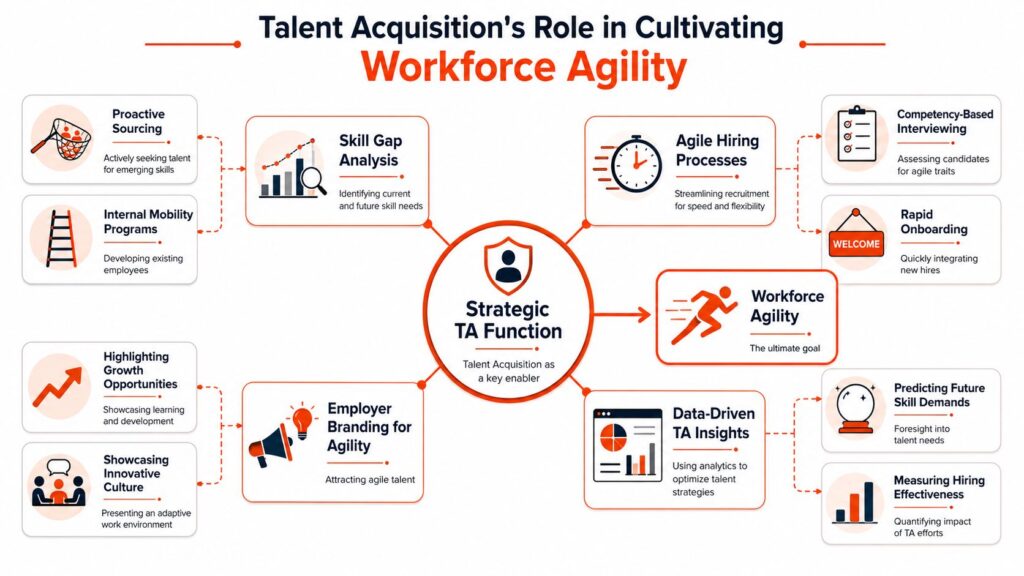
Organisations increasingly rely on skills-based hiring to improve workforce agility. Rather than evaluating candidates solely through job titles or years of experience, skills-based hiring focuses on transferable capabilities, learning agility, and future potential. This approach enables businesses to close workforce skills gaps faster while creating stronger internal mobility opportunities.
Start with skills visibility, not requisitions
Mercer reports that 71% of businesses measure skills based on the current job, 68% rely on manager identification, and 49% use employee self-reporting. For agility, that is a problem. If skills are viewed mainly through current job descriptions or subjective judgement, organisations struggle to see transferability.
Forward-looking employers are beginning to combine AI-inferred proficiency scores with self or manager-rated data to improve directional accuracy. The significance isn’t the technology alone. It’s the shift in logic. TA can no longer rely only on CV matching or manager memory. It needs a dynamic skills picture that supports internal mobility and future hiring decisions.
Effective workforce agility begins with accurate skills intelligence. Organisations that conduct regular skills gap analysis gain greater visibility into existing capabilities, emerging shortages, and future workforce requirements. Rather than reacting to vacancies after they occur, leaders can proactively address workforce skills gaps through hiring, reskilling, internal mobility, and succession planning initiatives.
A practical TA agenda usually includes:
- Skill taxonomy discipline: Build a shared language for capability across functions so adjacent talent becomes easier to identify.
- Market mapping: Track where scarce capabilities sit externally, but also where they may be approximated internally.
- Assessment redesign: Evaluate for learning velocity, resilience, and transferability, not only for direct experience.
The operating philosophy behind this shift is captured well in Taggd’s discussion of agile talent acquisition, which links hiring responsiveness with broader capability planning.
Use TA to create movement, not just hiring activity
Strategic TA shapes internal opportunity flow. That means working with HR and business leaders to define where internal mobility is realistic, where redeployment needs reskilling support, and where external hiring is still the faster or safer route.
Many organisations underperform. They speak about agility, but they still evaluate talent in static categories. A TA function with strong talent intelligence can help managers make better choices across three routes:
- hire from the market
- move someone internally into adjacent work
- redesign the role around available capability
Agility grows when leaders trust skill evidence enough to make non-traditional staffing decisions.
Employer branding also matters, but not in the usual promotional sense. A business that wants adaptable hires must signal that careers are built through stretch, mobility, and development, not only linear progression. Candidates read those signals closely. So do existing employees.
The most useful way to judge TA maturity is simple: does the function help the business access capability through multiple pathways, or only through external requisition fulfilment? If the answer is the latter, agility will remain patchy.
Build Your Future-Ready Talent Function with Taggd
Building a future-ready workforce requires more than efficient recruitment processes. It demands strategic workforce planning, talent intelligence, and a deliberate focus on capability development. Organisations that integrate talent acquisition with workforce planning are better positioned to anticipate future skill needs, improve employee mobility, and maintain business resilience during periods of disruption.
As industries continue to evolve under the influence of AI, automation, and changing business models, workforce agility will increasingly depend on an organisation’s ability to identify, acquire, develop, and deploy skills at speed. Strategic talent acquisition plays a central role in making that capability possible.
A practical transformation agenda
Start with an audit of current hiring logic. Review how requisitions are approved, which metrics dominate, how skills are recorded, and where hiring managers override broader workforce considerations. If the system mostly rewards closure speed, it will keep producing short-term behaviour.
Then define a future-state capability view. In sectors such as manufacturing, BFSI, and GCCs, agility is increasingly tied to role redesign as AI and automation change work. At the same time, overemphasising rapid redeployment without support can create capability bottlenecks, as discussed in Fuel50’s perspective on workforce agility and talent mapping. That means your target model should specify not only where talent must move, but what support, reskilling, and managerial enablement make that movement productive.
A sensible transformation roadmap usually includes:
- Reframing KPIs: Track whether the function is improving capability access, not only vacancy throughput.
- Improving skill evidence: Replace fragmented judgement with better skills data and role adjacency mapping.
- Clarifying decision rights: Define when the business should hire externally, redeploy internally, or redesign work.
- Building manager confidence: Equip leaders to assess potential and mobility, not just title match.
What execution support should look like
Execution often fails because organisations separate strategy from delivery. They produce a TA blueprint but keep using the same operating routines, vendor structures, and approval habits.
An external partner becomes useful, provided the support includes more than sourcing. Taggd’s approach to talent acquisition and recruitment strategy describes services such as TA strategy, RPO, and talent mapping that can support organisations redesigning their hiring model around business goals rather than requisition volume.
For a CHRO, the immediate test is practical:
- Are you still solving for open roles, or for future capability?
- Can your function identify transferable talent before demand becomes urgent?
- Do managers trust the system enough to make mobility-led staffing decisions?
If the answer to those questions is mixed, the organisation doesn’t need more recruiting pressure. It needs a stronger TA architecture.
Taggd helps organisations in India move from vacancy-led hiring to business-aligned talent acquisition through services such as TA strategy, talent mapping, RPO, and recruitment transformation. If you’re redesigning your talent function to build agility skills in the workplace, explore Taggd as part of your evaluation process.