India’s FMCG sector is expanding fast. Valued at roughly 9 lakh crore rupees in 2023, it’s projected to reach 18 lakh crores by 2025. For CHROs, this means territory expansion at 40 to 50 percent growth rates. New plants need operators before rosters lock. Sales launches demand field teams across regions simultaneously. Distribution requires backfill speed internal teams can’t deliver. Every hiring delay doesn’t just miss targets. It delays revenue, postpones market entry, and lets competitors move faster into your territories.
This guide explores how distributed FMCG hiring breaks under pressure, why traditional models collapse at scale, and how leading companies redesign their hiring as an operational system instead of a department function. You’ll see what’s driving the shift to RPO partnerships, how AI removes friction without replacing judgment, and the exact steps to pilot a new bulk hiring model in one region before scaling nationally.
Why Traditional Bulk Hiring Fails in India’s FMCG Sector
Traditional bulk hiring often breaks down at scale. While corporate teams may see active requisitions and interview schedules, frontline hiring faces delays, candidate drop-offs, and coordination gaps.
As India’s FMCG sector continues to expand rapidly, hiring demand across sales, manufacturing, and distribution is increasing. Manual hiring processes struggle to keep pace with multi-location recruitment needs.
Common failure points include:
- Fragmented workflows: Recruiters, hiring managers, and local teams often rely on separate systems, creating visibility and coordination issues.
- Slow hiring cycles: Lengthy approvals and manual processes lead to candidate drop-offs in high-demand frontline roles.
- One-size-fits-all processes: Applying the same hiring approach across sales, plant, and logistics roles often reduces efficiency and candidate experience.
Traditional bulk hiring doesn’t fail because recruiters work slowly. It fails because the process wasn’t built for high-volume, decentralized hiring.
The Hidden Cost of Broken Bulk Hiring Models
Now that you see hiring as a business problem, it’s time to look at what those costs when your current model breaks under pressure.
Most CHROs don’t see this as a “hiring problem.” They see it as a business problem wearing a hiring mask.
Here’s what happens under traditional models: Your TA team opens requisitions faster than the hiring process can close them. Applications come in, but mobile candidates abandon mid-application. Local teams use WhatsApp instead of your ATS. Line managers take weeks to provide feedback on shortlists. By the time an offer reaches a field hire, they’ve already accepted somewhere else. Your pipeline looks active on the spreadsheet but leaks candidates at every stage.
The cost? Not just unfilled positions. That’s visible. The hidden costs are worse.
Revenue delay. A warehouse without operators can’t hit the shipment targets that drive quarterly performance. A sales launch without frontline hires delays market entry and competitive positioning. When hiring delays by 4 to 6 weeks on distributed roles, that’s not a TA metric. That’s a business outcome.
Replacement churn. Frontline roles in FMCG have high turnover. When you can’t scale hiring fast enough, you create a permanent shortfall. Sites stay understaffed. Remaining staff work longer hours. Attrition accelerates. Now you’re hiring faster just to stay in place.
Cost creep. Your internal TA team gets stretched. They work around process bottlenecks by calling candidates directly, completing applications on their behalf, and managing workflows in spreadsheets. This isn’t scalable. It’s also expensive. You’re paying senior recruiters to do data entry because the process doesn’t work at scale.
Talent quality loss. When speed becomes the only metric, screening rigor collapses. You hire faster but fit gets worse. Turnover hits harder.
That’s the state most FMCG CHROs inherit when they try to handle territory expansion with internal-only models. And the frustrating part is, it usually doesn’t improve with more headcount.
Why Territory Expansion Breaks Traditional Hiring
FMCG growth in India isn’t linear. It’s distributed. A company may need to hire 20 people in Kolkata, 15 in Vadodara, 10 in Kochi, 25 for a warehouse cluster, and 40 across new sales territories, all on different timelines and across different labour markets.
Traditional hiring assumes centralization: one TA team, one process, and one approval chain. But distributed growth requires localized execution with consistent oversight.
The challenge isn’t a lack of recruiters or better screening tools. It’s operational fragmentation. Plant HR, regional sales teams, and corporate functions often work at different speeds, creating delays and visibility gaps.
As territory expansion accelerates, hiring success depends less on adding headcount and more on building systems that can manage high-volume hiring across multiple locations simultaneously.
What Leading FMCG Companies Are Doing Differently
The companies building repeatable hiring capacity now share a few distinct traits that separate them from peers still struggling with bulk hiring.
They treat hiring as an operational network, not a department function. They map the actual flow of decisions. Who approves? When? Based on what criteria? Then they place AI, tools, and people around that flow.
They design for frontline reality, not corporate theory. A plant operator candidate doesn’t behave like a corporate hire. They’re applying from a phone. They’re deciding in hours, not weeks. They value clarity and speed, not branded videos.
They invest in local language and cultural fit differently. Not as an afterthought, but as part of role architecture. They know a Pune candidate and a Thiruvananthapuram candidate will respond to different prompts, different timing, and different role explanations.
They hold TA and operations to the same SLAs. If recruiters are screening in 48 hours but plant managers review in 2 weeks, nothing improves. They enforce equal accountability.
They measure funnel health continuously. Not quarterly reviews. Weekly dashboards showing application completion by location, interview conversion by role family, offer-to-joining by source. They treat hiring data like operations data.
They own replacement demand differently. They track which sites keep reopening the same roles and ask why. Is it pay? Is it role clarity? Is it manager effectiveness? They fix the root instead of just hiring faster.
These practices are creating a shift in what’s possible at scale. But where does this lead as technology and process combine?
How AI-Powered RPO Services Solve FMCG Hiring Challenges
As FMCG hiring scales across regions, companies need more than recruiter capacity. They need systems that combine process consistency, local execution, and hiring visibility.
Many FMCG organizations recognize these challenges but struggle to address them consistently at scale. As explored in our guide on bulk hiring strategies and solutions, sustainable hiring outcomes require more than additional recruiter capacity, they require a system designed for speed, visibility, and distributed execution.
Role-specific hiring workflows
AI-powered RPO providers help standardize hiring while adapting processes for sales, warehouse, and plant roles.
Localized execution at scale
With hiring spread across multiple markets, on-ground recruitment support helps address regional talent, language, and operational differences. This is why many FMCG companies work with partners such as Taggd during expansion phases.
Automation that reduces delays
AI tools streamline screening, scheduling, candidate communication, and offer management, helping recruiters focus on candidate quality rather than coordination. For a deeper look at how AI is transforming talent acquisition, explore our guide on AI in recruitment.
Real-time visibility and optimization
Hiring analytics identify bottlenecks, dropout points, and market-level challenges, enabling faster intervention and continuous improvement.
The goal isn’t just faster hiring. It’s building a scalable recruitment system that delivers speed, consistency, and stronger hiring outcomes across locations.
Designing Your AI Hiring Framework for Scale
AI hiring frameworks should address where FMCG hiring breaks at scale, not just screening delays. The biggest challenges are distributed frontline hiring, multi-site approvals, local language requirements, and rapid replacement needs.
Designing AI Hiring Framework
Having understood the solutions to existing hiring challenges, one must also master how to design the perfect framework to implement the same. AI hiring should start with business bottlenecks, not software features. In FMCG, common challenges include high-volume frontline hiring, candidate drop-offs, approval delays, and location-specific hiring constraints.
A practical framework typically includes:
- Role architecture: Design hiring journeys based on role type and hiring behavior, not just job families.
- Candidate access: Keep applications mobile-first, simple, and accessible for candidates in Tier-2 and Tier-3 markets.
- Decision governance: Define clear ownership for shortlisting, approvals, and offer releases to prevent bottlenecks.
Mapping Candidate Journeys for Frontline FMCG Roles
Different frontline roles require different hiring journeys.
Warehouse operators: Prioritize short application flows focused on eligibility, shift suitability, location, and document readiness.
Field sales trainees: Use simple mobile applications, clear role communication, and fast interview scheduling to improve engagement and completion rates.
Plant technicians and machine operators: Implement role-specific screening for equipment familiarity, safety awareness, and shift compatibility. Structured assessments help improve hiring accuracy and speed.
Merchandisers and route sales staff: Focus on mobility, territory coverage capability, communication skills, and local market familiarity. Simplified screening and quick decision-making help reduce drop-offs.
Regardless of role, the most effective hiring journeys remove friction for candidates while giving hiring teams clear, consistent information for faster decisions. This aligns closely with the principles of employee journey mapping, where every interaction is designed to improve engagement and outcomes.
AI Hiring Tech Stack
The right stack isn’t the one with the most AI labels. It’s the one that supports high-volume execution without forcing recruiters and site teams into workarounds. In FMCG, the stack should match how hiring moves across local demand, field coordination, and fast decision cycles.
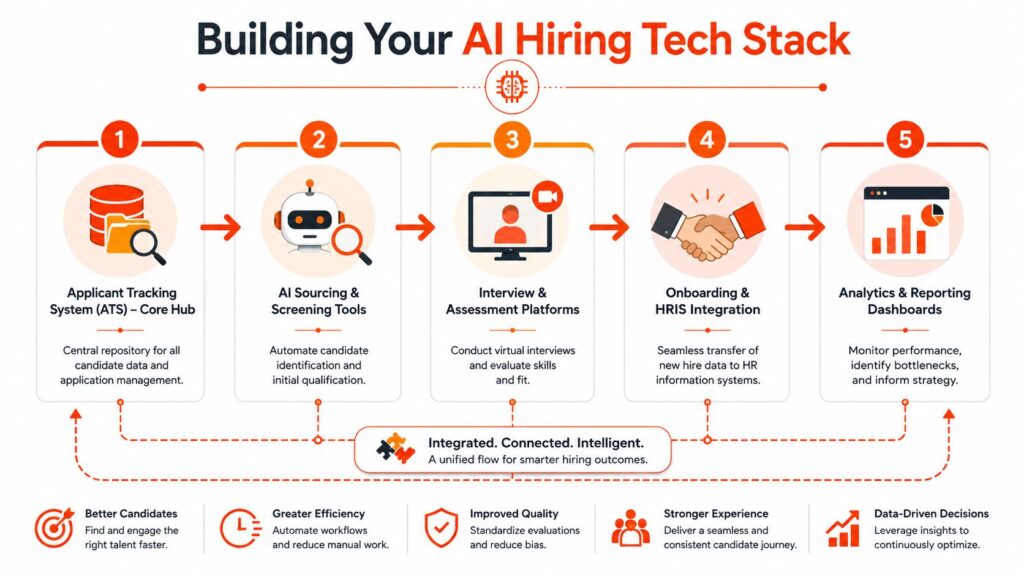
A practical AI bulk-hiring workflow for FMCG in India uses a mobile-first funnel that includes QR-code or job-link applications, AI resume parsing and skill-based ranking, one-way video interviews, bulk offer generation, and real-time funnel analytics.
That sequence works because it removes friction in the places where recruiters usually lose time.
After the candidate enters through a QR code or job link, parsing and ranking help prioritise the right profiles without manually sorting every application. One-way video interviews reduce calendar dependency in early stages. Bulk offer generation matters in large hiring bursts. Funnel analytics then show exactly where the process is slowing down.
For teams evaluating architecture options, this broader primer on a modern recruitment tech stack helps frame the categories, but FMCG needs each category tuned for distributed execution.
Implementing AI Hiring Process
Most AI hiring rollouts don’t fail because the tools are unusable. They fail because governance is weak, role ownership is fuzzy, and managers keep reverting to old habits. Technology changes faster than hiring behaviour does.
A safer approach is a phased rollout. Guidance for bulk hiring implementation recommends mapping high-volume roles, defining competencies, piloting in one or two representative regions, and setting measurable success metrics such as time-to-hire reduction and quality-of-hire indicators.
Pilot where complexity is real but manageable
Don’t start with the easiest role just to produce a clean success story. Start with a role and region that reflect real operating conditions but won’t expose the whole organisation if the process needs tuning.
Good pilot choices often share a few qualities:
- Repeated hiring demand: The role is hired often enough to generate learning quickly.
- Visible business importance: Managers care enough to engage seriously.
- Contained geography: One or two regions let you test variation without national sprawl.
- Clear workflow owners: TA, site HR, and business stakeholders can be named upfront.
A pilot should prove more than speed. It should prove that the process is easier to run, easier to govern, and easier to replicate.
Governance makes AI usable
Governance sounds administrative, but in practice it decides whether AI recommendations get acted on or ignored.
The rollout should specify:
| Governance area | Decision to make |
| Competency model | What “fit” means for each frontline role |
| Structured interviews | Which questions every manager must use |
| SLA ownership | How quickly each stakeholder must respond |
| Escalation rules | What happens when approvals stall |
| Audit trail | Where decisions and overrides are recorded |
Service level agreements are especially important in high-volume hiring. If recruiters submit shortlists fast but line managers review slowly, the process still fails. If offers are approved centrally but sites expect same-day release, candidate loss becomes predictable.
Operating principle: AI improves throughput only when decision rights are already clear.
Change management
Hiring managers often say they support AI, then continue choosing candidates based on instinct, urgency, or personal familiarity. That doesn’t make them resistant. It usually means the system hasn’t earned trust in their day-to-day context.
Training should therefore be practical, not conceptual. Show managers how AI ranking supports, but doesn’t replace, judgement. Train them on structured feedback forms. Clarify when they can override recommendations and how those overrides will be reviewed. Make the process faster for them, not just more compliant for TA.
A strong implementation rhythm usually includes:
- Role and journey mapping for pilot positions.
- Competency calibration with hiring managers.
- Workflow testing with real approvals and communication templates.
- Manager enablement through live use cases.
- Weekly review cadences during the pilot.
- Refinement before expansion into the next region or role family.
What doesn’t work is launching nationwide with generic training and hoping local teams adapt. In FMCG, local variation is too strong for that. Governance has to travel with the rollout.
Measuring ROI and Optimizing Your Hiring Funnel
If your dashboard only reports requisitions opened, positions closed, and recruiter activity, it won’t help you improve bulk hiring. You need a view of the funnel that links hiring performance to operational readiness.
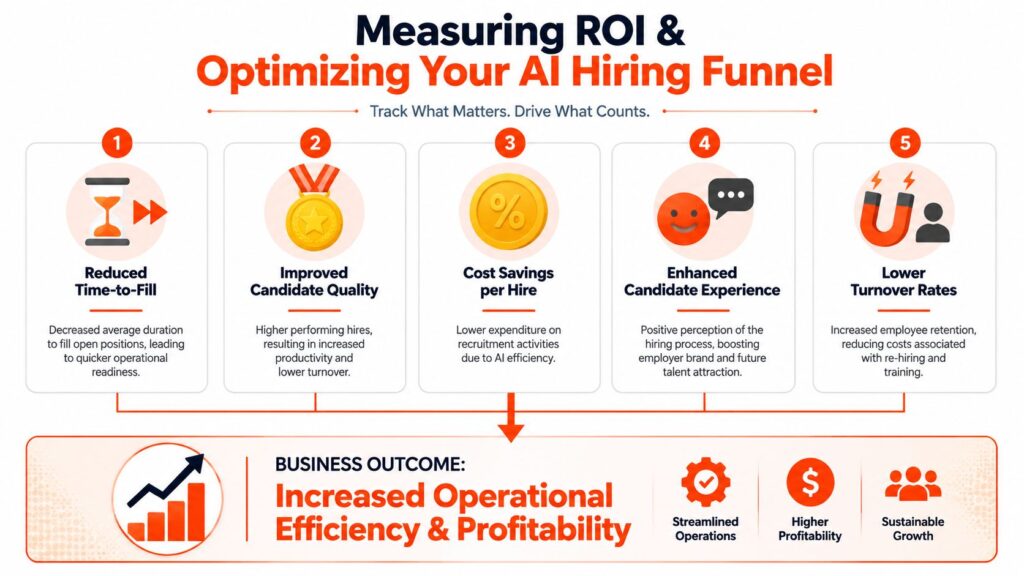
Turn Hiring Data into Actionable Intelligence
Most hiring dashboards generate reports. The best ones drive decisions.
Track funnel movement and candidate drop-off by role, region, source, and hiring stage. This helps talent acquisition leaders quickly identify where hiring performance breaks down. Which locations have low application completion rates? Which roles experience the highest interview attrition? Where are offer acceptance rates strong but joining conversions weak?
To gain a complete view of hiring effectiveness, connect recruitment metrics with post-hire outcomes such as early manager feedback, attendance consistency, and recurring replacement demand. Together, these signals reveal whether hiring success is translating into workforce stability.
Use AI Powered Insights to Continuously Improve Hiring Outcomes
The real value of AI in recruitment goes beyond automation. It helps identify patterns that would otherwise remain hidden across large hiring volumes.
Funnel analytics may reveal that one sourcing channel generates high application numbers but poor interview conversion, while another delivers fewer candidates with stronger hiring outcomes. One region may benefit from a shorter application process, while another requires faster hiring manager feedback.
An effective optimization cycle should regularly review:
- Application completion rates
- Shortlist quality and recruiter acceptance
- Interview-to-selection conversion
- Offer-to-joining performance
- Recurring replacement demand by location
A high-performing hiring funnel doesn’t just show how candidates move through the process, it explains why they progress, drop off, or fail to join.
The most successful talent acquisition teams treat AI as an ongoing optimization engine, using continuous feedback and performance data to improve hiring efficiency, quality, and scalability over time. Measuring these improvements is equally important, which is why leading organizations track the ROI of their recruiting efforts alongside traditional hiring metrics.
Scale Bulk Hiring Effectively
Don’t begin with a company-wide transformation. Start with a hiring diagnostic.
Choose one high-volume role in a region where recruitment delays are affecting business performance. Map the current hiring journey, identify bottlenecks, and understand where approvals or decisions are slowing progress.
Then run a six-week pilot using improved processes, AI-powered recruitment tools, and stronger local coordination. This allows you to test changes, measure outcomes, and build a business case for scaling.
Many organizations see 40–60% faster time-to-hire, 20–30% better quality of hire, and clearer recruitment SLAs during these pilots. With proven results, scaling becomes a strategic decision rather than a leap of faith.
For CHROs, the priority is clear: build a repeatable, scalable hiring engine before growth accelerates. An AI-powered RPO partnership can help turn bulk hiring from an operational challenge into a long-term competitive advantage.
The Future of AI Hiring in FMCG
Once your pilot proves that redesigned process works, you’ll see something shift. Hiring that used to take 6 weeks moves to 3. Quality stops degrading when speed increases. Approval delays disappear. That’s when the question changes from “can this work” to “what does this become as we scale and refine it.”
The future of bulk hiring in FMCG isn’t full automation. It’s augmented operations where AI removes routine friction and humans focus on judgment and fit.
Here’s what’s emerging:
Predictive candidate movement. AI flagging at application stage which candidates will join. You source smarter, not bigger. Less waste, faster pipelines.
Role-specific hiring journeys. Different workflows for field sales hires, warehouse operators, and plant technicians managed in one system. No more forcing candidates into processes that don’t fit their labor segment.
Talent reactivation at scale. AI tracking past applicants who might fit new roles or locations. Weeks saved on sourcing by reaching the right pool you already know.
Local language fluency. Candidates assessing and interviewing in Tamil, Marathi, Gujarati, or Kannada. Removing language as a barrier to completion.
Outcome-based refinement. The funnel continuously shifts toward sourcing channels and screening methods that produce stable long-term hires, not just fast closes.
The companies winning in 2026 aren’t the ones with the most advanced AI. They’re the ones who redesigned hiring as a supply chain operation, then layered technology on top. That’s the only way distributed FMCG hiring becomes truly reliable at scale.
FAQs
What is AI-powered bulk hiring solutions?
AI-powered bulk hiring solutions use automation, analytics, and workflow technology to help organizations manage high-volume recruitment faster, improve candidate experience, and reduce manual effort across hiring stages.
Why is bulk hiring challenging in the FMCG industry?
FMCG hiring often spans multiple locations, high-turnover frontline roles, and varying labor markets. These factors create complexity, making speed, consistency, and local execution critical for success.
How does AI improve high-volume recruitment?
AI automates repetitive tasks such as resume screening, interview scheduling, candidate communication, and analytics, enabling recruiters to focus on assessment, engagement, and hiring decisions.
What should FMCG companies track when measuring hiring success?
Key metrics include application completion rates, time-to-hire, interview conversion, offer-to-joining ratios, quality of hire, and replacement demand across locations and role categories.
How can organizations reduce candidate drop-offs during bulk hiring?
Mobile-friendly applications, faster approvals, structured communication, local language support, and streamlined interview processes help improve candidate completion and joining rates.
What role does an RPO partner play in FMCG bulk hiring?
An RPO partner provides recruitment expertise, technology, process governance, and scalable execution support to help organizations manage high-volume hiring efficiently across multiple regions.
If you’re rethinking bulk hiring at enterprise scale, Taggd can help you turn strategy into an operating model that works effectively on the ground. As an AI-powered talent fulfilment partner built for India, Taggd combines technology, governance, and on-ground market intelligence to support high-volume hiring across distributed roles, regions, and business units. Whether you want to diagnose funnel leakage, pilot a new hiring workflow, or build a more resilient TA engine for FMCG growth, Taggd brings the structure and execution depth to make that transition practical.