Most advice on AI-proof careers is too shallow to help a CHRO. It gives you a list of “safe” jobs, usually written for a generic global audience, then stops there. That approach fails in India, where role resilience depends less on broad labels and more on who holds accountability, who must show up on the ground, and who carries compliance risk when something goes wrong.
That’s why the better question isn’t which jobs are safe. It’s which tasks, decisions, and responsibilitiesinside a job remain defensible when AI is built into enterprise workflows. In Indian enterprises and GCCs, that distinction matters more each quarter. Routine reporting, templated analysis, and standardised coordination are getting faster to automate. Escalation handling, auditability, stakeholder judgement, frontline trust, and regulated execution are not.
What Are AI-Proof Careers?
Many discussions about AI-proof careers focus on identifying jobs that are supposedly safe from automation. In reality, no role is completely immune to technological change. What makes a career resilient is not the job title itself but the combination of skills, judgement, accountability, and human interaction required to perform it successfully.
As AI adoption accelerates, organisations must evaluate which tasks can be automated and which responsibilities continue to require human expertise. This shift is redefining what it means to build a future-ready workforce.
For CHROs in India, this is the strategic shift. Stop asking whether a job is safe. Start asking which tasks inside the job are resilient because they require context, trust, physical presence, licensing, or accountability.
Why AI-Proof Careers Look Different in India
Much of the popular guidance on AI-proof careers is written for broad audiences and misses the India-specific reality of regulated sectors, licensed work, field execution, and service delivery. A more useful framing is that resilience comes from accountability, compliance, and on-ground execution, especially when AI is embedded into GCCs, manufacturing, BFSI, healthcare, or energy operations, as discussed in this analysis of resilient career contexts.
That matters because a finance role in a shared services environment isn’t exposed in the same way as a risk role handling exceptions. An HR operations role processing standard requests isn’t protected in the same way as an HR business partner managing investigations or workforce conflict. A plant engineer producing repetitive documentation faces a different risk profile from a plant leader making safety calls during shutdowns.
Practical rule: Don’t classify resilience at job-title level until you’ve mapped the task mix.
This is also why employer positioning needs to change. If your talent brand still sells stability through static titles, you’ll struggle to attract people who understand where work is going. The better play is to show candidates how your organisation develops judgement-heavy, AI-augmented capability, which is the same shift discussed in this piece on attracting talent for the autonomous age.
Characteristics of AI-Proof Careers
AI-proof careers share several common characteristics. They typically involve decision-making under uncertainty, relationship management, compliance accountability, creative problem-solving, or responsibilities that require direct human interaction.
While AI can improve efficiency and automate routine activities, organisations still rely on people to interpret complex situations, manage risk, build trust, and make final decisions when outcomes carry significant business consequences.
| Role context | Tasks AI can assist | Tasks humans still own |
| Healthcare delivery | Notes, scheduling, triage support | Diagnosis, counselling, clinical accountability |
| GCC risk and compliance | Monitoring, documentation drafts | Escalation judgement, policy interpretation |
| Manufacturing operations | Predictive inputs, reporting | Safety decisions, exception handling, field coordination |
| BFSI service delivery | Workflow routing, summarisation | Customer trust, regulatory judgement, dispute resolution |
The point isn’t that AI leaves these jobs untouched. It won’t. The point is that organisations still need a human who can absorb ambiguity, decide under pressure, and take responsibility for the outcome.
How to Build an AI-Resilient Workforce
The practical implication is simple. Enterprises shouldn’t design talent strategy around preserving job descriptions. They should redesign roles around resilient work.
That means:
- Strip out routine tasks where AI can improve speed and consistency.
- Prioritize judgement tasks that require interpretation, negotiation, and accountability.
- Train managers differently so they can lead hybrid human-machine work instead of supervising manual throughput.
If you treat AI-proof careers as a fixed list, you’ll underinvest in redesign. If you treat resilience as a skill-and-task problem, you can build a workforce that stays valuable even as tools change.
Top AI-Proof Skills for 2026
As AI automates more routine work, organisations increasingly value skills that require human judgement, relationship building, creativity, and accountability. These capabilities form the foundation of AI-proof careers across industries.
- Critical thinking
- Decision-making
- Emotional intelligence
- Leadership
- Communication
- Creativity
- Adaptability
- Risk management
- Problem-solving
- Stakeholder management
Top Skills Needed for AI-Proof Careers
The most valuable skills in the AI era extend beyond technical knowledge. Employees who combine digital fluency with strong judgement, adaptability, collaboration, and creative thinking are more likely to remain relevant as roles evolve.
These capabilities help professionals work alongside AI tools while continuing to add uniquely human value.
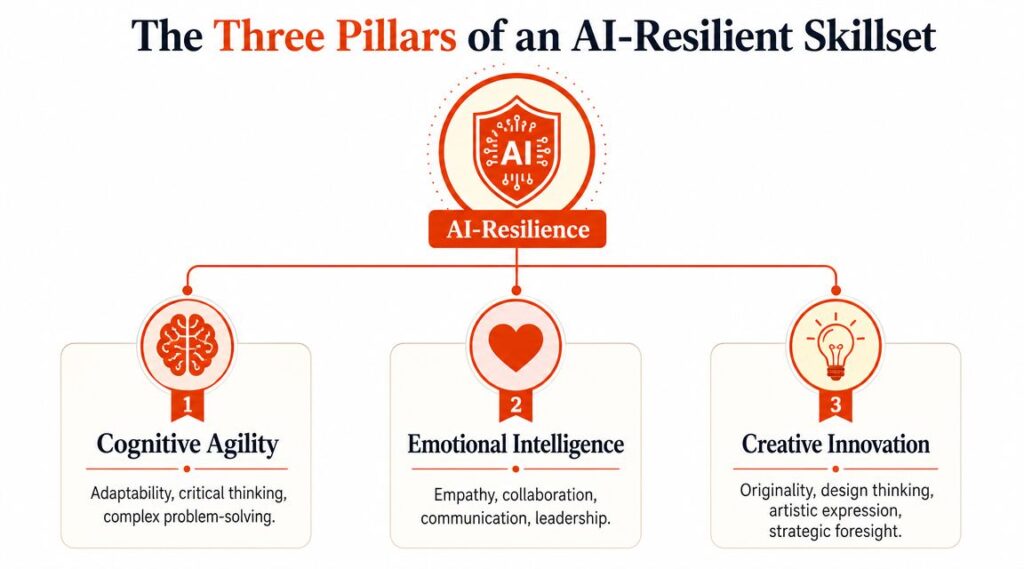
In practice, I’d frame them as judgement, influence, and design. They show up differently in a GCC, plant, hospital, or BFSI operation, but the pattern is consistent.
Critical Thinking and Decision-Making Skills
This pillar sits at the heart of AI-resilient work. It’s the ability to interpret incomplete information, separate a signal from noise, and decide when a model output is useful, risky, or wrong.
A cybersecurity lead does this when an alert looks routine but the surrounding context suggests a broader control issue. A finance controller does it when the numbers reconcile but the business explanation doesn’t. A manufacturing engineer does it when data suggests one intervention, but plant conditions point elsewhere.
Watch this discussion if you want a practical lens on how skills are shifting:
What doesn’t work is generic “critical thinking” training detached from real work. What does work is scenario-based development:
- Exception reviews: Teams evaluate ambiguous cases, not textbook ones.
- Decision logs: Managers record why they overrode a system recommendation.
- Risk simulations: Functions practise escalation under incomplete information.
Emotional Intelligence and Leadership Skills
Most AI tools work best in bounded environments. Enterprises don’t. People disagree, incentives clash, and business priorities shift midstream. That’s why social intelligence remains a core resilience pillar.
This isn’t just about empathy. It includes:
- Negotiation: getting operations, legal, finance, and business leaders aligned.
- Managerial judgement: handling performance, conflict, and morale.
- Stakeholder translation: turning technical outputs into business decisions.
A manager becomes more resilient when their value comes from resolving tension between functions, not forwarding information between them.
In Indian enterprises, this matters acutely in matrixed environments. GCC leaders, shared services heads, and plant managers often succeed because they can manage local execution realities while satisfying global process standards. AI can summarise a meeting. It can’t repair trust after a failed transition or persuade a hesitant business leader to back a risky but necessary change.
A strong capability-building agenda should therefore include coaching, cross-functional problem-solving, and stretch roles that force leaders to influence outside formal authority. That’s also why the market is putting more attention on AI skills in demand rather than narrow software usage alone.
Creative Problem-Solving and Systems Thinking
The third pillar is often misunderstood. Creativity in enterprises isn’t limited to design teams or advertising. It’s the ability to redesign work, connect disconnected signals, and build better operating models.
A few examples make this concrete:
- In manufacturing: redesigning a human-machine workflow so operators intervene only where judgement adds value.
- In healthcare operations: reworking patient flow so digital triage supports clinicians without weakening patient trust.
- In a GCC: restructuring a reporting-heavy role into a product operations role with stronger business ownership.
Here the resilient skill isn’t “idea generation” in the abstract. It’s systems thinking with commercial relevance.
| Pillar | Enterprise expression | Weak signal of skill | Strong signal of skill |
| Cognitive agility | Risk judgement, exception handling | Can explain concepts | Can decide under ambiguity |
| Social intelligence | Influence, leadership, collaboration | Communicates clearly | Moves conflicting stakeholders |
| Creative systems thinking | Role redesign, innovation, integration | Suggests improvements | Rebuilds workflows end to end |
When CHROs assess future capability, these three pillars give a more useful lens than degree pedigree or years of experience. They tell you who can grow with AI and who depends on yesterday’s process architecture.
How to Spot and Hire AI-Resilient Talent
Hiring for AI-resilient capability requires a different filter from traditional volume recruitment. Credentials still matter in regulated roles, but they’re no longer enough. You need evidence that a candidate can operate when the process breaks, the instruction is incomplete, and the tool output needs human interpretation.
That shift is especially important in India’s labour market. The India Skills Report 2024 projected that 48.7% of Indian youth would be employable, highlighting the premium on job-ready capability rather than generic qualifications. At the same time, India’s GCC ecosystem has expanded to more than 1,580 centres employing over 1.66 million people, with demand moving toward higher-value work such as cybersecurity, data governance, product operations, risk, compliance, and engineering leadership.
Hire for Judgement, Not Just Credentials
Many hiring teams still confuse confidence with judgement. They reward fluent answers, clean CV narratives, and keyword familiarity. That approach misses the people who’ve handled ambiguity.
A better interview design tests for moments when the candidate had to:
- Resolve an exception without a complete playbook.
- Push back on a flawed decision backed by authority or data.
- Learn a new tool or domain quickly because the business context changed.
- Coordinate across functions where priorities conflicted.
The strongest evidence usually sits inside real operating stories, not abstract competency claims.
Use Scenario-Based Hiring Assessments
If the role involves judgement, assess judgement directly. For mid-level and senior roles, I prefer situational prompts built around realistic business friction.
For example:
| Role type | Better assessment prompt |
| GCC compliance lead | A global team wants speed. Local controls require additional review. What do you do first? |
| Plant maintenance manager | A dashboard says equipment is stable, but supervisors report unusual behaviour. How do you respond? |
| HR business partner | An AI-assisted screening tool improves efficiency, but business leaders raise fairness concerns. How do you handle it? |
| Product operations lead | The model output is technically correct but commercially unhelpful. What would you change? |
This approach surfaces more than domain knowledge. It reveals escalation instinct, ethical reasoning, and communication under pressure.
Don’t ask candidates whether they’re adaptable. Ask them to reconstruct a situation where they had to adapt and defend the trade-off they chose.
Assess Learning Agility and Adaptability
The clearest hiring signal for AI-resilient talent is often not a current skill. It’s the pattern of how someone has built new capability across shifts in tools, mandates, or business environments.
Strong signals include:
- Role evolution: moving from execution work into exception-heavy or stakeholder-heavy responsibilities.
- Cross-functional exposure: handling operations plus risk, product plus compliance, or engineering plus customer issues.
- Tool adoption with ownership: not just using automation but improving a workflow because of it.
Many enterprises still need discipline in competency mapping. A candidate who’s held the same title for years may have grown sharply in judgement. Another candidate with rapid promotions may still depend on structured environments. Comprehensive assessment frameworks help separate those profiles, which is why sharper managerial talent identification strategies matter more now than before.
What to de-emphasise
In AI-sensitive hiring, I’d reduce weight on three things:
- Perfectly linear careers: resilient people often have nonlinear growth because they moved toward harder problems.
- Tool-name inflation: familiarity with platforms matters less than judgement about when to trust them.
- Scripted leadership answers: if every answer sounds pre-rehearsed, you’re not hearing how the person thinks.
The market is already rewarding candidates who can combine AI fluency with business
How to Future-Proof Your Workforce
Hiring alone won’t solve this problem. Most enterprises already carry roles with uneven exposure to automation, and many of the people in those roles can be retained if the organisation redesigns work early enough.
The most effective playbook I’ve seen has three moves. Audit the work. Develop the missing skills. Redeploy people into redesigned roles.
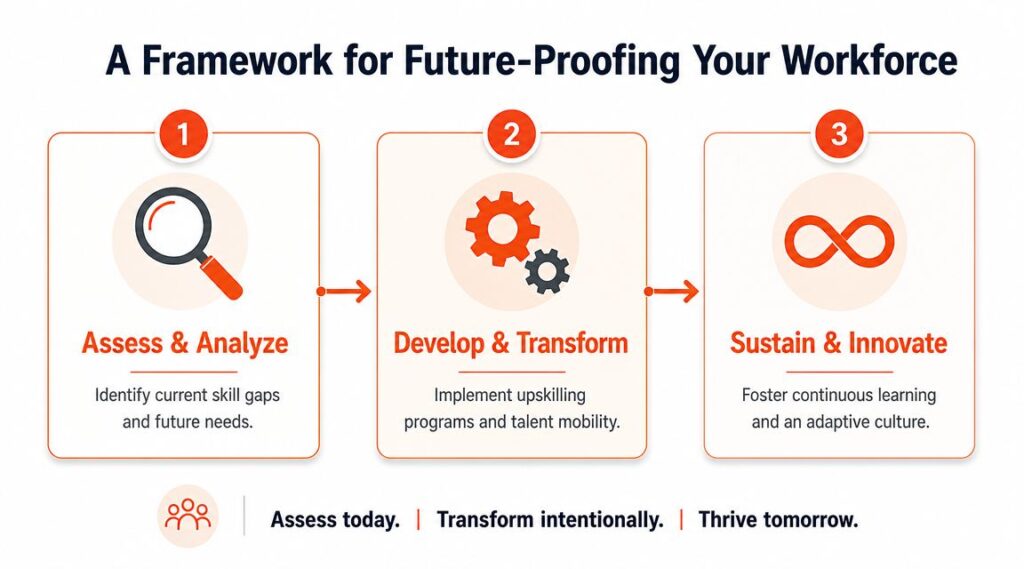
Assess Tasks at Risk of Automation
A job architecture review is too blunt on its own. You need a task-level resilience map across functions.
Break each role into four buckets:
- Routine repeatable work
- Rules-based judgement
- Exception handling
- Relationship or accountability-heavy work
This gives you a practical view of which jobs are being reshaped fastest. In one operations team, a role may still look stable by title while half the weekly workload is already vulnerable to automation. In another, the title sounds exposed, but its core value sits in escalations, compliance decisions, and stakeholder management.
A simple working table helps.
| Task category | Automation likelihood | Enterprise response |
| Repetitive documentation | High | Automate and reduce manual load |
| Standard workflow routing | High | Systemise and monitor exceptions |
| Policy interpretation | Moderate | Support with AI, retain human review |
| Safety or legal accountability | Low | Strengthen human capability and control |
| Cross-functional negotiation | Low | Build manager capability |
The quality of this audit determines everything that follows. If you classify people loosely, your learning agenda becomes generic and expensive.
Build AI-Ready Skills Through Reskilling
Many reskilling programmes fail because they teach broad concepts with no role adjacency. Employees sit through sessions on prompt writing, digital fluency, or innovation language, then return to unchanged workflows.
The better model is targeted capability building tied to redesigned work:
- For operations teams: train exception handling, root-cause analysis, and escalation quality.
- For managers: build decision judgement, cross-functional influence, and risk communication.
- For technical teams: deepen architecture, governance, and controls rather than routine production tasks.
CHROs require tight partnership with business leaders. The question isn’t “what training do employees want?” It’s “what new human contribution will this function need once AI absorbs lower-value tasks?”
If a learning plan doesn’t connect to a redesigned task set, it’s development theatre.
For many enterprises, this also means moving beyond stand-alone LMS consumption into applied workshops, internal projects, and role-based capability cohorts. The strategic lens in this workforce transformation resource is useful because it treats AI adoption as an operating model issue, not just a training issue.
Create Internal Mobility Pathways
Internal mobility is the underused lever in most AI conversations. Enterprises often wait until a role is visibly shrinking, then try to solve the problem through attrition, external hiring, or late-stage retraining.
A stronger approach is to create adjacency pathways early.
Examples:
- Finance operations into risk controls or data governance support.
- IT support into cybersecurity operations or cloud governance coordination.
- HR shared services into employee relations, workforce analytics interpretation, or change enablement.
- Plant reporting roles into maintenance planning, quality investigation, or EHS coordination.
Redeployment works when three conditions are present:
- Visible pathways: employees can see realistic next roles.
- Manager incentives: leaders are rewarded for exporting talent, not hoarding it.
- Transitional support: learning, shadowing, and temporary assignments bridge the gap.
Sustain the system
Futureproofing isn’t a one-time project. It needs a rhythm.
A practical operating cadence includes:
- Quarterly task reviews for high-change functions
- Role redesign checkpoints during annual workforce planning
- Mobility dashboards that track movement into AI-augmented roles
- Manager capability reviews focused on leading hybrid work
The organisations that handle AI well won’t be the ones with the most automation. They’ll be the ones that convert automation into stronger human contribution.
Top AI-Proof Careers in India
Lists of AI-proof careers become useful only when they reflect how work is structured in India. The sectors that matter most here are the ones where AI is being embedded quickly, but outcomes still rely on licensed judgement, customer trust, field execution, or governance.
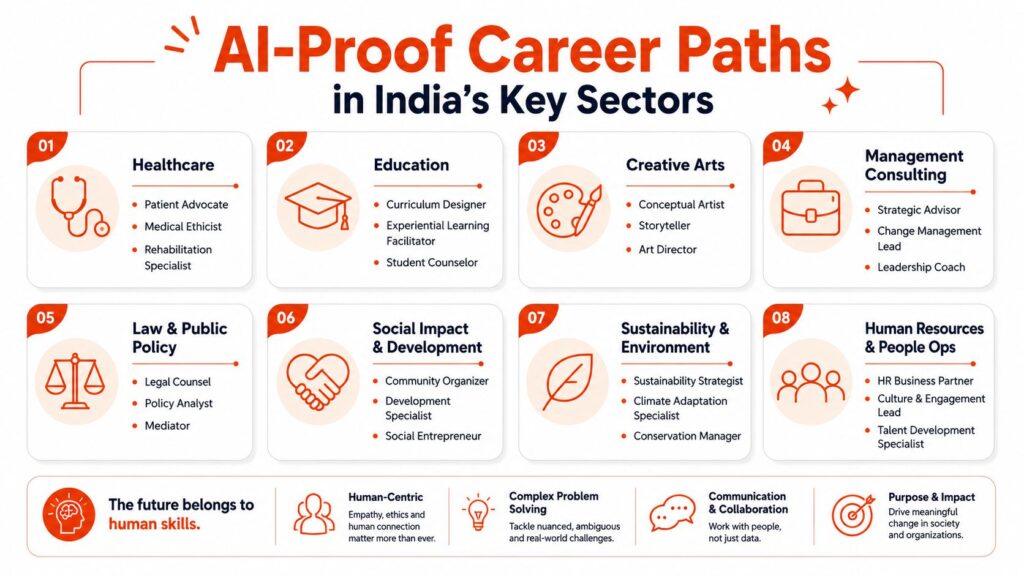
AI-Proof Careers in Healthcare
Healthcare remains one of the clearest examples of durable role resilience in India. The underlying reason is structural. The country has long faced pressure on clinical capacity, and the World Health Organization benchmark of 1 doctor per 1,000 people has historically remained above India’s level in many assessments, which helps explain why doctor, nurse, therapist, and related roles are less exposed to automation than routine administrative work.
The resilient paths here aren’t just “doctor” or “nurse”. They include roles where technology supports, but doesn’t replace, human care:
- Therapists and rehabilitation specialists
- Mental health professionals
- Special educators
- Clinical coordinators with patient-facing responsibility
- Frontline service leaders in hospitals and care networks
AI can assist with triage, documentation, and diagnostic support. It can’t replace patient counselling, in-person assessment, or clinical accountability.
AI-Proof Careers in Technology and GCCs
In Indian GCCs, the durable career tracks are moving up the value chain. The strongest examples are cybersecurity, cloud architecture, and AI/data governance because they combine automation with non-routine judgement, risk ownership, and compliance.
These roles are resilient for a simple reason. AI reduces repetitive troubleshooting and standard documentation, but it increases the need for people who can:
- interpret policy in live conditions
- decide on risk thresholds
- manage escalations across functions
- own auditability and control design
That’s why a routine support role is more exposed than a security architect. A junior coding role may be more exposed than a governance lead or platform owner. In GCC environments, the distinction between execution and oversight is becoming sharper.
AI-Proof Careers in Manufacturing and Engineering
Manufacturing resilience in India rarely comes from broad “engineering” labels. It comes from proximity to physical systems, safety, and exception handling.
The defensible paths usually sit in roles such as:
- Plant maintenance leadership
- Quality and root-cause investigation
- EHS and compliance-heavy operations
- Automation integration with human oversight
- Field engineering and service coordination
These roles evolve rather than disappear. AI can improve predictive maintenance, scheduling inputs, and issue detection. But someone still needs to decide whether the alert matters, whether the line should stop, whether the safety risk is real, and how to coordinate the response on the ground.
The closer a role sits to physical consequence or regulatory consequence, the more likely AI becomes a tool inside the work rather than a substitute for the worker.
How to Build AI-Proof Career Paths
For CHROs, the practical move is to stop presenting employees with flat role maps. Build career latticesinstead.
A few examples:
- Service desk analyst to cloud governance coordinator
- Finance ops analyst to controls and compliance specialist
- Nurse to specialised therapist pathway
- Process engineer to automation oversight leader
- HR operations executive to employee relations or workforce planning partner
If you want a broader labour-market view of where Indian roles are moving, this India Decoding Jobs perspective is a useful complement. The key point is straightforward. AI-proof careers in India are rarely isolated occupations. They’re usually evolved pathways built around stronger judgement, stronger accountability, and less routine work.
Measuring the Impact of AI Workforce Strategies
A workforce strategy built around AI resilience should be measured like any other business investment. If it only produces learning completions or internal communication activity, it hasn’t done enough.
The business case rests on task-level redesign. That matters because much of the public discussion still overstates job-level safety and underexplains task-level risk. One guide, for example, notes that skilled trades score 91/100 in AI resistance while white-collar work scores 68/100, yet the same source also says junior and routine coding roles face high risk while senior tech roles are only moderately protected. For CHROs in India, the more useful question is which tasks inside plant maintenance, IT support, finance operations, or HR will be automated first.
Measuring the Impact of AI Workforce Strategies
The strongest metrics usually sit in five areas:
- Productivity quality: Are teams using AI to reduce routine load while improving decision quality?
- Internal mobility: Are employees moving from vulnerable tasks into higher-judgement roles?
- Retention of critical talent: Do people see a future inside the organisation?
- Hiring quality: Are new hires ramping into exception-heavy work faster?
- Manager effectiveness: Can leaders run hybrid workflows without creating control gaps?
Recruiting analytics and workforce analytics need to connect. A cleaner way to evaluate that connection is through disciplined measurement, like the thinking behind tracking the ROI of recruiting efforts.
The risk of inaction is straightforward. If you focus only on which jobs look safe, you’ll miss where value is shifting inside those jobs. Enterprises that win won’t be the ones that protect titles. They’ll be the ones that redesign work before the market forces them to.
FAQs
What are AI-proof careers?
AI-proof careers are roles that rely on human judgement, creativity, leadership, emotional intelligence, and complex decision-making rather than repetitive or predictable tasks.
What jobs are least likely to be replaced by AI?
Healthcare professionals, therapists, compliance specialists, senior managers, engineers, educators, and roles requiring relationship management are generally considered less vulnerable to automation.
What skills are most important for AI-proof careers?
Critical thinking, adaptability, communication, leadership, creativity, emotional intelligence, and problem-solving are among the most valuable skills for long-term career resilience.
Can AI replace managers and leaders?
AI can support managers with analysis, reporting, and recommendations, but leadership responsibilities involving people management, conflict resolution, strategy, and decision-making still require human judgement.
How can organisations build an AI-resilient workforce?
Organisations can improve workforce resilience through role redesign, targeted reskilling, internal mobility programs, and hiring strategies that prioritise adaptability and judgement.
Which industries offer the strongest AI-proof career opportunities?
Healthcare, manufacturing, engineering, cybersecurity, compliance, risk management, energy, and leadership-focused roles continue to offer strong long-term career resilience.
Building AI-proof careers requires more than technology adoption. It requires thoughtful workforce planning, skills development, role redesign, and talent strategies that align with evolving business needs.
At Taggd, we help organisations strengthen hiring, workforce transformation, talent mapping, and leadership pipelines to build AI-resilient teams prepared for long-term growth and change.