To answer “Why should I hire you?”, explain how your skills, experience, and achievements match the job requirements. Highlight what makes you unique, support your answer with a relevant example, and show genuine enthusiasm for contributing to the company’s goals.
Most candidates treat this question like an invitation to recite their resume. It is not. This is the moment the interviewer stops asking about your past and starts asking about your future. Get it right, and you leave the room as the obvious choice. Get it wrong, and a stronger candidate with a crisper answer lands the offer.
This guide walks you through exactly how to answer why should I hire you, with a proven framework, sample answers for freshers and experienced professionals, role-specific examples, and the mistakes that quietly cost candidates the job.
Why Do Interviewers Ask “Why Should I Hire You?”
Before you can answer the question well, you need to understand what the interviewer is actually trying to learn. This is not small talk or a warm-up question.
According to the University of Hawaii Career Center, this question is one of the most revealing in any interview because it forces candidates to synthesize everything about themselves into a focused, employer-centric pitch. Interviewers are simultaneously evaluating five things:
- Confidence: Do you believe in your own ability to do this job?
- Self-awareness: Do you know your real strengths rather than just using buzzwords?
- Job fit: Have you connected your background to this specific role?
- Value proposition: What do you bring that other candidates do not?
- Communication: Can you think on your feet and articulate a clear point under pressure?
Candidates who answer with “I am a hard worker” or “I am very passionate about this field” fail all five checks at once. Those phrases are so common they carry zero signal. Every single candidate says them, which means saying them differentiates you from nobody.
The 4-Step Framework to Structure Your Answer
Here is a simple structure that works across industries, experience levels, and job types. Think of it as building a short, evidence-backed business case for yourself rather than delivering a monologue about your personality.
Step 1: Lead with your strongest relevant skill. Do not open with a general statement. Open with the single most valuable skill you bring for this particular job. Review the job description before the interview and identify what matters most to the employer right now.
Step 2: Connect it directly to the role. Tie that skill to a specific requirement or challenge in the job description. This signals that you have done your homework and you are thinking about their needs, not just showcasing your achievements.
Step 3: Back it with a real example or number. Vague claims lose. Specifics win. A brief, concrete example (even from a college project, internship, or volunteer role) instantly makes your answer more credible. Whenever possible, attach a number to the result.
Step 4: Close with your future contribution. End by looking forward. Tell them what you will bring to the team. This shifts the conversation from “what I have done” to “what I will do for you,” which is exactly the question the interviewer is trying to answer.
This four-step structure keeps your answer focused, relevant, and under two minutes, which is the ideal length for this kind of response.
Sample Answers: Why Should I Hire You?
Generic templates rarely work. What works is a tailored answer grounded in your real background. The examples below follow the four-step framework and are designed to be starting points you adapt, not scripts you memorize.
Why Should I Hire You: Freshers
If you are a recent graduate or someone without formal work experience, the instinct is to apologize for the gap. Resist it. Lead with what you do have: academic projects, internships, certifications, and the ability to learn quickly.
Sample answer for freshers:
“I just completed my degree in Computer Science, and during my final year I built a full-stack web application as part of a team project that reduced data retrieval time by 40% through optimized database queries. That project taught me how to work under deadlines, collaborate across roles, and write maintainable code. I am genuinely excited about this role because your team works with the same tech stack I have been building on, and I am confident I can contribute meaningfully from day one while continuing to grow.”
This answer for freshers works because it replaces vague enthusiasm with a real, quantified result.
Why Should I Hire You: Experienced Candidate Answer
For experienced professionals, interviewers expect specifics. They are looking for evidence of impact, not a list of responsibilities.
Sample answer for an experienced candidate:
“In my five years as a sales manager, I grew regional revenue by 35% year-over-year by restructuring the outbound process and introducing a customer-segmentation model the team had not previously used. I have also built and mentored teams of up to 12 people, several of whom have moved into senior roles since then. This position looks like an opportunity to apply those skills at a larger scale, and the challenges you described in the job description are exactly the kind I find most energizing.”
Software Developer
“I specialize in Python and cloud architecture, and in my last role I led the migration of a monolithic application to microservices, cutting deployment time from three hours to under 20 minutes. I read about your platform’s scalability roadmap, and I would love to bring that same systems-thinking approach to your engineering team.”
Sales Professional
“My strength is building trust-based relationships that convert. At my previous company, I closed 120% of my annual quota for two consecutive years by focusing on consultative selling rather than feature-pushing. I can bring that same approach to your enterprise accounts and help your team move upmarket more efficiently.”
HR Professional
“I have spent four years as an HR business partner supporting teams across three countries, and I led initiatives that reduced voluntary attrition by 18% within 12 months through targeted engagement programs. I believe that people strategy and business strategy need to move together, and that is the mindset I would bring to this role.”
Customer Service Executive
Good customer service is measurable, so use that. You can also explore common customer service interview questions to prepare for the wider interview.
“In my last role, I maintained a customer satisfaction score of 94% over 18 months while handling an average of 80 tickets per day. I achieved that by focusing on first-contact resolution rather than just ticket closure. I want to bring that same customer-first discipline to your support team.”
Marketing Professional
“I have managed paid social campaigns with budgets up to $200,000 and consistently delivered a 3:1 return on ad spend. Beyond the numbers, I am skilled at translating data into creative direction that the whole team can execute on. For a brand at your stage of growth, I think that combination of analytical and creative thinking is exactly what you need.”
For further preparation across marketing roles, Taggd’s guide to marketing interview questions covers the full range of questions you are likely to encounter.
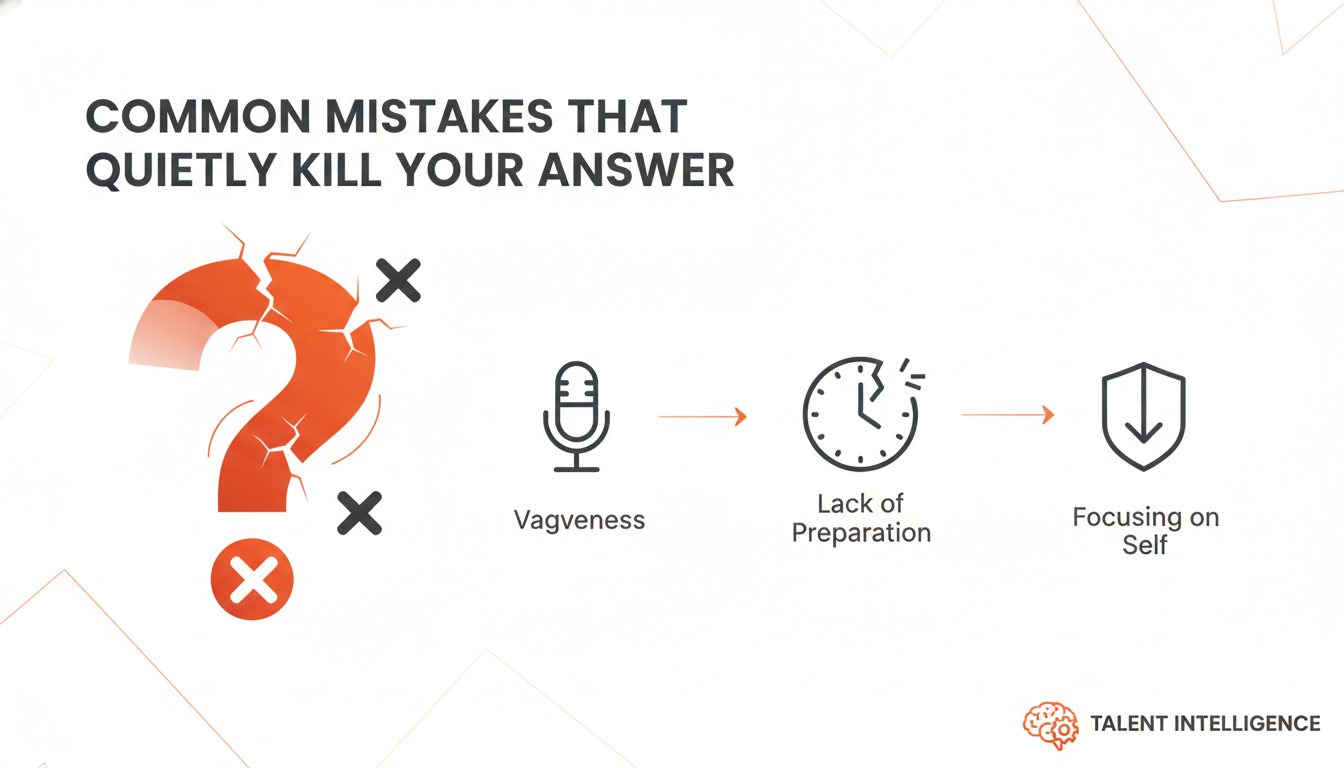
Common Mistakes That Quietly Kill Your Answer
Forbes reports that even strong, well-qualified candidates stumble on this question because they misread what is actually being asked. Here are the six mistakes to avoid:
| Mistake | Why It Hurts | What to Do Instead |
|---|---|---|
| Sounding overconfident | Alienates the interviewer | Use evidence, not superlatives |
| Giving a generic answer | Zero differentiation from other candidates | Tailor every answer to the specific role |
| Repeating the resume verbatim | Wastes a prime opportunity | Add context, outcomes, and meaning |
| Speaking too long | Loses the interviewer’s attention fast | Aim for 60 to 90 seconds |
| Criticizing previous employers | Signals poor professionalism | Keep the answer forward-looking |
| Not connecting skills to this role | Misses the entire point of the question | Always link back to the job description |
One more mistake worth naming directly: trying to memorize a scripted answer word for word. Memorized answers sound flat and rehearsed, and experienced interviewers hear them constantly. Use the four-step framework as a guide, not a script. Know your talking points well enough that you can adapt them in the moment based on how the conversation is going.
Tips to Make Your Answer Stand Out
Structure alone will not separate you from other well-prepared candidates. These tips push your answer from competent to genuinely memorable.
Research the company before you walk in. Know their recent news, key products, stated values, and any challenges facing the industry. One specific and accurate reference to the company makes your answer feel tailored rather than recycled, and it demonstrates the kind of diligence employers want in new hires.
Quantify wherever you can. Numbers are specific, and specific is credible. “Improved customer satisfaction” is forgettable. “Improved customer satisfaction by 22% in six months by redesigning the escalation process” is not.
Lead with employer needs, not your feelings. “I am passionate about marketing” is about you. “I have built campaigns that consistently outperform industry benchmarks, and I want to bring that track record to your growth goals” is about them. The second version will always land better.
Use the STAR method for your example. Keep it tight: Situation, Task, Action, Result. Two to three sentences is enough. This approach works well across all behavioral questions, including tricky ones like explaining your greatest weakness or your reasons for leaving a previous job.
Back up your soft skills with evidence. Yes, you can mention soft skills in your answer. But do not just claim them. “I am a strong communicator” means nothing on its own. “I presented quarterly findings to the executive board and consistently received feedback on clarity and conciseness” means something concrete.
Practice out loud, not just in your head. Your answer will sound noticeably different when spoken versus when read. Record yourself once, listen back, and adjust for anything that feels stilted, too long, or overly formal.
Your Quick Answer Template
Use this fill-in-the-blank version to build your personalized answer before the interview:
“I believe I am a strong fit for this role because I have [specific skill or experience relevant to the job]. In my previous experience or project, I successfully [describe a real achievement], which helped [describe the measurable outcome or impact]. I am excited about this opportunity because I can use these skills to [connect to the company’s specific goals or challenges].”
Once you have filled in the blanks, practice it until you can say it naturally without reading it. Then be ready to adapt it in real time based on how the conversation flows. The best answers feel like a conversation, not a rehearsed pitch.
Key Takeaways
- “Why should I hire you?” is a forward-looking question. Answer it by connecting your past to their future needs, not by summarizing your resume.
- The four-step framework (relevant skill, role connection, real example, future contribution) works across industries and experience levels.
- Freshers should replace apologies for lack of experience with project-based evidence and demonstrated learning agility.
- Experienced candidates should quantify their impact and tie past results directly to what the new role requires.
- Avoid generic claims, memorized scripts, and any answer that centers on your own feelings rather than the employer’s needs.
- Aim for 60 to 90 seconds. Longer answers signal poor self-editing, not depth.
- Practice out loud at least once before the interview so the answer sounds natural, not performed.
Frequently Asked Questions
How to answer why should I hire you?
Focus on three things: your most relevant skill for this specific role, a concrete example that proves it, and how you will apply it to the company’s goals. Avoid vague qualities like “hardworking” and stay specific. Use the four-step framework in this guide to keep your answer focused and under two minutes.
How to answer the question why should I hire you when I have no experience?
Lead with transferable skills from academic projects, internships, volunteer work, or relevant coursework. Show you have researched the role and the company. Emphasize your ability to learn quickly and contribute from day one. A well-structured answer built around a real project beats a weak answer built around years of irrelevant work history.
How to answer for why should I hire you without repeating the resume?
Your resume lists what you did. This answer should explain what it meant and what you will do next. Pick one or two strong examples from your background, add context and outcomes that are not on the resume, and close by linking your experience to the specific role. That is the layer of insight a resume cannot show.
How to answer in interview why should I hire you without sounding arrogant?
Ground every claim in evidence rather than assertion. Instead of “I am the best candidate,” say “In my last role, I delivered X result, and I would love to bring that same approach here.” Evidence sounds confident. Superlatives sound arrogant. Always end by focusing on what you will contribute, not on how exceptional you are.
How to answer a question on why should I hire you if I am switching careers?
Acknowledge the transition briefly, then pivot to the transferable skills that make you a strong fit for the new role. Highlight any steps you have taken to bridge the gap, such as certifications, courses, or personal projects. Employers are often more open to career switchers than candidates expect, especially when the candidate demonstrates self-awareness, preparation, and a clear reason for the move.
What is the best answer for “Why should I hire you?”
The best answer is specific, evidence-backed, and employer-focused. It opens with your strongest relevant skill, connects it to the role through a real example, and closes with how you will contribute to the team’s goals. There is no single universal answer because the best answer is always tailored to the specific job and company you are interviewing with.
Can I mention soft skills in my answer?
Yes, but always tie them to evidence. “I am a strong collaborator” is empty. “I have led cross-functional teams across three time zones and consistently delivered projects on schedule” makes the same point credibly. Soft skills become believable when they are attached to real situations and specific outcomes.
Whether you are preparing for your very first interview or returning to the job market after years in a role, this question is an opportunity most candidates underuse. A sharp, honest, evidence-backed answer does not just improve your chances. It signals the kind of professional clarity that strong teams want to work with every day.
For RPO solutions and executive search hiring, connect with the Taggd and explore everything we have to offer.