The conversation is probably familiar. The board wants confidence that the company’s sustainability disclosures will hold up under scrutiny. Finance wants numbers that reconcile. Operations insists the raw data sits across plants, offices, and vendor systems. Procurement says suppliers aren’t ready. Legal wants to know who signs off. HR is asked a simple question that isn’t simple at all: who owns this internally?
In many Indian enterprises, that answer can’t be “the sustainability team will manage it in Excel”. The work has become too cross-functional, too technical, and too exposed to compliance risk. What’s needed is a Carbon Accountant who can turn messy operational data into an auditable emissions inventory, and who can do it in a way the business can govern.
For CHROs, this is no longer a niche green hire. It’s a role design question, a capability build question, and increasingly a risk management question.
What Is a Carbon Accountant?
A Carbon Accountant is a sustainability and compliance professional responsible for measuring, managing, and reporting an organisation’s greenhouse gas (GHG) emissions.
They build and maintain carbon inventories, oversee Scope 1, Scope 2, and Scope 3 emissions reporting, and ensure carbon accounting data is accurate, auditable, and aligned with reporting frameworks such as the GHG Protocol, BRSR, and ISO 14064.
Why Businesses Need Carbon Accounting Expertise Today?
As ESG reporting requirements, sustainability disclosures, and climate-related regulations increase, businesses need professionals who can connect finance, operations, and sustainability functions.
A Carbon Accountant bridges these teams by translating operational activity data into reliable emissions reports that support compliance, governance, and business decision-making.
That matters because carbon data behaves like financial data in one important way. Once it enters a disclosure process, weak controls become a business problem, not just a reporting inconvenience.
Practical rule: If nobody owns boundary-setting, source-data logic, and audit trail design, the company doesn’t yet have carbon accounting. It has carbon estimates.
A strong carbon accountant usually sits in the overlap between finance discipline, operational understanding, and sustainability requirements. They don’t just “calculate emissions”. They define what the company will count, what evidence supports each line item, which assumptions are acceptable, and where estimation must be replaced with actual activity data over time.
For CHROs mapping emerging roles, this is part of a broader sustainability hiring shift. Taggd’s perspective on green jobs and the sustainability hiring gap in India is useful because it frames these hires as capability builders, not symbolic additions.
Carbon Accountant vs other roles
The confusion usually starts because the title sounds close to roles that already exist. It isn’t the same job.
| Attribute | Carbon Accountant | Financial Accountant | Sustainability Manager |
| Primary focus | Emissions inventory design, data integrity, carbon reporting | Financial transactions, ledgers, statutory reporting | ESG strategy, programmes, stakeholder communication |
| Core metrics | Scope 1, Scope 2, Scope 3, CO2e, boundary coverage, data quality | Revenue, cost, profit, assets, liabilities, cash flow | ESG indicators, programme outcomes, disclosure narratives |
| Main inputs | Utility bills, fuel data, process records, supplier inputs, travel and waste data | ERP records, invoices, journals, balance sheet schedules | Cross-functional ESG inputs, policies, initiatives, survey data |
| Typical output | Auditable GHG inventory and disclosure-ready emissions dataset | Financial statements and management accounts | Sustainability reports, plans, internal initiatives |
| Key risk if weak | Misstated emissions and poor assurance readiness | Misstatement of financials and compliance issues | Weak programme execution or inconsistent ESG messaging |
| Daily collaboration | Finance, procurement, operations, legal, facilities, suppliers | Finance, audit, tax, controllers | HR, communications, CSR, business leadership |
The practical test is this. When leadership asks, “Can we defend this number?”, the carbon accountant should be able to answer with method, source trail, and control logic. The sustainability manager usually won’t own that depth of data architecture. The financial accountant usually won’t own emissions methodology.
That’s why the role has become so important. It fills a control gap that most organisations only notice when scrutiny rises.
BRSR Compliance and Carbon Markets: Why Carbon Accountants Are in Demand
India has changed the context for this role. Carbon accounting is no longer only a voluntary exercise for companies with ambitious ESG agendas. It now sits inside a more formal disclosure and market architecture.
Why the urgency is real
Carbon accounting has become a critical business function in India due to growing ESG reporting requirements, sustainability regulations, and climate disclosure obligations. Organisations increasingly require Carbon Accountants to manage emissions reporting, improve data quality, and support compliance with evolving sustainability frameworks.
The Securities and Exchange Board of India introduced the Business Responsibility and Sustainability Report for the top 1,000 listed companies by market capitalisation, and it became mandatory from FY 2022–23.
That one shift changes the internal conversation. Once disclosure expectations become structured and mandatory for a defined set of companies, emissions data can’t stay trapped in ad hoc spreadsheets owned by well-meaning teams. It needs process ownership, review logic, and documented methods.
The pressure this creates often lands in HR in a secondary form. Leadership sees the compliance burden. Hiring teams then discover there’s a shortage of professionals who can combine reporting, controls, and environmental data fluency. That’s why the wider conversation around compliance and regulatory talent shortages is relevant here. Carbon accounting talent is one example of a broader market pattern where regulation creates entirely new hiring bottlenecks.
How India’s Carbon Credit Trading Scheme Is Raising Reporting Standards
India’s Carbon Credit Trading Scheme notified in 2023 adds another layer. A domestic carbon market architecture depends on credible measurement and verification. In practical terms, that means the organisation’s emissions data can’t just be present. It must be consistent, reviewable, and built on accepted methodology.
Board oversight gets harder when the company can describe its climate intent but can’t explain where its emissions numbers came from.
Many teams make a strategic mistake: they treat carbon accounting as a downstream disclosure exercise. It starts upstream in data capture and boundary-setting. If the foundational inventory is weak, every later use of that data becomes weaker too, whether that use is compliance reporting, internal target-setting, or participation in emerging market mechanisms.
For a CHRO, the hiring implication is direct. You are not recruiting a report writer. You are recruiting a control owner for an increasingly material class of enterprise data.
Carbon Accountant Roles and Responsibilities
Carbon Accountant responsibilities include measuring greenhouse gas emissions, building emissions inventories, managing Scope 1, Scope 2, and Scope 3 reporting, ensuring regulatory compliance, and maintaining accurate carbon accounting records. Good practitioners begin by defining organisational boundaries and establishing reliable emissions data collection processes.
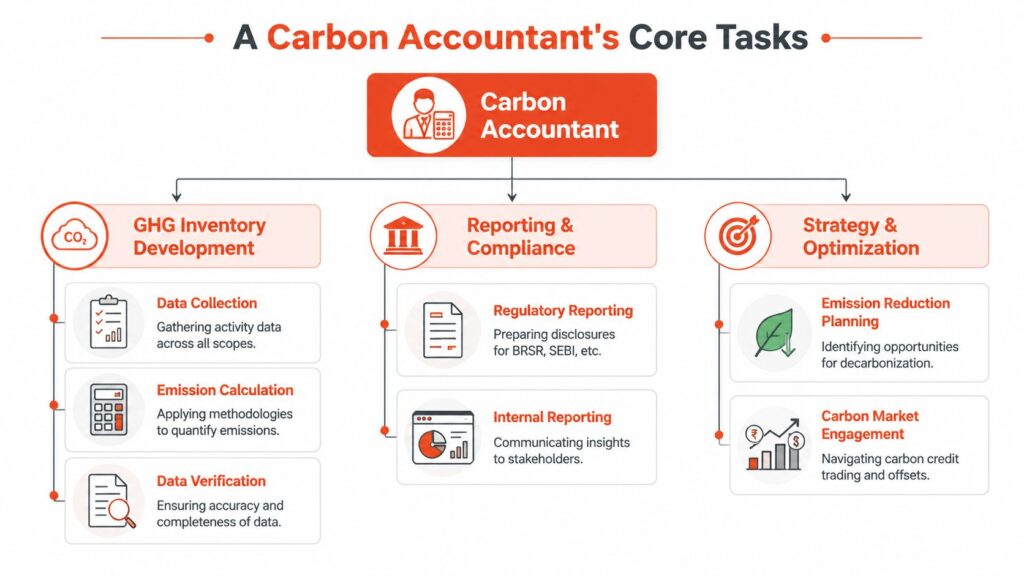
How the workflow starts?
The first technical task is to build a defensible emissions inventory. That means defining the organisational boundary and the operational boundary, then classifying emissions into Scope 1, Scope 2, and Scope 3. After that, the accountant gathers business activity data and applies emissions factors to convert diverse inputs into CO2e using accepted standards such as the GHG Protocol or ISO 14064.
In a real company, this often means answering questions that sound mundane but determine whether the inventory will stand up later:
- Which entities are in scope: Parent only, subsidiaries, joint operations, leased sites, project offices.
- Which activities count: Fuel combustion, refrigerants, purchased electricity, employee travel, waste, logistics, purchased goods.
- Which data source wins: Meter read, utility invoice, ERP extract, supplier declaration, or spend proxy.
- Which standard governs treatment: GHG Protocol logic, ISO-based documentation, internal policy, or assurance requirement.
A candidate who can explain these decisions clearly is usually stronger than one who only talks about dashboards.
For talent teams, it helps to compare this with more traditional accounting capability. The role has some obvious overlap with analytical finance hiring, and this background on accountant roles and responsibilitiesis useful context when drafting scorecards.
A short explainer can help align non-technical stakeholders before interviews begin:
Understanding Scope 1, Scope 2, and Scope 3 Emissions
The three scopes are simple in theory and messy in practice.
Scope 1 covers direct emissions from sources the company owns or controls. In India, that may include fuel used in boilers, furnaces, diesel generators, company vehicles, or process emissions at manufacturing sites.
Scope 2 covers purchased electricity or steam, and with it, location detail begins to matter. A multi-site business with plants and offices across states can’t rely on a lazy, one-size-fits-all treatment if it wants credible reporting.
Scope 3 is the value chain. Purchased goods, logistics, business travel, waste, capital goods, and product use can all sit here. For IT services, GCCs, and BFSI operations, Scope 3 may involve business travel, employee commuting, outsourced services, and purchased goods. For manufacturing and automotive firms, supplier material data becomes central very quickly.
How to Hire a Carbon Accountant?
Finding qualified carbon accountants in 2026 requires a fundamentally different approach than standard sustainability hiring. The cross-disciplinary profile combining environmental science, financial data management, and regulatory expertise is rare and heavily competed for across corporate, consulting, and financial services sectors simultaneously.
| Hiring Challenge | Recommended Solution |
|---|---|
| Scarce cross-disciplinary talent | Hire strong finance or environmental analysts and invest in GHG Protocol and carbon platform training |
| Verification of technical expertise | Use practical carbon calculation assessments including Scope 3 category mapping exercises |
| Platform proficiency gap | Partner with Persefoni or Watershed for certified user training programs |
| Rapidly evolving regulatory knowledge | Prioritize candidates active in GRI, TCFD, and CDP professional communities |
| Retention risk from consulting offers | Build clear CSO career tracks with SBTi and assurance milestone-linked progression |
| Scope 3 data quality challenges | Hire candidates with direct supplier engagement and procurement emissions experience |
Carbon Accountant Job Description Template
Job Title: Carbon Accountant / GHG Accounting Specialist
Department: Sustainability / ESG / Finance / Corporate Affairs
Reports To: Head of Sustainability / Chief Sustainability Officer / CFO
Location: [Location]
Employment Type: Full-time
Job Summary: We are looking for a detail-oriented and analytically rigorous Carbon Accountant to join our [Department] team. In this role, you will measure, track, and report organizational greenhouse gas emissions across Scope 1, 2, and 3 categories, ensuring all carbon accounting activities meet GHG Protocol, ISO 14064, and applicable regulatory disclosure standards. You will work cross-functionally with operations, finance, procurement, and sustainability teams to build credible, audit-ready carbon data that supports organizational net-zero commitments and regulatory reporting obligations.
Key Responsibilities
- Collect, validate, and analyze Scope 1, 2, and 3 emissions data across operations and value chain.
- Prepare GHG emissions inventories aligned with GHG Protocol and ISO 14064 standards.
- Support BRSR, TCFD, CSRD, and CDP climate disclosure reporting requirements.
- Maintain carbon accounting databases, emission factor libraries, and calculation models.
- Coordinate with suppliers on Scope 3 data collection and emissions reporting.
- Support internal and third-party carbon data verification and assurance processes.
- Monitor regulatory developments in carbon pricing, emissions trading, and disclosure frameworks.
- Identify emissions reduction opportunities and track progress against organizational targets.
Required Qualifications
- Degree in Environmental Science, Finance, Economics, Engineering, or related discipline.
- 3 to 7 years of experience in carbon accounting, GHG reporting, or sustainability analytics.
- Proficient in GHG Protocol methodology and Scope 1, 2, and 3 emissions calculation.
- Strong data management and analytical skills with advanced Excel or equivalent proficiency.
- Familiar with BRSR, TCFD, CSRD, and CDP disclosure frameworks and requirements.
Preferred Qualifications
- Experience with carbon accounting software platforms including Persefoni, Watershed, or Salesforce Net Zero Cloud.
- Knowledge of Science Based Targets initiative methodology and net-zero pathway modeling.
- ISO 14064 Lead Verifier or equivalent carbon assurance qualification preferred.
- Exposure to carbon markets, voluntary offsets, and carbon credit registry systems.
- Familiar with sector-specific emission factors and industry carbon accounting methodologies.
Key Skills
- GHG Emissions Inventory and Carbon Accounting
- Regulatory Disclosure and ESG Reporting
- Scope 3 Value Chain Emissions Management
- Carbon Data Verification and Assurance Support
- Emissions Reduction Tracking and Performance Reporting
Key Skills of a Successful Carbon Accountant
Strong carbon accountants do three things well.
First, they translate operational activity into accounting logic. They can take litres of fuel, kilowatt-hours of electricity, freight records, or supplier data and map each input correctly.
Second, they document assumptions. That sounds basic, but it’s where many inventories fail. A number without a method note isn’t audit ready.
Third, they build repeatability. One-off carbon footprint exercises may satisfy a presentation. They don’t build enterprise capability.
The best practitioners leave behind a system the business can rerun, review, and improve. Not just a report.
Skills of a successful Carbon Accountant include:
- Carbon Accounting & GHG Reporting
- Scope 1, 2 & 3 Emissions Management
- Sustainability & ESG Reporting
- Data Analysis & Data Governance
- Financial Accounting & Audit Controls
- Regulatory Compliance (BRSR, GHG Protocol, ISO 14064)
- Stakeholder Management
- ERP & Sustainability Software Proficiency
- Project Management
- Problem Solving & Communication
Industries Hiring Carbon Accountants
Carbon accountants are in demand across every industry facing mandatory emissions disclosure, investor carbon scrutiny, and net-zero transition pressure. Key industries actively hiring are:
Banking and Financial Services
BFSI organizations face financed emissions reporting mandates and mandatory climate disclosure requirements making carbon accountants essential for portfolio-level Scope 3 measurement.
- Financed emissions measurement using PCAF methodology
- TCFD and CSRD carbon disclosure data preparation
- Green bond and sustainability-linked loan reporting support
- RBI and SEBI climate disclosure compliance management
Manufacturing and Heavy Industry
High-emission manufacturers face the most urgent Scope 1 and 2 reduction pressure requiring carbon accountants with industrial process emission factor expertise.
- Industrial process Scope 1 emissions inventory management
- Energy consumption and Scope 2 market-based accounting
- Supply chain Scope 3 supplier emissions data collection
- SBTi carbon reduction target tracking and reporting
Technology and GCCs
Technology companies face growing investor and client pressure to demonstrate credible Scope 3 supply chain emissions management and renewable energy accounting.
- Scope 3 purchased goods and services emissions quantification
- Renewable energy certificate and PPA carbon accounting
- Employee travel and commuting emissions measurement
- CDP and sustainability disclosure carbon data preparation
Real Estate and Infrastructure
Real estate organizations face building energy emissions mandates and green certification requirements driving demand for building-level carbon measurement expertise.
- Building energy Scope 2 emissions measurement and reporting
- Embodied carbon measurement for construction and retrofit projects
- GRESB and green building certification carbon data preparation
- Net-zero building pathway modeling and progress tracking
Latest Trends to Watch in 2026 for Carbon Accountants
The carbon accounting profession is being shaped by regulatory acceleration, data technology transformation, and expanding emissions accountability creating unprecedented demand for qualified practitioners.
- CSRD has made carbon reporting mandatory for over 50,000 European companies, directly driving demand across Indian GCCs and multinationals.
- SEBI’s BRSR Core now legally requires assured Scope 1 and 2 emissions data from India’s top 150 listed companies.
- Scope 3 emissions account for over 70% of most organizational carbon footprints, making value chain accounting the fastest-growing specialization.
- AI carbon platforms like Persefoni and Watershed are cutting manual data collection time by 60%, shifting value toward interpretation and strategy.
- The voluntary carbon market is projected to reach $50 billion by 2030, creating demand for offset quality and carbon credit registry expertise.
- EU Carbon Border Adjustment Mechanism is creating urgent demand for embedded product carbon calculation expertise across export-driven manufacturers.
- ISO 14064 verification experience commands salary premiums of up to 25% above unverified carbon accounting peers.
- SBTi validation experience commands 20 to 30% salary premiums across financial services and manufacturing sectors.
- TNFD frameworks are expanding carbon accountant scope into biodiversity and natural capital accounting beyond GHG emissions.
- The global carbon accounting talent shortage is estimated at over 100,000 professionals by 2027.
Carbon Accountant Salary Trends 2026
In 2026, Carbon Accountant salaries in India typically range from INR 4 L – INR 30 L+ per year, with freshers at INR 5 L – INR 8 L, mid‑level at INR 8 L – INR 14 L, seniors at INR 12 L – INR 20 L, and leads at INR 18 L – INR 30 L+. Pay is highest in Bangalore, Mumbai, and Delhi‑NCR, especially in ESG consulting, energy, and BFSI, driven by rising carbon reporting regulations, ESG disclosures, and net‑zero commitments.
1. By industry
Carbon Accountants in consulting and ESG/climate advisory firms typically earn INR 8 L – INR 20 L. Energy, utilities, and renewables pay around INR 7 L – INR 18 L, manufacturing and industrial sectors INR 6 L – INR 16 L, BFSI and financial services INR 7 L – INR 19 L, and corporates in automotive, FMCG, and tech INR 6 L – INR 15 L.
| Industry sector | Typical salary band (per year) |
|---|---|
| Consulting / ESG & climate advisory firms | INR 8 L – INR 20 L |
| Energy / utilities / renewables | INR 7 L – INR 18 L |
| Manufacturing / industrial sectors | INR 6 L – INR 16 L |
| BFSI / financial services | INR 7 L – INR 19 L |
| Corporates (automotive, FMCG, tech) | INR 6 L – INR 15 L |
2. By location
In major business and climate hubs like Bangalore, Mumbai, and Delhi‑NCR, bands are usually INR 7 L – INR 20 L. Hyderabad, Pune, and Chennai commonly range INR 6 L – INR 16 L, other tier‑1 cities INR 5 L – INR 12 L, and tier‑2 locations INR 4 L – INR 9 L for similar carbon accountant roles and experience levels.
| Location / city type | Typical salary band (per year) |
|---|---|
| Bangalore / Mumbai / Delhi‑NCR | INR 7 L – INR 20 L |
| Hyderabad / Pune / Chennai | INR 6 L – INR 16 L |
| Other tier‑1 cities | INR 5 L – INR 12 L |
| Tier‑2 cities | INR 4 L – INR 9 L |
3. By experience level
Fresher carbon accountants or junior analysts (0–2 years) generally earn INR 5 L – INR 8 L. Mid‑level accountants (3–5 years) often land INR 8 L – INR 14 L. Senior accountants (6–9 years) commonly reach INR 12 L – INR 20 L, and managers or heads of carbon accounting (10+ years) can command INR 18 L – INR 30 L+ in consulting firms and large corporates.
| Experience level | Typical salary band (per year) |
|---|---|
| Fresher / 0–2 years (junior analyst) | INR 5 L – INR 8 L |
| Mid‑level / 3–5 years (accountant) | INR 8 L – INR 14 L |
| Senior / 6–9 years (senior accountant) | INR 12 L – INR 20 L |
| Lead / 10+ years (manager / head) | INR 18 L – INR 30 L+ |
Carbon Accounting Challenges in India and How to Solve Them
The market still talks about carbon accountants as if the main task is calculation. In India, that’s only part of the job. The harder part is building a credible inventory when the underlying data is fragmented, inconsistent, or outside the company’s direct control.
Data governance
A central reality in India is this: the major underserved question is not what the role does, but how to build a credible carbon inventory when India-specific emissions data is fragmented and supplier coverage is weak. The best answer is increasingly a data-governance and supply-chain coordination problem rather than a pure emissions-calculation role.
That distinction matters because it changes the hiring profile. If you recruit only for reporting familiarity or carbon software exposure, you’ll miss the actual work the role must do.
The practical bottlenecks usually look like this:
- Fragmented utility records: Different plants, landlords, captive arrangements, and local billing formats create uneven data quality.
- Weak source standardisation: The same business activity may be recorded differently across locations or functions.
- Partial supplier response: Vendors may not have emissions data, may provide non-comparable formats, or may not understand the request.
- Overuse of proxies: Teams rely on spend-based estimates long after better activity-based data should have been built.
Managing Supplier Data for Scope 3 Carbon Reporting
For Indian enterprises, data architecture determines calculation accuracy, and activity-based data generally produces more precise results than spend-based proxies, while hybrid models are often used when supplier or meter data is incomplete.
IBM also emphasises tagging at the account or meter level so emissions can be aggregated by location and reporting group, which is especially practical in multi-site environments such as manufacturing, BFSI, and GCC operations, according to IBM’s discussion of carbon accounting data architecture.
Weak hiring briefs fail in this regard. They ask for “experience in sustainability reporting software” when they should ask whether the candidate has ever improved source-data granularity.
A capable carbon accountant will usually push for:
- Meter-level or account-level tagging where possible, so energy and utility data can be grouped correctly.
- A documented hierarchy of data sources, so actual activity data outranks generic estimates.
- Supplier data-request processes that procurement can realistically support.
- Hybrid methodology governance, so the company knows where it is using actual data and where it is still estimating.
What doesn’t work is forcing perfect data too early. In India, most large organisations will begin with mixed maturity across categories. Good carbon accountants know how to move from rough to reliable without pretending the gaps don’t exist.
A mature inventory isn’t the one with no estimates. It’s the one where estimates are visible, controlled, and being replaced in a disciplined way.
That’s why this role often succeeds or fails on influence. The person must work across procurement, plant operations, travel desks, facilities, finance controllers, and suppliers. Technical accuracy matters. So does organisational diplomacy.
How to Hire a Carbon Accountant?
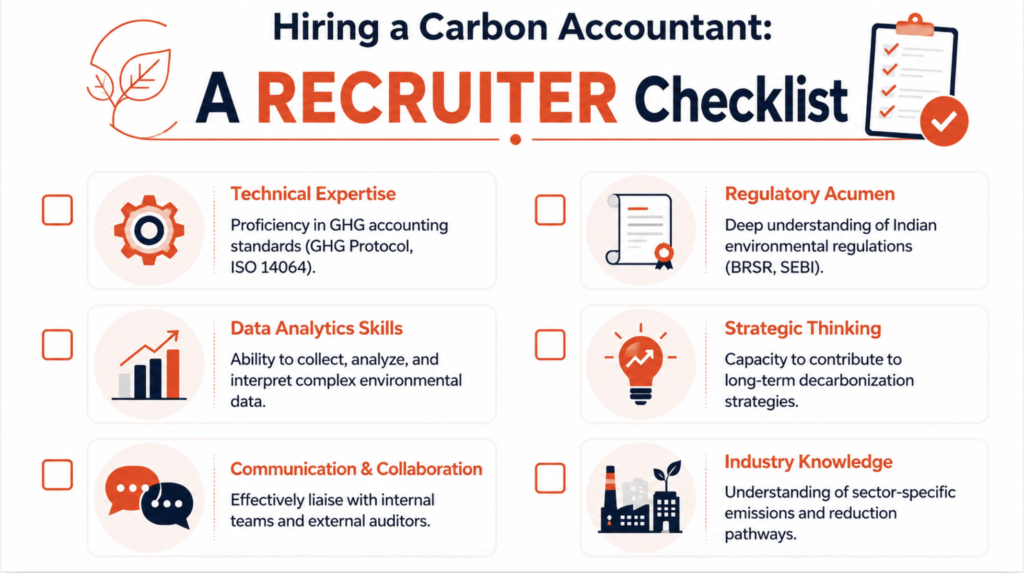
Hiring a Carbon Accountant requires organisations to look beyond sustainability reporting experience alone. The ideal candidate combines expertise in carbon accounting, emissions reporting, data governance, compliance management, and stakeholder engagement to support long-term sustainability objectives.
In most Indian enterprises, the answer should be the third.
Essential Skills and Qualifications for Carbon Accountant Hiring
Use a scorecard that combines technical credibility with operating maturity.
- Methodology fluency: The candidate should understand GHG Protocol logic, organisational and operational boundaries, and how to classify data across scopes.
- Data discipline: Look for evidence that they’ve worked with source systems, utility records, ERP exports, procurement data, or facility-level inputs. Theory alone won’t be enough.
- Control mindset: They should speak naturally about assumptions, audit trail, documentation, and review workflows.
- Cross-functional influence: This person will need cooperation from finance, operations, legal, procurement, and suppliers.
- India context: Ask whether they’ve worked with multi-site operations, uneven data maturity, or state-level operational complexity.
The strongest hiring signal is usually not the brand of software they’ve used. It’s whether they can explain how data architecture affects output quality.
IBM’s operational insight is especially useful here: tagging at the account or meter level allows emissions to be aggregated by location and reporting group, which is highly practical in India’s multi-site environments and points to the need for strong data governance capability. That’s the underlying reason hiring teams should prioritise systems thinking, not just report production.
When TA teams are building hiring plans for emerging roles, broader guidance on how to build an effective recruitment strategy helps, especially when the market is thin and the role cuts across established job families.
Where should a Carbon Accountant sit in your organisation?
There isn’t one perfect reporting line. But there are trade-offs.
| Organisational home | What works | What can go wrong |
| Finance | Better controls, documentation rigour, stronger audit discipline | Role may become disclosure-heavy and too distant from operations |
| Sustainability or ESG | Better strategic context and stakeholder alignment | Weak process control if the team lacks accounting discipline |
| Shared model between finance and sustainability | Best balance when responsibilities are clearly split | Confusion if nobody owns final methodology and sign-off |
In large Indian businesses, a hybrid structure often works best if one executive owns the inventory and another owns broader sustainability strategy. The role itself should have authority to request data across functions. Without that, the hire becomes dependent on persuasion alone.
A specialist hiring partner can also help map adjacent talent pools. For example, Taggd works across recruitment strategy, talent mapping, executive search, and project hiring in India, which is relevant when the right candidate may sit in finance transformation, ESG reporting, internal audit, or operations analytics rather than under a clean “carbon accountant” title.
Interview Questions for Hiring Carbon Accountants
Ask questions that force the candidate to reason through imperfect conditions.
- “How would you define the reporting boundary for a company with multiple sites and mixed operating models?”
- “What would you do if supplier data was unavailable for a material category?”
- “How do you decide when to use activity-based data, spend-based proxies, or a hybrid method?”
- “Describe how you would document assumptions so internal audit or an external assurer could follow your logic.”
- “If one plant has meter-level data and another has only invoices, how would you handle consistency?”
Don’t be satisfied with software names. Ask for method choices, trade-offs, and examples of incomplete data.
Red flags are equally important. Be cautious if the candidate speaks only in ESG narratives, can’t explain boundary-setting, treats Scope 3 as a generic bucket, or assumes all missing data can be solved with a tool.
Explore top interview questions with this guide which covers preparation tips across fresher, intermediate, and expert levels & recruiter insights.
How Carbon Accountants create long-term business value
Many companies first hire a carbon accountant because regulation forces the issue. That’s understandable. It’s also too narrow.
The strategic benefits of hiring a Carbon Accountant
A good carbon accountant gives the organisation something more valuable than a disclosure file. They create a trusted operational dataset that management can use across compliance, internal governance, supplier conversations, and future decarbonisation planning.
That changes how the role should be evaluated. If leadership treats the hire as a reporting cost, the job will remain reactive. If leadership treats the role as infrastructure for better decisions, the value compounds in more practical ways. Teams can identify where source data is weak, where supplier engagement is needed, and where internal ownership is missing.
The strategic case is strongest in companies with operational complexity. Multi-site manufacturers, BFSI firms with distributed facilities, GCCs managing leased offices, and energy-intensive businesses all need someone who can bring order to fragmented environmental data. In those settings, a carbon accountant doesn’t just measure exposure. They make it visible in a form the business can act on.
The workforce implication is equally important. This role sits inside a broader shift toward climate-linked capability building, and that’s why net zero workforce planning in India belongs in the CHRO agenda, not only in sustainability discussions.
The companies that move early will be in a stronger position. Not because they hired for optics, but because they built internal capacity before the data, disclosure, and assurance burden became harder to manage.
FAQs
What does a Carbon Accountant do?
A Carbon Accountant collects, validates, and analyzes emissions data across business operations. They build greenhouse gas inventories, ensure reporting accuracy, support compliance requirements, and help organizations measure and manage carbon footprints.
What qualifications are required to become a Carbon Accountant?
Most Carbon Accountants have backgrounds in accounting, finance, environmental science, engineering, or sustainability. Certifications in GHG accounting, ESG reporting, or sustainability frameworks can improve career prospects significantly.
What is the difference between a Carbon Accountant and an ESG Manager?
A Carbon Accountant focuses on emissions measurement, data quality, and reporting accuracy. An ESG Manager oversees broader sustainability initiatives, stakeholder engagement, ESG strategy, disclosures, and environmental, social, and governance programs.
How much does a Carbon Accountant earn in India?
Carbon Accountant salaries in India vary by experience, industry, and location. Entry-level professionals typically earn moderate salaries, while experienced specialists and managers command significantly higher compensation packages.
Why are Carbon Accountants important for BRSR compliance?
Carbon Accountants help organizations collect accurate emissions data, maintain audit-ready documentation, and support reliable sustainability disclosures, making them essential for meeting BRSR reporting and compliance requirements.
Which industries hire Carbon Accountants in India?
Manufacturing, energy, automotive, BFSI, IT services, GCCs, logistics, pharmaceuticals, construction, and consumer goods companies increasingly hire Carbon Accountants to support sustainability reporting and compliance initiatives.
What skills should CHROs look for when hiring Carbon Accountants?
CHROs should prioritize carbon accounting expertise, data analysis, regulatory knowledge, reporting framework familiarity, stakeholder management, problem-solving abilities, financial acumen, and strong documentation and communication skills.
If you’re defining this role, calibrating the scorecard, or mapping where Carbon Accountant talent sits in India, Taggd can support the search through talent mapping, specialist hiring design, and end-to-end recruitment delivery aligned to your business structure.