Most candidates think interview success begins when the first question is asked. It usually starts earlier, with how quickly the process moves and how prepared you are when it does. JobScore reports that 55% of applicants will give up if they do not schedule their first interview within a week (JobScore interviewing statistics). In India’s faster-moving hiring markets, especially across tech, manufacturing, and GCC roles, that changes the meaning of interview preparation.
Good interview tips and tricks are not just about polished answers. They also involve preparation, communication, and the ability to demonstrate value throughout the interview process.
They’re about showing that you can operate in a business setting where speed, clarity, and judgement matter. Hiring teams notice candidates who reply promptly, confirm logistics cleanly, understand the role context, and communicate like someone who can be trusted with real work.
That’s also why strong candidates often look calmer than everyone else. They aren’t improvising. They’ve prepared stories, tested their setup, anticipated objections, and decided what they want to signal in every round.
What Are the Best Interview Tips and Tricks?
Interview success starts before the interview begins. The best interview tips and tricks include researching the company, preparing examples using the STAR method, practicing common interview questions, understanding the role requirements, and following up professionally after the interview.
How to Make a Strong First Impression in an Interview
In Indian hiring, first impression is rarely just visual. It’s operational. Recruiters and hiring managers often form an early view from how you handle scheduling, how clearly you write, and whether you seem ready without needing to be chased.
That matters because good candidates disappear from the funnel quickly when a process drags. The practical lesson for you is simple. Treat every interaction before the interview as part of the interview.
One of the most overlooked interview tips is treating every interaction with a recruiter or hiring manager as part of the interview process.
Show process discipline early
Do these basics well:
- Reply with precision: Confirm the date, time, interview mode, and names of interviewers in one clean message.
- Check the brief: If the recruiter mentions a case, portfolio, code round, plant visit, or panel, prepare for that format specifically.
- Protect your availability: Don’t create avoidable confusion by asking for repeated reschedules unless there’s a real reason.
- Audit your digital presence: A hiring team will often look you up before the round. Clean up outdated profiles and make your positioning consistent with your application. This practical guide to building an effective online presence to stand out to hiring managers is worth reviewing before active interviewing.
A candidate who manages these basics signals maturity. A candidate who fumbles them creates work for the hiring team.
Practical rule: If your communication creates friction before the interview, interviewers may assume your work style will do the same after joining.
Prepare for a Job Interview Effectively
The strongest candidates don’t stop at “I’ve read the job description”. They ask sharper questions. What is this team trying to fix? Why is the role open now? Which outcomes matter in the first few months? Where could a hiring manager doubt my fit?
That shift changes your answers. You stop reciting experience and start translating it into relevance.
In senior and mid-career hiring, this is often the difference between “capable candidate” and “safe hire”. Hiring managers aren’t buying confidence. They’re reducing risk.
How to Prepare for an Interview Beyond Company Research
A surprising number of candidates stop their preparation at the About Us page. In Indian hiring, that leaves a lot of signals on the table.
Hiring teams in tech, manufacturing, BFSI, and GCCs are rarely testing whether you memorised the founder story or latest tagline. They are checking whether you understand the business pressure around the role. What is the team trying to improve? Where is execution getting stuck? Why are they hiring now instead of six months ago? Candidates who prepare at that level sound easier to hire because they answer in the language of outcomes, not just experience.
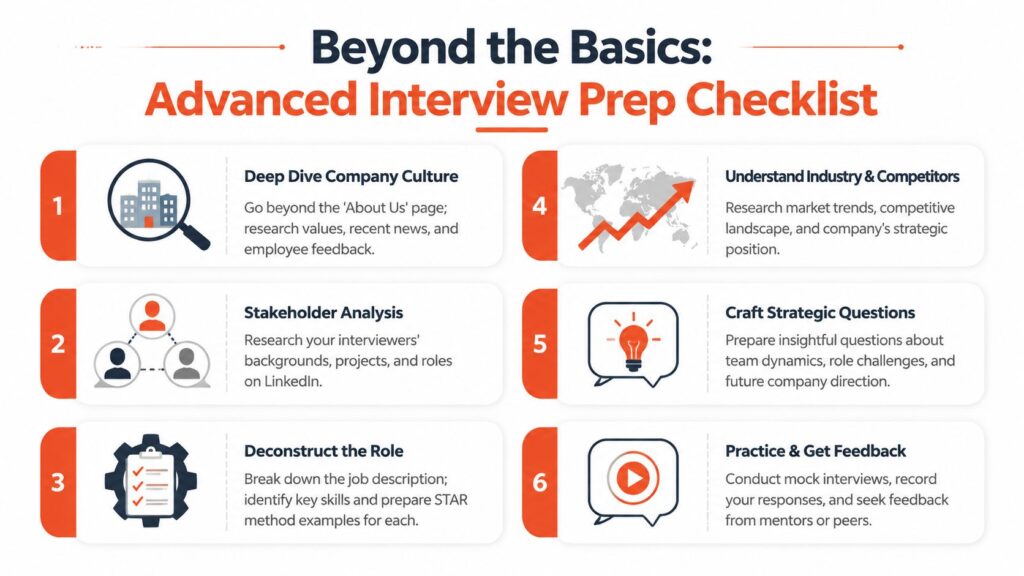
Create an Interview Preparation Checklist
Keep one working document for every serious interview.
A useful prep file usually includes:
- Business context: What the company sells, who buys it, what affects demand, and where margins, delivery, quality, compliance, or customer retention may be under pressure.
- Role translation: The top responsibilities in the job description, rewritten in plain language so you can explain how your work maps to them.
- Stakeholder map: Who will judge your success. In one role, that may be an engineering manager and product lead. In another, it may be a plant head, quality lead, procurement partner, or business finance stakeholder.
- Proof bank: Six to eight examples from your work with clear problem, action, and result detail; AI-led screening and structured interview scorecards reward clarity.
- Question list: A short set of questions that show commercial sense. Ask about priorities, team expectations, success in the first 90 days, or why the role has become important now.
This level of preparation changes the quality of your answers. It also helps hiring managers assess fit faster, which they appreciate more than candidates realise.
How to Answer “Tell Me About Yourself”
Your self-introduction carries more weight in India than many candidates expect. Interview loops are often compressed. The first answer sets the frame for everything that follows.
The U.S. Department of Labor advises candidates to be able to summarise their experience in about 30–60 seconds (U.S. Department of Labor interview tips). That is a useful benchmark, but the content matters more than the timing.
A strong introduction usually covers four points:
- Who you are professionally
- What relevant work you have done
- What business problem you solve well
- Why this role is the logical next step
For a GCC analytics role, for example, a candidate could say they have built reporting automation and stakeholder-facing dashboards, are strongest at converting messy operational data into decision support and now want broader ownership in a global delivery setup.
That answer gives the panel something to work with. A list of employers and tenure does not.
If you want a practical model, this recruiter-led guide to self-introduction tips for interviews gives a useful starting point.
Research the Job Role Before Your Interview
The same title can mean very different work across sectors. A program manager in a product company may be measured on releases and cross-functional execution. In a manufacturing setup, the same title may involve vendor coordination, quality follow-through, cost discipline, and plant-level problem solving. In a GCC, the bar may include stakeholder management across time zones and comfort with matrix reporting.
Candidates who ignore that context sound generic.
Before the interview, check how the company makes money, which market it serves, whether it is scaling, consolidating, hiring for transformation, or replacing someone who left. Then prepare examples that match that situation. This is one of the clearest differences between average candidates and candidates who get shortlisted across rounds.
Use the STAR Method to Structure Answers
Many employers now use scorecards, keyword-led screening, and tightly structured interviews. That does not mean you should speak like a robot. It means your examples should be easy to follow and easy to evaluate.
Use examples with a clean arc:
- the problem
- your role
- the action you took
- the result
- what changed because of your work
In my experience, candidates lose marks when they hide the result inside a long story, or when they describe team activity without making their own contribution clear. Interviewers want enough detail to trust your ownership, but not so much background that the answer loses shape.
Good preparation looks quiet from the outside. Inside the interview room, it looks like judgement.
How to Succeed in Different Interview Formats
The modern interview isn’t one event. It’s a funnel. You may move from ATS screening to recruiter call, then a recorded video response, then a skills test, then a hiring manager discussion, then a panel.
That’s why a lot of conventional interview tips and tricks feel outdated. They assume one person across a table asking predictable questions. Many Indian employers now assess candidates across hybrid workflows that mix automation with human judgement.
LinkedIn’s 2024 Future of Recruiting reporting, as cited here, says 76% of talent professionals say skills-based hiring is becoming more important than traditional credentials, and 62% believe AI will help reduce or remove bias in hiring (discussion of AI, skills-based hiring, and hybrid screening). So, your task is no longer just “perform well in the interview”. It’s “perform well across the funnel”.
Tips for Virtual and Remote Interviews
For remote formats, environment control matters more than candidates realise. Bad framing, weak audio, and visible distraction don’t just look untidy. They interfere with how confidently your answers land.
Use a quiet room, test your microphone, keep notes off-screen or minimal, and maintain eye contact with the camera at key moments. If you’re unfamiliar with virtual hiring etiquette, this overview of the remote interview process is a useful reference.
A remote round also rewards tighter answers. Online, rambling feels longer than it does in person.
Behavioural rounds
For behavioural questions, structure beats charm. Use STAR. Give the context, define your responsibility, explain your action, and close with the outcome and lesson.
Interviewers are usually testing for a pattern, not a single heroic moment. They want to know how you make decisions, handle ambiguity, influence others, and recover when things go wrong.
Many interview tips focus on confidence, but interviewers often place greater value on structured, evidence-based answers that clearly demonstrate your skills and experience.
Technical and case-style rounds
For technical rounds, don’t rush to the answer. Start by understanding the problem. Clarify assumptions. State trade-offs. Then move into the solution.
That approach makes you easier to trust, especially in engineering, data, operations, and process-heavy roles.
A short explainer on interview communication can help before practice rounds:
If an interviewer has to guess how you think, you’re making their job harder. Strong candidates make their reasoning visible.
Answering Behavioural and Technical Questions
Tough interview questions are usually useful questions. They reveal how you think when the answer isn’t obvious, when stakes are real, or when your judgement matters more than your résumé.
Candidates often fear these moments and start performing. That’s the mistake. A hiring team doesn’t need theatre. It needs evidence.
STAR Method Interview Answers
When you hear, “Tell me about a time when…”, don’t improvise in circles. Pick one relevant example and structure it.
| Component | What to Describe |
| Situation | The business context or problem you were facing |
| Task | Your responsibility or objective in that situation |
| Action | The specific steps you took, including decisions and collaboration |
| Result | The outcome, what changed, and what you learnt |
A strong behavioural answer has three qualities. It is specific, proportionate, and honest. Specific means you name the challenge clearly. Proportionate means you don’t claim the entire success if it was a team effort. Honest means you include trade-offs, resistance, or constraints when relevant.
Show Your Thought Process During Interviews
Many candidates make their stories too neat. Real work isn’t neat. If you had to choose between speed and accuracy, push back on a request, or recover from a poor first attempt, say so. That’s often where the signal is.
For example, when asked about conflict, don’t give a polished answer about “everyone aligning in the end”. Explain what the disagreement was about, how you handled it, and what changed in your behaviour afterwards.
Good behavioural answers don’t prove you were perfect. They prove you were responsible.
Handle technical questions with visible logic
In technical interviews, a reliable framework is clarify → model → solve → validate. That means:
- Clarify: Ask what success looks like and remove ambiguity.
- Model: Restate the problem and outline the logic or approach.
- Solve: Work through the answer in an organised way.
- Validate: Test assumptions, edge cases, or failure points.
This works because interviewers aren’t only testing correctness. They’re also watching how you reason under uncertainty, whether you can communicate trade-offs, and how you behave when the path isn’t obvious.
In software or data roles, that may mean verbalising complexity, assumptions, and test cases. In manufacturing or operations, it may mean walking through root cause thinking, constraints, process risk, and implementation practicality. In GCC environments, it often means balancing technical quality with stakeholder usability.
If you freeze, slow down and narrate your next step. Silence without structure worries interviewers more than a partial answer with logic.
Navigating Tough Questions and Career Gaps
Some questions feel dangerous because candidates assume they have only one wrong answer. In practice, interviewers are often testing judgement, self-awareness, and maturity.
“What is your greatest weakness?” is one example. The wrong move is choosing a fake weakness like “I work too hard”. The other wrong move is confessing a critical flaw with no evidence of improvement. The useful middle ground is a real limitation you’ve identified, what it affected, and how you now manage it. For practical examples, this guide to greatest weakness interview answers can help you phrase it properly.
How to Explain Employment Gaps in an Interview
Career gaps need clarity, not over explanation. A frequently missed point in Indian interviews is that employment continuity can carry extra weight, so your answer should convert the gap into proof of readinessby highlighting skills learnt or perspective gained.
A practical formula works well:
- State the reason briefly
- Explain what you did during that period
- Connect it to current readiness
- Return to the role you’re interviewing for
Examples:
- A layoff can be framed around how you used the time to reassess target roles, sharpen domain knowledge, or take on project-based work.
- A caregiving break can be framed with dignity and brevity, followed by what you did to stay current and why you’re ready for a structured return.
- A reskilling period becomes more credible when you connect the learning to actual work scenarios, not just course completion.
What not to do
Avoid these common mistakes:
- Don’t apologise for existing: Explain the gap calmly. Don’t sound defensive.
- Don’t over-disclose personal details: Give enough context for professional understanding, then move on.
- Don’t leave the gap as empty time: Even if the period was difficult, identify what kept you engaged, informed, or prepared.
- Don’t end in the past: Always bring the answer back to why you’re now ready to contribute.
Candidates who handle tough questions well don’t dodge them. They answer directly, stay composed, and keep the story moving forward.
What to Do After a Job Interview
A surprising number of candidates do solid interviews and then waste the final stretch with either silence or awkward chasing. Follow-up should reinforce your value, not create pressure.
Start with a short thank-you note. Mention the role, one part of the discussion that stood out, and one reason you remain interested. If there was a topic you could have answered better, this is your chance to clarify it briefly and professionally. Don’t send an essay.
A sensible follow-up rhythm
A practical sequence looks like this:
- Same day or next working day: Send a concise thank-you note.
- After the stated timeline passes: Send one polite check-in if you haven’t heard back.
- If there’s still no response: Stop spamming. Continue your search and keep momentum elsewhere.
Sometimes the silence reflects internal delays, approval loops, or role reprioritisation. Sometimes it’s poor candidate communication. If you’ve experienced that, understanding the hiring term ghosting in recruitmenthelps separate your performance from the employer’s process behaviour.
What a good note does
A strong follow-up note should do three things:
- Reconfirm fit: Remind them, in one line, why your background matches their need.
- Signal professionalism: Clear writing after the interview suggests clear thinking on the job.
- Keep the tone balanced: Interested, not desperate. Engaged, not entitled.
Silence after an interview isn’t always a verdict. Treat it as incomplete information, not personal failure.
If an offer comes, don’t rush because you’re relieved. Review the role scope, reporting line, work mode, location expectations, and growth path. If something is unclear, ask. Mature candidates don’t negotiate every sentence. They do clarify the points that affect day-to-day success.
Common Interview Mistakes to Avoid
Even well-qualified candidates can lose opportunities because of avoidable interview mistakes. Arriving unprepared, giving vague answers, speaking negatively about previous employers, or failing to research the company can create a poor impression. Candidates should also ask thoughtful questions and follow up professionally after the interview to demonstrate genuine interest and professionalism.
These include:
- Arriving unprepared
- Speaking negatively about past employers
- Giving vague answers
- Not researching the company
- Failing to ask questions
- Ignoring follow-up communication
FAQs
How can I prepare for a job interview?
Research the company, understand the job requirements, prepare examples of your achievements, practice common interview questions, and plan questions to ask the interviewer.
What are the best interview tips and tricks?
The most effective interview tips include researching the role, using the STAR method for behavioural questions, communicating clearly, demonstrating problem-solving skills, and following up professionally after the interview.
How should I answer behavioural interview questions?
Use the STAR method by explaining the Situation, Task, Action, and Result. This helps interviewers understand your contribution and decision-making process.
What should I do after an interview?
Send a professional thank-you email, reiterate your interest in the role, and follow up politely if you do not receive an update within the expected timeline.
How do I explain a career gap in an interview?
Briefly explain the reason for the gap, describe any skills or experience gained during that period, and focus on why you are ready for the role now.
If you’re hiring at scale or trying to improve candidate experience across complex interview funnels, Taggdworks on talent fulfilment, RPO, leadership hiring, talent mapping, and TA transformation for organisations in India.