Boards asking about jobs replaced by AI often start with the wrong unit of analysis. The useful question for Indian enterprises isn’t whether AI erases whole occupations overnight. It’s whether AI removes enough routine work from a role to force a redesign of workflows, spans, skills, and hiring plans.
That reframing matters because the labour signal is more nuanced than the public debate suggests. In India, employers surveyed for the World Economic Forum’s Future of Jobs Report 2025 expect job growth of 22%, job displacement of 16%, and therefore a net 6% employment increase by 2027, as cited in this summary of the report. For a CHRO, that doesn’t read like extinction. It reads like churn, redesign, and a race to rebuild capability faster than competitors.
Most board conversations still swing between hype and panic. Neither helps. A more practical starting point is to treat AI as an operating model change that shifts work from execution to supervision, from repetition to judgement, and from process compliance to exception handling. That’s why the discussion around ChatGPT and job loss in India is most useful when it moves past fear and into role design.
What Jobs Are Most Likely to Be Replaced by AI?
Jobs most likely to be replaced by AI are those that involve repetitive, rule-based, and predictable tasks. Roles in data entry, clerical processing, customer support, transactional finance, and administrative operations are among the most exposed because AI can automate many of their routine activities.
Top 10 Jobs Replaced by AI
AI is reshaping jobs across industries by automating repetitive and rule-based tasks. While complete job replacement remains uncommon, several roles are experiencing significant changes as organisations adopt AI-powered tools to improve efficiency, reduce costs, and streamline workflows.
High Risk
- Data Entry Clerks
- Administrative Assistants
- Customer Service Representatives
- Telemarketing Executives
- Bookkeeping Clerks
Medium Risk
- Recruiters (Screening Tasks)
- Accounts Payable Specialists
- Basic IT Support Professionals
Lower Risk but Evolving
- Content Writers
- Market Research Analysts
Will AI Replace Jobs?
In most cases, AI does not replace entire jobs. Instead, it automates specific tasks within a role. While some jobs may shrink or change significantly, many roles will evolve to include more oversight, decision-making, creativity, and relationship management. For most organisations, AI is driving job transformation rather than complete job replacement.
For Indian businesses, the issue is amplified by where large-scale employment sits. Shared services, BFSI operations, GCC support functions, HR operations, finance operations, procurement support, and customer processes all contain work that can be standardised, documented, and checked against known rules. Generative AI works well in precisely those environments.
The risk isn’t simply automation. The risk is leaving jobs unchanged after the work inside them has already changed.
That creates a leadership challenge with three layers:
- Productivity layer: Teams can complete routine knowledge tasks faster when AI handles drafting, classification, summarisation, and first-pass responses.
- Workforce layer: Managers need fewer people doing full-cycle processing and more people reviewing outputs, handling exceptions, and making judgement calls.
- Strategic layer: Companies that redesign roles early can redeploy talent into growth work while slower firms get trapped in inflated structures and outdated job descriptions.
This is why the phrase jobs replaced by AI can mislead decision-makers. It encourages binary thinking. Keep or cut. Safe or unsafe. Human or machine. Indian CHROs need a sharper lens. Which tasks are stable, repetitive, and rules-based? Which tasks require context, trust, negotiation, and accountability? Which capabilities become more valuable when AI lowers the cost of routine execution?
Those questions lead to better decisions than any headline about job loss.
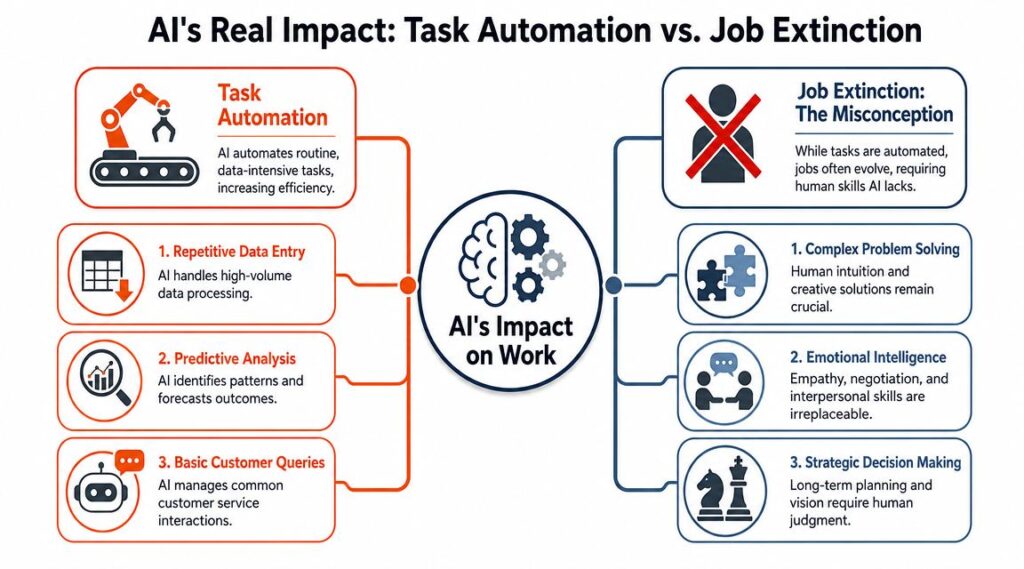
AI and Job Automation: Tasks vs Jobs
McKinsey’s work on generative AI has shown that the largest near-term value sits in automating specific activities inside functions, not erasing entire occupations. That distinction matters more than the headline debate about whether AI will “replace jobs.”
A job is a collection of tasks with different levels of repeatability, judgement, and risk. An accounts payable executive does not only process invoices. The role also includes follow-ups, exception handling, control checks, vendor communication, and escalation. A recruiter does not only screen resumes. The work includes sourcing, assessment, candidate persuasion, hiring manager alignment, and offer negotiation. Indian CHROs who plan at job-title level will miss where disruption starts.
Why the distinction matters
Generative AI performs well on work that can be expressed in text, checked against known rules, and reviewed quickly by a human. That includes first-draft responses, document classification, policy retrieval, meeting summaries, and standard workflow documentation. Performance drops when the work depends on tacit context, organisational judgement, trust, or accountability for a high-stakes decision.
For boards, the implication is straightforward. Workforce risk should be assessed at the task layer, while workforce strategy should be designed at the skill layer.
That shift changes the management question. The right question is not, “Which jobs disappear?” It is, “Which tasks are absorbed, which skills become more valuable, and how does the role need to be redesigned?” For Indian enterprises, that is the difference between controlled productivity gains and unplanned erosion of entry-level career paths. It also aligns with the capability gaps highlighted in the India Skills Report 2025, where employability is increasingly tied to applied skills rather than degree signals alone.
How to Assess AI Risk in Any Job
Boards and CHROs can use a four-part filter to assess exposure with more precision:
- Can the task be standardised?
AI adoption is faster when inputs are structured and outputs follow a recognisable pattern. - Can a reviewer verify quality quickly?
Automation works better when a human can check the result in minutes rather than recreate the work from scratch. - How often do exceptions occur?
Low-variance, high-volume work is easier to shift to AI-assisted execution. - Who carries the consequence of a wrong decision?
Work involving employee trust, regulatory interpretation, negotiation, or client trade-offs usually retains human ownership.
Operating rule: The more a task depends on routine interpretation of text, forms, and standard workflows, the more likely AI will handle the first pass.
What Business Leaders Should Do Next
The organisational effect is role redesign, not only headcount pressure. Teams often need different shape before they need fewer people. Entry-level work built around repetitive processing becomes thinner. Mid-level roles gain more review, exception management, and control responsibility. Managers increasingly supervise workflow quality across humans and AI systems together.
Consider finance operations. If AI extracts invoice data, flags mismatches, drafts supplier messages, and groups exceptions, the human role shifts toward validating edge cases, improving controls, and resolving disputes that require context. The job remains. The skill mix changes.
That is the strategic response Indian CHROs need. Treat AI disruption as a task migration problem and respond with skill mapping, role redesign, and internal mobility. Enterprises that do this early preserve productivity gains without weakening their future leadership pipeline.
Jobs Most Affected by AI in India
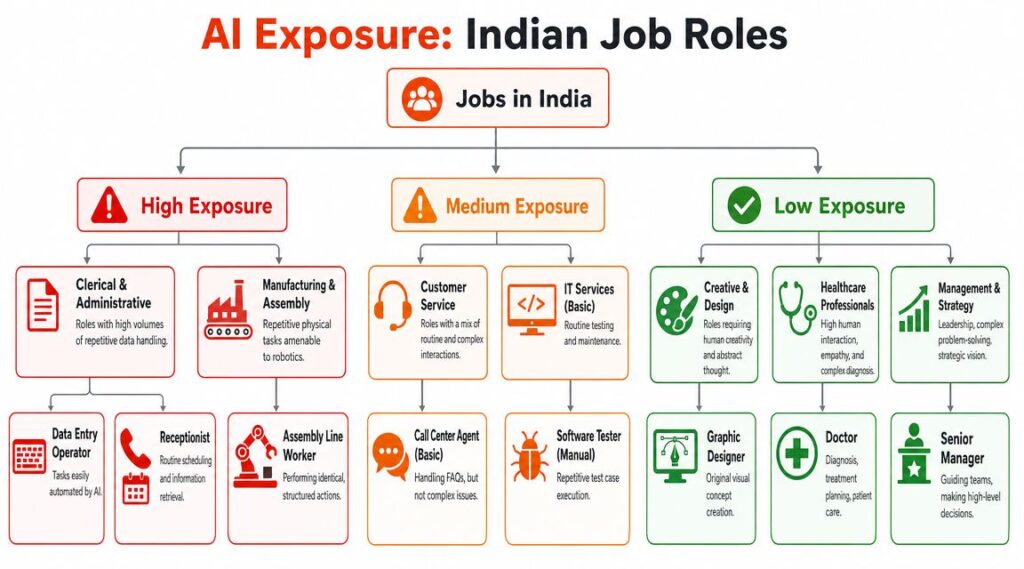
The most exposed work in India sits where scale, standardisation, and documentation already dominate the operating model. Think of process-heavy environments rather than glamorous job titles.
The clearest pattern appears in high-volume, rule-based knowledge work such as clerical processing, transactional finance, and customer operations. Generative AI performs best when work can be broken into structured text, standard decision rules, and repetitive exception handling. A related global pattern is visible in Harvard Business School’s analysis, which notes that job postings for heavily structured roles fell 13% after ChatGPT launched, while more analytical and creative roles rose 20%.
High-Risk Jobs for AI Automation
These roles have the highest concentration of predictable, repeatable tasks.
| Function | Why exposure is high | Indian enterprise examples |
| Clerical processing | Structured inputs and standard outputs | Shared services, admin processing, records operations |
| Transactional finance | Rules-based workflows and repetitive checks | AP, AR, reconciliations, claims support |
| Level-1 customer operations | FAQ-heavy queries and scripted resolution paths | Contact centres, service desks, inbound support |
| Documentation-heavy support work | Summarisation, retrieval, classification | Policy handling, case logging, document review |
For Indian GCCs and BPM environments, these roles are often large in volume and central to delivery economics. That means even modest automation of first-pass work can materially alter headcount planning, role design, and productivity expectations.
A useful secondary signal comes from the India Skills Report 2025 context. The core issue isn’t whether enterprises will stop hiring altogether. It’s whether they will continue hiring for older task mixes after technology has already changed them.
Moderately Exposed Jobs
These roles combine routine tasks with human judgement.
- Basic customer service agents: AI can handle common queries and draft responses, but escalations still need empathy and discretion.
- Manual testers and routine IT support roles: AI can speed up documentation, test creation, and pattern recognition, but complex diagnosis still needs human intervention.
- HR operations teams: Scheduling, policy Q&A, and first-pass screening can be automated, while employee relations and judgement-heavy decisions remain human-led.
- Procurement support: AI can assist with document comparison and vendor communication drafts, but negotiations and commercial trade-offs still sit with people.
These jobs won’t disappear first. They’ll fragment. Some tasks will compress into AI-assisted workflows, while the remaining human work becomes more specialised.
Jobs AI Cannot Easily Replace
Low exposure doesn’t mean no exposure. It means AI is more likely to act as a tool than a substitute.
- Strategic leadership roles: These depend on ambiguity management, judgement, and organisational influence.
- Relationship-heavy commercial roles: Trust, persuasion, and stakeholder politics still matter.
- Complex engineering and product roles: AI can accelerate execution, but architecture choices and trade-off decisions stay human-led.
- People managers in sensitive environments: Coaching, conflict management, and culture shaping don’t reduce neatly to prompts.
The strongest resilience comes from roles where the work cannot be separated from responsibility.
For Indian enterprises, this tiered view is more useful than generic lists of “safe” and “unsafe” jobs. It allows CHROs to prioritise role families where AI changes economics first, then redesign capability pathways around that reality.
New Jobs Created by AI
While AI is automating some tasks, it is also creating demand for new roles focused on implementation, governance, analytics, workflow design, and human oversight. Many organisations are hiring professionals who can bridge technology capabilities with business needs.
Every wave of automation removes some tasks and increases the value of others. AI is following that pattern, but with more speed in white-collar functions than many leaders expected.
That’s why discussions about jobs replaced by AI often miss the better strategic question. Which roles are being created around adoption, governance, implementation, and oversight?
Emerging AI Career Opportunities
A few roles are clearly emerging inside enterprises and service organisations:
- AI implementation specialists who connect business workflows with tooling, governance, and change management.
- AI product owners who prioritise use cases, define acceptable outputs, and manage adoption across functions.
- AI governance and ethics roles focused on controls, usage policy, risk review, and accountability.
- Prompt and workflow designers who turn messy business needs into repeatable interaction patterns with AI systems.
- Human-in-the-loop reviewers who validate outputs in regulated or quality-sensitive environments.
Many firms won’t hire all these as standalone titles. They’ll absorb them into existing structures across HR, operations, analytics, legal, and IT. That is why the larger opportunity lies in AI-adjacent roles, not only pure AI specialist roles.
A practical view of these opportunities appears in Taggd’s write-up on non-tech roles in AI, which reflects how business, governance, and transformation skills are becoming just as relevant as technical expertise.
How Existing Jobs Are Changing
The more significant shift is happening inside ordinary enterprise jobs.
A recruiter now needs to judge AI-generated outreach, not only write it. A financial analyst needs to validate machine-produced summaries and focus more on interpretation. A customer operations manager needs to set escalation logic for AI-enabled service flows. A software professional may spend less time on boilerplate and more time on architecture, code review, and integration judgement.
The most valuable employee in an AI-enabled team isn’t the one who does every task manually. It’s the one who knows which tasks to delegate to tools, which outputs to distrust, and where human judgement changes the decision.
In this context, role architecture starts to shift from fixed descriptions to capability stacks. The same person may need domain knowledge, AI literacy, communication skill, and risk judgement in one blended role.
A short visual explainer helps make that shift concrete.
For board leaders, the implication is direct. Don’t wait for perfect clarity on future job titles. Start identifying which current roles can be augmented, which need recomposition, and which need entirely new support capabilities around them.
Skills That Will Matter Most in the AI Era
Include:
- Critical thinking
- Problem solving
- Communication
- Leadership
- AI literacy
- Data interpretation
- Creativity
- Adaptability
Targets:
- future skills
- AI skills
- skills needed in AI era
How to Prepare for AI-Driven Workforce Change?
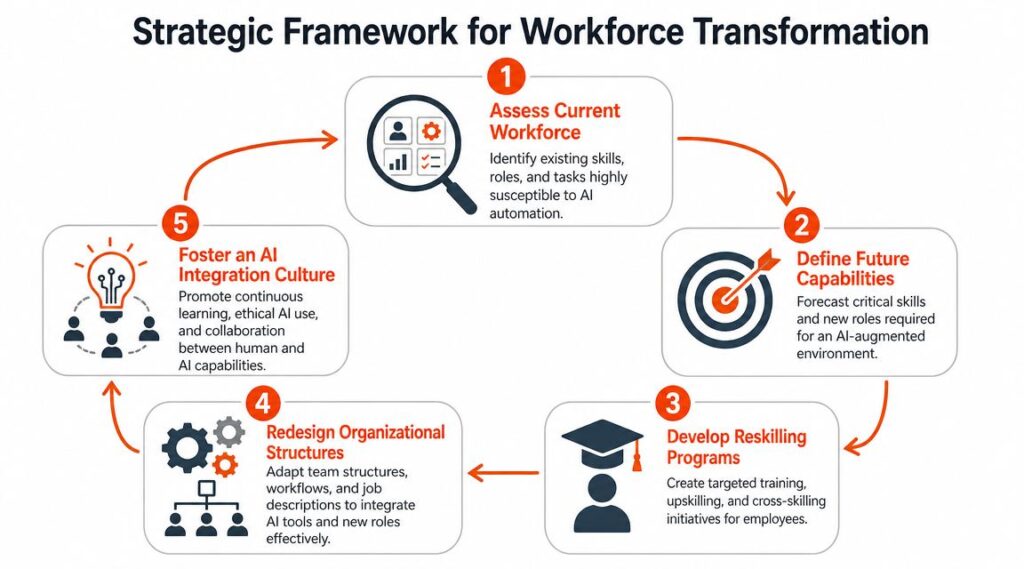
Indian labour data already points to the right strategic response. The better question is not how many jobs AI will eliminate, but how quickly enterprises can redesign work. That’s because overall employment in India rose from 475.7 million in 2023–24 to 477.8 million in 2024–25, even as AI adoption accelerated, according to this India-focused analysis. The signal is task disruption, not simple collapse.
For CHROs, that means reskilling cannot sit inside L&D as a side programme. It has to become part of operating model design.
Focus on Tasks, Not Job Titles
Most companies still inventory people by job family. That’s too coarse.
A stronger approach is to map each priority role into task clusters:
- Tasks AI can draft or complete
- Tasks humans must approve
- Tasks that need escalation
- Tasks that create customer, compliance, or employee risk if wrong
That exercise usually reveals that job titles hide multiple futures. One role may contain automatable work, judgement-heavy work, and relationship work all at once. If leaders skip this step, they either overreact and cut blindly or underreact and preserve outdated job structures.
Build AI-Focused Reskilling Pathways
Once task maps are clear, reskilling should be tied to target workflows rather than broad courses on “AI basics”.
Use three lanes:
- Augmentation lane for roles that remain intact but need AI literacy, output review, and prompt discipline.
- Transition lane for roles losing a high share of routine execution and moving toward review, controls, and exception handling.
- Redeployment lane for employees whose current work is shrinking and who can move into adjacent functions.
In this context, many firms need outside support to connect workforce planning with hiring and role architecture. Taggd’s work on workforce reskilling in India reflects this wider challenge of aligning skill building with actual business redesign.
Board test: If your learning agenda isn’t tied to changed workflows, it’s education. It isn’t transformation.
Redesign Teams for Human-AI Collaboration
Org redesign matters as much as training. Once AI handles first-pass work, team structures often need to shift in four ways:
| Design question | Old model | AI-augmented model |
| Entry-level work | Full-cycle processing | Review, validation, exception support |
| Manager role | Supervising activity volume | Governing quality, prompts, controls |
| Team metrics | Throughput and headcount | Accuracy, escalation quality, cycle efficiency |
| Hiring profile | Process discipline only | Process discipline plus judgement and AI literacy |
This has consequences for spans, layers, and career ladders. If junior staff no longer learn through repetitive processing alone, companies must redesign how they build judgement and domain understanding.
Foster trust during redesign
Employees usually accept technology faster than they accept uncertainty. Poor communication creates resistance even where the workflow change is sensible.
CHROs should be explicit about three things:
- What is changing: Identify tasks and workflows, not vague statements about AI transformation.
- What remains human-led: Clarify decision rights, review points, and accountability.
- What career path follows: Show how employees can move from routine execution into higher-value work.
The firms that handle this well treat AI adoption as a workforce contract, not just a software roll-out. That is where competitive advantage appears. A company that can redesign roles cleanly, reskill quickly, and preserve trust will move faster than a competitor still arguing about whether jobs replaced by AI is the right headline.
Future-Proofing Talent Acquisition
Talent acquisition now sits at the front end of workforce transformation. If hiring criteria stay static while roles are changing underneath, the organisation keeps refilling yesterday’s jobs.
That means TA leaders need to stop hiring by title alone and start hiring by capability mix. The most useful candidates will often combine domain experience with adaptability, judgement, and working knowledge of AI-enabled tools. That applies in operations, HR, finance, product, and customer functions alike.
How Talent Acquisition Teams Should Adapt
- Rewrite job descriptions around outputs: Specify the decisions, deliverables, and review responsibilities in the role, not just the task list inherited from the past.
- Assess for AI judgement, not buzzwords: Ask candidates how they validate machine-generated work, manage exceptions, and decide when not to rely on automation.
- Source from adjacent talent pools: Some of the best hires for transformed roles won’t come from identical titles. They’ll come from neighbouring functions with transferable judgement.
- Update employer branding: Strong candidates want clarity on how your firm uses AI, what remains human-led, and how careers will evolve.
- Use AI carefully inside recruiting: AI can support drafting, scheduling, screening support, and process consistency, but recruiters still need accountability for fairness, communication, and final judgement.
A practical reference point is Taggd’s overview of AI in HR tech and talent acquisition, which shows where AI can assist the TA process without replacing the function’s judgement-heavy work.
For TA heads, the priority isn’t to predict every future title. It’s to build a hiring system that can recognise learning agility, business judgement, and role adjacency early. In an AI-shaped labour market, those become more durable than narrow experience alone.
FAQs
Which jobs are most likely to be replaced by AI?
Jobs involving repetitive, predictable, and rule-based tasks are most vulnerable to AI disruption. Examples include data entry, clerical processing, customer support, bookkeeping, and administrative roles.
Will AI replace jobs completely?
In most cases, AI automates tasks rather than entire jobs. Many roles will evolve to include more oversight, decision-making, creativity, and relationship management.
What jobs are safe from AI?
Roles requiring human judgement, emotional intelligence, leadership, negotiation, and complex problem-solving are generally less vulnerable to automation.
What new jobs will AI create?
AI is creating opportunities in AI implementation, governance, data analysis, workflow design, prompt engineering, and human oversight of AI systems.
How can professionals prepare for AI-driven job changes?
Professionals can stay competitive by developing AI literacy, critical thinking, communication skills, adaptability, and expertise in areas where human judgement remains essential.
Which industries in India are most affected by AI?
Industries with high volumes of repetitive knowledge work, such as BFSI, IT services, customer operations, shared services, and business process management, are experiencing the greatest impact from AI adoption.
As AI continues to reshape how work is done, organisations need talent strategies that evolve with changing skill requirements and role expectations. Taggd helps businesses navigate workforce transformation through talent acquisition, workforce planning, recruitment strategy, and future-ready hiring solutions designed for India’s evolving labour market.