Every product you use was designed before it was built. And behind every great design is a Mechanical Design Engineer who made sure it would actually work in the real world.
As manufacturing complexity grows, product innovation accelerates, and industries from automotive to aerospace demand lighter, smarter, and more sustainable components, Mechanical Design Engineers have become among the most technically critical professionals in modern industry. In 2026, this is not a drafting support role. It is a product creation leadership position that determines whether organizations can innovate, compete, and manufacture at scale.
This guide explains everything candidates and recruiters need to know about Mechanical Design Engineers, including responsibilities, required skills, hiring challenges, job descriptions, and recruitment strategies.
What is a Mechanical Design Engineer?
A Mechanical Design Engineer is a technical professional who conceptualizes, designs, analyzes, and develops mechanical components, assemblies, and systems for manufactured products, ensuring they meet performance, safety, manufacturability, and cost requirements across the full product development lifecycle.
| A Mechanical Design Engineer is a specialist who translates engineering requirements and customer needs into detailed mechanical designs, using CAD tools, simulation software, and engineering principles to create products that are functional, manufacturable, reliable, and commercially viable. |
Mechanical Design Engineers work at the intersection of:
- Product Design and Engineering Development
- CAD Modeling and Technical Documentation
- Structural and Thermal Analysis
- Manufacturing Process and DFM Optimization
- Cross-functional Product Development Collaboration
In 2026, Mechanical Design Engineers are responsible for:
- Designing and developing mechanical components and assemblies using 3D CAD tools including CATIA, SolidWorks, and NX
- Conducting FEA and thermal analysis to validate design performance under real-world operating conditions
- Preparing detailed engineering drawings, BOM structures, and technical specifications for manufacturing
- Collaborating with manufacturing, materials, and quality teams to optimize designs for production
- Supporting prototype builds, testing programs, and design validation activities through development cycles
Think of a Mechanical Design Engineer as a combination of:
- Product Concept Creator
- CAD and Simulation Specialist
- Manufacturing Process Advisor
- Technical Documentation Owner
- Cross-functional Development Collaborator
Why Do Organizations Need a Mechanical Design Engineer?
In 2026, product innovation, lightweighting mandates, sustainability requirements, and manufacturing cost pressures are converging simultaneously. Organizations without strong mechanical design engineering capability cannot develop competitive products, cannot optimize manufacturing costs, and cannot meet the regulatory and performance standards that modern markets demand.
| Factor | Why It Matters |
|---|---|
| Product Innovation Pressure | Competitive markets demand faster, better, and more cost-efficient product development. |
| Lightweighting and Sustainability | Initiatives across EV, aerospace, and renewable energy sectors often involve collaboration with solar energy consultants. |
| Manufacturing Cost Optimization | DFM expertise directly reduces production costs and component waste at scale. |
| Regulatory Compliance | Products must meet increasingly stringent safety and environmental standards globally. |
| Digital Twin Adoption | Simulation-driven design requires specialized engineering software expertise. |
| Supply Chain Localization | Redesigning components for local manufacture requires dedicated engineering capability. |
| Product Lifecycle Management | Complex multi-variant product families need structured design management expertise. |
| Faster Time to Market | Concurrent engineering and simulation tools require experienced design engineers to leverage. |
Core Operational Tasks of a Mechanical Design Engineer
Mechanical design engineers keep product development programs on schedule, on specification, and manufacturable. Here is what their day-to-day looks like:
1. 3D CAD Design and Modeling:
Designing and developing mechanical components and assemblies using 3D CAD tools, a core capability shared by both Mechanical Design Engineers and CAD Engineers.
2. Engineering Drawing and Documentation:
Preparing detailed 2D engineering drawings, GD&T specifications, BOM structures, and design documentation that communicate design intent accurately to manufacturing, procurement, and quality teams.
3. FEA and Simulation Analysis:
Running structural, thermal, and fatigue analyses using ANSYS, Nastran, or equivalent FEA tools to validate design performance, identify failure modes, and optimize component geometry before physical prototype build.
4. Design for Manufacturability Review:
Reviewing designs against manufacturing process capabilities including casting, machining, stamping, injection molding, and additive manufacturing to identify cost reduction and producibility improvement opportunities.
5. Prototype and Test Support:
Supporting prototype build activities, coordinating with test teams on design validation plans, reviewing test results against design requirements, and implementing design changes based on prototype and testing findings.
6. Change Management and ECN Processing:
Managing engineering change requests, preparing engineering change notices, coordinating cross-functional impact assessments, and maintaining design revision control through PLM systems throughout the product lifecycle.
Key Responsibilities of a Mechanical Design Engineer
Mechanical design engineers ensure products are technically sound, manufacturable, and commercially viable by developing detailed designs, validating performance, supporting production, and driving continuous improvement across the full product development lifecycle.
1. Product Design and CAD Development
- Design and develop 3D CAD models for components and assemblies.
- Create and maintain detailed engineering drawings with GD&T specifications.
- Develop and manage BOM structures within PLM systems.
- Ensure designs meet functional, safety, and regulatory requirements.
2. Engineering Analysis and Simulation
- Conduct FEA structural and thermal analysis to validate designs.
- Identify and resolve failure modes through simulation before prototype build.
- Optimize component geometry for weight, strength, and cost simultaneously.
- Document analysis results and design justification for technical review.
3. Design for Manufacturability and Cost Optimization
- Review designs against manufacturing process capabilities and tolerances.
- Identify component consolidation and cost reduction opportunities.
- Collaborate with suppliers and sourcing managers on DFM feedback and design optimization.
- Support value engineering programs to reduce product cost at scale.
4. Prototype, Testing, and Validation Support
- Coordinate prototype build activities and component procurement alongside purchase managers.
- Support design validation testing and review results against specifications.
- Implement design changes based on prototype and test findings.
- Prepare design validation reports for internal and customer approval.
5. Cross-functional Collaboration and Technical Communication
- Collaborate with manufacturing, quality, and procurement specialists on design and sourcing challenges.
- Present design concepts and analysis results to project and leadership teams.
- Support customer technical reviews and design approval processes.
- Mentor junior engineers on CAD best practices and design standards.
Additional Scope (Senior Mechanical Design Engineer Roles)
- Lead design teams across complex multi-component product development programs.
- Own design architecture decisions for new product platforms and variants.
- Present technical design proposals and engineering change justifications to senior leadership.
- Drive adoption of new simulation tools and design methodologies across the team.
What Skills Does a Mechanical Design Engineer Need?
Great mechanical design engineers are not just proficient CAD operators. They are analytically rigorous, manufacturing-aware, and collaborative professionals who can translate complex requirements into elegant, producible designs. Here is what the best bring to the table:
Technical Skills
- 3D CAD platforms (CATIA V5/V6 / SolidWorks / Siemens NX / PTC Creo)
- FEA and simulation software (ANSYS / Nastran / Abaqus / HyperWorks)
- GD&T and engineering drawing standards (ISO / ASME)
- PLM and PDM systems (Teamcenter / Windchill / Enovia)
- Design for manufacturability across casting, stamping, and machining
- Material science and selection for mechanical applications
- Additive manufacturing and rapid prototyping design principles
- Product lifecycle and engineering change management processes
Soft Skills
- Analytical and systematic problem-solving approach
- Clear technical communication and drawing interpretation
- Collaborative mindset across multi-disciplinary development teams
- Attention to detail in design and documentation accuracy
- Adaptability to evolving project requirements and design iterations
- Continuous learning in rapidly advancing design tools and methods
Mechanical Design Engineer Job Description Template
Job Title: Mechanical Design Engineer / Senior Mechanical Design Engineer
Department: Engineering / Product Development / R&D
Reports To: Chief Engineer / Engineering Manager / Head of Product Development
Location: [Location]
Employment Type: Full-time
Job Summary: We are looking for a technically strong and detail-oriented Mechanical Design Engineer to join our [Department] team. In this role, you will design, analyze, and develop mechanical components and assemblies across our product portfolio, ensuring all designs meet performance, safety, manufacturability, and cost requirements. You will work cross-functionally with manufacturing, quality, procurement, and customer teams to deliver technically excellent and commercially competitive products.
Key Responsibilities
- Design and develop 3D CAD models and detailed engineering drawings.
- Conduct FEA and simulation analysis to validate design performance.
- Optimize designs for manufacturability, weight, and cost efficiency.
- Support prototype builds, testing, and design validation activities.
- Manage engineering changes through PLM systems accurately.
- Collaborate with manufacturing, quality, and supplier teams on design.
Required Qualifications
- B.Tech / B.E. in Mechanical Engineering from a recognized institution.
- 3 to 8 years of hands-on mechanical design experience in manufacturing or product development.
- Proficient in CATIA, SolidWorks, NX, or equivalent 3D CAD platforms.
- Strong FEA and simulation skills using ANSYS, Nastran, or equivalent tools.
- Familiar with GD&T, engineering drawing standards, and PLM systems.
Preferred Qualifications
- Experience in automotive, aerospace, or industrial equipment product design.
- Knowledge of design for additive manufacturing and rapid prototyping methods.
- M.Tech in Mechanical Engineering or CAD/CAM specialization preferred.
- Exposure to DFMEA, design validation planning, and DVP&R processes.
- Familiar with AUTOSAR, functional safety, or ISO 26262 for automotive roles.
Key Skills
- 3D CAD Modeling and Engineering Drawing
- FEA and Structural Simulation Analysis
- Design for Manufacturability and Cost Optimization
- Prototype and Design Validation Support
- PLM and Engineering Change Management
How to Become a Mechanical Design Engineer in 2026?
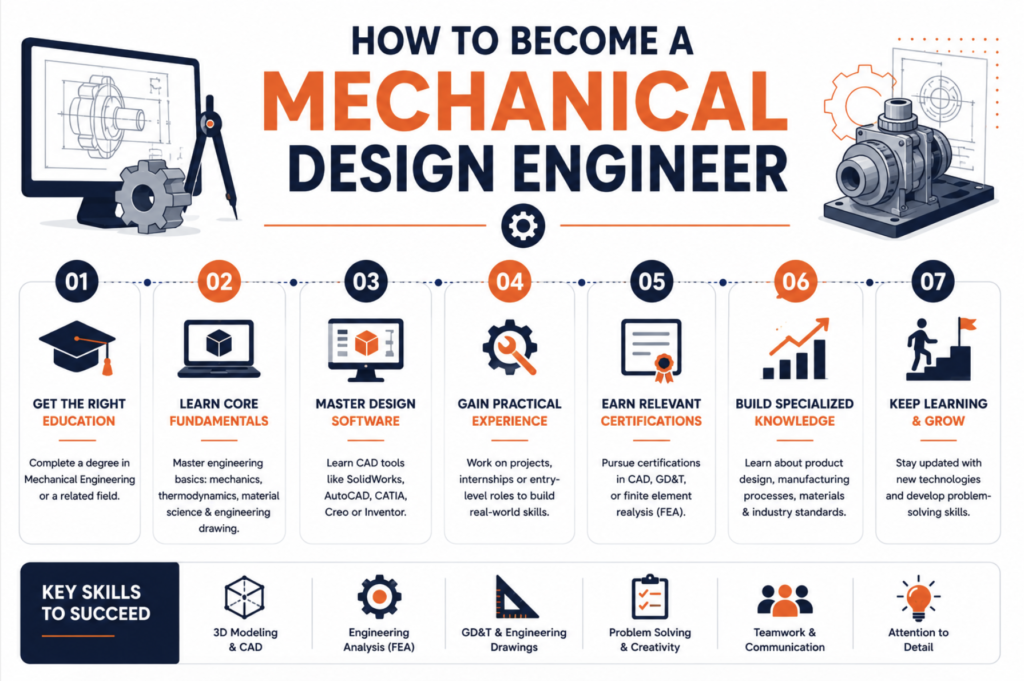
Educational Qualifications and Certifications
Most Mechanical Design Engineers hold a B.Tech or B.E. in Mechanical Engineering from a recognized institution. For senior design leadership or specialist simulation roles, companies prioritize candidates with postgraduate qualifications or recognized CAD and simulation certifications.
Educational Background
- B.Tech / B.E. in Mechanical Engineering from a recognized institution
- M.Tech / M.E. in Machine Design, CAD/CAM, or Product Design (for specialist roles)
- Diploma in Mechanical Engineering for junior design support and drafting roles
- B.Tech in Automotive Engineering (for vehicle and powertrain design roles)
- MBA with Engineering Background for Senior Design Manager or Head of Engineering roles
- Specialized PG Diploma in Product Design, Simulation Engineering, or Advanced Manufacturing
Relevant Certifications
In 2026, earning recognized certifications validates mechanical design expertise and significantly strengthens candidacy for specialist and senior design roles. These credentials demonstrate hands-on proficiency with industry-standard CAD, simulation, and product development platforms that leading manufacturers and engineering organizations expect from experienced design engineers.
| Certification | Best For | Industry Value |
|---|---|---|
| CATIA Certified Professional | Automotive and aerospace component and assembly design | Essential for design engineers in automotive OEM and Tier 1 supplier environments |
| SolidWorks Certified Professional (CSWP) | Mechanical component design and assembly modeling | High demand across industrial equipment, consumer products, and manufacturing design roles |
| ANSYS Certified Professional | FEA structural, thermal, and fatigue simulation analysis | Critical for design engineers responsible for simulation-driven product validation |
| Siemens NX Certification | Advanced CAD modeling for industrial and aerospace applications | Preferred for design engineers in aerospace, defense, and heavy engineering sectors |
| GD&T Professional Certification (ASME) | Engineering drawing interpretation and tolerance specification | Essential for design engineers communicating design intent to global manufacturing teams |
| Autodesk Fusion 360 Certification | Integrated CAD, CAM, and simulation for product development | High value for design engineers in startups, consumer products, and additive manufacturing |
| Certified Manufacturing Engineer (CMfgE) | Manufacturing process integration and DFM expertise | Strong differentiator for design engineers with significant manufacturing coordination responsibility |
Industries Hiring Mechanical Design Engineers
Mechanical design engineers are in demand across every industry where product development, component engineering, and manufacturing innovation drive competitive advantage. Key industries actively hiring are:
Automotive and EV
The automotive sector, including rapidly growing electric vehicle manufacturers, is one of the largest employers of mechanical design engineers, requiring expertise across body, chassis, powertrain, and battery system component design.
- Body structure and closures component design and development
- EV battery enclosure, thermal management, and structural design
- Chassis, suspension, and steering system component engineering
- Powertrain component and transmission mechanical design
Aerospace and Defense
Aerospace and defense organizations require mechanical design engineers with advanced simulation capability, strict regulatory compliance knowledge, and experience designing extreme operating environments.
- Airframe structural component and assembly design and analysis
- Propulsion system and engine component mechanical design
- Defense equipment and weapons system mechanical design development
- Avionics enclosure and aircraft interior component design
Industrial Equipment and Machinery
Industrial machinery, heavy equipment, and manufacturing automation manufacturers require design engineers who understand high-load, high-cycle operating environments and industrial manufacturing process requirements.
- Heavy industrial machinery component and frame design
- Manufacturing automation and robotic system mechanical design
- Hydraulic and pneumatic system component design and integration
- Material handling and conveyor system mechanical design development
Consumer Electronics and Products
Consumer electronics and product companies require mechanical design engineers who can design extreme miniaturization, high-volume manufacture, and premium aesthetic and functional standards simultaneously.
- Consumer electronics enclosure and mechanism design development
- Injection molded and stamped component DFM optimization
- Product ergonomics and human factors design integration
- High-volume assembly process design and tolerance optimization
Latest Trends to Watch in 2026 for Mechanical Design Engineers
Mechanical Design Engineers in 2026 are technically specialized and commercially valuable professionals commanding strong salaries and consistent career growth. CAD platform expertise, simulation capability, and DFM knowledge are the key differentiators driving hiring and compensation across every major manufacturing industry.
Job Role Trends
- Mechanical Design Engineers are now expected to own simulation-driven design validation rather than relying on physical prototype testing alone.
- Generative design and AI-assisted topology optimization tools are entering mainstream mechanical design workflows across leading manufacturers.
- Design for additive manufacturing has become a core competency as 3D printing moves from prototyping to production part manufacture.
- Lightweighting mandates and sustainability goals are increasing collaboration between design teams and sustainability consultants.
- Digital twin integration is requiring design engineers to build simulation-ready models rather than just manufacturing-ready drawings.
Hiring Trends
- CATIA and NX proficiency are non-negotiable hiring filters across automotive OEM and Tier 1 supplier design roles in 2026.
- EV and electric mobility sectors are driving the strongest mechanical design engineer hiring growth across India’s automotive hubs.
- Engineers with both CAD design and FEA simulation capability are significantly more competitive than single-skill specialists.
- Design engineers with DFM and supplier development experience are increasingly preferred over pure design office profiles.
- M.Tech qualified design engineers are consistently fast-tracked in shortlisting for senior design and simulation specialist roles.
Career and Pay Trends
- Mechanical Design Engineers with FEA simulation and CAD expertise command significantly higher starting packages than drawing-only profiles.
- Senior engineers with platform architecture and multi-variant design experience are fast-tracking into Chief Engineer and Engineering Manager roles.
- Performance bonuses tied to design cost reduction targets, weight savings, and development milestone achievement are increasingly standard.
- Design engineers specializing in EV systems, aerospace structures, and industrial automation command the highest mechanical design pay premiums.
- Mechanical design engineering is evolving from a drafting-adjacent function into a simulation-led product innovation role with significantly stronger career trajectories.
Career Path of a Mechanical Design Engineer
A mechanical design engineering career grows from creating basic CAD models as a graduate engineer to setting organizational engineering standards as a Technical Director or VP of Engineering. Each level builds deeper design expertise, simulation capability, and technical leadership authority across one of India’s most consistently in-demand and technically rewarding engineering career paths.
| Career Level | Typical Years of Experience | Core Focus | Key Responsibilities |
|---|---|---|---|
| Level 1: Graduate Engineer / Junior Design Engineer | 0–2 Years | Learning and Execution | Creating basic CAD models, preparing drawings, and supporting senior engineers. |
| Level 2: Mechanical Design Engineer | 2–5 Years | Independent Design | Designing components independently, running basic FEA, and managing ECNs. |
| Level 3: Senior Mechanical Design Engineer | 5–9 Years | Technical Leadership | Leading complex component design, conducting advanced simulation, and mentoring juniors. |
| Level 4: Lead Design Engineer / Principal Engineer | 9–13 Years | Design Ownership | Owning design architecture for product families and leading multi-discipline development. |
| Level 5: Engineering Manager / Chief Engineer | 13–17 Years | People and Strategy | Leading design teams, managing development programs, and driving technical excellence. |
| Level 6: VP of Engineering / Technical Director | 17+ Years | Strategic Leadership | Setting engineering standards and presenting technology roadmaps to leadership and customers. |
Salary trends of a Mechanical Design Engineer
In 2026, Mechanical Design Engineer salaries in India typically range from INR 3.5 L – INR 25 L+ per year, with freshers at INR 3.5 L – INR 6 L, mid‑level at INR 5 L – INR 10 L, seniors at INR 9 L – INR 16 L, and leads at INR 14 L – INR 25 L+. Pay is highest in Bangalore, Pune, and Chennai, especially in automotive, EV, aerospace, and deep‑tech, driven by product innovation, CAD/CAE expertise, and complex mechanical design demands.
1. By industry
Mechanical Design Engineers in automotive, EV, and mobility typically earn INR 6 L – INR 16 L. Industrial machinery and equipment pay around INR 5 L – INR 14 L, aerospace and defense INR 7 L – INR 18 L, consumer durable and electronics INR 5 L – INR 13 L, and startups in deep‑tech and robotics INR 5 L – INR 15 L.
| Industry sector | Typical salary band (per year) |
|---|---|
| Automotive / EV / mobility | INR 6 L – INR 16 L |
| Industrial machinery / equipment | INR 5 L – INR 14 L |
| Aerospace / defense | INR 7 L – INR 18 L |
| Consumer durable / electronics | INR 5 L – INR 13 L |
| Startups / deep‑tech / robotics | INR 5 L – INR 15 L |
2. By location
In engineering hubs like Bangalore, Pune, and Chennai, bands are usually INR 6 L – INR 17 L. Mumbai, Delhi‑NCR, and Hyderabad commonly range INR 5.5 L – INR 15 L, other tier‑1 cities INR 4.5 L – INR 12 L, and tier‑2 industrial belts INR 3.5 L – INR 9 L for similar mechanical design roles and experience levels.
| Location / city type | Typical salary band (per year) |
|---|---|
| Bangalore / Pune / Chennai | INR 6 L – INR 17 L |
| Mumbai / Delhi‑NCR / Hyderabad | INR 5.5 L – INR 15 L |
| Other tier‑1 cities | INR 4.5 L – INR 12 L |
| Tier‑2 cities / industrial belts | INR 3.5 L – INR 9 L |
3. By experience level
Fresher mechanical design engineers (0–2 years) generally earn INR 3.5 L – INR 6 L. Mid‑level design engineers (3–5 years) often land INR 5 L – INR 10 L. Senior engineers (6–9 years) commonly reach INR 9 L – INR 16 L, and lead or principal engineers (10+ years) can command INR 14 L – INR 25 L+ in automotive, aerospace, and deep‑tech firms.
| Experience level | Typical salary band (per year) |
|---|---|
| Fresher / 0–2 years (junior engineer) | INR 3.5 L – INR 6 L |
| Mid‑level / 3–5 years (design engineer) | INR 5 L – INR 10 L |
| Senior / 6–9 years (senior engineer) | INR 9 L – INR 16 L |
| Lead / 10+ years (principal engineer) | INR 14 L – INR 25 L+ |
Hiring Challenges in Mechanical Design Engineer Recruitment
Organizations in 2026 face a persistent mechanical design engineering talent shortage as product complexity and simulation tool adoption accelerate faster than universities can produce work-ready engineers. Finding designers who combine strong CAD capability with FEA simulation skills, manufacturing process knowledge, and cross-functional collaboration ability remains the primary hiring bottleneck.
- CAD Platform Specificity:
Most organizations require proficiency in a specific platform such as CATIA, NX, or SolidWorks, and engineers trained on alternative platforms require significant retraining time that many project timelines cannot accommodate.
- Simulation Skills Gap:
Many mechanical engineering graduates have strong CAD skills but lack hands-on FEA and thermal simulation experience, creating a persistent capability gap in design validation-focused roles.
- Industry Domain Knowledge Deficit:
Automotive, aerospace, and industrial equipment design each require specific product knowledge, standard familiarity, and process understanding that generalist mechanical engineers do not possess from day one.
- DFM Experience Scarcity:
Finding engineers who genuinely understand manufacturing process constraints and can design cost-efficient production rather than purely functional performance is consistently more difficult than it appears.
- Retention Challenges:
Experienced design engineers are frequently attracted by EV startups, overseas engineering centers, and CDAC opportunities offering higher compensation and more advanced technology exposure.
How to Hire a Mechanical Design Engineer?
Hiring skilled mechanical design engineers requires practical CAD and simulation assessments, campus partnership development, and specialist engineering recruitment support. Organizations that invest in tool training, structured mentorship programs, and compelling technology exposure will consistently attract and retain the best design engineering talent in 2026.
- Use Practical CAD and Simulation Assessments:
Design hiring tasks requiring candidates to model a component, run a basic FEA analysis, or review a drawing for DFM issues to evaluate real design engineering competence accurately.
- Partner with Engineering Colleges Early:
Build campus recruitment relationships with top NITs, IITs, and private engineering institutions to access fresh mechanical design talent before competitors reach them.
- Invest in CAD Platform Training:
Hire strong mechanical engineering graduates and invest in CATIA, NX, or SolidWorks training rather than requiring full platform proficiency upfront to significantly expand the available talent pool.
- Offer Advanced Technology Exposure:
Top design engineers are motivated by working on technically challenging and innovative products, so highlight the complexity, novelty, and industry significance of your engineering programs during recruitment.
- Build Structured Mentorship Programs:
Pair junior design engineers with experienced senior designers to accelerate technical development and reduce time to independent design capability.
- Leverage Specialist Engineering Recruiters:
Partner with agencies focused on mechanical and product design engineering hiring to access pre-vetted experienced design talent and reduce time to hire for urgent program vacancies.
- Offer Postgraduate Sponsorship:
Attract ambitious junior engineers by offering sponsored M.Tech programs in machine design or CAD/CAM tied to return service commitments and structured career progression.
Top 10 Interview Questions for a Mechanical Design Engineer
1. Walk me through your design process for developing a new mechanical component from requirements to release.
I start by reviewing and clarifying functional, performance, and manufacturing requirements with the project team, develop multiple concept options using first-principles engineering analysis, select the preferred concept based on a structured trade-off assessment, build the detailed 3D CAD model, run FEA simulation to validate performance and identify failure modes, optimize geometry based on simulation results, prepare detailed drawings with GD&T specifications, conduct DFM review with manufacturing and suppliers, implement feedback, and release through PLM with full documentation.
2. How do you approach FEA analysis for a component you are designing for the first time?
I start by clearly defining the loading conditions, boundary conditions, and failure criteria from the engineering requirements, build or simplify the CAD geometry appropriately for the analysis type, select the correct element type and mesh density based on stress gradient expectations, apply loads and constraints conservatively for the first run, review results for stress concentrations and displacement patterns, validate the model against hand calculations or known benchmarks, and iterate the design geometry until all performance criteria are satisfied with adequate safety margin.
3. How do you ensure your designs are optimized for manufacturability?
I engage manufacturing and supplier teams early in the design process rather than waiting until detailed design is complete, apply DFM principles including draft angles for castings, minimum wall thickness for moldings, and standard feature sizes for machining, use tolerance stack-up analysis to identify assembly risk, review material and process selections against supplier capabilities, and conduct formal DFM reviews with manufacturing engineers before releasing drawings for production.
4. How do you manage design changes during a development program without creating downstream disruption?
I assess every change request against a formal impact analysis covering functional performance, manufacturing, supply chain, testing, and program timeline before approving any modification, classify changes by risk level with appropriate approval authority at each level, document all changes through the PLM engineering change notice process with clear reason, affected parts, and implementation date, and communicate proactively to all affected functions before changes are implemented.
5. How do you select materials for a new mechanical component?
I define the performance requirements including mechanical properties, thermal environment, corrosion exposure, weight targets, and cost constraints, shortlist candidate materials against each requirement, assess manufacturing compatibility with available production processes, evaluate supply chain availability and cost at volume, review against any regulatory or customer specification requirements, and validate the selection through coupon testing or simulation before committing to a full design release.
6. What is your experience with tolerance stack-up analysis and how do you apply it?
I use both worst-case and statistical tolerance stack-up methods depending on the risk and volume profile of the assembly, identify the critical assembly dimensions that affect function or fit, map all contributing part tolerances and their directional contributions, calculate the cumulative variation and compare against the functional requirement, and adjust individual part tolerances or redesign assembly features to bring the stack-up within acceptable limits before releasing drawings for manufacture.
7. How do you design for weight reduction without compromising structural performance?
I use topology optimization and generative design tools to identify material that is not structurally loaded and can be removed, switch to higher specific-strength materials where weight savings justify cost, optimize cross-section geometries for bending and torsion efficiency, use rib and boss reinforcement strategies to maintain stiffness with thinner walls, and validate weight-optimized designs through FEA before prototype build to confirm structural performance is maintained throughout the optimization process.
8. How do you work effectively with suppliers during the design development process?
I engage key suppliers during concept and early detailed design rather than only at drawing release, share design intent and functional requirements rather than just geometric constraints to enable supplier DFM input, conduct joint design reviews at key development milestones, incorporate supplier manufacturing feedback into design iterations before tooling commitment, and maintain clear documentation of all design decisions influenced by supplier input for future reference and change management purposes.
9. How do you handle a situation where test results show your design is not meeting performance requirements?
I start by reviewing the test setup and data to confirm the failure is real and not a test artifact, identify the specific failure mode and its root cause through simulation comparison and physical inspection, assess whether the failure represents a design error, a requirements gap, or a manufacturing variation, develop multiple corrective design options with engineering justification, select the optimal solution based on performance, cost, and timeline impact, implement through the formal ECN process, and retest to verify the corrective action has resolved the failure.
10. How do you stay current with developments in mechanical design tools and engineering methods?
I maintain active engagement with SAE, ASME, and CII engineering communities, follow leading CAD and simulation software provider technical publications and release notes, participate in design engineering webinars and industry conferences, experiment with new tools including generative design and topology optimization on internal projects before applying to critical development programs, and share new techniques with my team through regular knowledge-sharing sessions and design review discussions.
Explore top interview questions with this guide which covers preparation tips across fresher, intermediate, and expert levels & recruiter insights.
Why RPO is the Answer to Mechanical Design Engineer Recruitment
As engineering programs scale, driven by EV transition, aerospace growth, and industrial automation investment, traditional recruitment models cannot keep pace with the volume and technical specificity of mechanical design engineer hiring required across simultaneous development programs.
This is where Recruitment Process Outsourcing (RPO) solutions have become a game changer for engineering-driven organizations. RPO providers embed themselves within your company to hire qualified mechanical design talent at scale.
They bring dedicated engineering sourcing teams, pre-built pools of certified design professionals, and technical competency-based assessment frameworks. This allows you to hire elite mechanical design engineers without overwhelming your internal HR teams during peak program mobilization and product development hiring periods.
For mechanical design engineer hiring specifically, the best RPO partners bring deep engineering and manufacturing domain expertise. They screen candidates for real CAD platform proficiency, simulation capability, and industry-specific design experience rather than just matching engineering keywords on a CV.
Key benefits of RPO for Mechanical Design Engineer talent acquisition:
- Faster time-to-hire: RPO cuts hiring timelines for hard-to-fill senior design and simulation specialist roles significantly.
- Access to passive engineering talent: Recruiters reach experienced design engineers not active on job boards but open to the right product and technology opportunity.
- Scalable model: Ramp from hiring one engineer to staffing an entire design team for a new product program without rebuilding your HR function.
- Reduced cost-per-hire: Significant savings compared to traditional contingency agencies for specialized mechanical design recruitment.
- Technical screening support: Expert vetting of CAD platform proficiency, FEA capability, DFM knowledge, and industry domain experience before candidates reach your interview stage.
- Employer branding: Strategies to position your organization as a top engineering employer highlighting technology innovation, design complexity, and exceptional career development opportunities.
Industries leveraging RPO most actively for Mechanical Design Engineer hiring: Automotive and EV | Aerospace and Defense | Industrial Equipment and Machinery | Consumer Electronics and Products | Oil and Gas and EPC | Medical Devices and Healthcare Technology.
Wrapping Up
The role of a Mechanical Design Engineer in 2026 has never been more technically demanding or more commercially consequential. As industries accelerate product innovation, embrace simulation-driven development, and demand lighter, smarter, and more sustainable designs, the engineers who can translate requirements into manufacturable reality are becoming indispensable to every organization that builds physical products.
Whether you are an engineering professional building a mechanical design career or an organization looking to hire the right design engineering expertise, understanding the skills, certifications, and market dynamics shaping this space is essential for staying competitive in one of India’s most consistently in-demand technical professions.
Ultimately, great products start with great design engineers. By embracing continuous technical learning, simulation tool adoption, and modern recruitment solutions like RPO, both mechanical design engineers and forward-thinking organizations can build the engineering capabilities that consistently deliver products worth making.
FAQs
What is a Mechanical Design Engineer and what do they do?
A Mechanical Design Engineer conceptualizes, designs, analyzes, and develops mechanical components and assemblies, using CAD tools and simulation software to create products that meet performance, safety, manufacturability, and cost requirements across the full product development lifecycle.
How is a Mechanical Design Engineer different from a Mechanical Engineer?
Mechanical engineers cover a broad range of functions including analysis, research, manufacturing, and project management. Mechanical design engineers specialize specifically in product design and development, focusing on CAD modeling, detailed engineering drawings, simulation analysis, and design optimization for manufacturable physical products.
How do I become a Mechanical Design Engineer in 2026?
Earn a B.Tech in Mechanical Engineering, develop proficiency in CATIA, SolidWorks, or NX, gain hands-on design and simulation experience through internships or junior design roles, and pursue CAD and FEA certifications to accelerate progression into senior mechanical design positions.
What software must a Mechanical Design Engineer know in 2026?
CATIA or NX for automotive and aerospace roles, SolidWorks for industrial and consumer product roles, ANSYS or Nastran for FEA simulation, Teamcenter or Windchill for PLM management, and AutoCAD for 2D drawing preparation are the essential tools for mechanical design engineering in 2026.
What are the top 5 skills for Mechanical Design Engineers in 2026?
3D CAD Modeling, FEA and Simulation Analysis, Design for Manufacturability, GD&T and Engineering Drawing, and PLM and Engineering Change Management. These skills determine hiring success and career progression across all mechanical design engineering roles in 2026.
What is the career outlook for Mechanical Design Engineers?
Exceptionally strong. India’s EV transition, aerospace growth, industrial automation investment, and consumer product innovation are driving sustained and growing demand for qualified mechanical design engineers. Skilled professionals are commanding higher salaries and fast-tracking into Chief Engineer and VP of Engineering roles across every major manufacturing sector.
Building world-class products starts with hiring the right mechanical design engineering professionals.
Taggd helps organizations hire skilled Mechanical Design Engineers across automotive, aerospace, industrial equipment, consumer electronics, oil and gas, and medical device sectors through specialized hiring solutions, talent intelligence, and scalable RPO support.