A product that fails in the hands of a customer does not just create a complaint. It creates a crisis. The professional who prevents that from happening is a Quality Inspector.
As manufacturing standards tighten, regulatory scrutiny intensifies, and customer zero-defect expectations become non-negotiable, Quality Inspectors have become among the most operationally critical professionals on any production floor.
In 2026, this is not a checkbox role. It is a frontline quality defense function that directly determines whether products reach customers safely, consistently, and specifications.
This guide explains everything candidates and recruiters need to know about Quality Inspectors, including responsibilities, required skills, hiring challenges, job descriptions, and recruitment strategies.
What is a Quality Inspector?
A Quality Inspector is a technical professional who examines, measures, and tests manufactured products, components, and materials to verify they meet defined quality standards, engineering specifications, and regulatory requirements before reaching the next stage of production or the end customer.
| A Quality Inspector is a specialist who serves as the final defense between a manufacturing process and a defective product, applying measurement tools, inspection techniques, and quality standards to ensure every item that passes through their hands meets the specification it was designed to. |
Quality Inspectors work at the intersection of:
- Incoming, In-process, and Final Product Inspection
- Measurement and Testing Equipment Operation
- Quality Standards and Regulatory Compliance
- Defect Identification and Non-conformance Reporting
- Production Team Collaboration and Corrective Action Support
In 2026, Quality Inspectors are responsible for:
- Conducting incoming material, in-process, and final product inspections against engineering drawings and specifications developed by CAD engineers.
- Operating precision measurement equipment including CMM, vernier calipers, micrometers, and gauges
- Identifying, documenting, and reporting non-conformances through formal NCR and CAPA processes
- Verifying corrective actions and monitoring defect trends to support continuous improvement
- Maintaining inspection records, calibration logs, and quality documentation for audit readiness
Think of a Quality Inspector as a combination of:
- Measurement and Metrology Specialist
- Defect Detection Expert
- Compliance Documentation Owner
- Production Process Watchdog
- Continuous Improvement Contributor
Why Do Organizations Need a Quality Inspector?
In 2026, a single quality escape can trigger customer recalls, regulatory penalties, and reputational damage that costs organizations far more than the entire quality inspection function. Organizations without rigorous quality inspection capability are not just risking products. They are risking customer relationships, certifications, and market position.
| Factor | Why It Matters |
|---|---|
| Zero Defect Customer Expectations | Customers and OEMs demand defect-free products with zero tolerance for escapes. |
| Regulatory Compliance | ISO, IATF, FDA, and sector-specific standards require documented inspection evidence. |
| Cost of Poor Quality | Defects caught early cost a fraction of defects discovered by customers in the field. |
| Supplier Quality Management | Incoming inspection and collaboration with procurement specialists prevent defective materials entering production. |
| Certification Maintenance | Quality management certifications require active and documented inspection programs. |
| Product Liability Risk | Defective products create significant legal and financial exposure for manufacturers. |
| Production Efficiency | Early defect detection prevents defective batches consuming downstream manufacturing costs. |
| Continuous Improvement | Inspection data drives root cause analysis and process improvement across production. |
Core Operational Tasks of a Quality Inspector
Quality inspectors keep production quality controlled, documented, and continuously improving. Here is what their day-to-day looks like:
1. Incoming Material Inspection
Inspecting raw materials and purchased components sourced through purchase manager-led procurement processes.
2. In-process Inspection
Conducting dimensional, visual, and functional checks at defined production stages to identify defects and process deviations before they are compounded through subsequent manufacturing operations.
3. Final Product Inspection
Performing comprehensive final inspection of finished products against specifications prepared by mechanical design engineers before customer delivery.
4. Measurement Equipment Operation
Operating precision measurement instruments including CMM machines, vernier calipers, micrometers, height gauges, surface roughness testers, and optical comparators to accurately verify component dimensions.
5. Non-conformance Reporting and CAPA
Documenting identified defects through formal non-conformance reports, initiating hold and quarantine procedures for affected material, and supporting root cause analysis and corrective action verification activities.
6. Inspection Record and Calibration Management
Maintaining accurate inspection records, first article inspection reports, calibration logs, and quality documentation that support audit readiness and provide traceability across all inspected products and materials.
The following table summarizes the primary areas of responsibility for a Quality Inspector. Unlike the detailed operational tasks that describe daily activities, these core functions provide a high-level view of how Quality Inspectors contribute to quality assurance, compliance, defect prevention, and continuous improvement.
| Core Area | Key Responsibility |
|---|---|
| Product Inspection | Inspect products against quality standards. |
| Measurement & Testing | Uses precision measuring instruments. |
| Defect Detection | Identify and reports of defects. |
| Documentation | Maintains quality records and reports. |
| Compliance | Ensures regulatory and quality compliance. |
| Continuous Improvement | Supports defect reduction and corrective actions. |
Key Responsibilities of a Quality Inspector
Quality inspectors protect product integrity and customer satisfaction by conducting rigorous inspections, documenting non-conformances, supporting corrective action processes, and maintaining the quality records that demonstrate organizational compliance with applicable standards.
1. Incoming and In-process Inspection
- Inspect incoming materials and components against drawings and acceptance criteria.
- Conduct in-process checks at defined production stage gates.
- Verify first article about inspections against customer-approved reference samples.
- Release or quarantine material based on inspection findings accurately.
2. Final Inspection and Product Release
- Perform comprehensive final product inspection against specifications and drawings.
- Verify packaging, labeling, and shipping documentation accuracy before dispatching.
- Complete inspection records and sign-off documentation for product release.
- Escalate non-conforming finished products through formal NCR processes.
3. Measurement and Testing Equipment Operation
- Operate CMM, vernier calipers, micrometers, and gauges accurately.
- Select appropriate measurement tools for each inspection requirement.
- Verify equipment calibration status before conducting measurements.
- Maintain measurement equipment in correct operating conditions.
4. Non-conformance and CAPA Management
- Document defects and non-conformances through formal NCR systems.
- Initiate material holds and quarantine procedures for non-conforming stock.
- Support root cause analysis and corrective action development.
- Verify effectiveness of implemented corrective actions through follow-up inspection.
5. Quality Records and Audit Readiness
- Maintain accurate and traceable inspection records for all products and materials.
- Manage calibration records and equipment status documentation.
- Prepare quality documentation for internal and customer audits.
- Support quality management system compliance and certification maintenance.
Additional Scope (Senior Quality Inspector Roles)
- Lead inspection teams across multiple production lines or shift patterns.
- Own first article inspection and customer approval documentation programs.
- Support supplier quality audits and incoming inspection standard development.
- Mentor junior inspectors on measurement techniques and quality standards.
What Skills Does a Quality Inspector Need?
Great quality inspectors are not just experienced at spotting defects. They are precise, methodical, and documentation-disciplined professionals who combine measurement expertise with process knowledge and clear communication. Here is what the best bring to the table:
Technical Skills
- Precision measurement instruments (CMM / vernier calipers / micrometers / gauges)
- Engineering drawing and GD&T interpretation
- Quality management systems (ISO 9001 / IATF 16949 / AS9100)
- Statistical process control and sampling plan methodology (AQL / MIL-STD)
- Non-conformance and CAPA documentation systems
- First article inspection and PPAP documentation
- Surface finish and material testing techniques
- Quality management software and ERP system inspection modules
Soft Skills
- Exceptional attention to detail and measurement precision
- Methodical and process-disciplined approach to inspection
- Clear and accurate documentation and reporting
- Calm and objective judgment under production pressure
- Collaborative communication with production and engineering teams
- Continuous improvement mindset and defect prevention focus
Tools Used by Quality Inspectors
Quality Inspectors use a range of precision measurement instruments and digital quality systems to verify product conformity, identify defects, maintain compliance, and ensure products consistently meet engineering and customer requirements.
| Tool | Primary Purpose |
|---|---|
| Vernier Caliper | Measures internal, external, and depth dimensions with accuracy. |
| Micrometer | Performs highly precise dimensional measurements on critical components. |
| Height Gauge | Measures vertical dimensions and verifies component heights. |
| Dial Indicator | Detects dimensional deviations, runout, and alignment variations. |
| CMM (Coordinate Measuring Machine) | Conducts advanced dimensional inspection of complex parts and geometries. |
| Optical Comparator | Magnifies and evaluates component profiles, contours, and geometric features. |
| Surface Roughness Tester | Measures and verifies surface finish quality against specifications. |
| Go/No-Go Gauges | Quickly confirms whether dimensions fall within acceptable tolerance limits. |
| SPC Software | Tracks process performance and identifies quality trends using statistical data. |
| Quality Management Systems (QMS) | Stores inspection records, audit documentation, and compliance data. |
Quality Inspector Job Description Template
Job Title: Quality Inspector / Senior Quality Inspector
Department: Quality / Manufacturing / Production
Reports To: Quality Engineer / Quality Manager / Head of Quality
Location: [Location]
Employment Type: Full-time
Job Summary: We are looking for a detail-oriented and technically skilled Quality Inspector to join our [Department] team. In this role, you will inspect incoming materials, in-process components, and finished products against engineering specifications and quality standards, identifying and documenting non-conformances and supporting corrective action processes that protect product quality and customer satisfaction. You will work closely with production, engineering, and supplier teams to maintain a robust quality inspection program across all manufacturing operations.
Key Responsibilities
- Inspect incoming materials, in-process components, and finished products.
- Operate precision measurement equipment including CMM and gauges.
- Document non-conformances and initiate NCR and quarantine procedures.
- Maintain inspection records, calibration logs, and audit documentation.
- Support root cause analysis and corrective action verification activities.
- Collaborate with production and engineering on quality improvement initiatives.
Required Qualifications
- Diploma or B.Tech in Mechanical, Production, or Manufacturing Engineering.
- 2 to 6 years of hands-on quality inspection experience in manufacturing environments.
- Proficient in operating CMM, vernier calipers, micrometers, and precision gauges.
- Strong ability to read and interpret engineering drawings and GD&T specifications.
- Familiar with ISO 9001, IATF 16949, or equivalent quality management standards.
Preferred Qualifications
- Experience with first article inspection and PPAP documentation processes.
- Knowledge of statistical process control and AQL sampling plan methodology.
- CQI or ASQ Certified Quality Inspector qualification preferred.
- Exposure to automotive, aerospace, or pharmaceutical quality inspection environments.
- Familiar with quality management software and ERP inspection modules.
Key Skills
- Precision Measurement and Dimensional Inspection
- Engineering Drawing and GD&T Interpretation
- Non-conformance Reporting and CAPA Support
- Quality Management System Compliance
- Inspection Record and Calibration Management
How to Become a Quality Inspector?
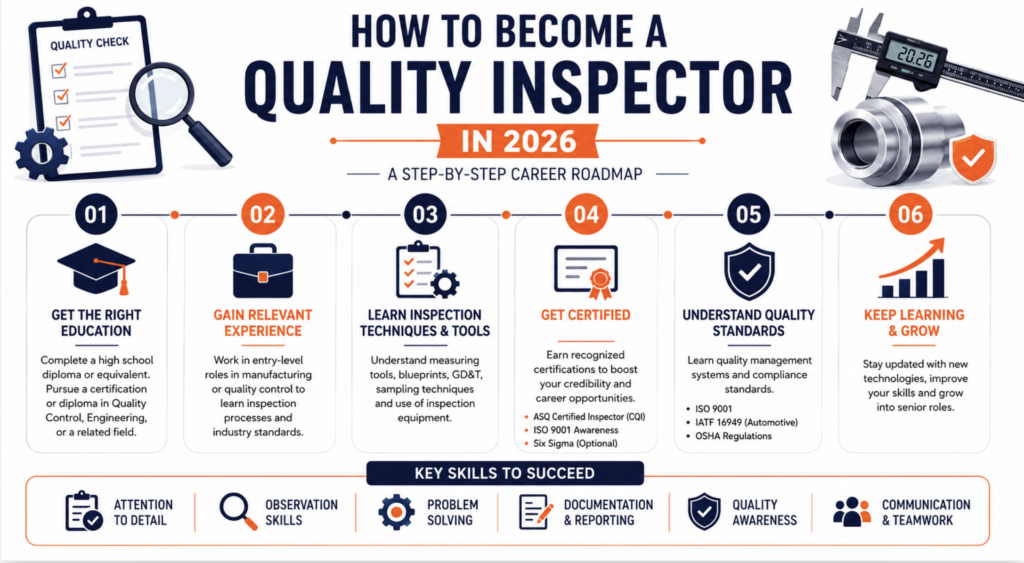
Educational Qualifications and Certifications
Most Quality Inspectors hold a diploma or bachelor’s degree in mechanical, production, or manufacturing engineering. For senior inspection or quality leadership roles, companies prioritize candidates with recognized quality management certifications or postgraduate qualifications in quality assurance and manufacturing systems.
Educational Background
- Diploma / B.Tech in Mechanical, Production, or Manufacturing Engineering
- B.Sc / M.Sc in Materials Science or Metrology (for specialist measurement roles)
- Diploma in Quality Management from recognized institutes covering inspection and QMS
- B.Tech in Industrial Engineering (for manufacturing process quality roles)
- MBA with Quality or Operations Specialization for Senior Quality Manager career progression
- Specialized PG Diploma in Quality Assurance, Metrology, or Manufacturing Systems
Relevant Certifications
In 2026, earning recognized certifications validates quality inspection expertise and significantly strengthens candidacy for specialist and senior quality roles. These credentials demonstrate hands-on proficiency with industry-standard measurement techniques, quality management frameworks, and inspection methodologies that leading manufacturers expect from experienced quality inspectors.
| Certification | Best For | Industry Value |
|---|---|---|
| ASQ Certified Quality Inspector (CQI) | Comprehensive quality inspection techniques and measurement methodology | Gold standard credential for quality inspectors across manufacturing sectors globally |
| ASQ Certified Quality Technician (CQT) | Quality systems, statistical methods, and inspection process management | High demand for quality inspectors moving into quality engineering and systems roles |
| IATF 16949 Internal Auditor | Automotive quality management system auditing and compliance | Essential for quality inspectors in automotive and Tier 1 supplier environments |
| ISO 9001 Internal Auditor | Quality management system implementation and compliance auditing | Critical for quality inspectors supporting QMS certification and maintenance programs |
| CMM Operator Certification | Coordinate measuring machine operation and programming | High value for quality inspectors in precision engineering and aerospace environments |
| Six Sigma Green Belt | Statistical process control and quality improvement methodology | Preferred for senior quality inspectors driving SPC and defect reduction programs |
| AS9100 Internal Auditor | Aerospace quality management system auditing and compliance | Essential for quality inspectors in aerospace, defense, and aviation manufacturing |
Industries Hiring Quality Inspectors
Quality inspectors are in demand across every industry where product conformance, regulatory compliance, and zero-defect customer delivery are central to manufacturing operations and business reputation. Key industries actively hiring are:
Automotive and EV
The automotive sector, including rapidly growing EV manufacturers, requires quality inspectors across body, chassis, powertrain, and battery component inspection with strict IATF 16949 compliance and OEM customer-specific requirements.
- Body and chassis component dimensional and visual inspection
- EV battery cell and module incoming and in-process inspection
- Powertrain and transmission component precision measurement
- PPAP and first article inspection for new component launches
Pharmaceuticals and Medical Devices
Pharma and medical device manufacturers operate under the strictest quality inspection regulatory frameworks in any industry, requiring inspectors with GDP, GMP, and FDA compliance expertise and meticulous documentation discipline.
- Raw material and API incoming inspection and release testing
- In-process inspection of tablet, capsule, and sterile product manufacturing
- Medical device dimensional and functional inspection against IEC and ISO standards
- Batch record review and quality documentation for regulatory submission
Aerospace and Defense
Aerospace and defense manufacturers require quality inspectors with AS9100 compliance knowledge, advanced measurement capability, and experience inspecting safety-critical components to extremely tight dimensional tolerances.
- Airframe structural component dimensional and surface inspection
- Precision machined part CMM inspection and geometric verification
- Non-destructive testing support for aerospace safety-critical components
- First article inspection and customer source inspection coordination
Electronics and Semiconductor
Electronics and semiconductor manufacturers require quality inspectors with expertise in visual defect detection, functional testing, and ESD-compliant inspection procedures across high-volume precision component production.
- PCB and electronic assembly visual and functional inspection
- Semiconductor component incoming and outgoing quality inspection
- ESD-compliant inspection procedures and handling verification
- AOI and automated inspection system monitoring and exception review
Latest Trends to Watch in 2026 for Quality Inspectors
Quality Inspectors in 2026 are technically precise and commercially valuable professionals commanding consistent career growth and improving compensation. CMM proficiency, GD&T expertise, and quality system knowledge are the key differentiators driving hiring and pay across every major manufacturing sector.
Job Role Trends
- Quality Inspectors are increasingly expected to operate and interpret automated optical inspection and vision system outputs alongside manual inspection activities.
- Digital inspection records and paperless quality management systems have replaced manual logbooks as the standard documentation method across modern manufacturing.
- Statistical process control interpretation is now expected at inspector level rather than being reserved exclusively for quality engineers.
- Quality Inspectors are being integrated into continuous improvement teams contributing defect trend data to root cause and process improvement activities.
- Inline and real-time inspection technologies are changing the inspector role from reactive defect detection to proactive process monitoring and control.
Hiring Trends
- CMM operation and programming proficiency has become a primary technical hiring filter for quality inspector roles in precision engineering sectors.
- Automotive and EV sectors are driving the strongest quality inspector hiring growth across India’s manufacturing hubs in 2026.
- Inspectors with both dimensional measurement and visual inspection capability across multiple product categories are significantly more competitive.
- IATF 16949 and ISO 9001 internal auditor credentials are increasingly expected for senior quality inspector and team lead roles.
- Quality inspectors with PPAP and first article inspection experience are among the most actively recruited profiles across Tier 1 automotive suppliers.
Career and Pay Trends
- Quality Inspectors with CMM and advanced measurement certification command significantly higher starting packages than manual measurement-only profiles.
- Senior inspectors with PPAP, SPC, and quality system audit experience are fast-tracking into Quality Engineer and Quality Manager career paths.
- Performance bonuses tied to defect escape rates, audit scores, and NCR closure times are increasingly standard in quality inspection compensation structures.
- Quality inspectors specializing in aerospace, pharmaceutical, and semiconductor inspection command the highest quality inspection pay premiums in India.
- Quality inspection is evolving from a manual detection function into a data-driven process monitoring discipline with significantly stronger long-term career trajectories.
Career Path of a Quality Inspector
A quality inspection career grows from conducting basic visual checks as a junior inspector to leading the entire quality function as a Quality Manager or Head of Quality. Each level builds deeper measurement expertise, quality system knowledge, and operational leadership capability across one of manufacturing’s most consistently essential and in-demand professional functions.
| Career Level | Typical Years of Experience | Core Focus | Key Responsibilities |
|---|---|---|---|
| Level 1: Junior Quality Inspector / Quality Checker | 0–2 Years | Learning and Execution | Conducting basic visual and dimensional checks and maintaining inspection records. |
| Level 2: Quality Inspector | 2–5 Years | Independent Inspection | Performing incoming, in-process, and final inspection using precision measurement tools. |
| Level 3: Senior Quality Inspector | 5–8 Years | Technical Leadership | Leading complex inspection programs, conducting FAI, and supporting CAPA processes. |
| Level 4: Quality Inspector Team Lead | 8–12 Years | Team Oversight | Managing inspection teams, owning NCR programs, and driving audit readiness. |
| Level 5: Quality Engineer / Quality Supervisor | 12–15 Years | Process and Systems | Owning quality systems, leading SPC programs, and supporting customer audits. |
| Level 6: Quality Manager / Head of Quality | 15+ Years | Strategic Leadership | Leading quality function, managing certifications, and presenting to leadership and customers. |
Salary Trends of Quality Inspectors
In 2026, Quality Inspector salaries in India typically range from INR 2 L – INR 9 L+ per year, with freshers atINR 2 L – INR 4 L, mid‑level at INR 3 L – INR 5.5 L, seniors at INR 4 L – INR 7 L, and leads at INR 5 L – INR 9 L+. Pay is highest in Pune, Chennai, and Bangalore, especially in automotive, aerospace, and pharma, driven by strict quality standards, inspection tool expertise, and zero‑defect manufacturing goals.
1. By industry
Quality Inspectors in automotive, EV, and auto components typically earn INR 3.5 L – INR 7 L. Manufacturing, machinery, and equipment pay around INR 3 L – INR 6.5 L, aerospace and defense INR 4 L – INR 8 L, pharmaceuticals and medical devices INR 3.5 L – INR 7 L, and FMCG or consumer goods INR 2.5 L – INR 5.5 L.
| Industry sector | Typical salary band (per year) |
|---|---|
| Automotive / EV / auto components | INR 3.5 L – INR 7 L |
| Manufacturing / machinery / equipment | INR 3 L – INR 6.5 L |
| Aerospace / defense | INR 4 L – INR 8 L |
| Pharmaceuticals / medical devices | INR 3.5 L – INR 7 L |
| FMCG / consumer goods | INR 2.5 L – INR 5.5 L |
2. By location
In industrial hubs like Pune, Chennai, and Bangalore, bands are usually INR 3.5 L – INR 7.5 L. Mumbai, Delhi‑NCR, and Hyderabad commonly range INR 3 L – INR 6.5 L, other tier‑1 cities INR 2.5 L – INR 5.5 L, and tier‑2 industrial belts INR 2 L – INR 4.5 L for similar quality inspector roles and experience levels.
| Location / city type | Typical salary band (per year) |
|---|---|
| Pune / Chennai / Bangalore | INR 3.5 L – INR 7.5 L |
| Mumbai / Delhi‑NCR / Hyderabad | INR 3 L – INR 6.5 L |
| Other tier‑1 cities | INR 2.5 L – INR 5.5 L |
| Tier‑2 cities / industrial belts | INR 2 L – INR 4.5 L |
3. By experience level
Fresher quality inspectors (0–2 years) generally earn INR 2 L – INR 4 L. Mid‑level inspectors (3–5 years) often land INR 3 L – INR 5.5 L. Senior inspectors (6–9 years) commonly reach INR 4 L – INR 7 L, and quality supervisors or lead inspectors (10+ years) can command INR 5 L – INR 9 L+ in manufacturing and automotive plants.
| Experience level | Typical salary band (per year) |
|---|---|
| Fresher / 0–2 years (junior inspector) | INR 2 L – INR 4 L |
| Mid‑level / 3–5 years (inspector) | INR 3 L – INR 5.5 L |
| Senior / 6–9 years (senior inspector) | INR 4 L – INR 7 L |
| Lead / 10+ years (quality supervisor) | INR 5 L – INR 9 L+ |
Hiring Challenges in Quality Inspector Recruitment
Organizations in 2026 face a persistent quality inspector talent shortage as manufacturing complexity and measurement technology sophistication accelerate faster than vocational training programs can produce work-ready inspection professionals. Finding inspectors who combine precision measurement skills with quality system knowledge and documentation discipline remains the primary hiring bottleneck.
- Measurement Equipment Proficiency Gap:
Many candidates have basic inspection experience but lack hands-on CMM operation and advanced measurement tool proficiency required in precision engineering environments.
- GD&T Interpretation Weakness:
Reading and interpreting complex engineering drawings with full GD&T specifications remains a persistent skill gap across many quality inspection candidates in the market.
- Industry-Specific Standard Knowledge:
Automotive IATF, aerospace AS9100, and pharmaceutical GMP inspection requirements each demand specific standard familiarity that generalist quality inspectors do not possess from day one.
- Documentation Discipline Gap:
Many experienced inspectors are skilled at finding defects but lack the systematic documentation discipline and NCR management capability required for regulated and audited manufacturing environments.
- Retention Challenges:
Experienced quality inspectors are frequently attracted by quality engineer promotion opportunities at competing manufacturers offering higher compensation and broader technical scope.
How to Hire a Quality Inspector?
Hiring skilled quality inspectors requires practical measurement and drawing interpretation assessments, vocational institute partnerships, and specialist manufacturing recruitment support. Organizations that invest in equipment training, structured quality development programs, and clear inspection career pathways will consistently attract and retain the best quality inspection talent in 2026.
- Use Practical Measurement Assessments:
Design hiring tasks requiring candidates to measure a component using provided instruments, interpret a drawing with GD&T callouts, or complete a sample inspection record to evaluate real inspection competence accurately.
- Partner with ITI and Polytechnic Institutes:
Build campus recruitment relationships with quality-focused ITI and diploma programs to access freshly trained inspection candidates entering the profession for the first time.
- Invest in Measurement Equipment Training:
Hire candidates with strong inspection fundamentals and invest in CMM operation and advanced gauge training rather than requiring full equipment proficiency upfront.
- Define Industry Standard Requirements Clearly:
Specify whether the role requires IATF, AS9100, ISO 9001, or GMP knowledge in job descriptions to attract candidates with relevant compliance experience.
- Offer Certification Sponsorship:
Attract ambitious inspectors by sponsoring ASQ CQI, CMM operator, and internal auditor certification programs tied to career progression milestones.
- Leverage Specialist Manufacturing Recruiters:
Partner with agencies focused on quality and manufacturing operations hiring to access pre-vetted experienced inspector talent and reduce time to hire.
- Build Internal Quality Career Ladders:
Define transparent progression from junior inspector to Quality Engineer with clear competency milestones and certification requirements to improve retention of high-potential inspection talent.
Top 10 Interview Questions for a Quality Inspector
1. Walk me through how you conduct an incoming material inspection.
I start by retrieving the approved purchase order, engineering drawing, and material certificate for the incoming delivery, verify the delivery quantity and part number against the purchase order, conduct dimensional inspection using appropriate measurement tools against drawing specifications, check material certificates against the approved material specification, apply the AQL sampling plan for the batch size, document all measurements and observations on the incoming inspection record, and either release the material to stores or raise an NCR and initiate quarantine if any non-conformance is identified.
2. How do you read and interpret a GD&T drawing?
I identify the datum reference frame first to understand the measurement coordinate system, then read each feature control frame systematically covering the geometric characteristic symbol, tolerance value, material condition modifier, and datum references, select the appropriate measurement method for each control including CMM fixturing for position and orientation tolerances, and verify each controlled feature against its tolerance requirement with the datum structure properly established before taking any measurements.
3. How do you operate a CMM to inspect a complex machined component?
I review the drawing and identify all features requiring CMM measurement, set up the part on the CMM fixture with the correct datum alignment, write or load the measurement program, probe each feature using the appropriate stylus configuration, collect measurement data for all controlled dimensions, compare results against drawing tolerances, generate a measurement report, and document the inspection outcome on the part traveler before making a conformance disposition decision.
4. How do you handle a situation where you find a non-conforming product that has already been partially assembled?
I immediately quarantine the affected assembly and all suspect components from the same batch, raise a formal NCR with a detailed description of the non-conformance including measurement data and photographs, notify the quality engineer and production supervisor, assess whether the non-conformance can be accepted under deviation, reworked, or requires scrapping, coordinate with engineering on the disposition decision, and ensure all affected material is clearly identified and physically segregated until a formal disposition is documented and approved.
5. How do you ensure your measurement equipment is giving accurate results?
I verify the calibration status label and due date on every instrument before use, perform a zero or master check at the start of each inspection session, use gauge blocks or reference standards to verify instrument accuracy at the measurement range required, repeat measurements on suspect readings to confirm consistency, and immediately remove any instrument showing calibration drift from service and raise a calibration recall notification for any product inspected with the affected equipment.
6. How do you apply an AQL sampling plan for a large incoming batch?
I determine the batch size and identify the applicable inspection level from the customer or organizational quality plan, select the sample size code letter from MIL-STD-1916 or equivalent standard, determine the sample size and acceptance and rejection numbers for the applicable AQL level, randomly select the sample from across the batch rather than from the top of the pallet, inspect each unit in the sample against all specified criteria, and accept or reject the batch based on the number of defects found against the acceptance number.
7. How do you support a root cause analysis investigation for a recurring defect?
I compile the inspection data and NCR history for the recurring defect, organize the data by defect type, production date, shift, machine, and operator to identify patterns, participate in the fishbone or 5-why analysis session providing factual inspection observations rather than opinions, conduct targeted inspection at the suspected process stage to generate additional data, verify that proposed corrective actions address the identified root cause rather than just the symptom, and conduct follow-up inspection over a defined monitoring period to confirm the defect has not recurred after the corrective action was implemented.
8. How do you manage your workload when you have incoming inspection, in-process checks, and final inspection all due simultaneously?
I assess the priority of each inspection based on production urgency, customer delivery commitment, and risk of defect escape, communicate workload conflicts to the quality supervisor immediately rather than attempting to manage alone, focus first on inspections that are blocking production or customer shipment, apply risk-based sampling where appropriate for lower-risk material, and ensure no inspection is skipped or undocumented regardless of time pressure by completing records for every inspection activity conducted.
9. How do you prepare quality documentation for a customer source inspection visit?
I compile all relevant quality records including FAI reports, material certifications, inspection records, calibration certificates, and NCR closure evidence for the products being source inspected, organize documentation against the customer’s source inspection checklist requirements, verify that all records are accurate, complete, and legible, prepare the inspection area and measurement equipment for customer use, brief the quality team on the inspection scope and customer-specific requirements, and ensure all identified non-conformances have been formally closed before the customer arrival.
10. How do you stay current with updates to quality standards and inspection methods?
I monitor ISO, IATF, and ASQ standard revision publications regularly, attend internal quality training sessions and external industry seminars, participate in supplier quality day events where customer quality requirements are communicated, discuss inspection technique improvements with quality engineers and experienced senior inspectors, and apply updated standard requirements immediately to my active inspection programs after receiving internal communication from the quality management team.
Explore top interview questions with this guide which covers preparation tips across fresher, intermediate, and expert levels & recruiter insights.
Why RPO is the Answer to Quality Inspector Recruitment
As manufacturing operations scale, driven by automotive EV transition, pharmaceutical capacity expansion, and aerospace program growth, traditional recruitment models cannot keep pace with the volume and technical specificity of quality inspector hiring required across simultaneous production ramp programs.
This is where Recruitment Process Outsourcing (RPO) solutions have become a game changer for quality-driven manufacturing organizations. RPO providers embed themselves within your company to hire qualified quality inspection talent at scale.
They bring dedicated manufacturing sourcing teams, pre-built pools of certified quality professionals, and practical competency-based assessment frameworks. This allows you to hire elite quality inspectors without overwhelming your internal HR teams during peak production ramp and quality system implementation periods.
For quality inspector hiring specifically, the best RPO partners bring deep manufacturing and quality domain expertise. They screen candidates for real measurement competence, drawing interpretation capability, and quality system knowledge rather than just matching inspection keywords on a CV.
Key benefits of RPO for Quality Inspector talent acquisition:
- Faster time-to-hire: RPO cuts hiring timelines for hard-to-fill senior inspection and quality team lead roles significantly.
- Access to passive quality talent: Recruiters reach experienced inspectors not active on job boards but open to the right manufacturing opportunity.
- Scalable model: Ramp from hiring one inspector to staffing an entire quality inspection team for a new production line without rebuilding your HR function.
- Reduced cost-per-hire: Significant savings compared to traditional contingency agencies for high-volume quality inspection recruitment.
- Technical screening support: Expert vetting of measurement equipment proficiency, drawing interpretation, quality standard knowledge, and documentation capability before candidates reach your interview stage.
- Employer branding: Strategies to position your organization as a top quality employer highlighting manufacturing technology, career development, and quality culture investment.
Industries leveraging RPO most actively for Quality Inspector hiring: Automotive and EV | Pharmaceuticals and Medical Devices | Aerospace and Defense | Electronics and Semiconductor | Industrial Equipment and Machinery | FMCG and Consumer Goods Manufacturing.
Wrapping Up
The role of a Quality Inspector in 2026 has never been more operationally critical or more commercially consequential. As manufacturing standards tighten, customer zero-defect expectations intensify, and regulatory compliance requirements expand, the professionals who can measure accurately, document precisely, and detect defects before they reach customers are becoming indispensable to every organization that manufactures physical products.
Whether you are a manufacturing professional building a quality inspection career or an organization looking to hire the right quality talent, understanding the skills, certifications, and market dynamics shaping this space is essential for staying competitive in one of India’s most consistently in-demand manufacturing functions.
Ultimately, quality is not inspected into a product. But without great quality inspectors, defects escape into the hands of customers. By investing in the right inspection talent, measurement technology, and modern recruitment solutions like RPO, both quality inspectors and forward-thinking manufacturers can build quality programs that consistently protect product integrity and customer trust.
FAQs
What is a Quality Inspector and what do they do?
A Quality Inspector examines, measures, and tests manufactured products and materials to verify they meet engineering specifications, quality standards, and regulatory requirements, preventing defective products from reaching customers or the next stage of production.
How is a Quality Inspector different from a Quality Engineer?
Quality inspectors focus on hands-on product and material inspection, measurement, and non-conformance documentation at the production floor level. Quality engineers design quality systems, lead root cause analysis, develop inspection plans, and manage quality improvement programs across the manufacturing operation.
How do I become a Quality Inspector in 2026?
Earn a diploma or degree in mechanical or manufacturing engineering, develop precision measurement and drawing interpretation skills, gain hands-on inspection experience through trainee or junior roles, and pursue ASQ CQI or ISO 9001 internal auditor certifications to accelerate career progression.
How long does it take to become a Quality Inspector?
Typically 2 to 4 years including relevant engineering education and 1 to 2 years of hands-on inspection experience. Candidates with strong mechanical aptitude and measurement tool exposure can fast-track through structured inspector trainee programs within 6 to 12 months.
What are the top 5 skills for Quality Inspectors in 2026?
Precision Measurement Equipment Operation, Engineering Drawing and GD&T Interpretation, Non-conformance Reporting and CAPA Support, Quality Management System Compliance, and Statistical Process Control Awareness. These skills determine hiring success and career progression across all quality inspection roles.
What is the career outlook for Quality Inspectors?
Consistently strong. India’s manufacturing expansion across automotive, EV, aerospace, pharmaceuticals, and electronics is driving sustained demand for qualified quality inspectors. Skilled professionals are commanding improving salaries and fast-tracking into Quality Engineer and Quality Manager roles across every major manufacturing sector.
Is a Quality Inspector role mostly on the production floor or office-based?
Primarily production floor based. Quality inspectors spend most of their time at inspection stations, receiving docks, and production lines conducting hands-on measurement and inspection activities, with additional time in the quality office completing documentation, NCR processing, and audit preparation activities.
Building defect-free manufacturing starts with hiring the right quality inspection professionals.
Taggd helps organizations hire skilled Quality Inspectors across automotive, pharmaceuticals, aerospace, electronics, industrial equipment, and consumer goods manufacturing sectors through specialized hiring solutions, talent intelligence, and scalable RPO support.