19% of workers described their workplace as very or somewhat toxic in the APA’s 2023 Work in America Survey, and workers in toxic environments were more than three times as likely to report mental-health harm at work as those in healthy workplaces, 52% versus 15% according to the APA’s 2023 findings on work and mental health.
For HR leaders in India, these toxic workplace signs should not be treated as isolated culture concerns that can wait for the next engagement cycle. Left unaddressed, a toxic work environment can weaken employee trust, increase turnover, and damage long-term business performance.
Most organisations don’t collapse because one person complains loudly. They weaken because good people stop volunteering ideas, stop trusting process, stop escalating risks, and eventually stop seeing a future inside the company.
That’s why toxic workplace signs belong in the same conversation as retention, manager quality, workforce planning, and employer brand.
What Is Workplace Toxicity?
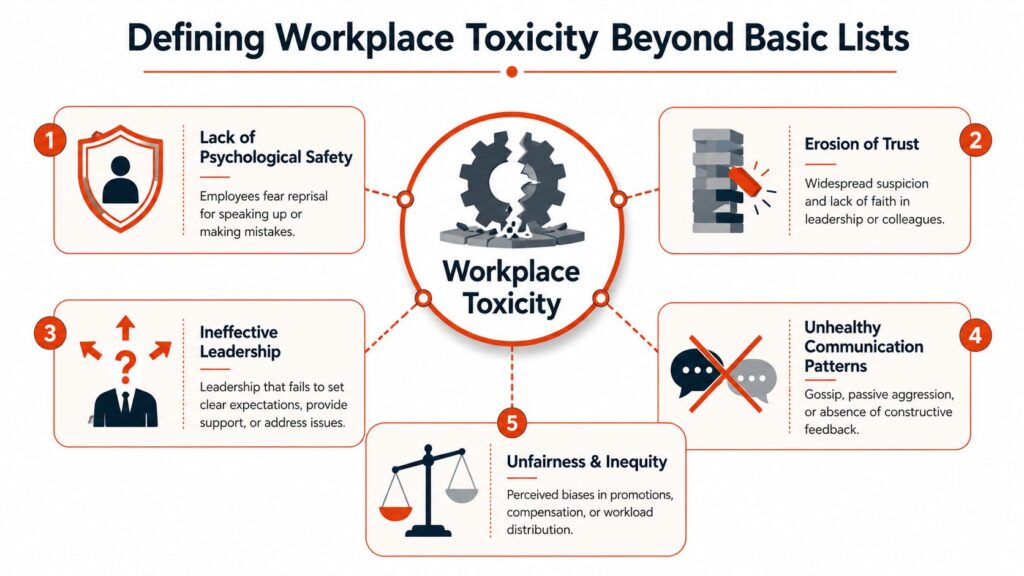
Workplace toxicity refers to a work environment where employees feel unsafe speaking up, experience unfair treatment, or struggle to trust leadership and workplace processes.
Common signs of a toxic workplace include poor communication, micromanagement, favoritism, unhealthy competition, and low psychological safety.
Research from MIT Sloan, cited by Lyra Health, found that toxic culture can be a stronger predictor of employee attrition than compensation. For HR leaders, this highlights that workplace toxicity is rarely just about a few difficult individuals. More often, it reflects deeper cultural norms, leadership behaviors, and organisational systems that allow harmful patterns to persist.
When these behaviors become normalized, employees often disengage, collaboration declines, and retention challenges begin to emerge across the organization.
20 Toxic Workplace Signs Every HR Leader Should Watch For
Toxic workplace signs rarely appear in isolation. They often emerge through leadership behaviours, employee experience issues, and communication breakdowns that gradually erode trust, engagement, and performance. Recognizing these warning signs early helps HR leaders address cultural risks before they become larger business problems.
Leadership & Culture
- Lack of psychological safety
- Poor leadership accountability
- Favoritism
- Low trust in leadership
- Resistance to feedback
- Retaliation
Employee Experience
- Burnout
- Excessive workload
- Poor work-life balance
- Lack of recognition
- High turnover
- Declining engagement
Communication & Collaboration
- Gossip
- Micromanagement
- Silent meetings
- Information hoarding
- Frequent conflict
- Unhealthy communication
- Fear of speaking up
- Unfair treatment
How Toxic Workplaces Drive Attrition
Silent resignation often begins long before an employee submits a notice. One of the earliest signs of a toxic workplace is a visible decline in participation, ownership, and willingness to speak openly. Employees in a toxic work culture gradually shift their focus from contribution to self-protection.
It shows up in reduced candour, slower escalation, narrower participation, and a visible shift from ownership to self-protection. In many organisations, those signals sit in plain sight for quarters before attrition appears in the dashboard.
As noted earlier, national survey data shows that toxic work environments correlate strongly with mental health strain and higher exposure to harassment. For HR leaders, the operational implication is clear. Toxicity rarely stays confined to morale. It weakens judgement, slows execution, and increases the cost of retaining capable people.
Why leaders miss the early workplace toxicity signals
Leadership teams often interpret toxic workplace signs as isolated personality clashes or manager-specific issues.
Many toxic work environment signs stem from broader cultural problems involving leadership behavior, communication norms, and accountability systems.
That interpretation delays action. By the time employees stop speaking openly, the organisation has already started losing decision quality, manager credibility, and discretionary effort.
The early pattern is consistent across functions:
- Voice declines: Employees stop questioning weak assumptions or unrealistic timelines in meetings.
- Risk reporting slows: Errors surface late because people no longer trust that bad news will be handled fairly.
- Effort turns defensive: Teams optimise for documentation, visibility, and personal cover instead of shared outcomes.
Practical rule: If withdrawal is rising before attrition is rising, HR needs a pulse check now, not at the next annual survey cycle.
The concept of “quiet quitting” is often misunderstood in this context. In practice, lower visible effort can signal low trust, uneven accountability, or manager fatigue more than low ambition. Leaders who want to address that pattern should connect culture diagnosis with retention action.
Taggd’s view on how to spot and stop quiet quitting is useful because it treats disengagement as an organisational signal, not only an employee attitude problem.
Why Toxicity Is a Business Risk
Toxic environments erode performance in ordinary, measurable ways. Hiring gets harder because candidate feedback circulates quickly. Managers spend more time containing conflict. Strong performers stop taking smart risks, and average performers learn that caution is safer than contribution.
That is why toxic workplace signs belong in business reviews, not only employee relations discussions. For Indian HR leaders, the task is to separate episodic friction from system-level toxicity early enough to intervene before it becomes a retention, productivity, and employer-brand problem.
The Role of Psychological Safety
Poor psychological safety is one of the clearest toxic workplace signs. Employees stop raising concerns, avoid constructive disagreement, and become cautious about sharing bad news. In many organisations, this is one of the earliest toxic work environment signs to emerge.
Employees stop raising risks, soften bad news, and avoid open disagreement in meetings. In Indian organisations, that pattern is often misread as alignment or respect for hierarchy. In practice, it usually signals that people have judged candour to be costly.
A demanding culture is not automatically a toxic one. Strong teams debate hard issues, maintain pressure during critical periods, and enforce high standards. Toxicity begins when challenge stops being safe, accountability becomes selective, or authority operates without scrutiny.
Leaders often confuse intensity with health.
What Toxic Cultures Normalise
Toxicity becomes cultural when harmful conduct is built into routines, incentives, and informal power structures. At that point, the issue is no longer a few difficult interactions. It is a pattern employees can predict.
Watch for signals such as:
- Silence in forums that should produce challenge: Town halls, business reviews, and skip-level conversations produce updates, not honest disagreement.
- Uneven consequences: Conduct standards apply to some managers but not to high performers who hit targets.
- Defensive collaboration: Functions hold back information, document every exchange, and treat transparency as political risk.
- Boundary erosion: Employees assume they must stay constantly available because workload norms and manager behaviour reward overextension.
These patterns affect behaviour in measurable ways. People withdraw ideas, reduce discretionary effort, and focus on self-protection. Culture improvement efforts gain traction when leaders stop chasing surface symptoms and start auditing trust, fairness, decision rights, and manager conduct.
Teams working on practical ways to improve company culture usually make better progress when they diagnose those system conditions first.
The more useful leadership question is not “Do we have difficult people?” It is “What behaviour does our system make rational?”
Systemic vs. Symptomatic Toxicity
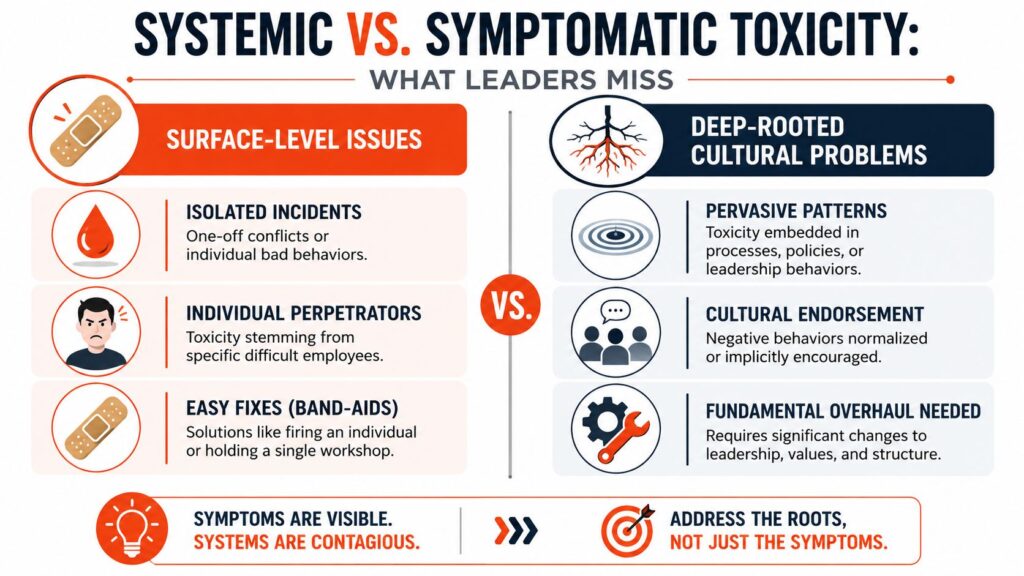
Most organisations are too quick to explain toxicity through personality. One abrasive manager. One conflict-heavy team. One unfortunate incident. Sometimes that’s true. Often it isn’t.
The more important distinction is between symptomatic toxicity and systemic toxicity. Symptomatic toxicity sits close to an individual or a local team. Systemic toxicity is built into the way work gets allocated, information gets controlled, performance gets rewarded, and dissent gets punished.
Systems Create Toxicity
Public explainers usually focus on obvious signs such as gossip, yelling, and micromanagement. But a more serious form of toxicity is structural. It appears as silent retaliation, exclusion from information, or impossible workload norms. The Muse notes this gap in common coverage and also points to the retention risk in India, citing Microsoft Work Trend Index data that 53% of employees in India are considering changing jobs, one of the highest rates globally, in its article on recognising a toxic work environment and what it looks like.
For Indian HR leaders, that’s the strategic issue. If large numbers of employees are open to leaving, the fundamental question isn’t only who is dissatisfied. It’s whether organisational design is pushing good people towards the door.
Diagnosing Toxicity Systemic vs Symptomatic Indicators
One of the most effective ways to identify a toxic workplace culture is to look for repeatable patterns. If the same complaints, behaviours, or employee concerns appear across teams or business units, leaders are likely dealing with workplace toxicity rather than isolated incidents.
If the same complaint appears across managers, locations, or business units, you’re probably not looking at a one-off problem. You’re looking at a system with a cultural fault line.
| Indicator Type | Symptomatic Toxicity (Isolated Issue) | Systemic Toxicity (Cultural Problem) |
| Leadership pattern | One manager creates fear or confusion | Multiple managers use the same harmful approach |
| Information flow | One team hoards updates | Key information is withheld across functions |
| Workload norms | A short-term spike goes unmanaged | Chronic overload is treated as commitment |
| Consequences | Action follows documented misconduct | High performers are excused despite harmful conduct |
| Employee response | Complaints cluster around one person | Employees describe similar patterns in different areas |
| Fix required | Coaching, reassignment, or case action | Changes to incentives, governance, manager quality, and reporting |
Ask a harder set of questions than “Who did this?”
- Where does this pattern repeat?
- What behaviour gets rewarded despite policy?
- Who controls information and access?
- What happens to employees who raise uncomfortable facts?
If replacing one manager would solve the problem, you have a management issue. If the same pattern survives the replacement, you have a system issue.
This distinction saves organisations from a common mistake. They remove the most visible offender, declare success, and then watch the same culture regenerate through the next layer of leadership.
Measuring Workplace Toxicity
Culture work loses credibility when it relies only on stories. Stories matter, but boards and business heads act faster when HR can show concentration, recurrence, and business exposure. The aim isn’t to reduce employee experience into a dashboard. It’s to convert weak signals into decision-grade evidence.
Build a measurement stack
Start with a simple principle. No single metric proves toxicity. You need triangulation across employee sentiment, people movement, conduct data, and operating patterns.
A practical measurement stack often includes:
- Pulse surveys on team safety and fairness
Keep questions tight. Ask whether employees can raise concerns, admit mistakes, disagree with managers, and access the information they need to do their jobs. - Attrition cuts by manager and business unit
Don’t look only at total exits. Review regrettable attrition, early exits, and resignations following manager changes or restructures. - Exit interview coding
Don’t just store transcripts. Code for recurring themes such as exclusion, retaliation, inconsistency, workload, lack of recognition, and trust in management. - Employee relations case mapping
Plot complaints by leader, function, geography, and allegation type. Patterns matter more than isolated volume. - Promotion and opportunity flow
Review who gets stretch work, visibility, and sponsorship. Toxicity often hides inside informal gatekeeping.
For leaders building that capability, a well-designed HR dashboard helps only if it compares signals across time, manager populations, and decision points. A static dashboard full of high-level engagement scores won’t tell you where the culture is breaking.
Spotting Toxicity Patterns
The common mistake is overreacting to single anecdotes or underreacting to repeated soft signals. Good diagnosis sits between those extremes.
Use a few practical rules:
- Escalate when signals converge: A manager with high attrition, repeated complaints, and weak survey scores deserves immediate review.
- Separate severity from frequency: One serious retaliation allegation can matter as much as many low-grade complaints.
- Track after interventions: If coaching, policy refreshes, or leadership changes don’t alter the pattern, your fix was too narrow.
- Read silence carefully: A unit with no complaints isn’t always healthy. It may have low trust in reporting channels.
Some teams also use text analytics to scan comment fields in surveys and exits for recurring language. Others map collaboration patterns to identify information bottlenecks. Those tools can help, but they only work when HR also reviews context with discipline.
The strongest business case usually comes from a simple combination: repeated conduct themes, concentrated manager-level attrition, and signs that employees no longer feel safe to speak plainly.
The Cost of a Toxic Culture
Leaders sometimes accept a degree of cultural damage when a team is still delivering output. That is usually a timing error, not a winning strategy.
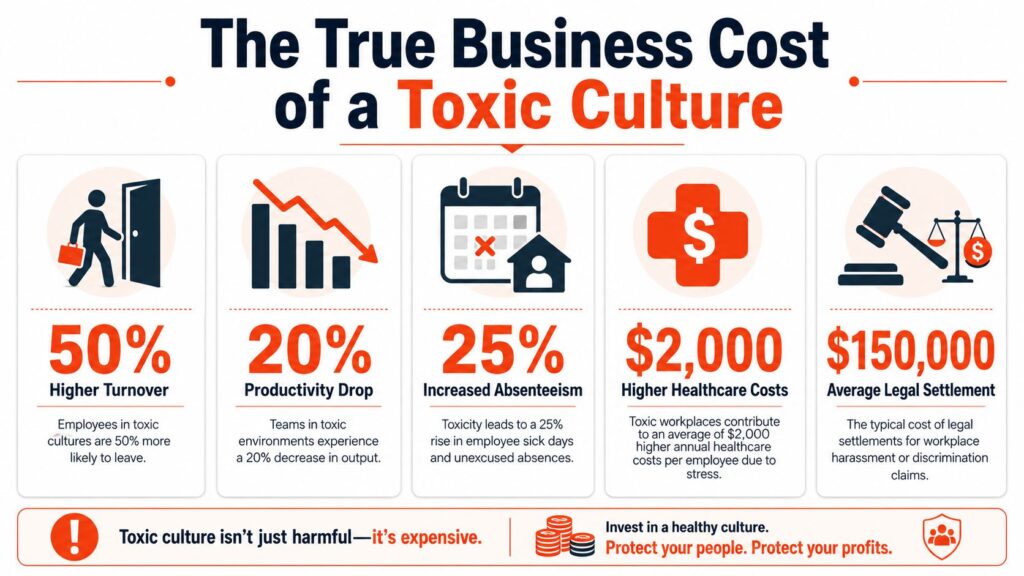
A toxic workplace culture may appear productive in the short term, but it often shifts hidden costs into employee turnover, hiring challenges, reduced engagement, workplace conflict, and declining trust. Over time, these toxic work environment effects become difficult to ignore.
Early in the cycle, the business can look stable. Revenue may hold. Projects may still ship. But the operating model becomes heavier because trust has fallen.
How Toxicity Hurts Performance
The first costs are rarely recorded under “toxicity”. They appear elsewhere:
- Recruitment friction: Candidates pick up negative signals through networks, reviews, and interviewer inconsistency.
- Lower managerial bandwidth: Leaders spend more time mediating conflict, checking alignment, and handling avoidable escalations.
- Reduced innovation: Employees stop testing ideas when failure feels politically dangerous.
- Productivity leakage: People protect themselves through excessive approvals, longer email trails, and less direct communication.
A clear way to ground that conversation is to connect culture with turnover economics. Taggd’s overview of turnover costs is useful because it frames attrition as replacement expense plus lost continuity, delayed productivity, and manager distraction.
This short video offers a useful prompt for leadership discussion:
What leaders often underestimate
The hardest cost to recover is not hiring spend. It’s trust depletion. Once employees believe the organisation rewards outcomes more than conduct, every future message from leadership gets filtered through that belief.
A toxic culture doesn’t only push people out. It teaches the people who stay to narrow their contribution.
Those narrowing affects succession depth, cross-functional cooperation, and quality of execution. People won’t follow leadership titles for long if the system keeps protecting harmful behaviour.
For the C-suite, the business question is straightforward. Are you treating culture failure as a soft issue, or as an operating risk that distorts talent quality and execution discipline?
How to Fix a Toxic Workplace
Most companies don’t need another values poster. They need operating changes that make healthy conduct easier, harmful conduct riskier, and leadership accountability visible. Detoxifying a workplace is less about one decisive intervention and more about disciplined repetition.
Preventing Workplace Toxicity
Prevention is where many organisations underinvest because the benefits feel indirect. It is cheaper and more durable than repeated clean-up.
Focus on a few design choices:
- Hire and promote for manager conduct, not only delivery history: A strong individual performer isn’t automatically safe to scale through people leadership.
- Define essential behavioral standards: “Respect” is too vague. Spell out what managers must do in reviews, feedback, meetings, and escalation handling.
- Train leaders on response under pressure: Toxic conduct often appears when deadlines tighten, not when conditions are easy.
One useful external partner in this space can be a recruitment and talent strategy firm that helps align hiring quality with culture design. For example, Taggd works across talent fulfilment, leadership hiring, and employer branding in India, which can support organisations trying to reduce manager-quality risk while scaling.
When Leadership Enables Toxicity
This is a definitive test. A company’s culture is revealed by what happens after a complaint about a commercially valuable manager.
Intervention works when organisations do three things consistently:
- Provide channels people trust
Reporting mechanisms must feel safe, confidential, and real. If employees believe complaint pathways only create exposure, they won’t use them. - Investigate patterns, not isolated wording
Toxicity often appears through accumulation. One episode may sound ambiguous. Ten similar accounts rarely are. - Apply consequences visibly enough to rebuild trust
Confidentiality matters, but silence after serious concerns can look like inaction.
Leadership test: If your top performer cannot be challenged safely, your culture is already being shaped by fear.
Rebuilding Workplace Trust
Repair is the phase many executives rush. They want closure after a policy update, a few exits, or a communication campaign. Employees won’t move that quickly.
Real repair usually includes:
- Transparent acknowledgement: Name the pattern without corporate evasiveness.
- Manager recalibration: Reset expectations for workload, communication norms, and decision rights.
- Positive reinforcement: Recognise leaders who create clarity, fairness, and candour, not only short-term output.
- Follow-through reviews: Recheck the teams that experienced harm. Don’t assume one action restored trust.
Leadership teams that want a practical benchmark for this mindset can review Taggd’s article on why the best workplaces are the result of visionary leadership. The useful lesson is simple. Healthy cultures are designed, measured, and defended. They don’t appear by accident.
FAQs
How can I tell if my workplace is toxic?
A toxic workplace often shows signs such as poor communication, lack of trust, unfair treatment, high employee turnover, and a culture where employees feel unsafe speaking up. When these behaviors become normal, they can negatively affect engagement, wellbeing, and performance.
What are the most common toxic workplace signs?
Common toxic workplace signs include micromanagement, workplace gossip, favoritism, excessive workloads, burnout, poor leadership accountability, unhealthy communication patterns, and declining employee engagement. These issues often signal deeper cultural and management problems.
How do you identify a toxic person at work?
A toxic employee may consistently create conflict, spread negativity, avoid accountability, undermine colleagues, or manipulate workplace relationships. However, organisations should also examine whether workplace systems or leadership behaviors are enabling these actions.
What are the effects of a toxic work environment on employees?
A toxic work environment can lead to stress, burnout, anxiety, lower job satisfaction, reduced productivity, and disengagement. Over time, employees may lose trust in leadership, withdraw from collaboration, and become more likely to leave the organisation.
How do you deal with toxicity in the workplace?
Addressing workplace toxicity requires identifying recurring behavioral patterns, strengthening manager accountability, improving reporting mechanisms, and promoting a culture of fairness and transparency. Sustainable change comes from addressing root causes rather than isolated incidents.
Can a toxic workplace culture affect employee retention?
Yes. Toxic workplace culture is one of the leading drivers of employee attrition. Employees are more likely to leave when they experience poor leadership, lack of recognition, unfair treatment, excessive workloads, or limited psychological safety.
What is the difference between a challenging workplace and a toxic workplace?
A challenging workplace maintains high standards while supporting open communication, fairness, and accountability. A toxic workplace, on the other hand, discourages feedback, normalises harmful behaviors, and creates an environment where employees feel unsupported or unsafe.
What should HR leaders do when they notice toxic workplace signs?
HR leaders should investigate patterns across employee feedback, attrition data, engagement surveys, and workplace conduct reports. Early intervention can help address cultural issues before they escalate into larger retention, productivity, or employer branding challenges.
Workplace culture is shaped by the people an organisation hires, develops, and promotes. Taggd helps businesses build stronger talent ecosystems through leadership hiring, talent acquisition, employer branding, and workforce solutions.
By aligning people strategy with business goals, we help organisations create workplaces that support performance, trust, and long-term growth.