Turbine engineer recruitment has quietly become one of the most complex talent challenges facing heavy engineering and power sector manufacturers today. While order books are filling up, project pipelines are expanding, and capacity investments are accelerating, the talent required to deliver on these commitments is becoming harder to secure.
According to LinkedIn’s engineering job data for India, over 1,000 active turbine engineering roles are open at any given time- a number that reflects both the scale of demand and the persistent difficulty in filling these positions.
For CHROs, HR Directors, and Talent Acquisition Leaders in the turbine and boiler manufacturing space, this is not a temporary supply blip. It is a structural talent challenge that is reshaping how competitive manufacturers think about hiring, workforce planning, and business risk.
This article examines the ten roles that are hardest to fill in 2026, explains the root causes of the shortage, and outlines the strategic actions manufacturing leaders need to take, before requisitions are raised.
Why the Talent Crisis in Turbine and Boiler Manufacturing Is Structural, Not Cyclical
The turbine and boiler manufacturing sector is facing a perfect storm: rising project demand meeting a shrinking pool of experienced engineers. Aging workforces, limited STEM pipeline entry into niche disciplines, and intensifying competition from EPC, infrastructure, and energy sectors have created a talent gap that reactive hiring cannot bridge.
India’s power generation capacity addition targets, the growth of combined-cycle and supercritical thermal power projects, and the scaling of renewable energy integration, including hybrid power systems are all driving aggressive hiring demand. EPC majors, OEMs, IPPs, and government utilities are competing for the same narrow band of experienced professionals.
Meanwhile, the average age of senior turbine and boiler engineers in the workforce is rising. Many domain specialists who built their expertise over 20–25 years of plant commissioning, thermal design, or rotating equipment engineering are approaching retirement.
The problem is that their knowledge cannot be transferred quickly. Turbine engineer recruitment at the senior and mid-senior levels requires candidates with very specific combinations of domain depth, OEM exposure, and field experience, qualities that take years to develop and cannot be sourced from job boards alone.
The hiring challenge is further compounded by the fact that many of these roles sit at the intersection of mechanical, thermal, instrumentation, and controls engineering. Generalist engineers simply cannot step into them.
The 10 Roles That Turbine and Boiler Manufacturers Cannot Hire Fast Enough
Turbine engineer recruitment struggles are concentrated in roles that require a combination of OEM-specific technical depth, field experience, and cross-functional knowledge. These are not entry-level gaps; they are mid-to-senior critical path roles whose vacancy directly delays project delivery and impacts revenue.
1. Turbine Design Engineer
Turbine Design Engineers are responsible for aerothermal analysis, rotor dynamics, blade design, and mechanical integrity. Demand is rising as manufacturers scale new product lines, upgrade existing fleets, and respond to efficiency mandates.
The hiring challenge is that most qualified professionals are locked in long-term roles at OEMs or EPC firms. When these candidates do move, they command premium compensation and take months to locate through traditional channels. A vacant Turbine Design Engineer role can delay a product development cycle by a full quarter.
2. Boiler Design Engineer
Boiler Design Engineers with expertise in pressure part design, CFD analysis, and compliance with IBR (Indian Boiler Regulation) standards are among the most difficult professionals to source in the sector.
The retirement of experienced boiler designers has not been met with an equivalent influx of trained mid-level engineers. Companies relying on reactive turbine engineer recruitment for this role consistently report time-to-fill exceeding 120 days.
3. Thermal Engineer
Thermal Engineers who can model heat transfer, combustion performance, and thermodynamic cycle efficiency are critical for both product design and plant optimization.
Their skill set is claimed by multiple sectors- power, oil and gas, HVAC, aerospace, which drives fierce cross-industry competition. A manufacturing organization without strong thermal engineering capacity struggles to meet efficiency guarantees and performance test commitments to customers.
4. Commissioning Engineer
Commissioning Engineers are essential to project delivery. They translate design intent into operational reality during the most critical phase of any power or industrial project.
Their experience requirements are non-negotiable; candidates need hands-on exposure to specific equipment types, control systems, and safety protocols. Baker Hughes actively recruits Field Service Engineers for heavy-duty gas turbines, illustrating how OEMs and majors are continuously pulling from the same talent pool. When a Commissioning Engineer vacancy coincides with project handover timelines, the cost to the business is immediate and measurable.
5. Welding Engineer
Certified Welding Engineers, particularly those qualified in pressure vessel fabrication, high-alloy steel joining, and code compliance (ASME, AWS, IS standards) are scarce. Welding engineering is a highly specialized discipline with a limited academic pipeline.
Most experienced professionals are self-taught over years in the field. Their absence creates manufacturing bottlenecks, quality non-conformances, and schedule overruns.
6. Quality Assurance Engineer
Quality Assurance Engineers who understand turbine and boiler manufacturing tolerances, NDT methods, third-party inspection protocols, and IBR/ASME certifications are critical for customer confidence and regulatory compliance.
With growing scrutiny on product quality and safety in power equipment, QA engineering roles are under-resourced at many mid-size manufacturers, increasing rework rates and customer escalation risks.
7. Instrumentation and Controls Engineer
As turbine and boiler systems integrate more sophisticated digital controls, predictive monitoring, and automation frameworks, the demand for Instrumentation and Controls Engineers has grown sharply.
However, the supply of professionals who understand both the physical plant- rotating equipment, pressure systems, thermal processes and modern DCS/SCADA platforms is limited. This role sits at a skills intersection that is genuinely difficult to fill through traditional turbine engineer recruitment approaches.
8. Manufacturing Engineer
Manufacturing Engineers who can optimize production processes for turbine components, including precision machining, casting, forging, heat treatment, and surface treatment are vital for capacity expansion.
As companies invest in new manufacturing lines and lean transformation, they need engineers who can bridge design intent and shopfloor execution. Finding professionals with both engineering depth and manufacturing system knowledge is a consistent pain point.
9. Project Engineer
Project Engineers who manage cross-functional execution of turbine and boiler supply contracts, coordinating design, procurement, manufacturing, testing, and logistics are in high demand from EPC companies, IPPs, and OEMs simultaneously.
The role requires both technical grounding and project management competence. The competition for these professionals is intense, and their unplanned exits often trigger downstream project delays.
10. Plant Maintenance and Service Engineer
With the installed base of turbines and boilers growing, after-sales service and planned maintenance engineering has become a major hiring priority.
Plant Maintenance Engineers and Service Engineers who can perform condition monitoring, overhaul planning, and root cause analysis are now core to long-term customer relationships and aftermarket revenue.
How Turbine Engineer Talent Shortages Translate Into Business Risk
When turbine engineer recruitment fails to deliver on time, the consequences extend far beyond the HR team. Unfilled technical roles create cascading delays across production, project delivery, quality assurance, and customer commitments, directly threatening revenue and reputation.
Consider a scenario where a manufacturer secures a supercritical boiler supply contract. If the Boiler Design Engineer team is under-resourced, drawing release timelines slip. Procurement cannot place orders on schedule. Fabrication starts late. Commissioning is compressed. Customer handover is delayed. Liquidated damages are triggered. A single critical hire missed at the right time can compress months of operational effort into a crisis.
Beyond individual projects, sustained talent shortages limit a manufacturer’s ability to bid on new contracts confidently. Business development teams know they cannot commit to delivery timelines if their engineering bench is thin. As a result, growth ambitions are constrained not by market opportunity, but by talent availability.
For boards and leadership teams, talent availability in turbine and boiler engineering is increasingly a financial risk indicator- one that should sit alongside raw material costs, order backlog, and working capital in strategic planning discussions.
Why Conventional Hiring Approaches Are Not Working
Most turbine and boiler manufacturers still rely on job postings, recruitment agencies, and employee referrals to fill critical engineering roles. These channels are too slow, too shallow, and too reactive for a talent market where the best candidates are rarely actively searching.
The professionals who hold deep turbine and boiler engineering expertise are typically employed, often working on multi-year projects, and not monitoring job boards. Reaching them requires proactive talent mapping, relationship-based outreach, and a credible employer value proposition that speaks to engineering impact, not just compensation.
Reactive hiring also inflates costs. Each month an engineering role sits vacant carries a productivity cost, a project delay cost, and often a consulting or contract staffing premium. For companies that treat turbine engineer recruitment as an HR transactional function rather than a strategic priority, the cumulative cost of slow hiring is substantial, even if it never appears as a line item on the P&L.
Traditional recruitment agencies often lack the domain knowledge to screen technical candidates effectively, leading to high CV volumes with low conversion rates. This slows down hiring managers already stretched across active projects, further extending the time-to-fill.
Regional Talent Hotspots and Emerging Skill Requirements
Understanding where talent clusters and what skills are emerging is central to effective turbine engineer recruitment strategy. India’s heavy engineering talent is geographically concentrated, and the skills landscape is shifting as digitalization, sustainability mandates, and new energy systems reshape the sector.
Where Engineering Talent Is Concentrated
India’s turbine and boiler engineering talent is predominantly located in industrial clusters across Gujarat (Vadodara, Surat, Ahmedabad), Maharashtra (Pune, Mumbai, Nagpur), Tamil Nadu (Chennai, Coimbatore), and the NCR belt (Noida, Gurgaon, Faridabad).
Companies expanding manufacturing capacity outside these zones face additional sourcing complexity because local talent pools are thin and relocation appetite among experienced engineers is limited.
For leadership and project management roles, metros including Mumbai and Hyderabad offer broader talent availability, but also host the highest concentration of competing employers.
Skills That Will Define the Next Five Years
Beyond traditional mechanical and thermal engineering competencies, turbine and boiler manufacturers need to plan now for professionals skilled in:
- Digital twin modeling for turbine performance simulation and predictive maintenance
- Emissions compliance engineering as environmental regulations tighten across industrial installations
- Hybrid energy systems integration, particularly for manufacturers expanding into biomass, waste-to-energy, or hydrogen-ready combustion systems
- Advanced materials knowledge, including high-temperature alloys and ceramic-coated components for next-generation turbine designs
- Data analytics and condition monitoring, enabling service teams to transition from reactive maintenance to predictive service models
These emerging competencies are not yet widely available in the candidate market. Forward-looking manufacturers need to build internal upskilling programs and identify external sourcing pipelines for these capabilities before demand peaks.
Why Workforce Planning Must Start Before Requisitions Are Raised
Effective turbine engineer recruitment is not a response to a vacancy; it is an output of sustained workforce planning. Companies that invest in talent mapping, succession planning, and market intelligence consistently fill critical roles faster and at lower cost than those who hire reactively.
Talent mapping means understanding, at any given time, who the top engineering professionals in your domain are, where they are employed, what their career trajectory looks like, and what would make them consider a move. This intelligence does not emerge from a job advertisement- it requires systematic research and relationship development over time.
Succession planning for critical technical roles is equally important. When a senior Turbine Design Engineer or a Chief Commissioning Engineer exits, the replacement timeline can stretch to six months or more. Without a succession plan and an internal pipeline, every departure becomes a crisis.
Workforce forecasting, modeled against project pipeline, order backlog, and planned capacity expansion allows HR leaders to raise talent acquisition activity six to twelve months before a role becomes critical. This window is often the difference between a competitive hire and a compromised one.
Also Read: How RPO Solutions Help Manufacturing Companies Scale Engineering Teams Faster
How Talent Intelligence Strengthens Turbine Engineer Recruitment Outcomes
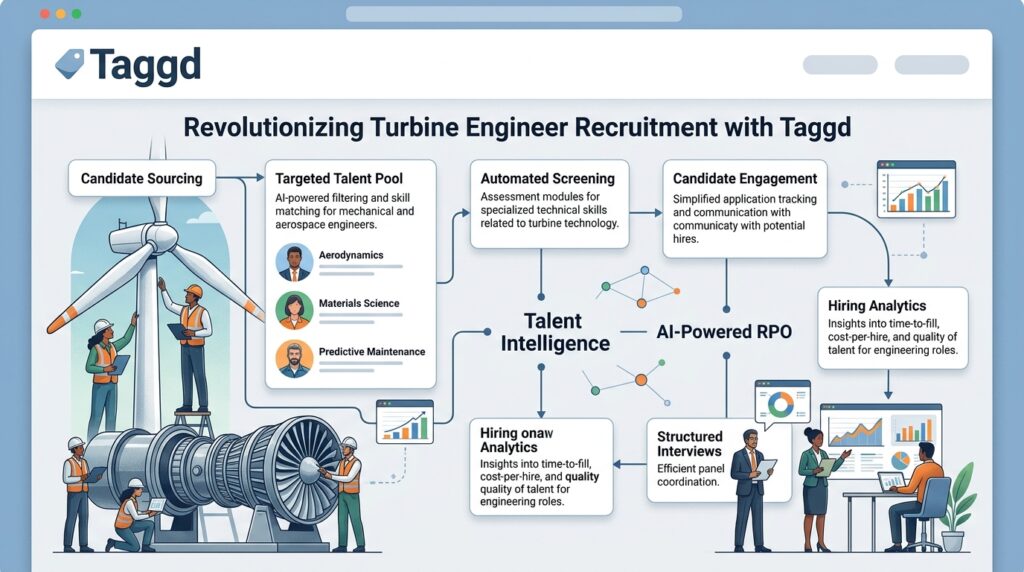
Talent intelligence transforms turbine engineer recruitment from a reactive search into a strategic, data-backed function. When hiring is informed by real-time market data on candidate availability, compensation benchmarks, hiring velocity, and competitor movements, decisions are faster, more accurate, and more defensible.
For CHROs and Talent Acquisition Leaders in manufacturing, talent intelligence means knowing before a position is opened whether the required profile exists in sufficient supply within commutable distance of your facility, which employers currently hold that talent, what compensation range will attract vs. repel target candidates, and how long a realistic search will take given current market conditions.
This level of insight is increasingly available through AI-powered recruitment platforms and RPO partners that specialize in engineering talent.
Taggd’s manufacturing hiring solutions, for example, combine talent intelligence with domain expertise to give manufacturing organizations a grounded picture of the talent market before they commit to a hiring plan. This prevents the common pattern of underestimating search complexity, setting unrealistic timelines, and then scrambling when searches run long.
For turbine and boiler manufacturers operating in a growth phase, pairing turbine engineer recruitment with structured talent intelligence is not a luxury; it is a strategic multiplier.
Building a Proactive Hiring Strategy for Critical Engineering Roles
Manufacturing companies that treat turbine engineer recruitment as a proactive discipline, rather than a response to vacancies consistently outperform peers in time-to-fill, offer acceptance rates, and first-year retention for critical technical roles.
The following principles define a proactive engineering talent strategy:
- Always-on talent mapping: Maintain live visibility of key talent pools in your engineering domains, even when no positions are open.
- Talent community building: Engage with engineers through technical forums, industry events, and alumni networks to build pre-qualified pipelines.
- Skills-based hiring frameworks: Define hiring criteria around demonstrated competencies and applied experience rather than job title or years of service, widening the addressable candidate pool.
- Internal mobility programs: Develop structured pathways for junior and mid-level engineers to progress into senior technical roles, reducing external dependency for leadership positions.
- Workforce scenario planning: Model talent requirements against three to five-year project and capacity expansion forecasts, not just near-term headcount plans.
Manufacturing organizations that adopt these principles find that turbine engineer recruitment becomes a sustainable capability rather than a recurring emergency.
FAQs
What makes turbine engineer recruitment so difficult compared to other engineering disciplines?
Turbine engineering requires a rare combination of thermal, mechanical, and rotating equipment expertise developed over years of OEM or plant-specific experience. This depth cannot be acquired quickly, and because most qualified professionals are continuously employed on long-term projects, active candidate availability is low. This makes proactive sourcing essential.
Which turbine and boiler manufacturing roles have the longest time-to-fill in 2026?
Based on current market conditions, Turbine Design Engineers, Boiler Design Engineers, Commissioning Engineers, and senior Instrumentation and Controls Engineers consistently show time-to-fill exceeding 90–120 days. Thermal Engineers and certified Welding Engineers are also persistently difficult to source, particularly outside major industrial clusters.
How does talent shortage in turbine and boiler manufacturing affect business growth?
Unfilled engineering roles delay product development cycles, slow manufacturing ramp-up, push back project commissioning timelines, and limit a company’s ability to bid confidently on new contracts. In competitive markets, talent availability has become a direct constraint on revenue growth and order intake.
Why is reactive hiring particularly costly in the turbine and boiler sector?
Reactive hiring in this sector inflates costs because critical roles are rarely filled from active candidate pools. Extended searches require premium recruitment resources, interim contract staffing at higher rates, and delayed project execution- all of which carry direct financial consequences that compound over multi-month vacancy periods.
What regional talent hubs should turbine and boiler manufacturers target for engineering recruitment?
The strongest engineering talent concentrations are in Gujarat (Vadodara, Ahmedabad), Maharashtra (Pune, Mumbai), Tamil Nadu (Chennai, Coimbatore), and the NCR belt (Noida, Gurgaon). Companies hiring for plant-based roles outside these clusters need longer lead times and stronger employer value propositions to attract talent willing to relocate.
What emerging skills should turbine and boiler manufacturers prioritize in workforce planning?
Over the next three to five years, manufacturers should build capability in digital twin modeling, emissions compliance engineering, hybrid energy system integration, advanced materials engineering, and data-driven condition monitoring. These skills are scarce now and will become critical as product portfolios and regulatory environments evolve.
How can talent intelligence improve turbine engineer recruitment outcomes?
Talent intelligence provides hiring teams with real-time data on candidate availability, competitive compensation benchmarks, hiring velocity, and talent cluster locations. This replaces guesswork with evidence, allowing HR leaders to set realistic timelines, design competitive offers, and launch searches months before positions become urgent.
What is the business case for partnering with an RPO provider for turbine and boiler engineering hiring?
RPO partners with manufacturing domain expertise offer pre-mapped talent pools, faster time-to-hire, consistent screening quality, and scalable capacity that internal TA teams cannot replicate for niche technical roles. For manufacturers in a growth phase, this translates directly into faster project staffing, reduced vacancy costs, and higher-quality engineering hires.
Conclusion
The companies that will lead turbine and boiler manufacturing over the next five years are not necessarily those with the best technology or the largest order books. They are the ones that build a reliable, proactive engineering talent engine before they need it.
Turbine engineer recruitment is too complex and too consequential to manage reactively. The ten roles covered in this article, from Turbine Design Engineers to Plant Maintenance Specialists represent the critical path of your manufacturing and delivery capability. When they are difficult to fill, projects slow, quality risks rise, and growth ambitions are constrained.
The strategic response is clear: invest in talent intelligence, build always-on pipelines, plan workforce requirements ahead of business demand, and work with hiring partners who understand the engineering domain deeply enough to find talent that job boards will never surface.
Facing Similar Hiring Challenges in Turbine and Boiler Manufacturing?
Whether you are struggling to hire design engineers, commissioning specialists, project managers, or plant leadership talent, the right hiring strategy starts with understanding your unique workforce challenges.
Our manufacturing talent experts will help you assess talent availability, identify hiring bottlenecks, and design the best approach to meet your workforce goals.