Every technology cycle has a defining role. In the cloud era it was the DevOps engineer. In the data era it was the data scientist. In 2026, that role is the Gen AI Engineer.
As organizations race to embed generative AI into products and workflows, professionals who can build, deploy, and optimize these systems have become the most sought-after engineers in the global technology market. This is not a research role. It is a full-stack engineering discipline combining LLM expertise, software architecture, and production deployment capability.
This guide explains everything candidates and recruiters need to know about Gen AI Engineers, including responsibilities, required skills, hiring challenges, job descriptions, and recruitment strategies.
What is a Gen AI Engineer?
A Gen AI Engineer is a specialized software developer who builds, deploys, and maintains applications powered by Large Language Models (LLMs), multimodal AI systems, and generative AI technologies. They integrate foundation models such as GPT, Claude, Gemini, and Llama with enterprise data, business workflows, and software systems to create production-ready AI applications.
| A Gen AI Engineer is a specialist who bridges the gap between frontier AI model capabilities and real-world software products, combining LLM integration expertise, software engineering discipline, and production deployment capability to build generative AI systems that actually work at scale. |
Gen AI Engineers work at the intersection of:
- Large Language Model Integration and Fine-tuning
- Agentic AI Framework and Workflow Development
- RAG Architecture and Vector Database Engineering
- MLOps and AI System Production Deployment
- Software Engineering and API Development
In 2026, Gen AI Engineers are responsible for:
- Designing and building LLM-powered applications using OpenAI, Anthropic, Google, and open-source model APIs
- Implementing RAG architectures, vector databases, and knowledge retrieval systems for enterprise AI applications
- Developing agentic AI workflows using LangChain, LlamaIndex, AutoGPT, and equivalent frameworks
- Fine-tuning and evaluating foundation models for domain-specific enterprise use cases
- Deploying and monitoring generative AI systems in production with appropriate guardrails, evaluation frameworks, and observability
Think of a Gen AI Engineer as a combination of:
- LLM Integration Specialist
- Software Architect
- MLOps and AI Deployment Engineer
- Agentic Workflow Developer
- AI Product Builder
Why Do Organizations Need a Gen AI Engineer?
In 2026, generative AI has moved from pilot projects to core product infrastructure. Organizations that cannot build, deploy, and maintain production-grade AI systems are losing competitive ground to those that can. Gen AI Engineers are the professionals who make the difference between an AI strategy and an AI product.
| Factor | Why It Matters |
|---|---|
| AI Product Differentiation | Generative AI features are now primary product differentiators across every technology category. |
| LLM Integration Complexity | Building reliable LLM-powered systems requires specialized engineering expertise. |
| Agentic AI Adoption | Autonomous AI agent systems need dedicated engineering capability to build and maintain. |
| RAG Implementation Demand | Enterprise knowledge retrieval systems require specialist vector database and retrieval engineering. |
| Production AI Reliability | Deploying AI at scale requires MLOps expertise that general software engineers do not possess. |
| AI Cost Optimization | Efficient LLM usage and model selection require specialist engineering to manage commercially. |
| Regulatory AI Compliance | AI governance and responsible deployment require engineering-level guardrail implementation. |
| Competitive Speed | Organizations that ship AI features faster often benefit from modern talent and sustainability hiring strategies that accelerate access to niche technology talent. |
Core Operational Tasks of a Gen AI Engineer
| Core Area | What a Gen AI Engineer Does |
|---|---|
| LLM Integration | Connects applications with models such as GPT, Claude, Gemini, and Llama. |
| Agentic Workflows | Builds AI agents capable of executing multi-step tasks autonomously. |
| RAG Development | Connects AI systems to enterprise knowledge and databases for accurate responses. |
| Prompt Engineering | Designs and optimizes prompts for better model performance. |
| AI Deployment | Deploys AI applications using cloud infrastructure and APIs. |
| Model Evaluation | Tests, monitors, and improves AI system quality and reliability. |
| Enterprise Integration | Embeds AI capabilities into existing business software and workflows. |
Key Responsibilities of a Gen AI Engineer
Gen AI Engineers drive organizational AI product capability by building LLM-powered applications, implementing RAG and agentic systems, deploying production AI infrastructure, and continuously improving the reliability, performance, and safety of generative AI systems at scale.
1. LLM Application and API Integration
- Design and build production-grade applications integrating LLM APIs across multiple model providers.
- Implement robust API management including rate limiting, fallback strategies, and cost optimization.
- Develop structured output parsing, validation, and error handling for LLM responses.
- Build multi-model architectures that route requests optimal models based on task requirements.
2. RAG and Knowledge System Engineering
- Design and implement end-to-end RAG pipelines from document ingestion to retrieval-augmented generation.
- Build and optimize vector databases using Pinecone, Weaviate, Chroma, or Qdrant for semantic search.
- Implement chunking strategies, embedding models, and reranking systems for retrieval of quality optimization.
- Develop hybrid search architectures combining semantic and keyword retrieval for enterprise knowledge systems.
3. Agentic AI Framework Development
- Build multi-step AI agent systems with tool use, function calling, and autonomous task execution capability.
- Design agent orchestration architectures using LangChain, LlamaIndex, AutoGen, and CrewAI frameworks.
- Implement memory management, state persistence, and context window optimization for long-running agents.
- Develop evaluation and monitoring frameworks for agentic system reliability and output quality.
4. Model Fine-tuning and Evaluation
- Fine-tune foundation models using LoRA, QLoRA, and PEFT techniques for domain-specific applications.
- Build systematic evaluation datasets, benchmarks, and automated scoring frameworks for model quality assessment.
- Implement RLHF and preference optimization techniques for output quality improvement.
- Conduct model selection and benchmarking to identify optimal models for specific production use cases.
5. MLOps and AI Production Engineering
- Deploy generative AI systems in production using containerized infrastructure on AWS, Azure, or GCP.
- Implement AI observability including LLM tracing, latency monitoring, cost tracking, and output quality metrics.
- Build guardrail systems for content safety, output validation, and responsible AI compliance in production.
- Optimize inference performance through model quantization, caching strategies, and batching optimization.
Additional Scope (Senior Gen AI Engineer Roles)
- Own AI platform architecture and technical standards across the engineering organization.
- Lead evaluation of frontier AI models and frameworks for organizational adoption decisions.
- Present AI engineering roadmaps and capability assessments to product and leadership teams.
- Build and mentor Gen AI engineering teams across complex multi-product AI development programs.
Tools used by Gen AI Engineers
To build production-ready AI applications, Gen AI Engineers rely on a combination of programming languages, Large Language Models (LLMs), AI frameworks, vector databases, cloud infrastructure, and deployment technologies.
| Technology Area | Common Tools |
|---|---|
| Programming Language | Python |
| Foundation Models | GPT, Claude, Gemini, Llama, Mistral |
| Agent Frameworks | LangChain, LangGraph, CrewAI, AutoGen |
| Vector Databases | Pinecone, Chroma, Weaviate, Qdrant |
| Cloud Platforms | AWS, Azure, Google Cloud |
| AI Platforms | Hugging Face, Databricks, Vertex AI |
| Deployment Tools | Docker, Kubernetes |
| Monitoring Tools | LangSmith, Arize AI, Weights & Biases |
What Skills Does a Gen AI Engineer Need?
Great Gen AI Engineers are not just familiar with ChatGPT and prompt writing. They are specialized software engineers who understand LLM integration, Retrieval-Augmented Generation (RAG), agentic workflows, prompt engineering, and production AI deployment.
They are production-grade software engineers who combine deep LLM integration expertise with software architecture discipline and MLOps deployment capability. Here is what the best bring to the table:
Technical Skills
- Python programming for AI application development
- LLM API integration (OpenAI / Anthropic / Google AI / Hugging Face)
- RAG architecture and vector database engineering (Pinecone / Weaviate / Chroma)
- Agentic AI frameworks (LangChain / LlamaIndex / AutoGen / CrewAI)
- Model fine-tuning techniques (LoRA / QLoRA / PEFT / instruction tuning)
- MLOps and AI deployment (Docker / Kubernetes / AWS SageMaker / Azure ML)
- AI observability and monitoring (LangSmith / Weights and Biases / Arize)
- Prompt engineering and systematic prompt optimization methodology
Soft Skills
- Systems thinking and AI architecture design judgment
- Clear technical communication with product and non-technical stakeholders
- Experimental mindset and disciplined hypothesis-driven development
- Adaptability to rapidly evolving AI model and framework landscape
- Collaborative engineering across cross-functional AI product teams
- Intellectual curiosity and continuous learning in a fast-moving field
Gen AI Engineer Job Description Template
Job Title: Gen AI Engineer / Generative AI Software Engineer
Department: Artificial Intelligence / Engineering / Product
Reports To: AI Engineering Manager / Head of AI / CTO / CAIO
Location: [Location]
Employment Type: Full-time
Job Summary: We are looking for a skilled and production-focused Gen AI Engineer to join our [Department] team. In this role, you will design, build, and deploy generative AI-powered applications and systems, integrating large language models, RAG architectures, and agentic frameworks into production-grade products that deliver measurable business value. You will work cross-functionally with product, data, and infrastructure teams to build AI capabilities that give our organization a sustainable and compounding competitive advantage.
Key Responsibilities
- Design and build production LLM-powered applications and API integrations.
- Implement RAG pipelines and vector database systems for enterprise AI.
- Develop agentic AI workflows using LangChain and equivalent frameworks.
- Fine-tune and evaluate foundation models for domain-specific use cases.
- Deploy AI systems to production with observability and guardrail infrastructure.
- Optimize LLM inference performance, cost, and output quality continuously.
Required Qualifications
- Degree in Computer Science, Software Engineering, or related technical discipline.
- 3 to 8 years of software engineering experience with 1 to 3 years in Gen AI development.
- Proficient in Python and hands-on LLM API integration across multiple model providers.
- Strong experience with RAG architecture, vector databases, and semantic search systems.
- Familiar with agentic AI frameworks, MLOps deployment, and AI system monitoring.
Preferred Qualifications
- Experience with model fine-tuning using LoRA, QLoRA, or equivalent PEFT techniques.
- Knowledge of AI safety, output guardrails, and responsible AI deployment practices.
- Contributions to open-source AI projects or published Gen AI engineering work preferred.
- Exposure multimodal AI systems including vision, audio, and document AI applications.
- Familiar with AI governance frameworks and enterprise AI compliance requirements.
Key Skills
- LLM Application Development and API Integration
- RAG Architecture and Vector Database Engineering
- Agentic AI Framework Development
- MLOps and AI Production Deployment
- Model Fine-tuning and Evaluation
How to Become a Gen AI Engineer?
Start with a computer science or software engineering degree. Build hands-on LLM API integration experience, implement real RAG and agentic systems as portfolio projects, and pursue certifications like DeepLearning.AI Generative AI Specialization. Over 70 percent of Gen AI Engineer roles in 2026 prioritize demonstrated project work over academic credentials alone.
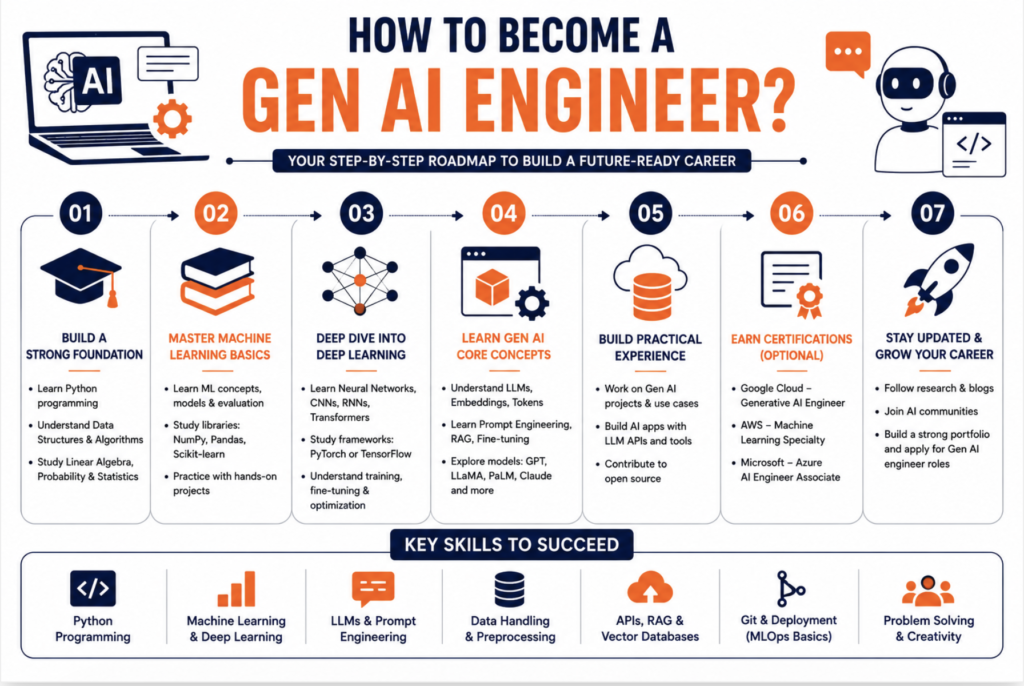
Educational Qualifications and Certifications
Most Gen AI Engineers hold a bachelor’s or master’s degree in computer science, software engineering, or a related technical discipline. For senior AI engineering or AI platform leadership roles, companies prioritize candidates with postgraduate AI qualifications or recognized generative AI engineering certifications alongside a strong portfolio of production AI projects.
Educational Background
- B.Tech / B.Sc in Computer Science, Software Engineering, or Artificial Intelligence
- M.Tech / M.Sc in Machine Learning, AI, or Data Science (for model-focused Gen AI roles)
- B.Tech in Electronics or Information Technology with AI specialization
- MBA with AI or Technology Specialization for Senior AI Engineering Manager or Head of AI roles
- M.Sc in Cognitive Science or Linguistics for language model and NLP-focused Gen AI roles
- Specialized PG Diploma in Applied AI, Deep Learning, or Generative AI Systems
Relevant Certifications
In 2026, certifications validate Gen AI engineering expertise and demonstrate hands-on proficiency with production AI development tools and frameworks. These credentials help candidates stand out by proving real-world capability with LLM integration, RAG implementation, and agentic AI development that organizations now demand from experienced Gen AI engineers.
| Certification | Best For | Industry Value |
|---|---|---|
| DeepLearning.AI Generative AI Specialization | Foundational Gen AI engineering concepts and LLM application development | Essential starting credential for all aspiring Gen AI engineers entering the profession |
| AWS Certified Machine Learning Specialty | Cloud-based AI deployment and production ML system engineering on AWS | Critical for Gen AI engineers building and deploying production AI on AWS infrastructure |
| Google Cloud Professional ML Engineer | GCP AI platform, Vertex AI, and generative AI deployment on Google Cloud | High demand for Gen AI engineers working in GCP-native or multicloud AI environments |
| Microsoft Azure AI Engineer Associate | Azure OpenAI Service integration and enterprise AI application development | Preferred for Gen AI engineers building enterprise AI solutions on Azure infrastructure |
| LangChain Certified Developer | Agentic AI framework development and LLM application chain building | Critical for Gen AI engineers specializing in agentic workflow and chain-of-thought systems |
| Hugging Face ML Engineer Certification | Open-source model fine-tuning and Hugging Face ecosystem proficiency | High value for Gen AI engineers specializing in model fine-tuning and open-source AI |
| Certified AI Security Professional | AI safety, responsible deployment, and AI governance framework expertise | Growing demand as enterprise AI governance and regulatory compliance requirements expand |
Industries Hiring Gen AI Engineers
Gen AI Engineers are among the fastest-growing technology professions, similar to other emerging high-demand roles transforming the future workforce. Key industries actively hiring are:
Technology and SaaS
Technology companies are the largest employers of Gen AI Engineers, embedding generative AI into core product features, developer tools, customer interfaces, and operational workflows across every software category.
- AI-powered product feature development and LLM API integration
- Agentic AI assistant and copilot system design and deployment
- RAG-based enterprise knowledge management system development
- AI platform and internal tooling development for engineering teams
Banking and Financial Services
BFSI organizations are deploying generative AI for document processing, customer service automation, risk analysis, and regulatory compliance, requiring Gen AI Engineers with financial domain knowledge and compliance-aware deployment expertise.
- Compliant AI document processing and financial report generation systems
- AI-powered customer service and advisor augmentation platform development
- Fraud detection and risk analysis AI workflow engineering
- Regulatory document analysis and compliance automation system development
Healthcare and Pharma
Healthcare and pharmaceutical organizations are deploying generative AI for clinical documentation, drug discovery support, and patient communication, requiring Gen AI Engineers who understand regulated deployment environments.
- Clinical documentation AI system development and EHR integration
- Drug discovery and literature analysis AI workflow engineering
- HIPAA-compliant patient communication AI application development
- Medical coding and billing automation AI system design and deployment
Retail and E-commerce
Online retailers are deploying generative AI for product discovery, personalized recommendations, content generation, and customer support, requiring Gen AI Engineers with high-scale system architecture expertise.
- AI-powered product search, discovery, and recommendation system development
- Customer support automation and conversational commerce AI engineering
- Personalized content and product description generation system development
- Visual search and multimodal product AI feature engineering
Latest Trends to Watch in 2026 for Gen AI Engineers
In 2026, Gen AI Engineers are not just building chatbots. They are architecting the intelligence layer of modern enterprise software, and organizations investing in this talent first are compounding advantages competitors cannot close quickly.
- Multi-agent systems are now mainstream, with over 40% of enterprise AI deployments in 2026 using autonomous agent collaboration frameworks.
- Multimodal AI engineering across text, image, audio, and documents has replaced text-only LLM work as the baseline expectation.
- RAG architecture has become the default enterprise AI pattern, making vector database engineering a non-negotiable core skill.
- AI red-teaming and output evaluation engineering is now a required discipline, not a separate QA function.
- LLM inference cost optimization is a primary KPI, with leading organizations targeting sub-$0.01 cost per query at production scale.
- On-device and edge AI deployment is creating urgent demand for model quantization and efficient inference expertise.
- Gen AI Engineer salaries in India are growing 3x faster than general software engineering roles in 2026.
- Open-source AI contributions and GitHub portfolios now outweigh formal degrees in most shortlisting decisions.
- GCCs across Bangalore and Hyderabad have collectively opened over 2,000 dedicated Gen AI Engineer positions in 2026.
- Gen AI engineering is the fastest-appreciating compensation category in global technology, with senior specialists commanding premiums of 40 to 60 percent above equivalent software engineers.
Career Path of a Gen AI Engineer
A Gen AI engineering career grows from building basic LLM integrations as a junior developer to driving enterprise AI strategy as a CTO or Chief AI Officer. Each level builds deeper LLM expertise, system architecture capability, and technical leadership authority across the fastest-growing and highest-compensated engineering career path in modern technology.
| Career Level | Typical Years of Experience | Core Focus | Key Responsibilities |
|---|---|---|---|
| Level 1: Junior AI Engineer / AI Developer | 0–2 Years | Learning and Integration | Building basic LLM integrations, exploring frameworks, and supporting senior AI engineers. |
| Level 2: Gen AI Engineer | 2–4 Years | Application Development | Independently building RAG systems, agentic workflows, and production LLM applications. |
| Level 3: Senior Gen AI Engineer | 4–7 Years | Technical Leadership | Architecting AI systems, leading complex deployments, and mentoring junior engineers. |
| Level 4: Lead AI Engineer / AI Architect | 7–10 Years | Platform Ownership | Owning AI platform architecture and driving technical standards across engineering teams. |
| Level 5: Head of AI Engineering / AI Director | 10–14 Years | People and Strategy | Leading AI engineering teams, driving AI product strategy, and advising C-suite on AI capability. |
| Level 6: CTO / Chief AI Officer | 14+ Years | Strategic Leadership | Driving enterprise AI engineering vision and presenting AI strategy to board and investors. |
Gen AI Engineer vs Other AI Roles
As AI adoption grows, many professionals confuse Gen AI Engineers with Machine Learning Engineers, Prompt Engineers, and AI Researchers. While these roles often collaborate, their responsibilities, tools, and business objectives are quite different.
| Role | Primary Focus | Typical Responsibilities |
|---|---|---|
| Gen AI Engineer | Building AI-powered applications | Develops RAG systems, AI agents, LLM integrations, and production AI applications. |
| Machine Learning Engineer | Building predictive models | Trains, deploys, and optimizes machine learning models for forecasting, classification, and analytics. |
| Prompt Engineer | Optimizing AI outputs | Designs and refines prompts to improve response quality and consistency. |
| AI Researcher | Advancing AI capabilities | Develops new AI models, algorithms, and techniques through research and experimentation. |
While Machine Learning Engineers focus on model development and AI Researchers focus on innovation, Gen AI Engineers specialize in turning foundation models into scalable business applications that deliver measurable value in real-world environments.
Gen AI Engineer Salary in India
In 2026, Generative AI Engineer salaries in India typically range from INR 6 L – INR 55 L+ per year, with freshers at INR 8 L – INR 14 L, mid‑level at INR 14 L – INR 24 L, seniors at INR 22 L – INR 36 L, and leads at INR 30 L – INR 55 L+. Pay is highest in Bangalore, Mumbai, and Delhi‑NCR, especially in AI‑first startups, SaaS, and fintech, driven by LLM expertise, model fine‑tuning, and product‑scale AI deployment demand.
1. By industry
Generative AI Engineers in AI‑first startups and Gen AI companies typically earn INR 12 L – INR 35 L+. SaaS and tech products pay around INR 14 L – INR 40 L+, IT services and consulting INR 10 L – INR 28 L, BFSI and fintech INR 12 L – INR 32 L, and media, entertainment, and gaming INR 10 L – INR 26 L.
| Industry sector | Typical salary band (per year) |
|---|---|
| AI‑first startups / Gen AI companies | INR 12 L – INR 35 L+ |
| SaaS / tech products | INR 14 L – INR 40 L+ |
| IT services / consulting | INR 10 L – INR 28 L |
| BFSI / fintech | INR 12 L – INR 32 L |
| Media / entertainment / gaming | INR 10 L – INR 26 L |
2. By location
In tech and AI hubs like Bangalore, Mumbai, and Delhi‑NCR, bands are usually INR 12 L – INR 40 L+. Hyderabad, Pune, and Chennai commonly range INR 10 L – INR 30 L, other tier‑1 cities INR 8 L – INR 22 L, and tier‑2 locations INR 6 L – INR 15 L for similar Generative AI Engineer roles and experience levels.
| Location / city type | Typical salary band (per year) |
|---|---|
| Bangalore / Mumbai / Delhi‑NCR | INR 12 L – INR 40 L+ |
| Hyderabad / Pune / Chennai | INR 10 L – INR 30 L |
| Other tier‑1 cities | INR 8 L – INR 22 L |
| Tier‑2 cities | INR 6 L – INR 15 L |
3. By experience level
Fresher Generative AI Engineers (0–2 years) generally earn INR 8 L – INR 14 L. Mid‑level engineers (3–5 years) often land INR 14 L – INR 24 L. Senior engineers (6–9 years) commonly reach INR 22 L – INR 36 L, and lead, principal, or staff engineers (10+ years) can command INR 30 L – INR 55 L+ in top tech and AI‑first firms.
| Fresher / 0–2 years (junior engineer) | INR 8 L – INR 14 L |
| Mid‑level / 3–5 years (engineer) | INR 14 L – INR 24 L |
| Senior / 6–9 years (senior engineer) | INR 22 L – INR 36 L |
| Lead / 10+ years (principal / staff) | INR 30 L – INR 55 L+ |
Hiring Challenges in Gen AI Engineer Recruitment
Organizations in 2026 face an acute Gen AI talent shortage, mirroring broader hiring challenges and talent gaps seen across emerging sectors.
Finding engineers who combine software engineering discipline with genuine LLM integration depth, RAG implementation experience, and MLOps deployment capability remains the most significant technology hiring challenge globally.
Production versus Research Gap
Many AI candidates have strong theoretical knowledge or research backgrounds but lack the software engineering discipline and production deployment experience required to build reliable AI systems at scale.
Framework Evolution Speed
AI frameworks including LangChain, LlamaIndex, and AutoGen are evolving so rapidly that even recent experience can become outdated, making it difficult to assess genuine current capability during hiring.
- RAG Implementation Depth:
Many candidates claim RAG experience but lack deep understanding of chunking strategy optimization, reranking, hybrid search, and retrieval quality evaluation that enterprise RAG systems actually require. - Compensation Expectation Premium:
Experienced Gen AI Engineers command significantly higher compensation than equivalent-experience general software engineers, stretching budgets particularly for organizations outside technology and financial services. - Retention Risk:
High-performing Gen AI Engineers are heavily recruited by AI-first companies, top-tier technology organizations, and well-funded startups offering equity, frontier model access, and more complex technical challenges.
How to Hire a Gen AI Engineer?
Hiring the right Gen AI Engineer requires more than reviewing resumes. Organizations must evaluate practical AI development skills, real-world project experience, and the ability to build production-ready generative AI applications.
- Review AI Projects and Portfolios:
Assess GitHub repositories, RAG implementations, AI agents, and deployed Gen AI applications to verify hands-on experience. - Use Practical Technical Assessments:
Test candidates with real-world tasks such as building a RAG workflow, creating an AI agent, or optimizing prompts for a business use case. - Prioritize Strong Software Engineering Fundamentals:
Look for backend or full-stack engineers with AI project experience and the ability to learn rapidly evolving frameworks. - Engage with AI Communities:
Build visibility in communities such as Hugging Face, LangChain, AI meetups, and open-source ecosystems to attract high-quality talent. - Highlight Your AI Stack and Projects:
Top Gen AI Engineers are attracted to organizations working with modern AI models, frameworks, and challenging real-world applications. - Partner with AI Recruitment Specialists:
Specialized recruiters can help identify pre-vetted Gen AI talent and significantly reduce hiring timelines. - Provide Clear Career Growth Opportunities:
Define progression paths from AI Developer to Lead AI Engineer, AI Architect, and Head of AI to improve attraction and retention.
Forward-leading organizations are already partnering with Taggd to hire for AI roles using Agentic AI workflows embedded directly into their recruitment process. Taggd’s AI-powered talent acquisition model uses intelligent screening, automated candidate matching, and agentic sourcing pipelines to identify, assess, and pipeline Gen AI Engineers at a speed and quality that traditional hiring models simply cannot match.
For organizations building AI teams in a market where the best talent is passive, scarce, and heavily competed for, Taggd’s combination of AI-driven recruitment technology and deep domain expertise in technology hiring is the most effective path to building a world-class Gen AI engineering team in 2026.
Top 10 Gen AI Engineer Interview Questions and Answers
1. How Would You Build a Production RAG System?
I would design a document ingestion pipeline, implement vector search, optimize retrieval quality, and use monitoring to improve response accuracy and reduce hallucinations.
2. How Do You Build Multi-Agent AI Systems?
I would break the workflow into tasks, assign specialized agents, enable communication between them, and use orchestration frameworks like LangChain, CrewAI, or AutoGen.
3. How Do You Evaluate Different Large Language Models (LLMs)?
I compare models based on accuracy, latency, cost, context window size, safety, and overall performance for the specific business use case.
4. How Do You Reduce LLM Costs in Production?
I optimize prompts, use model routing, implement caching, monitor token usage, and select cost-effective models for different workloads.
5. How Do You Implement AI Guardrails?
I use input validation, prompt constraints, output filtering, monitoring, and human review mechanisms to ensure safe and reliable AI outputs.
6. When Would You Fine-Tune a Foundation Model?
I fine-tune models when prompt engineering alone cannot achieve the required accuracy, consistency, or domain-specific performance.
7. How Do You Manage Memory in AI Agents?
I combine short-term context with vector database memory and retrieval mechanisms to maintain relevant information across long-running interactions.
8. How Do You Troubleshoot a Poorly Performing RAG System?
I analyze retrieval quality, review chunking strategies, evaluate prompts, test embeddings, and monitor answer accuracy to identify root causes.
9. How Do You Stay Updated on Generative AI Trends?
I follow AI research, experiment with new models, participate in developer communities, contribute to projects, and continuously test emerging frameworks.
10. How Do You Design Reliable AI Systems for Production?
I implement failover strategies, monitoring, auto-scaling, observability, and robust deployment practices to ensure high availability and performance.
Ace hiring with our expert Gen AI interview questions. Go beyond hype to assess real skill for engineers, prompt experts, and product roles.
Why RPO is the Answer to Gen AI Engineer Recruitment
As AI product development scales, driven by generative AI feature adoption, agentic system deployment, and enterprise AI platform building, traditional recruitment models cannot keep pace with the speed and technical depth required in Gen AI engineer hiring.
This is where Recruitment Process Outsourcing (RPO) solutions have become a game changer for AI-driven organizations. RPO providers embed themselves within your company to hire qualified Gen AI engineering talent at scale without compromising technical assessment of quality.
They bring dedicated AI engineering sourcing teams, pre-built networks of production AI developers, and technical portfolio-based assessment frameworks. This allows you to hire elite Gen AI Engineers without overwhelming your internal HR teams during periods of rapid AI product development and platform scaling.
For Gen AI Engineer hiring specifically, the best RPO partners bring deep AI engineering and technology domain expertise. They assess candidates for real production deployment experience, RAG implementation depth, and agentic framework capability rather than just matching AI keyword lists on a CV.
Key benefits of RPO for Gen AI Engineer talent acquisition:
- Faster time-to-hire: RPO cuts hiring timelines for scarce senior AI engineering and AI architecture roles significantly without sacrificing technical assessment rigor.
- Access to passive AI engineering talent: Recruiters reach experienced Gen AI Engineers not actively job hunting but open to the right technical challenge and organizational opportunity.
- Scalable model: Ramp from hiring one Gen AI Engineer to building an entire AI engineering team without rebuilding your technical hiring capability.
- Reduced cost-per-hire: Significant savings compared to traditional contingency agencies for highly specialized AI engineering recruitment.
- Technical screening support: Expert vetting of LLM integration depth, RAG implementation quality, agentic framework experience, and MLOps deployment capability before candidates reach your engineering interview stage.
- Employer Branding: Strategies to position your organization as a top AI engineering employer highlighting frontier model access, technical innovation, engineering culture, and exceptional AI career growth opportunities.
Industries leveraging RPO most actively for Gen AI Engineer hiring: Technology and SaaS | Banking and Financial Services | Healthcare and Pharma | Retail and E-commerce | GCCs and IT Services | AI-first Startups and Deep Tech Organizations.
Wrapping Up
The role of a Gen AI Engineer in 2026 sits at the most commercially valuable and technically exciting frontier of the global technology landscape. As organizations embed generative AI into core products and operations, the engineers who can build, deploy, and optimize these systems reliably at scale are not just valuable. They are indispensable.
Whether you are a software engineer building a Gen AI career or an organization looking to hire the right AI engineering expertise, understanding the skills, frameworks, and market dynamics shaping this space is essential for staying competitive in the AI era.
Ultimately, the organizations that win against AI are not the ones with the best models. They are the ones with the best engineers building with those models. By investing in the right Gen AI engineering talent, the right technical infrastructure, and modern recruitment solutions like RPO, both Gen AI Engineers and forward-thinking organizations can build AI systems that consistently deliver competitive advantage in 2026 and beyond.
FAQs
What is a Gen AI Engineer and what do they do?
A Gen AI Engineer designs, builds, and deploys generative AI-powered applications and systems, integrating large language models, RAG architectures, and agentic frameworks into production-grade products that deliver measurable and reliable business value at scale.
How is a Gen AI Engineer different from an AI Prompt Engineer?
Prompt engineers focus on designing and optimizing the instructions given to AI systems to improve output quality. Gen AI Engineers focus on building the software infrastructure, RAG systems, agentic workflows, and production deployment pipelines that make AI applications function reliably at scale.
How do I become a Gen AI Engineer in 2026?
Build strong Python and software engineering foundations, develop hands-on LLM API integration experience, implement real RAG and agentic systems as portfolio projects, contribute to open-source AI projects, and pursue certifications like DeepLearning.AI Generative AI Specialization and cloud AI engineering credentials.
How long does it take to become a Gen AI Engineer?
Typically, 3 to 5 years including a computer science degree and 2 to 3 years of software engineering experience with a dedicated AI development focus. Strong software engineers with Python proficiency can transition into Gen AI engineering within 6 to 12 months through focused project building and framework learning.
What are the top 5 skills for Gen AI Engineers in 2026?
LLM API Integration and Application Development, RAG Architecture and Vector Database Engineering, Agentic AI Framework Development, MLOps and Production AI Deployment, and Model Fine-tuning and Evaluation. These skills determine hiring success and compensation across all Gen AI engineering roles.
What is the career outlook for Gen AI Engineers?
Exceptional and accelerating. Surging enterprise AI adoption, acute talent shortages, and expanding scope of AI system complexity are driving some of the fastest salary growth and strongest hiring demand in the history of software engineering. Senior Gen AI Engineers are fast-tracking into CTO and Chief AI Officer roles across every major technology organization globally.
What is the difference between a Gen AI Engineer and a Machine Learning Engineer?
Machine learning engineers typically focus on training, optimizing, and deploying traditional ML models including classification, regression, and computer vision systems. Gen AI Engineers focus specifically on building applications using large language models, generative AI capabilities, and agentic systems, requiring a different technical stack and engineering discipline.
Building AI-powered organizations starts with hiring the right Gen AI engineering professionals.
Taggd helps organizations hire skilled Gen AI Engineers across technology, banking, healthcare, retail, GCCs, and AI-first startup sectors through specialized hiring solutions, talent intelligence, and scalable RPO support.