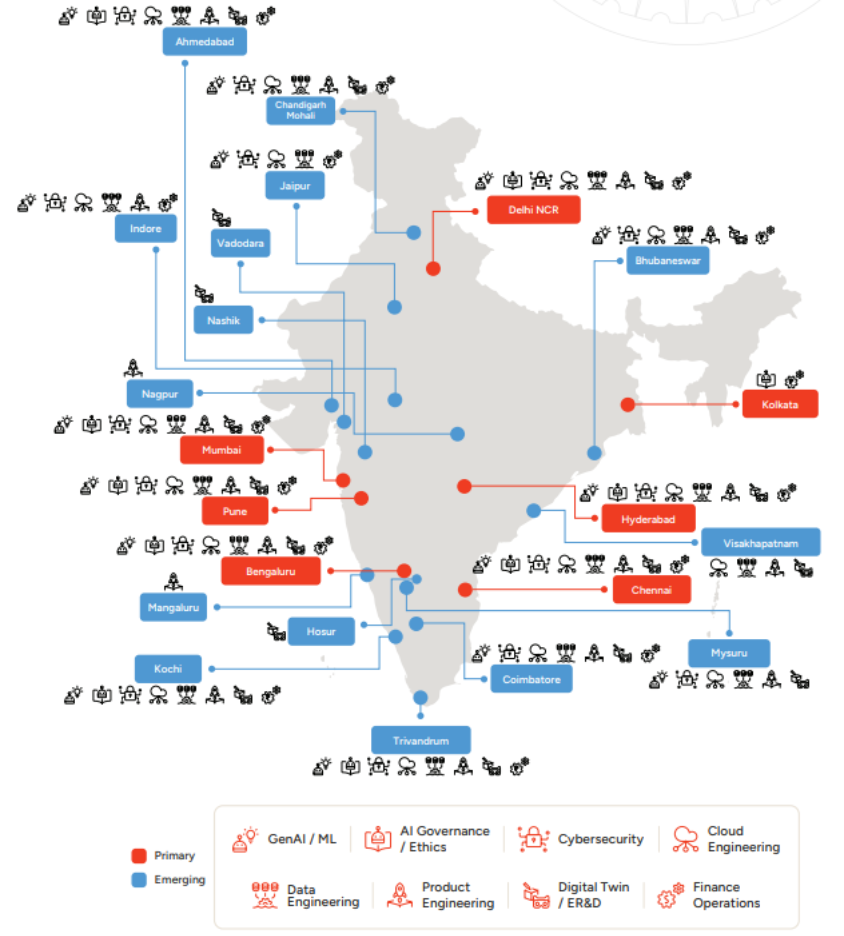
Three Indian cities show up as an emerging talent hub for every single skill cluster tracked in Taggd’s GCC Report 2026: Kochi, Ahmedabad, and Thiruvananthapuram.
Coimbatore, Bhubaneswar, and Chandigarh-Mohali are close behind, each covering 7 of 8 clusters.
A handful of cities, Vadodara, Nashik, Hosur, Nagpur, Mangaluru, show up for exactly one cluster each, which makes them strong bets for a specific mandate and a poor bet for anything broader.
That’s the finding this article is built around: not every Tier-2 city is an emerging hub in the same way and knowing which kind you’re looking at changes how you should plan around it.
Get the full data: Download the GCC Talent Lab Report 2026 for the complete skill-cluster map across all 8 capability areas.
Why Skills Mapping Matters for Tier-2 GCC Hiring
Choosing a Tier-2 location should start with the capabilities a GCC needs to build, not simply the cities gaining attention.
A location may have a growing talent base but still lack the experience, scale, or specialized skills required for a particular mandate.
Skill mapping helps GCCs assess whether a capability can be hired at scale, developed internally, or requires a longer-term talent-building approach.
The GCC Talent Lab Report 2026 identifies emerging hubs across eight skill clusters. The city-level comparison below shows where these capabilities are beginning to take shape.
For a detailed framework, see our guide to Skill Mapping for GCCs.
Which Tier-2 Cities in India Are Emerging GCC Talent Hubs?
For GCCs planning a multi-function Tier-2 location, these cities offer the broadest emerging skill coverage in the report.
| City | Clusters it’s emerging for |
| Kochi | GenAI / ML, AI Governance / Ethics, Cybersecurity, Cloud Engineering, Data Engineering, Product Engineering, Digital Twin / ER&D, Finance Operations |
| Ahmedabad | GenAI / ML, AI Governance / Ethics, Cybersecurity, Cloud Engineering, Data Engineering, Product Engineering, Digital Twin / ER&D, Finance Operations |
| Thiruvananthapuram | GenAI / ML, AI Governance / Ethics, Cybersecurity, Cloud Engineering, Data Engineering, Product Engineering, Digital Twin / ER&D, Finance Operations |
| Coimbatore | GenAI / ML, Cybersecurity, Cloud Engineering, Data Engineering, Product Engineering, Digital Twin / ER&D, Finance Operations |
| Bhubaneswar | GenAI / ML, Cybersecurity, Cloud Engineering, Data Engineering, Product Engineering, Digital Twin / ER&D, Finance Operations |
| Chandigarh-Mohali | GenAI / ML, Cybersecurity, Cloud Engineering, Data Engineering, Product Engineering, Digital Twin / ER&D, Finance Operations |
| Jaipur | GenAI / ML, Cybersecurity, Cloud Engineering, Data Engineering, Product Engineering, Finance Operations |
| Indore | GenAI / ML, Cybersecurity, Cloud Engineering, Data Engineering, Product Engineering, Finance Operations |
| Mysuru | GenAI / ML, Cybersecurity, Data Engineering, Product Engineering, Digital Twin / ER&D |
| Visakhapatnam | Cloud Engineering, Data Engineering, Product Engineering, Finance Operations |
| Vadodara | Digital Twin / ER&D |
| Nashik | Digital Twin / ER&D |
| Hosur | Digital Twin / ER&D |
| Nagpur | Product Engineering |
| Mangaluru | Product Engineering |
Please Note: The table ranking reflects the number of skill clusters in which each city is identified as an emerging talent hub. It does not represent the size, depth, or readiness of the available talent pool.
Full-Spectrum Tier-2 Talent Hubs for GCCs
These three cities appear on the emerging list for GenAI/ML, AI Governance/Ethics, cybersecurity, cloud engineering, data engineering, product engineering, digital twin/ER&D, and finance operations, every cluster in the report tracks. That breadth matters most for GCCs planning a multi-function Tier-2 location, not a single-skill satellite office.
If a GCC needs a location that can eventually support tech, finance, and specialized engineering roles under one roof, these three carry the least location risk.
Kochi and Thiruvananthapuram both draw on Kerala’s engineering and higher-education base, and their consistent appearance across every cluster, including the notoriously thin AI Governance/Ethics category, suggests a genuinely diversifying talent pipeline rather than a one-industry town.
Ahmedabad shows the same pattern, backed by Gujarat’s broader industrial and technical education base.
Emerging Tier-2 Talent Hubs: Coimbatore, Bhubaneswar, Chandigarh-Mohali
All three miss only one cluster: AI Governance/Ethics. That’s less a weakness specific to these cities and more a reflection of how immature that cluster is everywhere.
AI Governance/ Ethics has an emerging footprint in three cities nationally, and none of these three made that short list.
For every other capability, GenAI/ML, cybersecurity, cloud, data, product engineering, digital twin/ER&D, and finance operation, all three show up consistently.
Practically, this tier is close to interchangeable with the full-spectrum three for most GCC mandates, unless AI governance specifically is part of the plan.
Specialist Tier-2 Talent Hubs for GCC Hiring
Vadodara, Nashik, and Hosur each appear for exactly one cluster: Digital Twin/ER&D. That’s not a coincidence. All three sit inside or near India’s established automotive and industrial manufacturing corridors, Gujarat’s industrial belt, Maharashtra’s auto-manufacturing base, and the Tamil Nadu-Karnataka EV and automotive cluster near Bengaluru.
For a GCC building automotive engineering, EV powertrain, or embedded systems capability, these towns likely carry more relevant density than their single-cluster listing suggests. For anything else, they’re not the right bet.
Nagpur and Mangaluru show up only for product engineering. Treat them as satellite options for backend and full-stack capacity, not as candidates for a multi-function Tier-2 hub.
Jaipur, Indore, and Mysuru sit in the middle, broad enough to support most technology functions (GenAI/ML, cybersecurity, cloud, data, product engineering, finance operations) but missing AI Governance/Ethics and, in most cases, Digital Twin/ER&D.
These are solid general-purpose Tier-2 bets for a GCC that doesn’t need automotive-adjacent engineering or governance-specific roles.
Visakhapatnam covers cloud engineering, data engineering, product engineering, and finance operations, four clusters, but misses GenAI/ML, AI Governance, cybersecurity, and digital twin/ER&D entirely. It reads as a city building specifically toward tech-and-finance shared services rather than a broad engineering hub.
Tier-2 vs Tier-1: GCC Salary and Cost Trends
Tier-2 expansion is also a compensation story.
Entry-level salaries in these cities have moved from ₹5–9 LPA to ₹7–12 LPA, a percentage jump that matches or exceeds Tier-1 growth even though absolute pay stays 25–40% lower.
The cost of arbitrage that makes Tier-2 attractive is real, but it’s compressing, and it’s compressing at a similar rate whether a city is a full-spectrum hub like Kochi or a single-specialty one like Nashik.
Breadth of talent availability and pace of cost compression are two separate variables, worth checking both before committing to a location.
Check out the GCC Salary & Compensation Trends 2026 for complete insights.
How GCCs Can Source Talent in Tier-2 Cities
Choosing a city is only half the decision. The other half is how a GCC actually accesses talent once it’s there, and the answer looks different in Tier-2 markets than in Bengaluru or Hyderabad.
Across the market, IT services firms supply the largest share of external hires, 41%, and this matters more in Tier-2 planning than the number alone suggests.
Firms like TCS, Infosys, Wipro, and HCL already operate delivery centers in many of these emerging cities, which makes them the fastest on-ramp into a new Tier-2 location, faster than trying to build a standalone sourcing pipeline from scratch.
The tradeoff is the same one that applies everywhere: professionals moving from a delivery-led model need time to adapt to product ownership and end-to-end accountability.
Other GCCs supply 32% of external hires nationally, but this channel is thinner in most Tier-2 cities simply because fewer GCCs have established a presence there yet.
That’s likely to change as more centres expand into Kochi, Ahmedabad, and similar hubs, but for now it’s a smaller factor in Tier-2 sourcing than it is in Tier-1 metros.
Startups and product companies, 27% of external hires nationally, follow a similar pattern, concentrated in Tier-1 ecosystems, thinner in emerging cities.
That leaves the Build side of the equation doing more work in Tier-2 markets than the national average suggests.
Campus and fresher hiring, roughly 48% of the Build portion nationally, is often the strongest lever available in a new Tier-2 location: partnering with local engineering and commerce colleges to co-design curricula and build a pipeline that doesn’t depend on an existing GCC or IT services presence in the city.
For the full hiring trends breakdown: check out the GCC hiring trends 2026.
FAQs
Which Tier-2 cities in India are emerging as GCC talent hubs?
Kochi, Ahmedabad, and Thiruvananthapuram appear across all eight skill clusters tracked in Taggd’s GCC Talent Lab Report 2026. Coimbatore, Bhubaneswar, and Chandigarh-Mohali appear across seven clusters.
Which Tier-2 cities have the broadest talent pool for GCC hiring?
Kochi, Ahmedabad, and Thiruvananthapuram have the broadest skill-cluster coverage in the report, appearing across all eight tracked clusters. This reflects breadth of emerging capability coverage, not the size or depth of the actual talent pool.
Which Tier-2 cities are emerging for GCC technology and engineering hiring?
Coimbatore, Bhubaneswar, Chandigarh-Mohali, Jaipur, Indore, Mysuru and Visakhapatnam appear across multiple technology and engineering-related skill clusters, while Vadodara, Nashik and Hosur appear specifically for Digital Twin/ER&D and Nagpur and Mangaluru for Product Engineering.
Which Tier-2 cities are emerging for automotive and ER&D talent?
Vadodara, Nashik and Hosur appear in the GCC report’s emerging list for the Digital Twin/ER&D skill cluster
Is Tier-2 hiring cheaper than Tier-1 hiring for GCCs?
Entry-level salaries in Tier-2 markets are cited at ₹5–9 LPA historically and ₹7–12 LPA in the more recent benchmark discussed in the article, while absolute compensation remains 25–40% lower than Tier-1 levels. The article notes that the cost advantage is narrowing and should be reassessed regularly.
How do GCCs hire talent in Tier-2 cities?
The broader GCC hiring data in the report shows IT services firms accounting for 41% of external hires, other GCCs 32%, and startups/product companies 27%. The article also discusses campus and fresher hiring as a way to build talent pipelines in emerging markets. These percentages are national external-hiring figures, not city-specific sourcing shares.
How should GCCs choose a Tier-2 talent hub?
GCCs should assess a city’s coverage of the specific skill clusters they need, along with talent-pool depth, experience availability, compensation, retention, and the ability to scale the capability over time. The report’s city comparison should therefore be used as a starting point for location analysis rather than as a standalone location decision.
For the complete city-by-skill data, addressable pool sizes, and feeder institutions: Download the GCC Talent Lab Report 2026