You’re one of 250 resumes. Maybe 4 reach interviews. Only 1 gets hired.
Those aren’t pessimistic numbers. They’re recruiting realities. Recruiters spend 6 seconds per resume. 68% of candidates never reach panel stage. The ones who crack interviews aren’t smarter. They’re systematic.
Most candidates prepare only for questions. They miss the actual test: resume filtering, role fit alignment, structured communication, digital assessments, and offer negotiation. This guide covers the full system.
Your interview doesn’t start when you join the call. It started the day your application landed.
5 Interview Mistakes Strong Candidates Make
Most rejections aren’t about ability. They’re about system gaps. Strong candidates miss critical steps in resume filtering, role research, storytelling, and pressure-testing. Here are five gaps costing you the job.
1. Resume Gets Filtered Before You Ever Speak
Hiring managers spend 6 seconds on each resume. Your application must show obvious fit immediately or it dies.
What kills resumes:
- Generic job descriptions that don’t match the role
- No quantifiable proof (numbers, percentages, outcomes)
- Vague titles that don’t reflect actual responsibility
- Poor formatting (wall of text, unclear dates)
- Missing keywords from job description
What saves resumes:
- Role-specific language matching the JD
- One quantifiable outcome per role (improved X by Y%)
- Clear title and scope
- Scannable format with white space
- Keywords from the job naturally embedded
Rule: If your resume can’t be understood in 6 seconds, it won’t reach the interview stage.
2. You Research Surface-Level. Interviewers Can Tell.
Reading the About Us page and company tagline is basic. Everyone does it. It’s also not enough.
Useful research is operational. It answers: Why does this role exist now? What problem does it solve?
Five areas that matter:
Role Economics How does this function drive revenue, reduce risk, or improve customer experience?
Team Context Is this a build role (starting new), stabilization role (fixing broken), or scale role (growing existing)?
Sector Nuance BFSI operations, semiconductor engineering, and fintech platform roles reward different examples.
Decision Style GCCs value structured communication and global stakeholder management. Indian enterprises reward ownership and execution discipline.
Candidate Signal What makes you easy to shortlist and easy to defend in panel?
Where to dig:
- Business model page (not just About)
- Latest product launches or announcements
- Leadership commentary in investor updates
- Team structure on LinkedIn
- Customer/partner case studies
Candidates who understand where value is created sound different.
3. You Use the Same Answer Blueprint for Every Interview
A coding round tests different skills than a behavioural round, which tests different skills than a leadership round.
Using one playbook for all three wastes effort. You need role-specific preparation.
4. Your Stories Sound Memorized, Not Lived
Interviewers probe follow-ups. When your answer sounds scripted, the probe breaks it.
What happens:
- Interviewer asks: “Tell me about a conflict.”
- You deliver polished response.
- Interviewer asks: “What would you do differently?”
- You pause, searching for words.
- Interviewer knows you’re reciting, not remembering.
What works: Know the underlying story so well you can retell it naturally. That composure is credibility.
5. You Miss the Digital Interview Reality
63% of Indian tech hiring now uses AI screening or automated assessments. Your answer has to pass both a system and a human.
Automated systems care about:
- Clear, role-specific language
- Structured answers (not rambling)
- Quantifiable evidence
- Clean delivery (pacing, pauses)
Humans reviewing the automation care about:
- Does this person understand the role?
- Are they being genuine?
- Can they think on their feet?
You need both.
Pre-Interview Checklist
Most candidates define readiness too narrowly. They revise answers, skim the company website, and hope confidence will carry them. That isn’t enough in a market where shortlist odds are tight, and recruiter attention is fleeting.
The practical starting point is simple. If your resume, LinkedIn profile, and application narrative don’t show obvious fit in seconds, you may never get the chance to demonstrate depth. T
hat’s why pre-interview preparation is less about motivation and more about alignment.
Your Pre-Interview Operating System
Most preparation is random. You revise answers, skim websites, hope confidence carries you.
Systems beat hoping. Here’s what works.
Research company economics and role problems. Build five STAR story examples tied to outcomes. Practice aloud with timed mock interviews. Know your resume completely. Test tech setup. Prepare thoughtful questions about team context.
Three-Week Timeline
Week 1: Foundation
- Decode the job description (must-haves vs. nice-to-haves)
- Research company business model and recent changes
- Identify underlying business problem the role solves
- List your relevant examples
- Map each example to role requirements
Week 2: Stories and Structure
- Build five stories around themes: conflict, ownership, resilience, influence, learning agility
- Frame each story using STAR (Situation, Task, Action, Result)
- Practice each story aloud (not in your head)
- Time yourself (90 seconds max per story)
- Record and listen for clarity
Week 3: Pressure and Polish
- Do 3-5 mock interviews (with feedback, not just “good job”)
- Practice with timed responses
- Test video setup if remote
- Prepare 4-5 smart questions
- Mental rehearsal of potential curveballs
For candidates targeting fast-scaling centres, it also helps to understand what attracts and retains specialist talent in these environments. Taggd’s perspective on how GCCs can attract top tech talent is useful because it shows what employers themselves prioritise when they build teams.
Practical rule: Don’t prepare as an applicant. Prepare as someone who already understands the hiring manager’s problem.
Research beyond the About Us page
Surface-level research is easy to spot. If you only know the company’s tagline, office locations, and a recent award, you’ll sound like every other candidate. Useful research is operational. It tells the interviewer that you understand where value is created and where friction may sit.
Focus on five areas:
- Role economics
How does this function help revenue, risk control, delivery, customer experience, or innovation? - Team context
Is this a build role, a stabilisation role, or a scale role? - Sectors nuance
A BFSI operations role, a semiconductor role, and a tech platform role won’t reward the same examples. - Decision style
GCCs often value structured communication and global stakeholder management. Many Indian enterprises also look closely at ownership and execution discipline. - Candidate signal
What will make you easy to shortlist and easy to defend in an interview panel?
Mental conditioning matters too. Candidates often underestimate how much calm, precision, and listening affect their perceived readiness. If your preparation has been thoughtful, your confidence will look earned, not rehearsed.
| Other related reads |
|---|
| Cover letter for freshers with PDF |
| 85+ Business Development Executive interview questions: PDF with Sample answers |
| 50+ Graphic Designer Interview questions: PDF with Sample answers |
How to Answer Different Interview Types
One of the most common preparation mistakes is using the same playbook for every interview. It wastes effort. A coding round, a behavioural round, and a leadership discussion test different muscle.
For Technical Roles:
For India-based technical roles, a practical preparation stack is a 7-step workflow: rebuild fundamentals, learn recurring problem patterns, choose the right data structure, do targeted practice, then pressure-test with timed assessments and at least 5 to 10 mock interviews, as recommended in this technical interview preparation guidance.
The progression that works:
- Rebuild fundamentals first (arrays, recursion, complexity, hashing, trees, concurrency)
- Study recurring patterns (two pointers, sliding window, binary search, DFS/BFS, dynamic programming)
- Choose the right data structure (shows thinking, not just coding)
- Practice selectively (depth over volume, fewer problems solved well)
- Add pressure (timed mocks expose hesitation)
- Explain while solving (communication beats correctness alone)
What interviewers actually test:
- Can you break down the problem?
- Do you state assumptions?
- Can you explain trade-offs?
- How do you handle being stuck?
- Can you code while talking?
- Common mistake: Solving silently then explaining. Explain while solving instead.
A lot of hiring leaders now care as much about technical communication as technical correctness. That’s especially true in distributed teams and in centres where engineers collaborate with global product, architecture, and business stakeholders.
For leaders hiring in this space, the patterns are visible on both sides. Taggd’s view on tech leadership hiring in India reflects that same shift toward depth, adaptability, and role-context fit.
If you can solve the problem silently but can’t explain your assumptions, trade-offs, and next step under pressure, you’re only half-prepared.
For Behavioural Roles
Build a story bank, not scripts.
Themes that matter:
| Theme | What They’re Testing |
|---|---|
| Conflict | Do you handle disagreement professionally? |
| Ownership | Do you solve problems without being told twice? |
| Resilience | How do you handle failure or setbacks? |
| Influence | Can you persuade without formal authority? |
| Learning Agility | Do you jump into unfamiliar territory confidently? |
Each story should:
- Show a scene (not vague summary)
- Explain your specific decision
- Describe what changed (quantified if possible)
- Reveal what you learned
Weak story: “I improved our process by collaborating with teams.” Strong story: “Our verification team was slowing fulfillment by 2-3 days. I mapped the workflow, found duplicate manual checks, and worked with two teams to remove redundancy. We cut rework by 40% and made daily flow predictable.”
For Leadership Roles
Leadership interviews test judgment, not seniority.
Interviewers assess:
| Area | What They Want to Know |
|---|---|
| Strategy | Can you connect team priorities to business outcomes? |
| Team Building | Do you hire, coach, and develop deliberately? |
| Stakeholder Mgmt | Can you influence without creating friction? |
| Change Leadership | Can you lead through ambiguity and resistance? |
| Commercial Sense | Do you understand cost, speed, quality, and risk together? |
What strong leaders do:
- Speak in business language, not just functional language
- Describe where they changed team capability (not just delivered tasks)
- Explain trade-offs clearly (when resource, speed, quality was in tension)
- Show evidence of developing people
If you want a practical reference point, this explainer on the remote interview process is useful for understanding what employers are evaluating in digital conversations.
Crafting Compelling Answers Frameworks
Interviewers don’t remember most answers because most answers sound alike. They’re vague, duty-heavy, and unstructured. Candidates mention effort but not impact. They describe activity but not decision quality.
Structure fixes that.
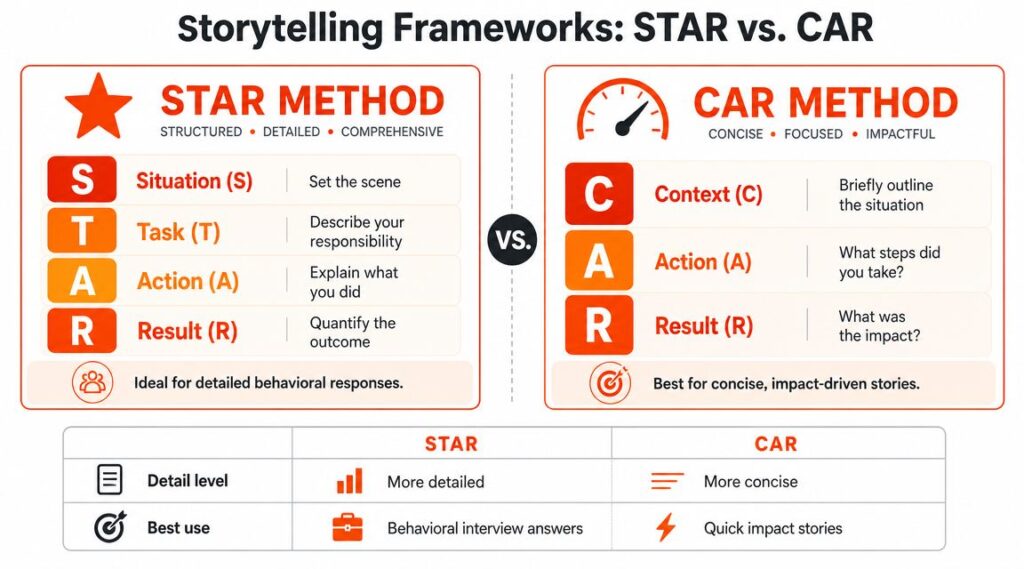
Expert interview guidance recommends starting with the simplest workable solution, talking through assumptions continuously, and quantifying achievements with numbers where relevant, because interviewers are judging both problem-solving and communication. It also warns that memorisation without retrieval is a major pitfall.
That advice applies beyond technical rounds. A structured behavioural answer tells the interviewer that you can think clearly, prioritise information, and communicate under time pressure.
Use this embedded walkthrough as a quick refresher before practice:
STAR vs. CAR: When to Use Each
Use STAR when:
- Interviewer wants detail and follow-ups
- Question is behavioral or scenario-based
- You have time and space
Structure: Situation (set the scene) → Task (your responsibility) → Action (what you did) → Result (what changed)
Use CAR when:
- Interviewer wants concise, impact-first
- You’re in an executive-style conversation
- Time is tight
Structure: Context (brief setup) → Action (what you did) → Result (business impact)
Example:
| Weak Answer | STAR Answer | CAR Answer |
|---|---|---|
| “I worked on process improvement. Coordinated with teams, fixed issues, made things smoother.” | “Our BFSI ops team had recurring delays between verification and fulfillment. I mapped the workflow, found duplicate manual checks, worked with two teams to simplify the exception path and standardize escalation triggers. We reduced avoidable rework and made daily flow predictable.” | “We had 2-3 day delays in our ops workflow due to redundant manual checks. I identified the source, coordinated simplification across teams, and reduced delays by 40%.” |
For questions about weaknesses, conflict, or pressure moments, candidates often become defensive or abstract. A practical reference is Taggd’s guide to greatest weakness interview answers, which shows how structure and self-awareness work better than self-protection.
STAR vs. CAR Frameworks briefly:
| Aspect | STAR (Situation, Task, Action, Result) | CAR (Context, Action, Result) |
| Detail level | More detailed and sequential | More concise and punchy |
| Best use | Behavioural questions with probing follow-ups | Shorter impact stories and executive-style responses |
| Opening | Starts with background and responsibility | Starts with a brief setup |
| Strength | Shows process and ownership clearly | Keeps the answer tight and outcome-led |
| Risk | Can become too long if poorly managed | Can feel incomplete if context is too thin |
A simple rule for better delivery
Don’t recite. Reconstruct.
If your answer sounds memorised, the interviewer will test it with follow-ups. If you know the underlying story well enough to retell it naturally, you’ll stay composed when the question changes. That’s often the difference between sounding prepared and sounding capable.
If you’re struggling to shape your opening pitch, these self introduction tips for interviews from a recruitercan help you build a sharper answer without sounding rehearsed.
| Other related reads |
|---|
| 60 Customer Service interview questions:PDF with Sample Answers |
| 45+ UI UX interview questions: PDF with Sample answers |
| 100 AI Engineer Interview questions: PDF with Sample answers |
Pressure-Testing Performance with Mock and AI Interviews
Preparation becomes useful only when it survives pressure. Many candidates know more than they show because they’ve prepared in low-stress conditions and perform in high-stress ones.
That gap is exactly why mock interviews matter. They aren’t a confidence ritual. They’re a performance rehearsal.
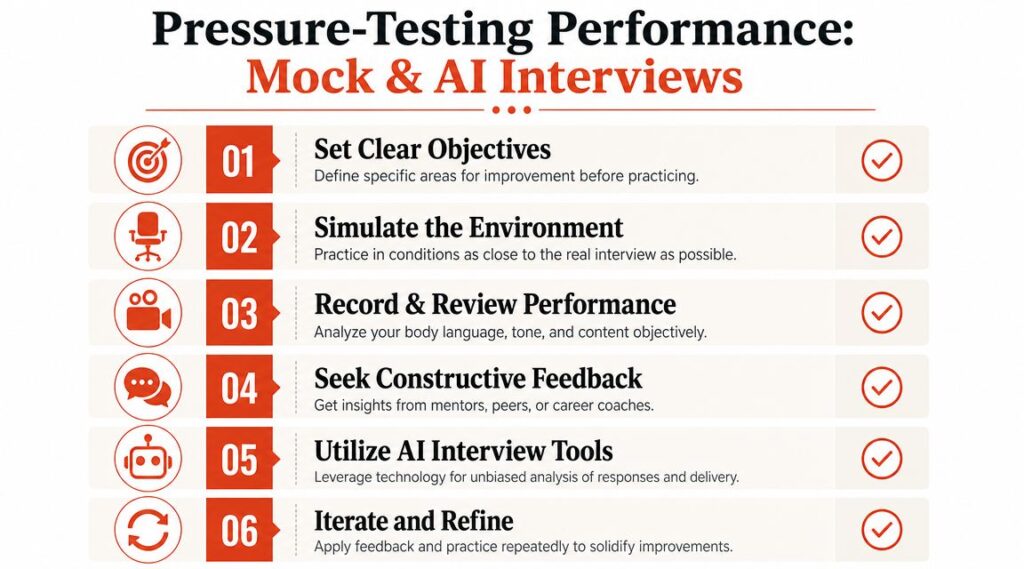
Mock interviews should feel uncomfortable
A useful mock is specific, timed, and honest. If the person taking your mock only says “good job” at the end, you haven’t learned much.
Test these elements instead:
- Opening clarity: Can you introduce yourself crisply without using up time?
- Answer structure: Do your examples land in a clear sequence?
- Thinking aloud: Can you explain assumptions and trade-offs in real time?
- Recovery ability: What happens when you’re interrupted or challenged?
- Non-verbal presence: Are you rushed, flat, apologetic, or overly verbose?
Record at least some of your practice rounds. Most candidates are surprised by their fillers, pacing, eye line, and tendency to over-explain. Taggd’s mock interview overview is one practical resource for understanding how these rehearsals help candidates refine body language, answer quality, and delivery.
Strong mock practice doesn’t make you sound polished. It makes you sound composed when things stop going to plan.
AI Interviews
India is rapidly digitising hiring, and AI use in recruitment is expanding. Candidate guidance, however, often doesn’t explain how to succeed when early screening or interview stages are automated, even though employers are increasingly using skills-first evaluation, especially in tech and GCC hiring.
63% of Indian companies now use AI screening or automated video interviews.
Automated systems evaluate:
- Role language (use terminology from job description naturally)
- Sentence clarity (short, direct sentences score better than rambling)
- Evidence quality (quantify what changed, not just effort)
- Delivery confidence (pause before answering, don’t rush)
Human reviewers then evaluate:
- Authenticity (does this person sound genuine?)
- Depth (can they go deeper on follow-up?)
- Role fit (do they understand what success looks like?)
Adjustment for AI rounds:
- Mirror job description language naturally
- Keep answers clean and scannable
- State evidence clearly (say what changed, not what you did)
- Pause deliberately (rushed delivery sounds less confident)
- Don’t let automation flatten your energy
Avoiding Unforced Errors and Common Pitfalls
Not every rejection comes from lack of capability. A surprising number come from preventable mistakes. In a market where the ILO reported India’s youth unemployment rate for ages 15 to 24 was 17.9% in 2023, competition for entry and early-career roles is intense, making errors more costly.
That should change how candidly candidates self-assess.
1. Asking Generic Questions at the End
Weak questions:
- “What’s the leave policy?”
- “How does work-from-home work?”
- “When’s the appraisal cycle?”
These make you sound self-focused, not role-focused.
Strong questions:
- “What would good performance look like in the first phase?”
- “What capability gap is this hire expected to fill?”
- “How does this team work with other functions?”
- “What’s evolving in this function right now?”
2. Poor Video Discipline
In virtual interviews, small mistakes become visible.
What weakens you:
- Looking away constantly
- Joining from noisy background
- Speaking over the interviewer
- Not testing audio/video before
- Checking your own image repeatedly
What strengthens you:
- Look at the camera when speaking
- Nod when listening
- Clean, non-distracting background
- Professional but not stiff
- Test everything 15 minutes early
3. Weak Salary Handling
Mistake: “Anything is fine” or “I’m flexible” Translation: “I haven’t thought through my move”
Better approach:
- Research market rates in your city and role
- State a range, not a single number
- Emphasize growth opportunity alongside salary
- Be prepared to discuss total package (bonus, equity, benefits)
- Don’t negotiate aggressively then disappear
4. Status Blindness
You can be casual with senior leaders. But ignoring hierarchy, decision dynamics, or business priorities signals immaturity.
Shows maturity:
- Listening more than talking in early rounds
- Asking about business context before suggesting solutions
- Acknowledging decision-makers and constraints
- Respecting time (concise answers, not long stories)
5. Answering Before You Understand
Mistake: Jumping to answer before the full question lands Better: “Let me make sure I understand: you’re asking about X, correct?”
Clarifying signals maturity. It also prevents you from answering the wrong question.
The Follow-Up that helps
A useful thank-you note is short, specific, and commercial. It shouldn’t repeat your CV. It should remind the interviewer why your profile fits the role.
A simple template works:
Thank you for the discussion today. I appreciated learning more about the team’s priorities and the scope of the role. Our conversation strengthened my interest in the opportunity, particularly because of the emphasis on [relevant challenge or priority]. I believe my experience in [relevant area] would allow me to contribute effectively. Please let me know if I can share any additional information.
That kind of follow-up is professional without sounding performative.
Handle the offer stage like a professional
If you receive an offer, slow down and evaluate it properly. Candidates often focus only on fixed pay or react emotionally to title. Strong decisions are broader.
Review the role through these lenses:
| Offer lens | What to check |
| Scope | Is the role substantive, or narrower than discussed? |
| Reporting line | Who will evaluate and support your work? |
| Growth path | Is there visible room to learn, build, or lead? |
| Operating environment | Will this company help you do strong work consistently? |
| Total package | Consider the full structure, not just one number |
If you want to negotiate, do it with clarity and respect. Explain your expectation based on role scope, experience fit, competing considerations if relevant, and the value you believe you bring. Don’t negotiate aggressively and then disappear. Don’t accept verbally and reopen every term later.
Once you’re ready to close, it helps to understand the basics of, offer letter acceptance so your response is prompt, clear, and professional.
Rejections matter too. If you don’t make it through, thank the team, keep the relationship intact, and move on with sharper insight. In India’s hiring market, reputations travel faster than many candidates realise.
Also read this guide to be prepared with the right questions to ask hiring managers when interviewing for a new role.
Key Takeaways for Cracking the Interview
Before you apply:
- Decode the job description to find the underlying business problem
- Research company economics and role context
- Assess resume fit in 6 seconds
Before you interview:
- Build five stories around themes (conflict, ownership, resilience, influence, learning)
- Practice with timed mocks (3-5 rounds with honest feedback)
- Prepare 4-5 smart questions about team and role
- Test tech setup completely
During the interview:
- Listen fully before answering
- Use STAR or CAR structure depending on question type
- Explain while solving or thinking, not just results
- Ask clarifying questions when needed
- Show genuine curiosity about the role
After the interview:
- Send short, specific thank-you within 24 hours
- Evaluate offer through scope, growth, reporting, environment
- Negotiate once, clearly, respectfully
- Keep the relationship intact whether you accept or decline
The system beats luck. Candidates who understand resume filtering, role fit alignment, structured communication, digital assessment reality, and negotiation usually win. Not because they’re more talented. Because they’re systematic.
FAQs
How do I stand out when my experience is limited?
Focus on outcomes not job titles. Quantify what changed in projects, roles, or volunteer work. Map your experience to role requirements clearly. Show learning velocity more than credentials. Evidence of impact beats years of experience.
What if I freeze during a technical question?
Say it out loud: “I’m thinking through the approach.” Then think aloud while solving. State assumptions. Explain trade-offs. Ask clarifying questions. Interviewers care more about your process than silence. Frozen silence looks worse than struggling aloud.
How much should I prepare versus staying natural?
Prepare stories until you can retell them naturally, not word-for-word. Know your examples cold but deliver conversationally. Mock interviews help find this balance. Audiences notice when you’re performing versus when you’re communicating.
Should I negotiate salary in round one or wait?
Research market rates beforehand. If asked early, give a range with reasoning. If they ask later, base it on full scope and feedback. Negotiate only once. Reopening terms after agreement damages trust. Keep documentation of conversations.
What if the interviewer is an AI system?
Use role-specific language naturally. Keep sentences clean and short. State evidence clearly with numbers. Pause before answering instead of rushing. Don’t let automation kill your energy. Your delivery matters to both the system and the human reviewer.
How do I know if the opportunity is right for me?
Ask about team context, reporting line, growth path, and operating environment. Talk to current employees if possible. Evaluate total package and company stability. Don’t accept based only on title or immediate salary. Mismatched roles cost both you and the employer.
Taggd helps organisations across India strengthen hiring outcomes through AI-powered talent fulfilment, RPO, leadership hiring, talent mapping, and hiring strategy support. If you’re building interview processes that identify stronger talent, or you’re looking for sharper insight into how candidates and employers can improve hiring quality, explore Taggd.