When supply chains break, businesses bleed. When they run perfectly, nobody notices. That invisibility is exactly what a great Logistics manager delivers every single day.
As global trade complexity grows, e-commerce volumes surge, and customer delivery expectations reach new heights, Logistics managers have become among the most operationally critical professionals in modern business. In 2026, this is not a back-office coordination role. It is a strategic function that directly determines whether organizations can compete, scale, and satisfy customers consistently.
This guide explains everything candidates and recruiters need to know about Logistics Managers, including responsibilities, required skills, hiring challenges, job descriptions, and recruitment strategies.
What is a Logistics Manager?
A Logistics Manager is a senior supply chain professional who oversees the end-to-end movement of goods, manages logistics teams and carrier networks, controls freight budgets, and drives continuous improvement across transportation, warehousing, and distribution operations.
| A Logistics Manager is a specialist who plans, leads, and optimizes the systems, teams, and partnerships that keep goods moving efficiently, cost-effectively, and reliably from origin to destination across domestic and international supply chains. |
Logistics Managers work at the intersection of:
- Transportation and Freight Strategy
- Warehouse and Distribution Management
- Carrier and Third-Party Logistics Partner Management
- Supply Chain Cost Optimization
- Team Leadership and Operational Performance
In 2026, Logistics Managers are responsible for:
- Leading logistics teams and managing carrier and 3PL partner relationships
- Controlling freight budgets and driving cost reduction across transportation modes
- Overseeing warehouse operations, inventory accuracy, and distribution performance
- Implementing logistics technology including TMS and supply chain visibility platforms
- Developing logistics strategy aligned with organizational growth and service level targets
Think of a Logistics Manager as a combination of:
- Supply Chain Strategist
- Operations Team Leader
- Freight Cost Controller
- Technology Implementation Driver
- Customer Service Performance Owner
Why Do Organizations Need a Logistics Manager?
In 2026, logistics is no longer just about moving boxes. It is a direct driver of customer experience, operational cost, and competitive advantage. Organizations without strong logistics leadership face rising freight costs, deteriorating delivery performance, and supply chain vulnerabilities that directly impact revenue and reputation.
| Factor | Why It Matters |
|---|---|
| Rising Freight Costs | Strategic carrier management is essential to control escalating logistics spend. |
| Customer Delivery Expectations | Faster, more reliable delivery requires dedicated logistics leadership to deliver. |
| Supply Chain Complexity | Multi-modal, multi-geography logistics networks need experienced management. |
| 3PL Partner Performance | Third-party logistics partners need structured oversight to deliver consistently. |
| Technology Adoption | TMS and visibility platforms require experienced leadership to implement effectively. |
| Sustainability Pressure | Green logistics and carbon-efficient routing need strategic management commitment. |
| E-commerce Growth | High-volume digital commerce demands scalable and responsive logistics operations. |
| Disruption Resilience | Proactive logistics strategy minimizes the business impact of supply chain shocks. |
Core Operational Tasks of a Logistics Manager
Logistics managers keep supply chains running efficiently, cost-effectively, and reliable. Here is what their day-to-day looks like:
- Freight and Transport Oversight:
Managing domestic and international freight operations across road, air, sea, and rail modes, ensuring shipments are delivered on time, within budget, and in compliance with all regulatory requirements.
- Carrier and 3PL Management:
Overseeing relationships with transport carriers, freight forwarders, and third-party logistics providers, conducting performance reviews, managing contracts, and driving service level compliance. - Warehouse and Distribution Coordination:
Directing warehouse operations, inbound and outbound stock movements, inventory accuracy, and distribution scheduling to align logistics execution with production and customer delivery requirements. - Logistics Budget Management:
Controlling the logistics cost budget, tracking freight spend against targets, identifying savings opportunities, and presenting cost performance reports to senior leadership regularly. - Team Leadership and Development:
Leading, coaching, and developing logistics coordination and operations teams, setting performance expectations, and building team capability across freight, customs, and distribution functions. - Technology and Process Improvement:
Driving TMS implementation, process standardization, and logistics performance improvement initiatives that reduce cost, improve reliability, and increase supply chain visibility across the organization.
Key Responsibilities of a Logistics Manager
Logistics managers ensure supply chain efficiency, cost control, and customer satisfaction by leading teams, managing partners, optimizing freight operations, and driving continuous performance improvement.
1. Freight Strategy and Transport Management
- Develop and own logistics strategy across all freight modes and geographies.
- Negotiate carrier contracts and freight rates to optimize cost and service.
- Manage freight forwarder and customs broker relationships for international freight.
- Monitor transport market trends and collaborate with sourcing managers to adjust sourcing strategies accordingly.
2. Carrier and 3PL Performance Management
- Own carrier and 3PL performance scorecards across delivery, cost, and compliance.
- Lead regular business reviews with key logistics partners to drive improvement.
- Manage contract renewals, SLA enforcement, and escalation alongside contract managers.
- Develop contingency carrier strategies to maintain continuity during disruptions.
3. Warehouse and Distribution Management
- Oversee inbound and outbound operations, inventory accuracy, and dispatch scheduling.
- Align distribution plans with production and customer delivery requirements.
- Manage returns, reverse logistics, and damaged goods handling efficiently.
- Drive warehouse productivity through process optimization and technology adoption.
4. Logistics Cost Management and Reporting
- Own the logistics cost budget and track freight spend against targets.
- Identify and implement cost reduction opportunities across carrier and route selection.
- Prepare logistics performance reports covering costs, service levels, and exceptions.
- Support annual budget planning with cost modelling and volume forecasting.
5. Team Leadership and Capability Development
- Lead and develop logistics teams across coordination and operations functions.
- Set performance targets, conduct reviews, and manage underperformance constructively.
- Build team capability through training and certification sponsorship.
- Foster a culture of continuous improvement and operational accountability.
Additional Scope (Senior Logistics Manager Roles)
- Own enterprise-wide logistics network design and distribution strategy.
- Lead digital logistics transformation including TMS selection and implementation.
- Present logistics strategy and cost performance roadmap to C-suite and board.
- Manage logistics across multiple geographies, distribution centers, and business units.
What Skills Does a Logistics Manager Need?
Great logistics managers are not just operationally experienced. They are strategically sharp, commercially astute, and capable of leading teams and technology transformations simultaneously. Here is what the best brings to the table:
Technical Skills
- Transportation management systems (SAP TM / Oracle TMS / Manhattan)
- Warehouse management system oversight (SAP WM / Blue Yonder / Körber)
- Freight cost modelling and budget management
- Supply chain visibility and real-time tracking platforms
- Customs compliance and international trade regulatory knowledge
- Carrier contract negotiation and 3PL management
- Logistics data analytics and KPI reporting
- E-commerce fulfillment and last-mile logistics management
Soft Skills
- Strategic thinking and supply chain network planning
- Decisive leadership under operational pressure
- Clear commercial negotiation and stakeholder communication
- Cross-functional collaboration across procurement specialists, sales, and operations teams.
- Change management and technology adoption leadership
- Analytical and data-driven performance management
Logistics Manager Job Description Template
Job Title: Logistics Manager / Senior Logistics Manager
Department: Supply Chain / Logistics / Operations
Reports To: Supply Chain Director / Head of Operations / COO
Location: [Location]
Employment Type: Full-time
Job Summary: We are looking for an experienced and commercially sharp Logistics Manager to join our [Department] team. In this role, you will lead our logistics operations, manage carrier and 3PL partner relationships, control freight budgets, and drive continuous improvement across transportation, warehousing, and distribution functions. You will work cross-functionally with procurement, sales, finance, and operations teams to build a logistics function that delivers competitive service levels at optimized cost.
Key Responsibilities
- Lead freight operations across domestic and international transport modes.
- Manage carrier and 3PL partner relationships and performance reviews.
- Control logistics budget and drive freight cost reduction initiatives.
- Oversee warehouse and distribution operations and team performance.
- Implement TMS and supply chain visibility platforms across the function.
- Present logistics performance and cost reports to senior leadership.
Required Qualifications
- Degree in Logistics, Supply Chain Management, or Business Administration.
- 7 to 12 years of experience in logistics management or supply chain leadership roles.
- Proven track record managing carrier networks, freight budgets, and logistics teams.
- Proficient in TMS platforms and supply chain visibility and reporting tools.
- Strong knowledge of domestic and international freight, customs, and trade compliance.
Preferred Qualifications
- Experience managing 3PL partnerships and outsourced logistics networks at scale.
- Knowledge of e-commerce fulfillment and last-mile logistics management.
- CILT, APICS CSCP, or equivalent senior supply chain certification preferred.
- Exposure green logistics initiatives and carbon-efficient transport optimization.
- Familiar with SAP or Oracle supply chain modules for logistics and distribution management.
Key Skills
- Freight Strategy and Transport Management
- Carrier and 3PL Performance Oversight
- Logistics Cost Control and Budget Management
- Warehouse and Distribution Leadership
- Supply Chain Technology Implementation
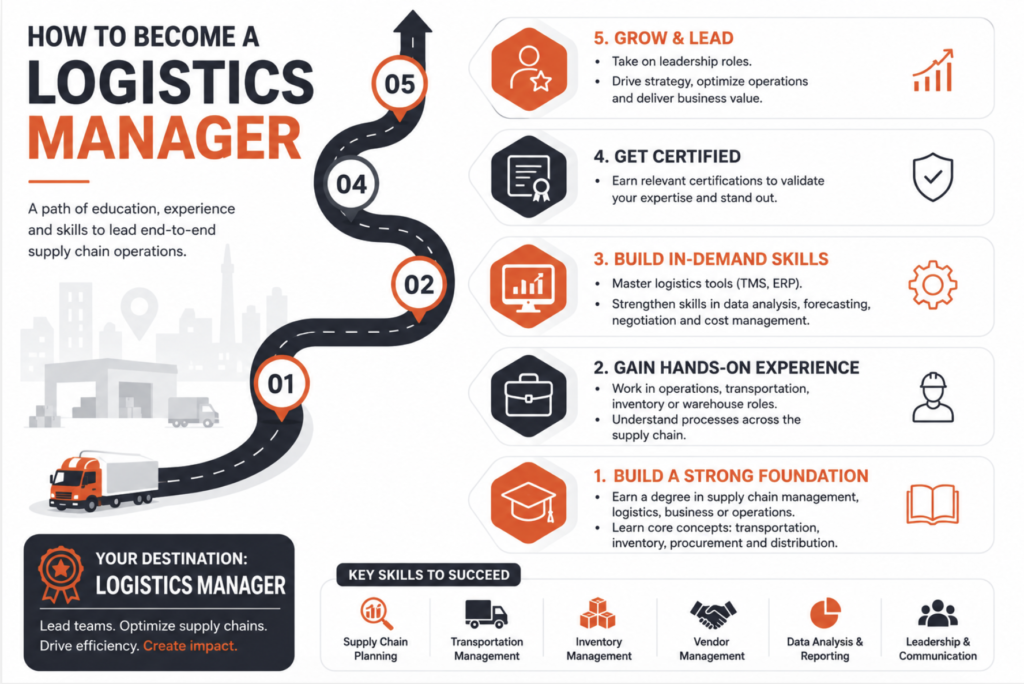
How to Become a Logistics Manager in 2026?
Educational Qualifications and Certifications
Most Logistics Managers hold a bachelor’s or master’s degree in logistics, supply chain management, or business administration. For senior logistics leadership or supply chain director roles, companies prioritize candidates with recognized supply chain certifications or postgraduate qualifications in operations and logistics management.
Educational Background
- BBA / B.Com in Logistics, Supply Chain Management, or Business Administration
- B.Sc / M.Sc in Operations Management or Industrial Engineering
- Diploma in Logistics and Supply Chain from CILT, IISC, or equivalent institutes
- B.Tech / B.E. in Industrial or Mechanical Engineering (for manufacturing logistics roles)
- MBA with Supply Chain Specialization for Senior Logistics Manager or Supply Chain Director roles
- Specialized PG Diploma in Freight Management, International Trade, or Logistics Operations
Relevant Certifications
In 2026, earning recognized certifications is a powerful way to validate logistics management expertise. These credentials help you stand out to recruiters by proving you have hands-on experience with industry-standard supply chain platforms, freight management frameworks, and logistics leadership methodologies that organizations now demand.
| Certification | Best For | Industry Value |
|---|---|---|
| CILT Fellowship / Advanced Diploma | Senior logistics management and supply chain leadership | Gold standard credential for logistics managers in India and globally |
| APICS CSCP | End-to-end supply chain strategy and logistics optimization | High demand across manufacturing, retail, and e-commerce logistics management |
| Six Sigma Black Belt | Logistics process optimization and supply chain performance improvement | Preferred for logistics managers leading large-scale efficiency programs |
| SAP TM / Oracle TMS Certification | Transportation management system implementation and optimization | Critical for logistics managers owning TMS selection and deployment |
| FIATA Diploma in Freight Forwarding | International freight management and customs coordination | Essential for logistics managers overseeing cross-border supply chains |
| PMP Certification | Project management for logistics technology and network redesign projects | High value for logistics managers leading major transformation programs |
| IATA Dangerous Goods Certification | Dangerous goods air freight compliance and logistics management | Essential for logistics managers in chemical, pharma, and industrial sectors |
Industries Hiring Logistics Managers
Logistics managers are in demand across every industry where supply chain performance, freight cost control, and distribution reliability are central to business operations and competitive positioning. Key industries actively hiring are:
Manufacturing and Automotive:
Manufacturers and automotive OEMs depend on logistics managers to coordinate just-in-time inbound supply, manage outbound finished goods distribution, and maintain production continuity across complex multi-tier supplier networks.
- Inbound raw material logistics strategy and coordination with purchase managers.
- Finished goods distribution network design and carrier management
- Just-in-time and kanban logistics execution and performance oversight
- Cross-border parts and components supply chain management
Retail and E-commerce:
High-volume retail and online commerce organizations need logistics managers who can scale operations, manage last-mile delivery partners, and maintain service levels during peak trading periods.
- Omnichannel distribution network management and optimization
- Last-mile delivery partner performance and cost management
- Peak season logistics capacity planning and execution
- Returns and reverse logistics network management
Pharmaceuticals and Healthcare:
Pharma and healthcare organizations require logistics managers with cold chain expertise, GDP compliance knowledge, and regulatory documentation capability to protect product integrity across complex distribution networks.
- Cold chain and temperature-controlled distribution network management
- GDP-compliant pharmaceutical logistics operations oversight
- Import and export management for regulated healthcare products
- Hospital and healthcare provider distribution network coordination
Third-Party Logistics and Freight Forwarding:
3PL and freight forwarding organizations require experienced logistics managers to lead client account operations, manage multi-client warehouse and transport functions, and drive commercial growth through operational excellence.
- Multi-client warehouse and distribution operations leadership
- Freight forwarding account management and operational performance
- New client logistics solution design and implementation
- Operational team leadership and capability development
Latest Trends to Watch in 2026 for Logistics Managers
Logistics Managers in 2026 are operationally critical and strategically influential professionals commanding strong salaries and consistent career growth. TMS expertise, 3PL management capability, and freight cost leadership are the key differentiators driving hiring and compensation across every major industry sector.
Job Role Trends
- Logistics Managers are now expected to lead AI-powered route optimization and demand-driven freight planning adoption.
- Green logistics including carbon footprint tracking and low-emission carrier selection have entered mainstream management responsibility.
- Real-time supply chain visibility ownership has moved from IT to logistics management as a core operational accountability.
- Logistics Managers are increasingly responsible for last-mile innovation, including drone, EV fleet, and locker delivery programs.
- Supply chain resilience planning has become a board-level deliverable owned by senior logistics leadership.
Hiring Trends
- TMS implementation experience is now a primary hiring filter for senior logistics manager roles.
- E-commerce and D2C brands are driving the strongest logistics management hiring growth across India in 2026.
- Managers with both domestic and international freight experience command significantly stronger market interest.
- Logistics managers with 3PL transition and outsourcing management experience are among the most sought-after profiles.
- MBA and CILT-qualified logistics leaders are consistently fast-tracked in shortlisting across enterprise hiring processes.
Career and Pay Trends
- Logistics Managers with TMS and supply chain visibility platform ownership command significant salary premiums above peers.
- Senior managers with network redesign and 3PL transformation experience are fast-tracking into Supply Chain Director roles.
- Performance bonuses tied to freight cost savings, on-time delivery rates, and inventory accuracy targets are now standard.
- Logistics managers specializing in pharmaceutical cold chain and e-commerce last-mile command the highest market premiums.
- Logistics management is evolving into one of the most important future leadership roles in supply chain operations.
Career Path of a Logistics Manager
A logistics management career grows from supporting basic shipment bookings to owning enterprise supply chain strategy as a Supply Chain Director. Each level builds deeper freight expertise, commercial acumen, and organizational leadership capability across one of India’s most consistently in-demand supply chain functions.
| Career Level | Typical Years of Experience | Core Focus | Key Responsibilities |
|---|---|---|---|
| Level 1: Logistics Assistant / Junior Coordinator | 0–2 Years | Learning and Execution | Supporting bookings, tracking shipments, and assisting with documentation. |
| Level 2: Logistics Coordinator | 2–5 Years | Operational Coordination | Managing shipments, coordinating carriers, and resolving delivery exceptions. |
| Level 3: Logistics Supervisor / Team Lead | 5–8 Years | Team and Operations Leadership | Leading coordination teams, managing carrier performance, and driving cost efficiency. |
| Level 4: Logistics Manager | 8–12 Years | Strategic Ownership | Owning freight strategy, managing 3PLs, controlling budgets, and leading teams. |
| Level 5: Senior Logistics Manager / Head of Logistics | 12–16 Years | People and Strategy | Leading the logistics function, managing budgets, and aligning strategy with business goals. |
| Level 6: Supply Chain Director / VP of Logistics | 16+ Years | Strategic Leadership | Driving enterprise logistics and supply chain strategy at board and C-suite level. |
Salary trends of a Logistics Manager
In 2026, Logistics Manager salaries in India typically range from INR 4 L – INR 30 L+ per year, with assistant managers earning INR 5 L – INR 8 L, mid‑level managers at INR 8 L – INR 14 L, senior managers at INR 12 L – INR 20 L, and heads of logistics reaching INR 18 L – INR 30 L+.
Pay is highest in Mumbai, Bangalore, and Delhi‑NCR, in e‑commerce, retail, pharma, and large 3PL firms, and is driven by e‑commerce growth, supply‑chain complexity, automation, and the need for cost‑efficient, resilient logistics networks.
1. By industry
Logistics Managers in e‑commerce and retail logistics typically earn INR 8 L – INR 20 L. Manufacturing and FMCG pay around INR 7 L – INR 18 L, third‑party logistics (3PL) providers INR 6 L – INR 15 L, automotive and heavy industry INR 7 L – INR 17 L, and pharma or healthcare logistics INR 8 L – INR 19 L.
| Industry sector | Typical salary band (per year) |
|---|---|
| E‑commerce / retail logistics | INR 8 L – INR 20 L |
| Manufacturing / FMCG | INR 7 L – INR 18 L |
| 3PL / logistics service providers | INR 6 L – INR 15 L |
| Automotive / heavy industry | INR 7 L – INR 17 L |
| Pharma / healthcare logistics | INR 8 L – INR 19 L |
2. By location
In logistics and commercial hubs like Mumbai, Bangalore, and Delhi‑NCR, bands are usually INR 8 L – INR 22 L. Chennai, Hyderabad, and Pune commonly range INR 7 L – INR 18 L, port and industrial cities like Kolkata and Ahmedabad INR 6 L – INR 15 L, other tier‑1 cities INR 5 L – INR 12 L, and tier‑2 hubs INR 4 L – INR 10 L.
| Location / city type | Typical salary band (per year) |
|---|---|
| Mumbai / Bangalore / Delhi‑NCR | INR 8 L – INR 22 L |
| Chennai / Hyderabad / Pune | INR 7 L – INR 18 L |
| Kolkata / Ahmedabad / Coimbatore | INR 6 L – INR 15 L |
| Other tier‑1 cities | INR 5 L – INR 12 L |
| Tier‑2 cities / logistics hubs | INR 4 L – INR 10 L |
3. By experience level
Assistant logistics managers (0–2 years) generally earn INR 5 L – INR 8 L. Mid‑level managers (3–6 years) often land INR 8 L – INR 14 L. Senior managers (7–10 years) commonly reach INR 12 L – INR 20 L, and heads of logistics (10+ years) can command INR 18 L – INR 30 L+ in large e‑commerce, manufacturing, and 3PL firms.
| Experience level | Typical salary band (per year) |
|---|---|
| Fresher / 0–2 years (assistant manager) | INR 5 L – INR 8 L |
| Mid‑level / 3–6 years (manager) | INR 8 L – INR 14 L |
| Senior / 7–10 years (senior manager) | INR 12 L – INR 20 L |
| Lead / 10+ years (head of logistics) | INR 18 L – INR 30 L+ |
Hiring Challenges in Logistics Manager Recruitment
Organizations in 2026 face a persistent logistics management talent shortage as supply chain complexity and technology adoption accelerate faster than the market can produce experienced leaders.
Finding managers who combine strategic freight expertise with team leadership capability and technology implementation experience remains the primary hiring challenge.
- Technology Leadership Gap:
Many experienced logistics managers lack hands-on TMS implementation and supply chain visibility platform leadership experience now required in digitally mature organizations.
- Strategic versus Operational Balance:
Finding managers who can operate strategically at budget and network level while remaining operationally credible with carriers and warehouse teams is consistently difficult.
- International Freight Expertise Scarcity:
Managers with deep cross-border freight, customs compliance, and multi-modal international logistics experience are scarce relative to employer demand.
- 3PL Transition Experience Deficit:
Managing the transition to outsourced logistics models requires specific experience that many internally trained logistics managers do not possess.
- High Attrition to Competitor Offers:
Experienced logistics managers are frequently attracted by e-commerce and 3PL operators, offering higher compensation and more complex supply chain challenges.
How to Hire a Logistics Manager?
Hiring skilled logistics managers requires practical operational leadership assessments, professional certification screening, and specialist supply chain recruitment support. Organizations that invest in TMS capability development, structured leadership pipelines, and compelling logistics career tracks will consistently attract and retain the best management talent in 2026.
- Use Practical Logistics Leadership Assessments: Design hiring scenarios requiring candidates to restructure a carrier network, manage a freight budget overrun, or design a 3PL transition plan to evaluate real management competence.
- Prioritize Commercial and Strategic Thinking: Assess candidates on their ability to connect logistics decisions to business outcomes including cost, customer service, and competitive positioning rather than purely operational execution.
- Partner with Supply Chain and Logistics Institutes: Build relationships with CILT, APICS, and logistics-focused MBA programs to access senior logistics talent with recognized professional credentials.
- Offer TMS and Technology Development: Attract ambitious logistics professionals by providing access to leading TMS platforms, supply chain visibility tools, and digital logistics transformation programs.
- Define the Role Scope Precisely: Specify freight modes, geographic coverage, team size, budget ownership, and 3PL management responsibility to attract correctly matched senior candidates.
- Leverage Specialist Supply Chain Recruiters: Partner with agencies focused on logistics and supply chain leadership hiring to access pre-vetted experienced manager talent and reduce time to hire.
- Build Succession from Within: Identify high-potential logistics coordinators and supervisors and invest in structured management development programs to build internal logistics leadership pipelines.
Top 10 Interview Questions for a Logistics Manager
Top logistics manager interview questions typically assess supply chain planning, inventory control, transportation management, cost optimization, vendor relations, leadership, problem-solving, ERP/TMS proficiency, KPI tracking, and crisis management. Employers look for candidates who can improve efficiency, reduce costs, and lead high-performing logistics operations.
1. How do you develop and execute a logistics strategy aligned with business growth targets?
I start by understanding the organization’s revenue targets, customer service commitments, and geographic expansion plans, assess current logistics network capabilities and gaps, design a logistics strategy covering carrier mix, warehouse footprint, technology requirements, and cost targets, align the plan with supply chain and commercial leadership, and establish KPIs to track strategy execution against business outcomes quarterly.
2. How do you manage a freight budget that is consistently overspending?
I conduct a detailed spend analysis by carrier, mode, lane, and business unit to identify the primary cost drivers, assess whether overspend reflects volume growth, rate increases, or operational inefficiency, develop targeted corrective actions including carrier renegotiation, mode shift, consolidation programs, and process improvements, and implement a monthly budget review cadence with clear accountability for each cost category.
3. How do you select and manage third-party logistics partners?
I define the service requirements and evaluation criteria upfront including operational capability, technology compatibility, financial stability, and cultural fit, conduct a structured RFP process, negotiate commercial terms and SLA commitments, implement a formal performance governance framework with monthly scorecards and quarterly business reviews, and maintain contingency carrier relationships to ensure continuity during partner performance failures.
4. How do you lead a logistics team through a major operational disruption like a port closure or carrier failure?
I activate the contingency logistics plan immediately, assess the volume and timeline impact of the disruption, engage alternative carrier and routing options, communicate proactively with internal stakeholders and customers on revised delivery timelines, coordinate the team to prioritize the most critical shipments, document the incident for post-event review, and update contingency plans based on lessons learned.
5. How do you approach implementing a new transportation management system?
I define the functional requirements with input from logistics, IT, finance, and operations, conduct a structured vendor evaluation and selection process, develop a phased implementation plan with clear milestones and user acceptance testing, manage change communication and training across the team, establish performance benchmarks to measure post-implementation improvement, and maintain close vendor engagement during the go-live stabilization period.
6. How do you build a high-performing logistics team?
I establish clear role expectations and performance metrics for every team member, conduct regular one-on-ones to understand development needs and motivation, sponsor certification programs and skill development investments, create stretch opportunities that build capability above current role requirements, manage underperformance constructively and quickly, and recognize and reward strong performance visibly to reinforce the behaviors the team needs to succeed.
7. How do you optimize freight costs without compromising service levels?
I analyze the trade-off between cost and service for each freight lane and customer segment, identify opportunities to shift modes, consolidate shipments, extend lead times for non-urgent shipments, renegotiate rate structures with carriers, and use TMS optimization tools to improve route efficiency. I present cost-service trade-off options to commercial leadership rather than making unilateral decisions that affect customer experience.
8. How do you manage customs compliance across a complex international supply chain?
I maintain a customs compliance framework covering documentation requirements, tariff classification, duty optimization, and regulatory filing processes for all key trade lanes, work closely with licensed customs brokers and trade compliance teams, conduct regular compliance audits to identify gaps, stay current with trade regulation changes affecting our supply lanes, and train the logistics team on customs documentation standards and exception escalation procedures.
9. How do you measure and report logistics performance to senior leadership?
I maintain a logistics performance dashboard covering on-time delivery rates, freight cost per unit, exception frequency, carrier performance scores, and warehouse productivity metrics, prepare monthly performance reports with variance analysis against budget and target, present findings with clear root cause analysis and recommended management actions, and connect logistics performance metrics directly to customer satisfaction and business financial outcomes.
10. How do you build supply chain resilience into your logistics network?
I develop a multi-carrier strategy that avoids single-source dependency on any transport lane, maintain alternative warehouse and distribution options for critical supply routes, build buffer inventory strategies for high-risk inbound material flows, conduct annual supply chain risk assessments to identify emerging vulnerabilities, and test business continuity plans through tabletop exercises with the logistics and supply chain leadership team annually.
Explore top interview questions with this guide which covers preparation tips across fresher, intermediate, and expert levels & recruiter insights.
Why RPO is the Answer to Logistics Manager Recruitment
As logistics functions scale, driven by e-commerce growth, global supply chain expansion, and increasing 3PL adoption, traditional recruitment models cannot keep pace with the volume and seniority of logistics management hiring required across organizations of all sizes.
This is where Recruitment Process Outsourcing (RPO) solutions have become a game changer for supply chain-driven organizations. RPO providers embed themselves within your company to hire qualified logistics management talent at scale.
They bring dedicated supply chain sourcing teams, pre-built pools of certified logistics professionals, and leadership competency-based assessment frameworks. This allows you to hire elite logistics managers without overwhelming your internal HR teams during periods of rapid supply chain expansion and network redesign.
For logistics manager hiring specifically, the best RPO partners bring deep supply chain and freight management domain expertise. They screen candidates for real freight strategy competence, team leadership capability, and TMS platform experience rather than just matching keywords on a CV.
Key benefits of RPO for Logistics Manager talent acquisition:
- Faster time-to-hire: RPO cuts hiring timelines for hard-to-fill senior logistics management and supply chain leadership roles significantly.
- Access to passive logistics talent: Recruiters reach experienced logistics managers not active on job boards but open to the right supply chain opportunity.
- Scalable model: Ramp from hiring one manager to building an entire logistics leadership team without rebuilding your HR function.
- Reduced cost-per-hire: Significant savings compared to traditional contingency agencies for specialized logistics management recruitment.
- Technical screening support: Expert vetting of freight strategy, TMS experience, 3PL management, and team leadership capability before candidates reach your interview stage.
- Employer branding: Strategies to position your organization as a top logistics employer highlighting supply chain scale, technology investment, and exceptional career growth opportunities.
Industries leveraging RPO most actively for Logistics Manager hiring: Manufacturing and Automotive | Retail and E-commerce | Pharmaceuticals and Healthcare | Third-Party Logistics and Freight Forwarding | FMCG | Oil, Gas, and EPC.
Wrapping Up
The role of a Logistics Manager in 2026 has never been more commercially critical or more strategically valued. As supply chains grow more complex, customer expectations intensify, and logistics technology reshapes how goods move globally, the professionals who can lead teams, control costs, manage partners, and drive continuous improvement are becoming indispensable to every organization that depends on reliable delivery.
Whether you are a supply chain professional building a logistics management career or an organization looking to hire the right logistics leadership, understanding the skills, certifications, and market dynamics shaping this space is essential for staying competitive in one of India’s most consistently in-demand operational management functions.
Ultimately, great logistics management is invisible to customers and invaluable to organizations. By embracing continuous learning, technology platform adoption, and modern recruitment solutions like RPO, both logistics managers and forward-thinking organizations can build supply chains that consistently deliver competitive advantage.
FAQs
What is a Logistics Manager and what do they do?
A Logistics Manager leads the end-to-end movement of goods across supply chains, managing carrier networks, freight budgets, warehouse operations, and logistics teams to deliver consistent, cost-efficient, and reliable supply chain performance.
How is a Logistics Manager different from a Logistics Coordinator?
Logistics coordinators focus on day-to-day shipment execution including booking, tracking, and documentation. Logistics managers lead the overall logistics function, owning strategy, budget, team performance, carrier contract management, and supply chain technology across the organization.
How do I become a Logistics Manager in 2026?
Earn a degree in logistics or supply chain management, build hands-on freight and operations experience, develop TMS platform and team leadership skills, and pursue certifications like CILT or APICS CSCP to accelerate progression into senior logistics management roles.
How long does it take to become a Logistics Manager?
Typically 8 to 12 years including relevant education and progressive logistics experience from coordinator through supervisor to manager level. High-performing logistics professionals with strong commercial and leadership skills can accelerate this timeline significantly.
What are the top 5 skills for Logistics Managers in 2026?
Freight Strategy and Transport Management, TMS Platform Leadership, Carrier and 3PL Performance Management, Logistics Cost Control, and Team Leadership and Development. These skills determine hiring success and career progression across all logistics management roles in 2026.
What is the career outlook for Logistics Managers?
Exceptionally strong. E-commerce growth, global supply chain complexity, and increasing logistics technology investment are driving sustained demand for experienced logistics managers. Skilled professionals command higher salaries and fast-tracking into Supply Chain Director and VP of Logistics roles.
Is a Logistics Manager role mostly strategic or operational?
It is both. Logistics managers balance day-to-day operational oversight of freight, warehouse, and carrier performance with strategic responsibilities including budget management, network design, technology implementation, and supply chain planning aligned with broader business objectives.
Building efficient supply chains starts with hiring the right logistics leaders.
Taggd Helps organizations hire skilled Logistics Managers across manufacturing, retail, pharmaceuticals, automotive, third-party logistics, and FMCG sectors through specialized hiring solutions, talent intelligence, and scalable RPO support.