Every operational hour a facility runs without failure is a Maintenance Engineer doing their job. Every unplanned stoppage is what happens without one.
Maintenance Engineers plan, execute, and optimize the maintenance of industrial equipment across manufacturing, oil and gas, power, and pharmaceutical sectors. In 2026, the role demands far more than breakdown response. It requires reliability engineering methodology, predictive maintenance capability, and CMMS platform expertise that directly determines whether industrial assets perform, production targets are met, and facilities remain safe, compliant, and profitable.
What is a Maintenance Engineer?
A Maintenance Engineer is a technical professional who plans, executes, and optimizes the maintenance of industrial equipment, machinery, and facility systems to ensure maximum asset availability, operational reliability, and safety compliance.
| A Maintenance Engineer bridges the gap between equipment failure and operational continuity, combining mechanical and electrical expertise, preventive maintenance discipline, and CMMS-driven planning to keep industrial assets performing around the clock. |
Maintenance Engineers work at the intersection of:
- Preventive and Predictive Maintenance Planning
- Breakdown Diagnosis and Corrective Maintenance
- CMMS and Asset Management Systems
- Reliability Engineering and Root Cause Analysis
- Health, Safety, and Regulatory Compliance
Maintenance Engineers are responsible for:
- Planning and executing preventive maintenance across mechanical, electrical, and instrumentation systems
- Diagnosing and resolving equipment breakdowns including motors, pumps, compressors, and PLCs
- Managing CMMS platforms for work order management, asset history, and KPI reporting
- Conducting root cause analysis on recurring failures and implementing reliability improvements
- Supporting shutdown and turnaround planning, execution, and post-shutdown performance review
Think of a Maintenance Engineer as a combination of:
- Mechanical and Electrical Systems Specialist
- Preventive Maintenance Planner
- Breakdown Diagnosis Expert
- Reliability and RCA Practitioner
- Asset Performance Manager
Why Do Organizations Need a Maintenance Engineer?
In 2026, unplanned downtime is a direct financial loss, a safety risk, and a competitive disadvantage. Organizations without strong maintenance engineering capability face failures that cascade into production stoppages, regulatory non-compliance, and accelerated asset degradation.
| Factor | Why It Matters |
|---|---|
| Asset Reliability Pressure | Maximum equipment uptime is non-negotiable across modern manufacturing. |
| Predictive Maintenance Adoption | IoT and condition monitoring tools require specialist expertise to leverage. |
| Safety and Compliance | Equipment failures create safety incidents and regulatory liability. |
| Energy Efficiency Mandates | Poorly maintained assets consume excess energy and make it difficult for sustainability managers to achieve efficiency and emissions targets. |
| Production Cost Control | Unplanned breakdowns cost far more than structured preventive programs. |
| Aging Industrial Infrastructure | India’s expanding industrial base includes aging assets needing rehabilitation. |
Core Operational Tasks of a Maintenance Engineer
Maintenance engineers keep industrial equipment running, failures prevented, and assets performing at designed capacity. Here is what their day-to-day looks like:
1. Preventive Maintenance Execution
Planning and executing scheduled PM activities across mechanical, electrical, instrumentation, and utility systems based on manufacturer recommendations and condition monitoring data.
2. Breakdown Diagnosis and Corrective Maintenance
Diagnosing equipment failures across motors, drives, pumps, compressors, PLCs, and conveyors, while collaborating with mechanical design engineers to address recurring design-related issues.
3. CMMS Work Order Management
Creating, managing, and closing work orders through SAP PM, Maximo, and Infor EAM, maintaining accurate equipment history and using system data to optimize schedules.
4. Condition Monitoring and Predictive Maintenance
Operating vibration analyzers, thermal cameras, oil analysis, and ultrasonic equipment to monitor asset health and schedule targeted interventions before breakdowns occur.
5. Spare Parts and Materials Management
Managing critical spare parts inventory and coordinating with procurement to ensure the right materials are available to minimize repair downtime and maintenance backlog.
6. Shutdown and Turnaround Support
Planning and executing scheduled plant shutdowns including scope definition, work package preparation, contractor coordination, and post-shutdown performance verification.
Key Responsibilities of a Maintenance Engineer
Maintenance engineers protect asset reliability, operational continuity, and workplace safety by planning preventive programs, responding to breakdowns, driving root cause elimination, and continuously improving maintenance system effectiveness.
1. Preventive and Predictive Maintenance Management
- Develop and own PM schedules aligned with equipment criticality.
- Implement condition monitoring using vibration, thermal, and oil analysis.
- Shift from reactive to predictive maintenance across priority assets.
- Update PM task lists based on failure history and reliability outcomes.
2. Breakdown Response and Corrective Maintenance
- Diagnose faults across motors, drives, pumps, and process systems.
- Execute repairs within target response and repair time KPIs.
- Coordinate with production to minimize downtime during breakdowns.
- Document breakdown causes and repair actions for trend analysis.
3. Root Cause Analysis and Reliability Improvement
- Lead RCA for recurring and high-impact failures.
- Implement corrective actions with defined accountability and timelines.
- Develop FMEA for critical equipment categories.
- Track MTBF and MTTR improvements across asset groups.
4. CMMS and Asset Management
- Manage work orders, equipment history, and records through CMMS.
- Analyze maintenance performance, backlog, and resource utilization.
- Maintain equipment files, manuals, and spare parts records accurately.
- Generate maintenance of KPI reports for engineering and operations leadership.
5. Safety, Compliance, and Contractor Management
- Ensure compliance with permits to work, LOTO, and site safety standards.
- Manage contractor induction, supervision, and performance on site.
- Support statutory inspections for pressure vessels and electrical systems.
- Maintain documentation for audit readiness and regulatory submissions.
Additional Scope (Senior Maintenance Engineer Roles)
- Own maintenance budget planning and cost optimization.
- Lead shutdown and turnaround planning for major plant outages.
- Drive digital maintenance transformation including CMMS and IoT integration.
- Present reliability improvement roadmaps to plant leadership.
What Skills Does a Maintenance Engineer Need?
Great maintenance engineers combine multi-discipline technical expertise with CMMS capability, reliability methodology knowledge, and strong cross-functional collaboration skills. Here is what the best brings to the table:
Technical Skills
- Electrical systems including motors, drives, switchgear, and PLC fault-finding
- CMMS platforms (SAP PM / IBM Maximo / Infor EAM / eMaint)
- Condition monitoring including vibration analysis and thermography
- Reliability engineering methods (RCM / FMEA / RCA)
- Hydraulic and pneumatic system maintenance and troubleshooting
- Statutory compliance for pressure systems and electrical installations
- Shutdown and turnaround planning and execution methodology
Soft Skills
- Calm and decisive problem solving under pressure
- Clear technical communication across production and management teams
- Disciplined CMMS documentation and record-keeping habits
- Collaborative coordination with operations, procurement, and contractors
- Continuous improvement mindset and reliability ownership
- Physical resilience across shift-based industrial environments
Maintenance Engineer Job Description Template
Job Title: Maintenance Engineer / Reliability Engineer
Department: Engineering / Maintenance / Operations
Reports To: Maintenance Manager / Plant Engineer / Head of Engineering
Location: [Location]
Employment Type: Full-time
Job Summary: We are looking for a technically skilled and reliability-focused Maintenance Engineer to join our [Department] team. In this role, you will plan and execute preventive maintenance programs, respond to equipment breakdowns, drive root cause elimination, and manage CMMS-based asset management to maximize equipment availability and operational reliability. You will work closely with production, procurement, safety, and contractor teams to deliver maintenance excellence every shift.
Key Responsibilities
- Plan and execute preventive maintenance across mechanical and electrical systems.
- Diagnose and repair equipment breakdowns to minimize production downtime.
- Lead root cause analysis for recurring and high-impact failures.
- Manage CMMS work orders, equipment history, and KPI reporting.
- Ensure all maintenance activities comply with permits to work and LOTO standards.
- Support shutdown and turnaround planning and execution activities.
Required Qualifications
- B.Tech / Diploma in Mechanical, Electrical, or Instrumentation Engineering.
- 3 to 8 years of hands-on maintenance engineering experience in manufacturing or industrial facilities.
- Proficient in CMMS platforms including SAP PM, Maximo, or equivalent.
- Strong diagnostic skills across rotating equipment, electrical systems, and PLCs.
- Familiar with RCM, FMEA, and reliability engineering methodologies.
Preferred Qualifications
- Experience implementing predictive maintenance using vibration analysis or thermography.
- Knowledge of shutdown and turnaround planning and critical path management.
- Certified Maintenance and Reliability Professional (CMRP) preferred.
- Exposure to IoT-based condition monitoring and Industry 4.0 maintenance tools.
- Familiar with statutory compliance for pressure vessels and electrical installations.
Key Skills
- Preventive and Predictive Maintenance Management
- Breakdown Diagnosis and Corrective Maintenance
- Root Cause Analysis and Reliability Engineering
- CMMS and Asset Performance Management
- Safety Compliance and Contractor Management
How to Become a Maintenance Engineer?
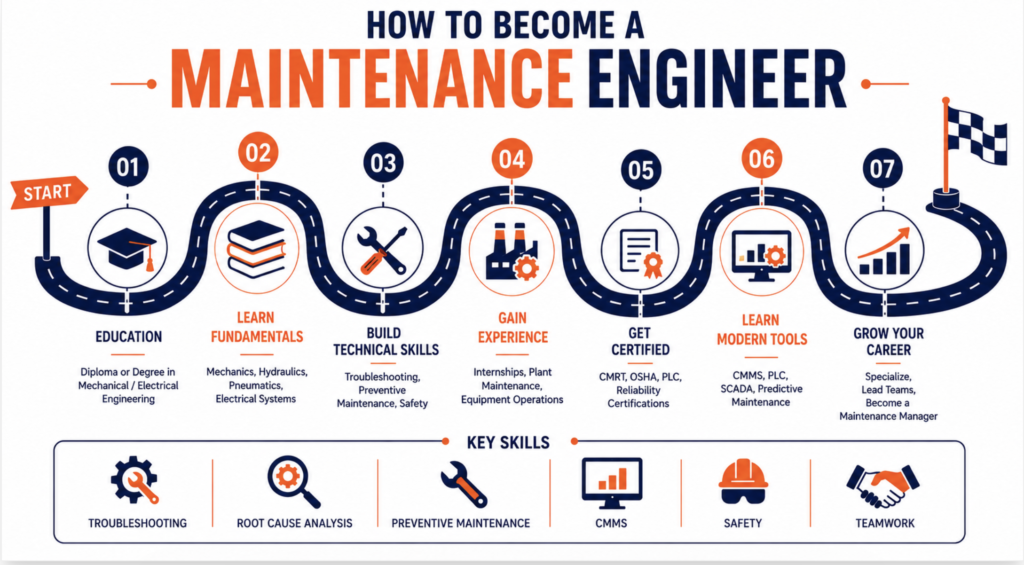
India faces a shortage of over 500,000 skilled maintenance engineers by 2027, making this one of the most opportunity-rich technical careers available right now. Start with a B.Tech or Diploma in Mechanical or Electrical Engineering, build hands-on plant experience, develop CMMS proficiency, and pursue a CMRP certification to stand out in a market where qualified talent is scarce and demand is only growing.
Educational Qualifications and Certifications
Most Maintenance Engineers hold a B.Tech or Diploma in Mechanical, Electrical, or Instrumentation Engineering.For senior reliability or maintenance leadership roles, companies prioritize candidates with postgraduate qualifications or recognized maintenance and reliability certifications.
Educational Background
- B.Tech / Diploma in Mechanical, Electrical, or Instrumentation Engineering
- B.Tech / B.E. in Chemical or Production Engineering (for process plant roles)
- Diploma in Industrial Maintenance from recognized technical institutes
- B.Sc in Applied Sciences or Physics (for instrumentation-heavy roles)
- MBA with Operations or Engineering Management for Senior Maintenance Manager progression
- Specialized PG Diploma in Reliability Engineering, Plant Maintenance, or Industrial Automation
Relevant Certifications
In 2026, earning recognized certifications validates maintenance engineering expertise and significantly strengthens candidacy for specialist and senior reliability roles.
| Certification | Best For | Industry Value |
|---|---|---|
| CMRP (Certified Maintenance and Reliability Professional) | Comprehensive maintenance and reliability management expertise | Gold standard credential for maintenance engineers across all industrial sectors |
| CRL (Certified Reliability Leader) | Reliability program leadership and asset performance management | High demand for senior engineers moving into reliability engineering roles |
| NEBOSH International General Certificate | Workplace safety and HSE compliance in industrial maintenance environments | Essential for maintenance engineers in high-hazard process and manufacturing facilities |
| SAP PM / IBM Maximo Certification | CMMS platform proficiency and work order management optimization | Critical for engineers responsible for asset management system ownership |
| Vibration Analysis Category II (ISO 18436) | Condition monitoring and predictive maintenance using vibration analysis | High value for engineers implementing PdM programs across rotating equipment |
| Thermography Level I Certification | Infrared thermal imaging for electrical and mechanical predictive maintenance | Preferred for engineers managing condition-based maintenance programs |
| Six Sigma Green Belt | Maintenance process optimization and reliability improvement programs | Strong differentiator for senior engineers driving MTBF improvement initiatives |
Industries Hiring Maintenance Engineers
Maintenance engineers are in demand across every industry where asset reliability, equipment uptime, and operational continuity are central to business performance. Key industries actively hiring are:
Manufacturing and Automotive
Manufacturing plants and automotive facilities are among the largest employers of maintenance engineers in India, requiring multi-discipline expertise to maintain high-speed production lines at maximum availability.
- Production line mechanical and electrical preventive maintenance
- Robotic and automated assembly system maintenance and fault-finding
- Utility systems including compressed air, cooling, and steam
- CMMS-driven asset management and KPI improvement
Oil, Gas, and Petrochemicals
These environments require rotating equipment expertise, process safety knowledge, and shutdown management capability across some of the most complex and high-consequence industrial settings.
- Rotating equipment maintenance including compressors, pumps, and turbines
- Instrumentation and control system maintenance and calibration
- Statutory inspection compliance for pressure vessels and piping
- Turnaround planning, execution, and post-shutdown reliability verification
Power and Energy
Power facilities require maintenance engineers to keep critical generation and transmission assets performing reliably within strict regulatory and safety frameworks.
- Boiler, turbine, and generator mechanical and electrical maintenance
- Transformer, switchgear, and HV electrical system testing
- Condition monitoring and predictive maintenance for generation assets
- Outage planning, execution, and equipment overhaul management
Pharmaceuticals and Food Processing
These facilities require GMP compliance knowledge, hygienic engineering expertise, and meticulous documentation discipline across regulated production environments.
- GMP-compliant equipment maintenance and qualification documentation
- Clean utility systems including WFI, purified water, and HVAC
- Validated equipment calibration and preventive maintenance execution
- Regulatory inspection readiness and maintenance documentation management
Latest Trends to Watch in 2026 for Maintenance Engineers
Maintenance Engineers in 2026 are reliability-critical professionals commanding strong and improving salaries.
CMMS proficiency, predictive maintenance expertise, and multi-discipline technical capability are the key differentiators driving hiring and compensation across India’s industrial sector.
Job Role Trends
- IoT sensor data and AI-driven failure prediction are now integrated into daily maintenance planning decisions.
- Reliability-centered maintenance has replaced time-based schedules as the primary strategy framework.
- Digital twin platforms are enabling maintenance engineers to simulate failure scenarios before physical intervention.
- Energy efficiency optimization is now a core maintenance engineer with accountability alongside asset availability.
- Cross-discipline capability spanning mechanical, electrical, and instrumentation is now a baseline expectation.
Hiring Trends
- SAP PM and Maximo proficiency are non-negotiable hiring filters across enterprise manufacturers.
- EV and semiconductor sectors are driving the strongest maintenance engineer hiring growth in 2026.
- Engineers combining PdM tool experience and reliability methodology knowledge are most in demand.
- Shutdown and turnaround management experience are among the most actively recruited skillsets.
- CMRP-certified engineers are consistently fast-tracked in shortlisting across leading industrial organizations.
Career and Pay Trends
- CMMS and reliability engineering capability commands significantly higher packages than breakdown-only profiles.
- RCM implementation and shutdown management experience fast-tracks engineers into Maintenance Manager roles.
- Performance bonuses tied to MTBF for improvement and equipment availability are increasingly standard.
- Oil and gas rotating equipment and pharmaceutical GMP specialists command the highest pay premiums.
- Maintenance engineering is evolving from a reactive trade into a data-driven reliability profession.
Career Path of a Maintenance Engineer
A maintenance engineering career grows from assisting with basic PM tasks as a trainee to driving enterprise asset management strategy as a Plant Engineer or Head of Engineering. Each level builds deeper technical expertise, reliability methodology ownership, and operational leadership capability.
| Career Level | Typical Years of Experience | Core Focus | Key Responsibilities |
|---|---|---|---|
| Level 1: Trainee Maintenance Engineer | 0–2 Years | Learning and Execution | Assisting with PM tasks, learning CMMS, and supporting breakdown response. |
| Level 2: Maintenance Engineer | 2–5 Years | Independent Maintenance | Executing PM schedules, diagnosing faults, and managing work orders. |
| Level 3: Senior Maintenance Engineer | 5–9 Years | Technical Leadership | Leading RCA programs, implementing PdM, and managing contractors. |
| Level 4: Lead Maintenance Engineer / Reliability Engineer | 9–13 Years | Asset Ownership | Owning reliability programs and managing shutdown planning. |
| Level 5: Maintenance Manager / Engineering Manager | 13–17 Years | People and Strategy | Leading teams, managing budgets, and aligning strategies with plant goals. |
| Level 6: Plant Engineer / Head of Engineering | 17+ Years | Strategic Leadership | Driving asset management strategy and presenting roadmaps to leadership. |
Maintenance Engineer Salary Structures
When hiring maintenance engineers for Indian industrial, utility, or healthcare operations, a headline Cost to Company (CTC) often fails to close top talent.
Because these roles anchor 24/7 operational uptime and stressful midnight breakdown responses, candidates look past the total number to evaluate the allowance design for practical monthly take-home, shift fairness, and tax efficiency.
If you need a refresher on the building blocks, Taggd’s guide to salary structure in India is a useful reference.
Practical Rule: If a recruiter needs ten minutes to decode the offer structure, it is too complicated for a candidate to trust. A clean structure accelerates acceptance, reduces early attrition in tough operating environments, and minimizes compliance risks.
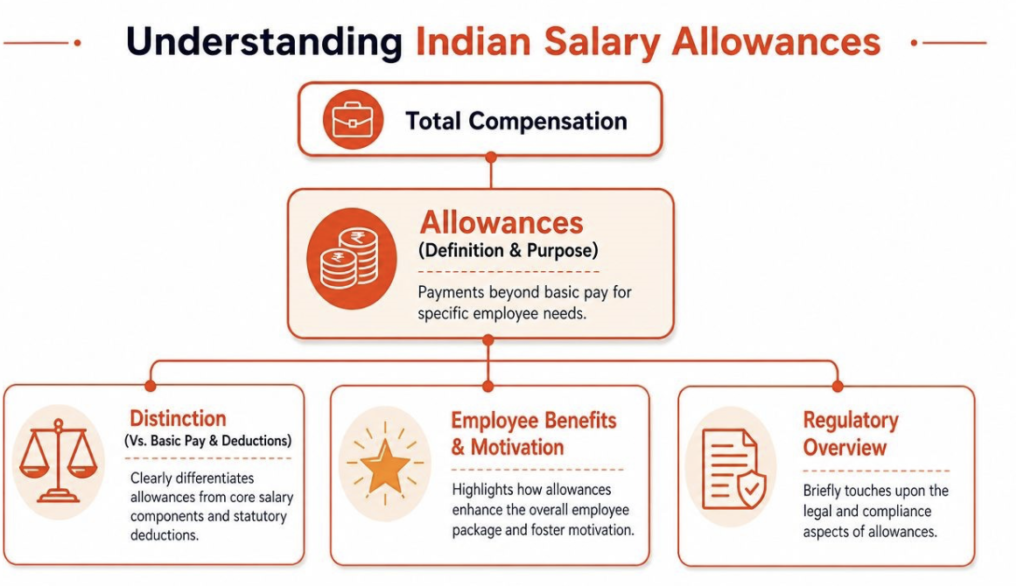
If your team needs a plain-language baseline before drafting salary templates or explaining offers to managers, Taggd’s glossary entry on employee allowance and its meaning in salary structures is a useful internal reference.
Core Salary Architecture
| Component | Strategic Purpose | Industrial Hiring Guardrail |
|---|---|---|
| Basic Salary | Core fixed pay; anchors PF and gratuity | Keep it balanced. Setting it too low looks deceptive; setting it too high inflates deductions and cuts monthly take-home cash. |
| House Rent Allowance (HRA) | Support for actual rental burden | Crucial for site-based roles in remote industrial belts or city outskirts. Avoid keeping it artificially low. |
| Conveyance / Transport | Commuting support | Critical for engineers traveling to plants outside urban cores or working rotating shifts when public transport is unavailable. |
| Special Allowance | Gross salary balancing | Use cleanly to maintain payroll flexibility for senior grades. Do not use it as an unexplained dumping ground to pad a weak offer. |
Maintenance Engineer Salary by Location
In industrial hubs like Pune, Chennai, and Bangalore, bands are usually INR 4.5 L – INR 11 L. Mumbai, Delhi‑NCR, and Hyderabad commonly range INR 4 L – INR 10 L, other tier‑1 cities INR 3.5 L – INR 8 L, and tier‑2 industrial belts INR 2.5 L – INR 6.5 L for similar maintenance engineer roles and experience levels.
| Location / city type | Typical salary band (per year) |
|---|---|
| Pune / Chennai / Bangalore | INR 4.5 L – INR 11 L |
| Mumbai / Delhi‑NCR / Hyderabad | INR 4 L – INR 10 L |
| Other tier‑1 cities | INR 3.5 L – INR 8 L |
| Tier‑2 cities / industrial belts | INR 2.5 L – INR 6.5 L |
Maintenance Engineer Salary by Key Industry
Maintenance Engineers in manufacturing, FMCG, and consumer goods typically earn INR 4 L – INR 9 L. Automotive and auto components pay around INR 4.5 L – INR 10 L, pharmaceuticals and chemical plants INR 4.5 L – INR 11 L, power plants and utilities INR 5 L – INR 12 L, and heavy industry, mining, or steel INR 4 L – INR 10 L.
| Industry | Typical salary band (per year) |
|---|---|
| Manufacturing / FMCG / consumer goods | INR 4 L – INR 9 L |
| Automotive / auto components | INR 4.5 L – INR 10 L |
| Pharmaceuticals / chemical plants | INR 4.5 L – INR 11 L |
| Power plants / utilities | INR 5 L – INR 12 L |
| Heavy industry / mining / steel | INR 4 L – INR 10 L |
Maintenance Engineer Salary by Experience
Fresher maintenance engineers (0–2 years) generally earn INR 2.5 L – INR 4.5 L. Mid‑level engineers (3–5 years) often land INR 4 L – INR 6.5 L. Senior engineers (6–9 years) commonly reach INR 5.5 L – INR 9 L, and maintenance supervisors or lead engineers (10+ years) can command INR 7 L – INR 12 L+ in large plants and heavy industries.
| Experience level | Typical salary band (per year) |
|---|---|
| Fresher / 0–2 years (junior engineer) | INR 2.5 L – INR 4.5 L |
| Mid‑level / 3–5 years (engineer) | INR 4 L – INR 6.5 L |
| Senior / 6–9 years (senior engineer) | INR 5.5 L – INR 9 L |
| Lead / 10+ years (maintenance supervisor) | INR 7 L – INR 12 L+ |
Hiring Challenges in Maintenance Engineer Recruitment
Organizations in 2026 face a persistent maintenance engineering talent shortage as industrial automation complexity and reliability management expectations accelerate faster than technical education programs can produce work-ready engineers.
- Multi-discipline Skills Gap: Many candidates are strong in either mechanical or electrical maintenance but lack cross-discipline capability across modern automated facilities.
- CMMS Proficiency Deficit: Most candidates have operational experience but lack structured CMMS platform proficiency including work order management and KPI reporting.
- Reliability Methodology Gap: Candidates trained in reactive breakdown response often lack formal RCM, FMEA, and predictive maintenance knowledge now expected at engineer level.
- Remote and Shift Role Acceptance: Hard-to-fill sites, rotating shifts, and plant-area housing constraints significantly narrow the candidate pool willing to accept offers.
- Attrition to Overseas Opportunities: Experienced engineers are frequently attracted by Middle East industrial operator roles and EPC project positions offering higher compensation.
How to Hire a Maintenance Engineer?
Hiring skilled maintenance engineers requires practical technical assessment, vocational institute partnerships, and specialist industrial recruitment support. Organizations that invest in CMMS training, structured reliability development, and compelling career pathways will consistently attract and retain the best maintenance engineering talent in 2026.
- Use Practical Technical Assessments: Design tasks requiring candidates to diagnose a fault scenario, interpret CMMS work order history, or develop a PM schedule to evaluate real competency accurately.
- Partner with Engineering Colleges and ITI Institutes: Build structured relationships to access freshly qualified candidates before competitors engage them.
- Invest in CMMS and Reliability Tool Training: Hire technically strong engineers and invest in SAP PM and Maximo training rather than requiring full proficiency upfront.
- Address Site and Shift Realities in Compensation: Design salary structures that recognize plant location burden and shift accountability through transparent allowance design.
- Build Structured Mentorship Programs: Pair junior engineers with experienced seniors to accelerate technical development and CMMS discipline.
- Leverage Specialist Industrial Recruiters: Partner with agencies focused on mechanical and reliability engineering hiring to access pre-vetted talent.
- Offer Certification Sponsorship: Sponsor CMRP, vibration analysis, and thermography certifications tied to career progression milestones.
Top 10 Interview Questions for a Maintenance Engineer
1. Walk me through how you develop a preventive maintenance schedule for a new production line.
I collect all OEM maintenance recommendations, rank equipment by criticality, define PM task lists covering lubrication, inspection, and functional testing, set frequencies based on operating hours and condition data, load everything into the CMMS, and review against failure history after the first cycle to optimize.
2. How do you diagnose a recurring motor failure?
I pull CMMS breakdown history to understand failure frequency and conditions, inspect the motor and its environment, review vibration and thermal data, assess alignment and coupling condition, apply a 5-why RCA to find the true root cause, implement a corrective action, and monitor through subsequent cycles to confirm elimination.
3. How do you prioritize when maintenance backlog exceeds available hours?
I rank all backlog by safety risk, production impact, and compliance criticality, address safety items immediately, escalate the situation to the maintenance manager with quantified risk exposure, use criticality-weighted sequencing for the rest, and use the backlog data to build a case for additional resource.
4. How do you manage contractors during a plant shutdown?
I ensure full site induction before work starts, assign a maintenance engineer to each contractor crew, issue permits for all high-risk activities with daily review, conduct progress meetings against the critical path, monitor work quality at defined inspection hold points, and verify all work through functional testing before returning equipment to production.
5. How do you implement a predictive maintenance program for rotating equipment?
I identify critical rotating assets, establish baseline vibration and thermal signatures, set alert and alarm thresholds to ISO 10816 standards, schedule periodic condition monitoring routes, train technicians on data collection, review trending data to identify deteriorating assets, and schedule planned interventions before failures occur.
6. How do you conduct a root cause analysis for a high-impact failure?
I convene the RCA team within 24 hours, secure the failed equipment and preserve evidence, collect operating data, alarm history, and maintenance records, apply a 5-why or fault tree methodology to identify physical, human, and systemic root causes, assign corrective actions with accountability and due dates, and verify effectiveness through follow-up monitoring.
7. How do you ensure machine reliability after a major overhaul?
I develop a quality inspection checklist covering critical reassembly dimensions and torque specs before the overhaul starts, assign hold points requiring sign-off at each assembly stage, conduct pre-commissioning checks including alignment and electrical testing, perform a controlled startup with physical monitoring, record post-overhaul baseline data in the CMMS, and follow up with a 30-day inspection.
8. How do you manage spare parts without overstocking or creating shortages?
I classify spares by criticality and lead time into strategic, routine, and non-stock categories, set reorder points based on consumption history and vendor lead time, review slow-moving stock regularly, coordinate vendor-managed inventory for high-consumption items, and use CMMS spare parts modules to link consumption to work orders for accurate cost tracking.
9. How do you handle a situation where a system software update is required on a critical machine?
I review the update release notes and assess compatibility with existing machine configuration, test the update on a non-critical or identical backup system first, and prepare a rollback plan in case of instability. Then I brief the operating team on any changed functionality and document the update in the CMMS equipment history.
10. How do you balance emergency breakdown responses with planned maintenance commitments?
I use CMMS priority flags to distinguish safety-critical breakdowns from production-impact and non-urgent failures, respond to safety-critical events immediately, assess whether production-impact breakdowns require immediate resource reallocation or can be managed within planned capacity.
Explore top interview questions with this guide which covers preparation tips across fresher, intermediate, and expert levels & recruiter insights.
Why RPO is the Answer to Maintenance Engineer Recruitment
As industrial operations scale, driven by manufacturing capacity expansion, EV transition, and process industry growth, traditional recruitment models cannot keep pace with the volume, technical specificity, and geographic spread of maintenance engineer hiring.
This is where Recruitment Process Outsourcing (RPO) solutions have become a game changer for asset-intensive organizations. RPO providers embed themselves within your company to hire qualified maintenance engineering talent at scale across multiple plant locations without compromising technical assessment of quality.
They bring dedicated industrial sourcing teams, pre-built pools of certified maintenance professionals, and practical competency-based assessment frameworks.
For maintenance engineer hiring specifically, the best RPO partners bring deep industrial engineering and manufacturing domain expertise. They screen candidates for real multi-discipline technical capability, CMMS proficiency, and reliability methodology knowledge rather than just matching keywords on a CV.
Key benefits of RPO for Maintenance Engineer talent acquisition:
- Faster time-to-hire: RPO cuts hiring timelines for hard-to-fill senior maintenance and reliability engineer roles significantly.
- Access to passive maintenance talent: Recruiters reach experienced engineers not active on job boards but open to the right opportunity.
- Scalable model: Ramp from hiring one engineer to staffing an entire maintenance team without rebuilding your HR function.
- Reduced cost-per-hire: Significant savings compared to traditional contingency agencies for specialized industrial recruitment.
- Technical screening support: Expert vetting of multi-discipline knowledge, CMMS experience, reliability methodology, and shift role suitability.
- Employer branding: Strategies to position your facility as a top maintenance employer highlighting technology investment and career development.
Industries leveraging RPO most actively for Maintenance Engineer hiring: Manufacturing and Automotive | Oil, Gas, and Petrochemicals | Power and Energy | Pharmaceuticals and Food Processing | Mining and Metals | Infrastructure and Utilities.
Wrapping Up
The role of a Maintenance Engineer in 2026 carries more strategic weight than ever before. As industrial facilities grow more automated, more complex, and more zero-downtime-intolerant, professionals who can prevent failures, diagnose faults, and manage assets with data-driven discipline are becoming indispensable to every organization that depends on physical equipment to generate revenue.
Whether you are building a maintenance career or hiring the right expertise, understanding the skills, certifications, and market dynamics shaping this space is essential for staying competitive in one of India’s most consistently in-demand industrial engineering functions.
Ultimately, great maintenance engineering is invisible when working and unmistakable when not. By investing in the right talent, the right reliability methodology, and modern recruitment solutions like RPO, both maintenance engineers and forward-thinking organizations can build asset management programs that consistently deliver the uptime, safety, and performance modern operations demand.
FAQs
What is a Maintenance Engineer and what do they do?
A Maintenance Engineer plans, executes, and optimizes the maintenance of industrial equipment and systems, combining preventive maintenance discipline, breakdown diagnosis expertise, and reliability methodology to maximize asset availability, operational safety, and facility performance.
How is a Maintenance Engineer different from a Maintenance Technician?
Maintenance technicians focus on hands-on repair and PM execution. Maintenance engineers plan programs, conduct root cause analysis, manage CMMS systems, drive reliability improvement, and provide technical leadership across the maintenance function.
How do I become a Maintenance Engineer in 2026?
Earn a B.Tech or Diploma in Mechanical or Electrical Engineering, develop multi-discipline technical skills through plant-based roles, gain CMMS proficiency, pursue CMRP or reliability certifications, and build hands-on experience across preventive, predictive, and corrective maintenance programs.
What is the difference between preventive and predictive maintenance?
Preventive maintenance is time-based, executing tasks on a schedule regardless of equipment condition. Predictive maintenance uses condition monitoring data including vibration and temperature to identify developing failures and schedule intervention only when health indicators suggest it is needed.
What are the top 5 skills for Maintenance Engineers in 2026?
Multi-discipline Technical Competency, CMMS Platform Proficiency, Root Cause Analysis and RCM Methodology, Predictive Maintenance and Condition Monitoring, Shutdown and Turnaround Management.
What is the career outlook for Maintenance Engineers?
Consistently strong. India’s manufacturing expansion, EV transition, and industrial automation investment are driving sustained demand. Skilled professionals with reliability engineering capability are fast-tracking into Maintenance Manager and Plant Engineer roles.
How does salary structure work for Maintenance Engineers in India?
Compensation includes basic salary, HRA, conveyance, medical allowance, special allowance, and statutory contributions. For plant-based roles, allowance design should reflect site location burden and shift accountability. Always evaluate monthly take-home alongside CTC, particularly for remote or shift-heavy positions.
Is a Maintenance Engineer role physically demanding?
Yes. Maintenance engineers conduct active equipment rounds, respond to breakdowns at any hour, work rotating shifts, and operate in industrial plant environments that require physical fitness and resilience alongside technical expertise.
Building reliable industrial operations starts with hiring the right maintenance engineering professionals.
Taggd helps organizations hire skilled Maintenance Engineers across manufacturing, oil and gas, power, pharmaceuticals, mining, and infrastructure sectors through specialized hiring solutions, talent intelligence, and scalable RPO support.