Net-zero is no longer a target on a slide deck. In 2026, it is a deadline with consequences.
As governments tighten environmental regulations, investors demand credible ESG performance, and consumers hold brands accountable for their impact, one role has moved from nice-to-have to non-negotiable at the heart of every serious organization: the Sustainability Manager.
This guide explains everything candidates and recruiters need to know about Sustainability Managers, including responsibilities, required skills, hiring challenges, job descriptions, and recruitment strategies.
What is a Sustainability Manager?
A Sustainability Manager is a senior professional who leads an organization’s sustainability agenda, driving environmental performance improvement, ESG reporting, regulatory compliance, and stakeholder engagement across all business functions.
Unlike sustainability consultants who advise from the outside, sustainability managers are embedded within organizations, owning the strategy and accountable for the outcomes.
| A Sustainability Manager is a professional who develops, implements, and oversees an organization’s environmental, social, and governance strategy. |
Sustainability managers work at the intersection of:
- ESG Strategy and Performance Management
- Carbon Management and Net-Zero Planning
- Regulatory Compliance and Reporting
- Supply Chain Sustainability and Ethical Sourcing
- Internal Culture Change and Stakeholder Engagement
Also Read: Why Net-Zero Targets Are Creating New Workforce Planning Pressures for CHROs
In 2026, Sustainability Managers are responsible for:
- Developing and executing organizational net-zero transition roadmaps
- Managing Scope 1, 2, and 3 greenhouse gas emissions inventories
- Leading ESG disclosure aligned with GRI, TCFD, BRSR, and CSRD frameworks
- Driving sustainability performance across supply chains and business operations
- Engaging investors, regulators, employees, and communities on sustainability outcomes
Think of a Sustainability Manager as a combination of:
- Environmental Strategist
- ESG Reporting Specialist
- Compliance and Risk Manager
- Change Management Leader
- Stakeholder Communication Expert
Why Do Organizations Need a Sustainability Manager?
In 2026, sustainability accountability moved from the CSR department to the boardroom. Organizations without dedicated sustainability leadership face regulatory penalties, investor exits, reputational damage, and talent losses. A Sustainability Manager ensures the organization stays ahead of every obligation and opportunity in the sustainability landscape.
| Factor | Why It Matters |
|---|---|
| Mandatory ESG Disclosure | Regulators now require credible and auditable sustainability reporting. |
| Net-Zero Deadlines | Science-based targets and government mandates demand structured delivery plans. |
| Investor ESG Screening | Capital allocation increasingly depends on verified sustainability performance. |
| Supply Chain Accountability | Organizations are responsible for Scope 3 emissions across their entire value chain. |
| Consumer Expectations | Brands without credible sustainability programs are losing market share. |
| Talent Attraction | Top professionals choose employers with genuine sustainability commitments. |
| Regulatory Risk | Non-compliance with environmental laws carries significant financial and legal penalties. |
| Cost Efficiency | Sustainability initiatives drive long-term energy, material, and operational savings. |
Core Operational Tasks of a Sustainability Manager
Sustainability managers keep organizational sustainability programs on track, compliant, and credibly reported. Here is what their day-to-day looks like:
1. ESG Data Collection and Reporting
Coordinating the collection, validation, and analysis of environmental, social, and governance data across business functions to support accurate and timely sustainability disclosure.
2. Carbon Footprint Management
Measuring and tracking Scope 1, 2, and 3 greenhouse gas emissions, identifying reduction opportunities, and monitoring progress against organizational net-zero targets.
3. Regulatory Compliance Monitoring
Tracking environmental regulations, ESG disclosure requirements, and sustainability standards across key markets to ensure organizational compliance and proactive risk management.
4. Supplier Sustainability Engagement
Working with procurement and supply chain teams to assess supplier sustainability performance, set expectations, and build responsible sourcing practices across the value chain.
5. Internal Sustainability Programs
Designing and implementing employee engagement initiatives, green workplace programs, and internal sustainability awareness campaigns across the organization.
6. Stakeholder Communication
Preparing sustainability reports, investor ESG presentations, and regulatory submissions that communicate organizational sustainability performance accurately and compellingly.
Key Responsibilities of a Sustainability Manager
Sustainability managers drive organizational environmental and social performance by owning ESG strategy, ensuring regulatory compliance, managing carbon reduction programs, and embedding sustainability across all business functions and stakeholder relationships.
1. Sustainability Strategy and Net-Zero Planning
- Develop and own the organizational sustainability strategy and net-zero roadmap.
- Define annual and long-term targets across environmental, social, and governance dimensions.
- Monitor global sustainability trends and benchmarks to keep strategy current.
- Present sustainability strategy updates and performance progress to leadership teams as sustainability becomes one of the most critical future leadership roles across industries.
2. ESG Reporting and Disclosure Management
- Lead annual ESG report preparation aligned with GRI, TCFD, SASB, BRSR, and CSRD.
- Establish robust ESG data collection and validation systems across all business units.
- Ensure disclosures meet investor, regulatory, and stock exchange requirements accurately.
- Manage ESG rating agency relationships and investor ESG questionnaire responses.
3. Carbon Management and Climate Risk
- Own the organizational GHG emissions inventory across Scope 1, 2, and 3.
- Identify and implement carbon reduction initiatives across operations and value chain.
- Integrate climate physical and transition risks into organizational risk frameworks.
- Guide carbon offsetting and voluntary carbon market participation aligned with net-zero.
4. Regulatory Compliance and Green Certification
- Ensure compliance with all applicable environmental regulations and standards.
- Manage ISO 14001, B Corp, and other sustainability certification programs.
- Monitor regulatory developments and advise leadership on compliance implications.
- Prepare environmental impact assessments and compliance submissions for authorities.
5. Supply Chain Sustainability and Stakeholder Engagement
- Develop supplier sustainability assessment frameworks and responsible sourcing standards.
- Design and lead stakeholder engagement programs across investors, employees, and regulators.
- Build internal sustainability culture through training and cross-functional working groups.
- Represent the organization in sustainability forums and regulatory consultations.
Additional Scope (Senior Sustainability Manager Roles)
- Own the enterprise-wide sustainability strategy across multiple business units or geographies.
- Lead sustainability due diligence for mergers, acquisitions, and major investment decisions.
- Present sustainability performance and net-zero transition progress directly to board and investor stakeholders.
- Build and lead a team of sustainability analysts, ESG specialists, and reporting coordinators.
What Skills Does a Sustainability Manager Need?
Great sustainability managers are not just environmentally passionate. They are strategically sharp, analytically rigorous, and exceptional at driving organizational change across complex business environments. Here is what the best brings to the table:
Technical Skills
- GHG accounting and carbon footprint methodology (GHG Protocol / ISO 14064)
- ESG reporting frameworks (GRI / TCFD / SASB / BRSR / CSRD)
- Science-based target setting and net-zero pathway modeling
- Climate risk assessment and TCFD scenario analysis
- Environmental compliance and regulatory frameworks
- Sustainability data management and reporting platforms
- Life cycle assessment and circular economy frameworks
- Green building and infrastructure certification standards
Soft Skills
- Strategic thinking and long-term planning
- Persuasive stakeholder communication and influence
- Analytical and data-driven problem solving
- Change management and cross-functional leadership
- Adaptability to rapidly evolving regulatory landscapes
- Ethical judgment and professional integrity
Sustainability Manager Job Description Template
Job Title: Sustainability Manager / ESG Manager
Department: Sustainability / Corporate Affairs / ESG
Reports To: Chief Sustainability Officer / VP of Corporate Affairs / CEO
Location: [Location]
Employment Type: Full-time
Job Summary: We are looking for a driven and strategically minded Sustainability Manager to join our [Department] team. In this role, you will lead the development and execution of our organizational sustainability strategy, manage ESG reporting, drive carbon reduction programs, and embed sustainability across all business functions. You will work cross-functionally with operations, finance, legal, and communications teams to translate sustainability commitments into measurable and reportable business outcomes.
Key Responsibilities
- Develop and execute organizational sustainability strategy and net-zero roadmap.
- Lead ESG reporting aligned with GRI, TCFD, BRSR, and CSRD frameworks.
- Own Scope 1, 2, and 3 emissions inventory and carbon reduction programs.
- Ensure compliance with environmental regulations.
- Drive supplier sustainability assessments.
- Engage investors, regulators, and employees on sustainability performance outcomes.
Required Qualifications
- Degree in Environmental Science, Sustainability, Business, or related discipline.
- 5 to 10 years of experience in sustainability management or ESG advisory roles.
- Proficient in GHG accounting methodologies and ESG reporting frameworks.
- Familiar with GRI, TCFD, BRSR, CSRD, and applicable environmental regulations.
Preferred Qualifications
- Experience with science-based target setting and net-zero pathway development.
- Knowledge of climate risk assessment and TCFD scenario analysis methodologies.
- ISO 14001 Lead Auditor or equivalent environmental management certification.
- Exposure to voluntary carbon markets and carbon offsetting strategy development.
- Familiar with emerging mandatory ESG disclosure regulations across key markets.
Key Skills
- Carbon Management and Net-Zero Strategy
- ESG Reporting and Disclosure Management
- Regulatory Compliance and Green Certification
- Supply Chain Sustainability and Responsible Sourcing
- Stakeholder Engagement and Communication
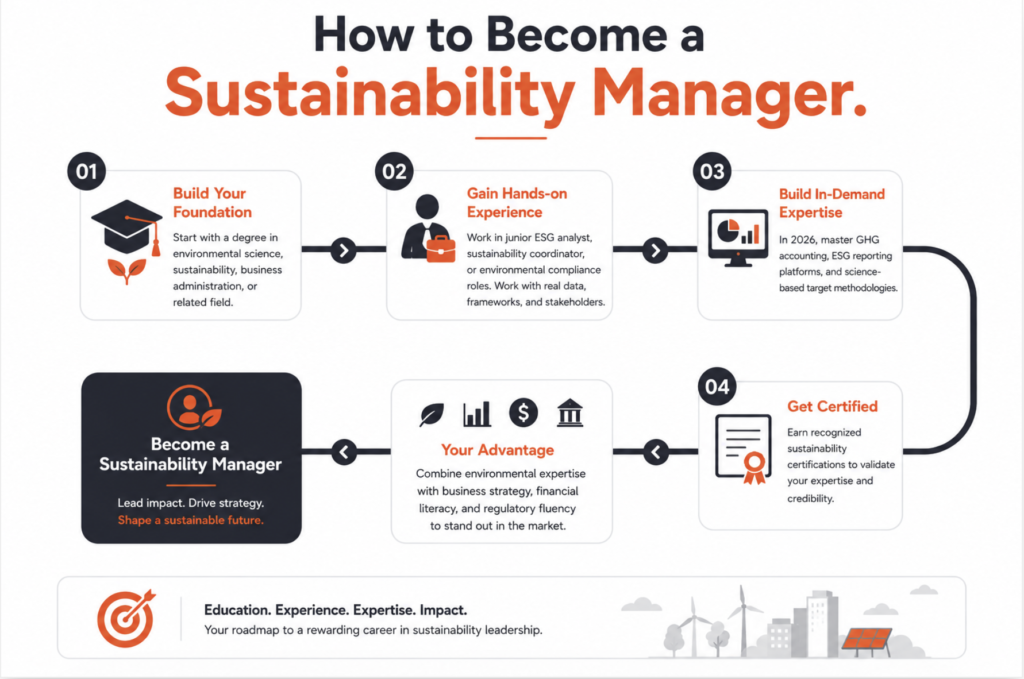
How to Become a Sustainability Manager in 2026?
Educational Qualifications and Certifications
Most Sustainability Managers hold a bachelor’s or master’s degree in environmental science or a related field. For senior leadership or CSO track roles, companies prioritize candidates with postgraduate qualifications or globally recognized sustainability and ESG certifications.
Educational Background
- B.Sc / M.Sc in Environmental Science, Ecology, or Climate Science
- BBA / MBA in Sustainable Business, Corporate Governance, or Strategy
- B.Tech / B.E. in Environmental Engineering or Renewable Energy
- Diploma in Sustainability Management in Carbon Accounting or ESG Reporting
- MBA with Sustainability Specialization for Senior Manager or CSO track roles
- Specialized PG Diploma in Climate Change, Circular Economy, or Environmental Policy
Relevant Certifications
In 2026, certifications like GRI, TCFD, and ISO 14001 validate sustainability management expertise and directly accelerate hiring. Certified managers consistently outperform in shortlisting, command higher salaries, and are fast-tracked into CSO and VP of Sustainability roles.
| Certification | Best For | Industry Value |
|---|---|---|
| GRI Certified Sustainability Professional | ESG reporting and sustainability disclosure framework expertise | Essential for all sustainability management and ESG reporting roles |
| TCFD Certification | Climate risk assessment and financial disclosure reporting | High demand across BFSI, investor relations, and large enterprise roles |
| ISO 14001 Lead Auditor | Environmental management system implementation and auditing | Critical for manufacturing, infrastructure, and compliance-heavy roles |
| SBTi Corporate Validation | Science-based target setting and net-zero pathway development | High value for organizations with formal net-zero commitments |
| LEED Accredited Professional | Green building sustainability and energy performance certification | Essential for real estate, construction, and infrastructure roles |
| Certified Carbon Auditor | GHG emissions inventory and carbon footprint assessment | Essential for carbon management and climate strategy roles |
| CSRD Compliance Certification | European sustainability reporting directive compliance expertise | Growing demand driven by mandatory ESG disclosure requirements |
Industries Hiring Sustainability Managers
Sustainability managers are in demand across industries rapidly expanding sustainability hiring due to rising regulatory and investor pressure. Key industries actively hiring are:
Manufacturing and Heavy Industry
High-emission manufacturers face the most urgent decarbonization pressure, making sustainability managers essential for carbon reduction, compliance management, and ESG reporting across complex industrial operations.
- Scope 1 and 2 emissions reduction and energy efficiency programs
- ISO 14001 environmental management system ownership
- Circular economy, waste reduction, and resource efficiency strategy
- Supply chain sustainability auditing and responsible sourcing programs
Banking and Financial Services
BFSI organizations face intense ESG investor scrutiny and mandatory climate risk disclosure, making sustainability managers critical for compliance, responsible investment strategy, and green finance product development.
- ESG integration into investment, lending, and insurance portfolios
- TCFD climate risk assessment and financial disclosure management
- Sustainable finance product development and green bond program management
- Regulatory ESG reporting for RBI, SEBI, and global disclosure frameworks
Technology and GCCs
Tech companies face growing pressure from global clients, employees, and investors to demonstrate credible sustainability performance while accelerating leadership hiring in renewable energy companies and clean-tech operations.
- Scope 3 supply chain emissions assessment and reduction programs
- Corporate sustainability reporting and ESG disclosure preparation
- Renewable energy procurement and power purchase agreement management often involves collaboration with a solar energy consultant to improve long-term energy efficiency outcomes.
- Employee sustainability engagement and green workplace program leadership
Retail and Consumer Goods
Consumer-facing brands face the most direct reputational risk from sustainability failures, making sustainability managers essential for supply chain transparency, product sustainability, and credible brand communication.
- Sustainable packaging strategy and circular economy program management
- Supplier sustainability auditing and ethical sourcing program development
- Product lifecycle assessment and environmental impact reduction initiatives
- Consumer-facing sustainability communication and brand credibility management
Latest Trends to Watch in 2026 for Sustainability Managers
Sustainability managers in 2026 are strategic ESG leaders commanding strong salaries and exceptional career growth. Regulatory expertise, carbon management proficiency, and ESG reporting credentials are the key differentiators driving hiring and compensation across every major industry sector.
Job Role Trends
- Sustainability Managers are now responsible for double materiality assessments as CSRD becomes mandatory across large organizations.
- Biodiversity net gain and nature-based solutions are emerging as core responsibilities alongside traditional carbon management.
- Sustainability Managers are working directly with treasury teams on green and sustainability-linked loan structuring.
- Internal carbon pricing frameworks are being designed and managed by sustainability managers across leading organizations.
- AI-powered ESG platforms are transforming how sustainability data is collected, validated, and reported at scale.
Hiring Trends
- CSRD and BRSR regulatory expertise is the single most differentiated skill in sustainability manager hiring in 2026.
- Board-level ESG communication experience is now actively sought as sustainability accountability moves into governance.
- Scope 3 and supply chain decarbonization experience commands the strongest market interest across manufacturing and retail.
- ESG platform proficiency including Salesforce Net Zero Cloud and Watershed is appearing in senior job descriptions.
- Candidates combining environmental science and business strategy backgrounds are increasingly leading emerging green jobs where demand is rising.
Career and Pay Trends
- Sustainability Managers linking ESG outcomes directly to financial metrics are fast-tracking into CSO roles.
- ESG performance bonuses tied to verified emissions reductions and rating improvements are now standard.
- The CSO role is being elevated to C-suite peer status across leading organizations globally.
- Sustainability management is transitioning from a cost center to a revenue-enabling function in 2026.
- Sustainability management remains one of the fastest-growing career paths globally amid the rising green jobs talent gap in sustainability hiring.
Career Path of a Sustainability Manager
A sustainability management career grows from collecting ESG data as an analyst to owning enterprise sustainability vision as a CSO.
Each level builds deeper environmental expertise, regulatory knowledge, and organizational leadership capability across one of the most purpose-driven and fastest-growing leadership career paths available in 2026.
| Career Level | Typical Years of Experience | Core Focus | Key Responsibilities |
|---|---|---|---|
| Level 1: Sustainability Analyst / ESG Coordinator | 0–3 Years | Learning and Data Management | Collecting ESG data, supporting carbon audits, and assisting with sustainability reporting. |
| Level 2: Sustainability Executive / Junior Manager | 3–6 Years | Program Delivery | Managing sustainability initiatives, preparing ESG reports, and supporting compliance programs. |
| Level 3: Sustainability Manager | 6–10 Years | Strategy Ownership | Leading sustainability strategy, owning ESG reporting, and managing regulatory compliance. |
| Level 4: Senior Sustainability Manager | 10–14 Years | Portfolio Leadership | Overseeing multiple sustainability programs, managing teams, and advising senior leadership. |
| Level 5: Head of Sustainability / ESG Director | 14–18 Years | People and Strategy | Leading the sustainability function, driving board-level reporting, and managing external stakeholders. |
| Level 6: Chief Sustainability Officer (CSO) | 18+ Years | Strategic Leadership | Owning enterprise sustainability vision and presenting net-zero roadmaps to board and investors. |
Sustainability Manager Salary Trends in 2026
In 2026, Sustainability Manager salaries in India typically range from INR 6 L – INR 40 L+ per year, with early‑career managers around INR 8 L – INR 12 L, mid‑career at INR 14 L – INR 20 L, and senior or head roles reaching INR 18 L – INR 40 L+. Pay is rising fast due to stricter ESG regulations, climate‑risk reporting, green‑finance growth, and corporate net‑zero commitments across manufacturing, BFSI, energy, and consulting firms.
Sustainability Manager Salary by Location
In metros like Bangalore, Mumbai, and Delhi‑NCR, bands are usually INR 12 L – INR 25 L. Hyderabad, Pune, and Chennai commonly range INR 10 L – INR 20 L, other tier‑1 cities INR 8 L – INR 16 L, and tier‑2 locations INR 6 L – INR 12 L for similar sustainability management roles and experience levels.
| Location / city type | Typical salary band (per year) |
|---|---|
| Bangalore / Mumbai / Delhi‑NCR | INR 12 L – INR 25 L |
| Hyderabad / Pune / Chennai | INR 10 L – INR 20 L |
| Other tier‑1 cities | INR 8 L – INR 16 L |
| Tier‑2 cities | INR 6 L – INR 12 L |
Sustainability Manager Salary by Key Industry
Sustainability Managers in management consulting and ESG advisory firms typically earn INR 12 L – INR 25 L. Corporates in manufacturing, FMCG, and retail pay around INR 10 L – INR 22 L, BFSI and financial services INR 12 L – INR 24 L, energy and renewables INR 11 L – INR 23 L, while startups and green‑tech ventures offer INR 8 L – INR 18 L.
| Industry sector | Typical salary band (per year) |
|---|---|
| Management consulting / ESG advisory firms | INR 12 L – INR 25 L |
| Corporates (manufacturing, FMCG, retail) | INR 10 L – INR 22 L |
| BFSI / banking / financial services | INR 12 L – INR 24 L |
| Energy / utilities / renewables | INR 11 L – INR 23 L |
| Startups / green‑tech / climate ventures | INR 8 L – INR 18 L |
Sustainability Manager Salary by Experience Level
Early‑career managers (1–4 years) generally earn INR 8 L – INR 12 L. Mid‑career managers (5–9 years) often land INR 14 L – INR 20 L. Senior managers (10–14 years) commonly reach INR 18 L – INR 28 L, and heads of sustainability (15+ years) can command INR 24 L – INR 40 L+ in large corporations and global firms.
| Experience level | Typical salary band (per year) |
|---|---|
| Early‑career / 1–4 years | INR 8 L – INR 12 L |
| Mid‑career / 5–9 years | INR 14 L – INR 20 L |
| Senior / 10–14 years | INR 18 L – INR 28 L |
| Head / 15+ years (Head of Sustainability) | INR 24 L – INR 40 L+ |
Hiring Challenges in Sustainability Manager Recruitment
Organizations in 2026 face a widening talent shortage in sustainability management, reflecting broader sustainability hiring trends and talent gaps in India. Finding managers who combine environmental expertise with business strategy, financial literacy, and regulatory fluency remains the defining hiring challenge.
Cross-disciplinary Skill Scarcity
Finding candidates who combine environmental science knowledge, business strategy expertise, ESG reporting proficiency, and stakeholder management capability in one profile is exceptionally rare and competitive.
Rapidly Evolving Regulatory Demands
CSRD, BRSR, and TCFD frameworks are evolving faster than most professionals can track, making it difficult to find managers genuinely current across all mandatory disclosure requirements.
Greenwashing Risk
Hiring under-qualified sustainability managers who lack reporting rigor exposes organizations to significant regulatory, investor, and reputational risk from inaccurate ESG disclosures.
Leadership Capability Gap
Many sustainability professionals have strong technical knowledge but lack the organizational influence, change management skills, and executive communication ability required at manager level.
High Compensation Expectations
Experienced sustainability managers command premium salaries driven by acute scarcity and simultaneous demand from corporate, consulting, and financial services sectors.
How to Hire Sustainability Managers?
Hiring skilled sustainability managers requires ESG track record screening, internal leadership pipeline development, and specialist recruitment partnerships.
Organizations adopting modern sustainability hiring strategies, practical assessments, and strong CSO career tracks will consistently attract top sustainability talent in 2026.
- Prioritize ESG Reporting Track Record: Evaluate genuine GHG accounting experience, published ESG reports, and regulatory compliance outcomes rather than relying solely on academic credentials during screening.
- Build Internal Sustainability Leadership Pipelines: Identify high-potential sustainability analysts and ESG coordinators and invest in leadership development, certification sponsorship, and stretch project assignments.
- Use Practical ESG Assessments: Design hiring tasks requiring candidates to analyze emissions data, structure an ESG disclosure, or develop a net-zero initiative plan for a realistic organizational scenario.
- Partner with Sustainability Academic Programs: Engage with environmental management, sustainable business, and ESG-focused postgraduate programs to access emerging management talent entering the profession.
- Offer Purpose and Impact as Incentives: Top sustainability managers are motivated by genuine organizational commitment to environmental outcomes, so demonstrate the real impact and board-level support behind your sustainability agenda.
- Create Transparent CSO Career Tracks: Define clear progression from sustainability analyst to Chief Sustainability Officer with milestones tied to certification achievement, reporting ownership, and measurable environmental impact delivery.
- Leverage Sustainability Specialist Recruiters: Partner with agencies focused on ESG and sustainability leadership hiring to access pre-vetted management talent and reduce time to hire for senior and urgent vacancies.
Top 10 Interview Questions for a Sustainability Manager
1. How do you develop and implement a net-zero roadmap for an organization?
I start by conducting a full Scope 1, 2, and 3 emissions baseline, set science-based reduction targets, identify decarbonization initiatives across operations and supply chain, assign accountability across business functions, and establish a monitoring and reporting framework to track progress annually.
2. How do you manage Scope 3 emissions across a complex supply chain?
I engage key suppliers through sustainability assessments and questionnaires, collect emissions data using GHGP Scope 3 categories, identify high-impact procurement categories for targeted reduction programs, and embed supplier sustainability expectations into procurement policies and contracts.
3. Walk me through how you prepare an ESG report aligned with GRI standards.
I define the materiality assessment scope, engage stakeholders to identify priority ESG topics, collect and validate data across all GRI disclosure requirements, draft the report with supporting evidence, obtain internal sign-off, and coordinate third-party assurance before publishing.
4. How do you manage relationships with ESG rating agencies?
I maintain a calendar of agency questionnaire deadlines, coordinate cross-functional data collection, prepare comprehensive and evidence-backed responses, track scoring methodology changes, and engage directly with agency analysts to clarify methodology and present improvement initiatives proactively.
5. How do you build a sustainability culture across a large organization?
I design internal sustainability awareness campaigns, create cross-functional green teams, integrate sustainability KPIs into employee performance frameworks, celebrate and communicate sustainability wins visibly, and ensure senior leadership actively champions the sustainability agenda at every level.
6. How do you integrate climate risk into organizational risk management frameworks?
I conduct TCFD-aligned physical and transition risk assessments, quantify financial exposure under different climate scenarios, work with the risk function to incorporate climate risks into the enterprise risk register, and present findings to the board with recommended mitigation strategies.
7. How do you handle a situation where sustainability targets conflict with short-term business priorities?
I build a business case quantifying the long-term financial, regulatory, and reputational cost of missing sustainability targets, engage senior leadership with data-driven analysis, propose phased implementation options that balance immediate business needs with sustainability commitments, and escalate to the board if required.
8. How do you assess and improve supplier sustainability performance?
I develop a supplier sustainability scorecard covering environmental, social, and governance criteria, conduct assessments through questionnaires and audits, categorize suppliers by risk and impact, set improvement targets for underperforming suppliers, and engage collaboratively to build their sustainability capability over time.
9. How do you stay current with evolving ESG regulations and reporting standards?
I monitor SEBI, GRI, TCFD, and CSRD regulatory updates regularly, subscribe to ESG industry publications, attend sustainability conferences and webinars, participate in professional sustainability networks, and maintain direct relationships with regulatory bodies and standard-setting organizations.
10. How do you measure and demonstrate the business value of sustainability initiatives?
I track financial metrics including energy cost savings, waste reduction value, and green financing benefits alongside ESG rating improvements, investor sentiment data, and regulatory compliance outcomes, and present a consolidated sustainability value dashboard to leadership and board stakeholders quarterly.
Why RPO is the Answer to Sustainability Manager Recruitment
As sustainability functions scale, driven by mandatory ESG disclosure requirements, net-zero regulatory mandates, and investor accountability pressure, traditional recruitment models cannot keep pace with the speed and leadership specialization of sustainability manager hiring.
This is where Recruitment Process Outsourcing (RPO) solutions have become a game changer for sustainability-driven organizations. RPO providers embed themselves within your company to hire certified sustainability leadership talent at scale.
They bring dedicated ESG sourcing teams, pre-built pools of certified sustainability professionals, and leadership competency-based assessment frameworks. This allows you to hire elite sustainability managers without overwhelming your internal HR teams during periods of rapid ESG function expansion.
For sustainability manager hiring specifically, the best RPO partners bring deep ESG domain expertise. They screen candidates for real carbon management competence, ESG reporting experience, and organizational leadership capability rather than just matching keywords on a CV.
Key benefits of RPO for Sustainability Manager talent acquisition:
- Faster time-to-hire: RPO cuts hiring timelines for scarce sustainability management and ESG leadership roles significantly.
- Access to passive sustainability talent: Recruiters reach experienced sustainability managers not active on job boards but open to the right purpose-driven leadership opportunity.
- Scalable model: Ramp from hiring one sustainability manager to building an entire ESG function without rebuilding your HR capability.
- Reduced cost-per-hire: Significant savings compared to traditional contingency agencies for specialized sustainability leadership recruitment.
- Technical screening support: Expert vetting of GHG accounting, ESG reporting framework knowledge, regulatory compliance, and organizational leadership skills before candidates reach your interview stage.
- Employer branding: Strategies to position your organization as a top sustainability employer highlighting genuine environmental impact, board-level commitment, and exceptional ESG career growth opportunities.
Industries leveraging RPO most actively for Sustainability Manager hiring: Manufacturing and Heavy Industry | Banking and Financial Services | Technology and GCCs | Retail and Consumer Goods | Real Estate and Infrastructure | Energy and Utilities.
Wrapping Up
The role of a Sustainability Manager in 2026 has never been more strategically important or more commercially consequential. As organizations face binding net-zero obligations, mandatory ESG disclosures, and growing investor and consumer accountability, sustainability managers have moved from supporting function to core business leadership.
Whether you are building a sustainability career or hiring ESG leadership, understanding the evolving green talent landscape is essential, especially as highlighted in this Green Jobs and Sustainability Hiring in India report.
Ultimately, the organizations that win on sustainability are the ones that hire the right people to lead it. By embracing continuous learning and modern recruitment solutions like RPO, both sustainability managers and forward-thinking organizations can turn environmental ambition into measurable, reportable, and commercially valuable reality.
FAQs
What is a Sustainability Manager and what do they do?
A Sustainability Manager leads an organization’s ESG strategy, carbon management, regulatory compliance, and sustainability reporting, driving measurable environmental and social performance improvements across all business functions and stakeholder relationships.
How is a Sustainability Manager different from a Sustainability Consultant?
Sustainability consultants advise organizations from outside on specific projects or programs. Sustainability managers are embedded internally, owning the strategy, accountable for outcomes, and responsible for driving sustainability performance across the entire organization continuously
How do I become a Sustainability Manager in 2026?
Earn a degree in environmental science or sustainable business, gain hands-on ESG program experience, develop GHG accounting and reporting framework proficiency, and pursue certifications like GRI, TCFD, or ISO 14001 to build credibility and accelerate progression.
What is the difference between a Sustainability Manager and an ESG Manager?
The roles are closely related and often used interchangeably. Sustainability managers typically have broader environmental and social program ownership, while ESG managers focus more specifically on investor-facing disclosure, rating agency management, and financial stakeholder reporting requirements.
What are the top 5 skills for Sustainability Managers in 2026?
GHG Accounting and Carbon Management, ESG Reporting Framework Proficiency, Climate Risk Assessment, Regulatory Compliance Expertise, and Organizational Change Management. These skills determine hiring success and compensation across all sustainability management roles.
What is the career outlook for Sustainability Managers?
Exceptional and accelerating. Mandatory ESG disclosure laws, binding net-zero targets, and investor pressure are driving unprecedented demand for qualified sustainability leaders. Skilled managers are commanding premium salaries and fast-tracking into Chief Sustainability Officer roles across every major industry in 2026.
Building responsible organizations starts with hiring the right sustainability leaders.
Taggd helps organizations hire skilled Sustainability Managers across manufacturing, banking, technology, retail, real estate, and energy sectors through specialized hiring solutions, talent intelligence, and scalable RPO support.