The interview mail is sitting in your inbox. You’ve read it three times. The date is fixed, the time is fixed, and now your mind is doing what fresher minds usually do. It’s replaying every weak answer you might give, every awkward pause, every possible way to get judged.
Research shows 72% of fresher interview rejections stem from avoidable mistakes, not lack of ability. Poor preparation, weak communication, and unfamiliarity with virtual interview norms account for most rejections. The good news? These errors are fixable within days.
If you’re a promising but nervous fresher, that’s good news. Common fresher interview mistakes can be corrected quickly when you know what interviewers are really noticing.
Your First Big Interview Is Not a Test It Is a Conversation
A lot of freshers sit outside the interview room convinced they’re about to be exposed. They think the interviewer is waiting to catch them not knowing something. That mindset creates stiff answers.
A better frame is this. The interviewer is trying to answer a few practical questions. Can this person prepare? Can this person communicate? Can this person learn?
That’s why many fresher mistakes are process mistakes. Not researching the company. Not understanding the role. Not preparing examples. Not asking a thoughtful question. These aren’t talent problems. They’re fixable habits.
When the interviewer asks whether you have questions, don’t waste that moment. Good questions often show maturity more clearly than rehearsed self-promotion.
Top 10 Fresher Interview Mistakes You’re Likely Making
These ten mistakes account for nearly two-thirds of fresher rejections in India. Most happen quietly, before you realize. Below is how to spot and fix each one before your interview.
1. Skipping Company Research
You walk in knowing the job title, not the business. Companies reject 43% of freshers who cannot articulate why they want to work there.
What interviewers check:
- You’ve read the About Us page
- You can name one company achievement or initiative
- You understand who the company serves
- You can connect the role to business impact
Fix it in 20 minutes:
- Read the career page and mission statement
- Skim recent company news or LinkedIn updates
- Find the job description and highlight three core tasks
- Prepare one sentence linking the role to company goals
2. Treating Interviews Like Exams
You sit outside the room convinced they’ll “expose” you. This mindset kills your performance.
The reality: Interviewers are having a conversation, not administering a test. They’re not waiting to catch gaps. They’re evaluating attitude, communication, and coachability.
Wrong mindset: “I need to know everything.” Right mindset: “I can communicate clearly and learn quickly.”
One creates stiff answers. The other creates dialogue.
3. Preparing Randomly Instead of Systematically
Most freshers prepare by thinking in their heads. This doesn’t work.
The system that works:
- Pick 2 academic projects and 1 internship (if you have one)
- Add 1 non-academic example (event, volunteer work, club role)
- Match each to a skill the role needs
- Write short versions (30 seconds) and long versions (90 seconds)
- Speak them aloud 3-4 times before the interview
Why this matters: Candidates who rehearse out loud reduce rambling by 60%. Your interviewer notices.
4. Not Understanding Your Own CV
If it’s on your CV, assume it will be questioned.
Common fumbles:
- You can’t explain your project tech stack
- You vaguely describe your role (“helped with”)
- You forget what you learned from the experience
- You mix up dates or project timelines
The rule: If you can’t explain it simply in 30 seconds, you don’t own it yet. Fix this before the interview.
5. Underselling Your College Work
“It was just an academic assignment” kills 31% of fresher chances. Employers know you’re early-stage. They expect relevant evidence, not a decade of work history.
Wrong approach: “It was just a college project.” Right approach: “My final-year project taught me deadline management, team coordination, and technical documentation. It directly mirrors tasks in this role.”
Your college work counts. Frame it as proof.
6. Speaking Without Ownership
Arrogant answers tank. Timid answers also tank. Ownership answers work.
Comparison table:
| Poor Approach | Better Approach |
|---|---|
| “I did the whole project” | “I owned the testing and documentation” |
| “I’m good at everything” | “My strength is organised execution under clear timelines” |
| “It was just small work” | “I managed X part, which improved Y by Z%” |
Confidence isn’t volume. It’s clarity.
7. Rambling Without Structure
57% of interview rejections mention “unclear communication.” Long answers bury your point.
STAR method works. Use it:
- Situation: What was happening?
- Task: What were you responsible for?
- Action: What did you do?
- Result: What improved?
Example that works: “In my final year, our team missed deadlines because work wasn’t tracked. I set up weekly check-ins and consolidated updates. We finished on time. I learned I’m effective bringing structure to drifting teams.”
No exaggeration. No filler. Just evidence.
8. Ignoring Virtual Interview Specifics
Virtual interviews are not in-person conversations on a smaller screen. 68% of online interview mistakes happen before the interview starts.
Common virtual disasters:
- Bad audio quality (interviewers tolerate poor video; they won’t tolerate unclear sound)
- Looking at screen instead of camera (kills eye contact perception)
- Joining from messy background or poor lighting
- Not testing tech 15 minutes before the call
- Household interruptions mishandled
Your backup checklist:
| Risk | Response |
|---|---|
| Internet drops | Keep phone ready with meeting link and data |
| Audio fails | Test early; keep earphones nearby |
| Background noise | Inform family; choose quietest corner |
| You get interrupted | Apologize once, fix it, continue |
| Can’t hear interviewer | Say it clearly once; ask them to repeat |
9. Weak or No Follow-Up
Your interview ends. Then you disappear. This costs jobs.
Facts:
- 38% of hiring decisions happen after the interview
- A thoughtful follow-up keeps you in memory
- No follow-up makes you seem passive
What works:
“Thank you for your time today. I particularly valued our discussion on how your team supports new hires in the first months. This strengthened my interest because I’m keen to contribute to a structured learning environment.”
What doesn’t work:
- “Hey, just checking” (too casual)
- Sending within 5 minutes (looks over-eager)
- Writing 3-4 paragraphs (not a second round)
- Long essay format (they won’t read it)
- Demanding feedback immediately
Send within 24 hours. Keep it short and specific.
10. Not Reflecting Between Rounds
Each interview gives data. Most freshers ignore it.
Questions after each interview:
- Which answer dragged or sounded weak?
- What question caught me unprepared?
- Where did I sound uncertain?
- Did I answer what was asked, or what I expected?
Candidates who review after every round improve 3x faster than those who just “hope next time goes better.”
| Other related reads |
|---|
| Cover letter for freshers with PDF |
| 85+ Business Development Executive interview questions: PDF with Sample answers |
| 50+ Graphic Designer Interview questions: PDF with Sample answers |
The Preparation Gaps That Sink You Early
Most freshers don’t fail in the interview room. They fail before they enter it.
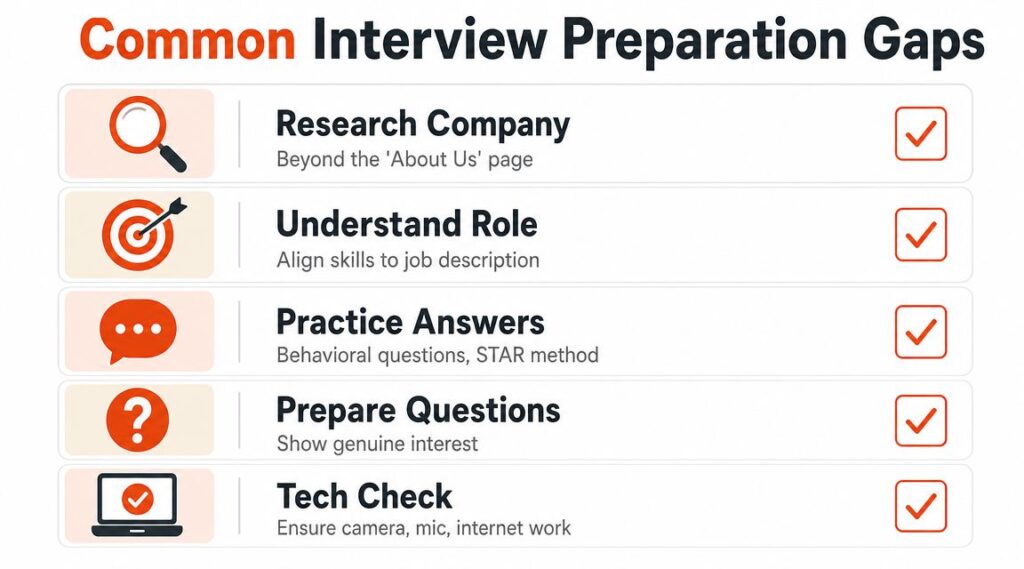
In India, fresher interview mistakes often begin with preparation gaps. Candidates commonly miss company research, role understanding, and structured answer practice. Practical guidance for freshers also recommends arriving 10 to 15 minutes early, keeping answers to 30 to 60 seconds when the question is straightforward, and preparing 2 to 3 questions for the interviewer.
What good research looks like
“Research the company” is weak advice if nobody tells you what to research.
Start with the company website, but don’t stop at the home page. Read the About Us page, then read what the company is selling, who it serves, and how it describes its own priorities. If the role is in operations, sales, technology, support, or manufacturing, the language on those pages tells you what the business values.
Then open the job description and mark three things:
- Core tasks: What will you do every day?
- Required skills: Which tools, behaviours, or subjects keep appearing?
- Business purpose: Why does this role exist in the first place?
A fresher who says, “I know this role supports client delivery, and my final-year project trained me to work with deadlines and structured reporting,” already sounds more employable than a fresher who says, “I’m a hard worker and quick learner.”
Pre interview routine-
Research company and role thoroughly. Build four solid STAR story examples. Practice answers aloud. Know your CV line by line. Test tech setup early. Prepare three strong thoughtful interview questions.
Day 1-2: Research
- Read company About page, mission statement, latest news
- Review job description three times
- Identify why this role exists in the business
Day 3-4: Build Your Stories
- Match 4 examples to the role’s core skills
- Write STAR versions of each story
- Time yourself: 30 seconds short, 90 seconds long
Day 5-6: Practice Aloud
- Speak all answers out loud (not in your head)
- Record yourself or do mock interviews with a friend
- Identify where you ramble, rush, or over-explain
Day 7: Final Check
- CV review: Know your CV line by line
- Prepare 3 questions for your interviewer
- Test tech setup if it’s a virtual interview
- Choose clothes and check grooming
This takes 4-5 hours total. It replaces panic.
Must read the best answers to “What is your greatest Weakness” to master your next interview today!
Mastering Communication and Confidence
Content matters. Delivery matters more.
Five habits make immediate difference:
- Pause before answering It signals control, not weakness. Silence feels long to you, short to them.
- Speak at 70% of your normal pace Fast speech sounds anxious even when the content is strong. Slow down.
- Listen fully to the actual question Many freshers answer the question they rehearsed, not the one asked. Pause, think, answer.
- Use direct language Replace “basically,” “sort of,” and “like” with clean sentences. It sounds sharper.
- Say “I don’t know” when you don’t Then add: “Here’s how I’d learn it.” This is credible. Guessing isn’t.
Confident candidates don’t speak the most. They speak with ownership.
Arrogant answers usually sound like this: “I led everything,” “I handled the whole project,” or “I’m the kind of person who can do any role.” Recruiters hear those lines and immediately test them. Underconfident answers fail in a different way: “It was just a small project,” “I only helped a little,” or “I don’t have much experience.”
Neither works.
Use this balance instead:
| Weak approach | Better approach |
| “I did the whole project.” | “I owned the testing and documentation part of the project.” |
| “It was just an academic assignment.” | “It was an academic project, but it taught me how to divide work, meet deadlines, and present findings clearly.” |
| “I’m good at everything.” | “My strongest area is organised execution. I do well when I have clear goals and timelines.” |
That is confidence with boundaries. It signals honesty, self-awareness, and maturity.
If you’re struggling to shape your opening pitch, these self introduction tips for interviews from a recruitercan help you build a sharper answer without sounding rehearsed.
A stronger answer sounds like this in practice: “In my final-year project, our team had repeated delays because work was not being tracked properly. I took responsibility for planning weekly check-ins and consolidating updates. That improved coordination and helped us complete the submission on time. It also taught me that I’m comfortable bringing structure when a team is drifting.”
Notice what happened there. No exaggeration. No fake leadership language. Just evidence.
This short video can help you sharpen that style of response.
Delivery habits that change how you sound
Your words matter, but your delivery changes how those words land.
A few habits make an immediate difference:
- Pause before answering: It shows control, not weakness.
- Keep your tone steady: Fast speech sounds anxious, even when the content is good.
- Listen fully: Many freshers answer the question they expected, not the one they were asked.
- Use direct language: Replace vague phrases like “basically” and “sort of” with cleaner sentences.
When you don’t know something, say so cleanly. Then add how you’d approach learning it. That sounds more credible than guessing.
Quiet confidence is easier to trust than polished overclaiming. Interviewers remember candidates who are clear, grounded, and coachable.
| Other related reads |
|---|
| Top Gen AI interview questions: PDF with Sample Answers |
| Best AWS interview questions: PDF with Sample answers |
| 40+ Power BI interview questions: PDF with Sample answers |
Common mistakes to avoid in Virtual Interviews
A virtual interview is not an in-person interview on a smaller screen. It’s a different environment with different failure points.
In India, the rise of virtual and hybrid interviewing has created a gap in fresher advice. Basic tips usually stop at lighting and technical glitches, but they often don’t explain how to manage connectivity risk, audio quality, or remote interview etiquette in a digital hiring process.
Virtual interviews are a different test
In person, your presence does some of the work for you. Online, the screen flattens energy and hides intent. That means small mistakes become more visible.
A few problems show up repeatedly:
- Bad audio: Interviewers tolerate average video more than unclear sound.
- Poor framing: If your face is too dark or off-centre, you look less engaged.
- Looking at the screen instead of the camera: It feels like weak eye contact.
- Household interruptions: They happen, but your handling matters.
- Joining in a rush: It creates immediate stress and sloppy communication.
Remote interviews reward candidates who look organised before they even start speaking. If you want a practical reference point, this explainer on the remote interview process is useful for understanding what employers are evaluating in digital conversations.
Online formats magnify small mistakes. Your systems must be tighter.
Before you join:
Setup check (do this 30 minutes early):
- Camera at eye level (not looking down)
- Background clean and non-distracting (not your bed)
- Lighting from front, not from behind (face visible)
- Mic and speaker tested (not laptop audio alone)
- Have earphones as backup
- Close unnecessary tabs and apps
During the call:
- Look at the camera when speaking, not the screen
- Nod when listening (shows engagement on video)
- Sit upright but relaxed (not stiff or slouching)
- Avoid checking your own image constantly
- Speak slightly more deliberately than in-person
- One interruption is okay if handled calmly
If something breaks:
- Internet drops: Call from your phone with meeting link ready. Explain briefly. Rejoin.
- Audio fails: Switch to earphones or phone. Don’t panic.
- Interruption happens: “Excuse me for one moment” works fine. Freshers who stay calm often impress more than those with zero disruptions.
Professionalism in virtual interviews lives in your systems, not just your words.
The Follow Up Fumbles Most Freshers Make
A lot of freshers believe the interview ends when the call ends. It doesn’t. Your follow-up is the last sample of your judgement.
That’s why a weak thank-you mail can undo some of the good impression you built. A generic message looks copied. An over-eager message looks anxious. No message at all can make you seem passive, especially when another candidate uses that final touch well.
What a strong follow up does
A strong follow-up is short, specific, and professional. It does three things:
- Thanks, the interviewer properly
Keep it simple. Appreciate their time. - Refers to the actual conversation
Mention one topic you discussed. That proves you were listening. - Reinforces fit without repeating your CV
A single line is enough. Remind them why the role still interests you.
A useful format is thanked you, one specific reference, one line on continued interest, polite close.
“Thank you for taking the time to speak with me today. I especially valued our discussion on how the team supports new hires during the early months of the role. The conversation strengthened my interest in the opportunity because I’m keen to contribute to a structured learning environment.”
That works because it sounds human. Not templated.
What not to send
Don’t make the common errors recruiters notice immediately:
- Don’t chase too quickly: Following up repeatedly creates pressure, not professionalism.
- Don’t send casual language: “Hey”, “just checking”, or smiley-heavy mail weakens your image.
- Don’t write a long essay: You thank-you note is not a second interview round.
- Don’t demand feedback instantly: You can ask politely later if the process closes.
The follow-up matters because hiring decisions are often close. When skills are comparable, professionalism in the small moments helps people remember you for the right reasons.
Also read to be prepared with the right questions to ask hiring managers when interviewing for a new role.
Turning Mistakes into Momentum
Every interview teaches you something. Most freshers waste this data.
After each round, write down:
- One answer that went well
- One answer that didn’t
- One question that caught you off-guard
- One thing you’d change
Patterns emerge. You’ll see recurring gaps. Fix them before round two.
The freshers who build momentum aren’t the ones with perfect interviews. They’re the ones who notice patterns, correct quickly, and show up next time with better judgment.
This is how you move from mistakes to maturity.
That mindset matters when the job search feels personal. It often does. If you need help staying steady through that phase, this piece on how to keep going when the job search gets you down is worth reading.
The freshers who build momentum aren’t the ones who never make mistakes. They’re the ones who notice patterns early, correct them quickly, and show up next time with better judgement.
| Other related reads |
|---|
| 60 Customer Service interview questions:PDF with Sample Answers |
| 45+ UI UX interview questions: PDF with Sample answers |
| 100 AI Engineer Interview questions: PDF with Sample answers |
Key Takeaways for Fresher Interview Success
Interviews test three things: preparation, clarity, coachability. Everything else flows from this.
Before the interview:
- Research the company beyond the home page
- Build stories matched to role requirements
- Practice speaking answers aloud
- Know your CV completely
- Test your tech setup early
During the interview:
- Listen fully before answering
- Use STAR structure for examples
- Speak with ownership, not arrogance
- Keep answers between 30-90 seconds
- Ask thoughtful questions at the end
After the interview:
- Send a short, specific thank-you within 24 hours
- Reflect on what worked and what didn’t
- Identify patterns across your interviews
- Adjust before your next round
For virtual interviews specifically:
- Systems prevent disasters
- Audio quality beats video quality
- Camera framing shows engagement
- Calm handling of disruption impresses
The edge comes from systems, not luck. Build them early.
FAQs
My introduction feels too long. What’s the sweet spot for “Tell me about yourself”?
Start with your education background, highlight one key project or internship, explain the relevant skills you developed, connect everything to why you fit this specific role. Keep under one minute.
What’s a realistic salary number to ask for as a fresher?
Research current market rates in your city and role type, express salary flexibility, state a realistic range based on research, emphasize growth opportunity over immediate salary, and ask about benefits.
Which weakness should I actually admit in an interview?
For strengths, pick two key skills relevant to the role with specific concrete examples. For weaknesses, choose something genuinely minor like time management, then explain how you’re actively improving it.
Should I mention other companies in my 5-year career plan?
Highlight realistic career progression in your field, name a specific role or leadership responsibility, tie it to the company’s business goals, show you’re serious about career growth not just salary.
What if I don’t genuinely care about the company values?
Research the company thoroughly, mention specific projects or company values that genuinely appeal to you, explain clearly how your skills match their actual business needs, avoid all generic salary reasons.
What questions make me look thoughtful instead of naive?
Ask about team structure, growth opportunities, or specific challenges the role faces daily. Avoid simple yes-no questions. Show genuine interest in the role, company culture, not just pure logistics details.
If you’re preparing for interviews or trying to understand what employers value, Taggd publishes practical career and hiring guidance built around real recruitment decisions, not generic advice.